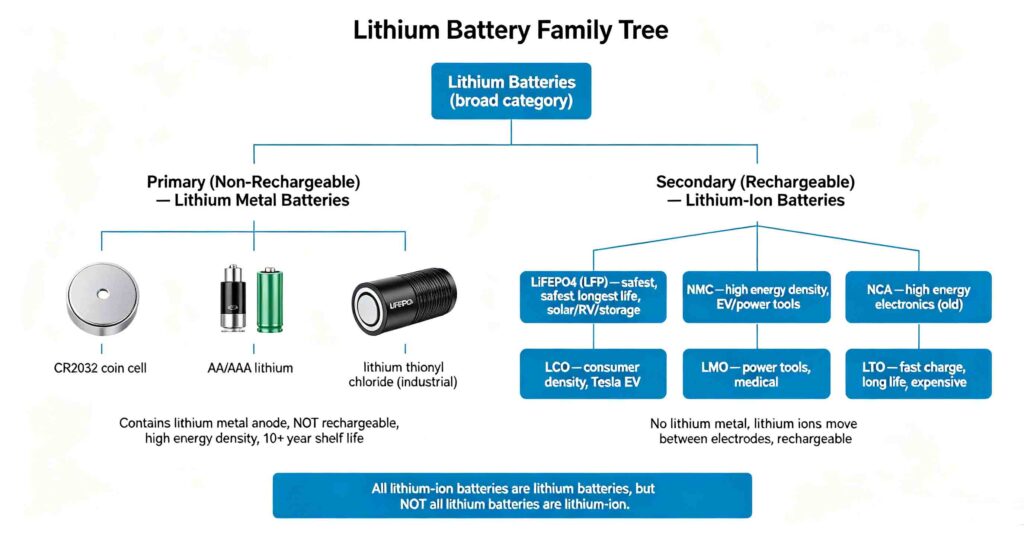
Lithium vs lithium-ion battery is a common source of confusion, and the short answer is: no, they are not the same. “Lithium battery” is a broad category that includes both primary (non-rechargeable) lithium metal batteries (e.g., CR2032 coin cells, AA lithium batteries) and secondary (rechargeable) lithium-ion batteries. “Lithium-ion battery” (Li-ion) specifically refers to rechargeable batteries that use lithium ions as the charge carrier, moving between the anode and cathode during charge and discharge — the anode is typically graphite (carbon), not lithium metal. All lithium-ion batteries are lithium batteries, but not all lithium batteries are lithium-ion. Within the lithium-ion category, there are multiple chemistries defined by the cathode material: LiFePO4 (lithium iron phosphate), NMC (nickel manganese cobalt), NCA (nickel cobalt aluminum), LCO (lithium cobalt oxide), LMO (lithium manganese oxide), and LTO (lithium titanate, which uses a different anode). When people say “lithium battery” in the context of solar storage, RV, or marine applications, they almost always mean a lithium-ion battery — specifically LiFePO4 (lithium iron phosphate), which is the safest and longest-lasting lithium-ion chemistry for deep cycle applications. The key safety distinction: primary lithium metal batteries (non-rechargeable) contain lithium metal, which is highly reactive and can cause thermal runaway if damaged or shorted — they should never be recharged. Lithium-ion batteries (rechargeable) do not contain lithium metal (the lithium is in ionic form in the electrolyte and cathode), but they can still experience thermal runaway if damaged, overcharged, or shorted — LiFePO4 is the most thermally stable lithium-ion chemistry.
The terminology around lithium vs lithium-ion battery is confusing because manufacturers, marketers, and consumers use the terms interchangeably — but they have distinct technical meanings, and confusing them can lead to incorrect purchasing decisions, improper use, and even safety risks. This guide clarifies the nomenclature: what “lithium battery” means, what “lithium-ion battery” means, the difference between primary and secondary batteries, the six main lithium-ion chemistries, and the five most common misconceptions. For a deep dive into LiFePO4 (the most common lithium-ion chemistry for solar and deep cycle applications), see #1 lithium iron phosphate batteries complete guide.
Primary vs secondary: the first distinction in lithium batteries
The first and most important distinction in lithium batteries is between primary (non-rechargeable) and secondary (rechargeable) batteries. This distinction is often overlooked when people use “lithium battery” as a generic term.
Primary lithium batteries are non-rechargeable batteries that use lithium metal as the anode. They are commonly known as “lithium metal batteries.” Examples include CR2032 coin cells (used in watches, calculators, and car key fobs), AA/AAA lithium batteries (used in digital cameras and high-drain devices), and lithium thionyl chloride (Li-SOCl2) batteries (used in industrial meters and military applications). Primary lithium batteries have very high energy density, extremely low self-discharge (1–2% per year), and a 10–20 year shelf life. However, they contain lithium metal, which is highly reactive — if a primary lithium battery is punctured, shorted, or exposed to high heat, it can experience thermal runaway (violent exothermic reaction). Primary lithium batteries should NEVER be recharged — attempting to recharge a primary lithium battery can cause it to rupture, leak, or catch fire.
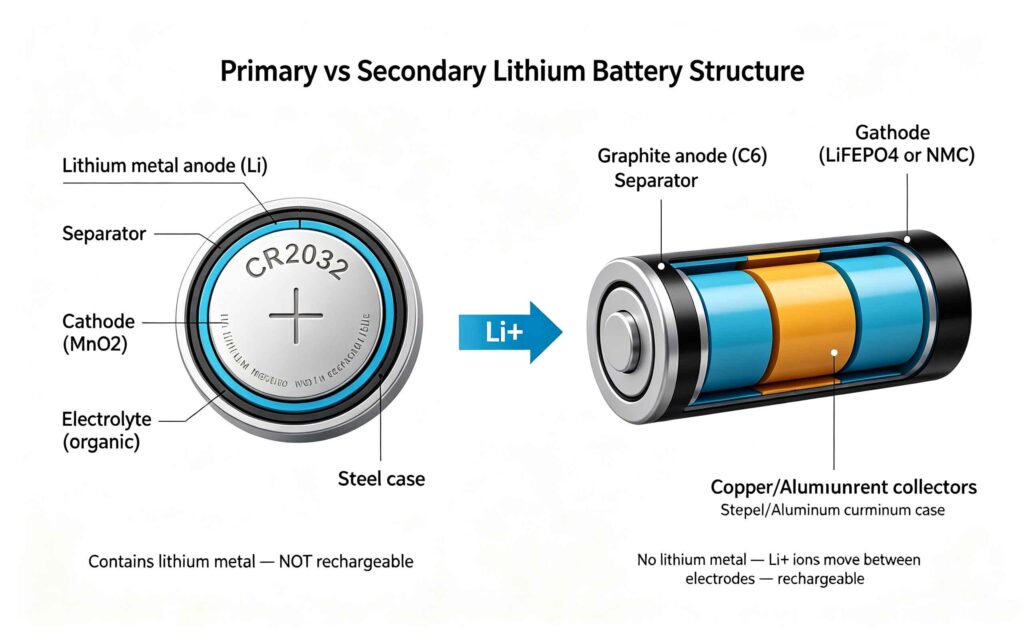
Secondary lithium batteries are rechargeable batteries more commonly known as “lithium-ion batteries.” They do NOT contain lithium metal — instead, lithium ions (Li+) move between the anode (typically graphite) and cathode (a lithium metal oxide) during charge and discharge. Lithium-ion batteries were first commercialized by Sony in 1991 and have since become the dominant rechargeable battery chemistry for consumer electronics, electric vehicles, and energy storage. Lithium-ion batteries have high energy density (150–350 Wh/kg), high charge/discharge efficiency (90–95%), and low self-discharge (2–5% per month). While lithium-ion batteries do not contain lithium metal, they can still experience thermal runaway if damaged, overcharged, or shorted — the risk varies by chemistry, with LiFePO4 being the most thermally stable and NMC/NCA being more energy-dense but less stable.
Six lithium-ion chemistries: which one is right for your application
Within the lithium-ion category, there are six main chemistries, defined primarily by the cathode material. Each chemistry has different tradeoffs in energy density, power density, cycle life, safety, cost, and best-use application.
| Chemistry | Cathode | Energy density | Cycle life | Safety | Best for |
|---|---|---|---|---|---|
| LiFePO4 (LFP) | Lithium iron phosphate | 120–160 Wh/kg | 6,000–10,000 | Excellent (most stable) | Solar storage, RV, marine, forklift, grid storage |
| NMC | Nickel manganese cobalt | 200–300 Wh/kg | 1,000–2,500 | Good (with BMS) | Electric vehicles, power tools, e-bikes |
| NCA | Nickel cobalt aluminum | 250–350 Wh/kg | 1,000–2,000 | Moderate (needs strong BMS) | Electric vehicles (Tesla), high-performance apps |
| LCO | Lithium cobalt oxide | 150–250 Wh/kg | 500–1,000 | Poor (cobalt, thermal runaway risk) | Consumer electronics (older laptops, phones) — being phased out |
| LMO | Lithium manganese oxide | 100–150 Wh/kg | 500–1,000 | Good | Power tools, medical devices, e-bikes (often blended with NMC) |
| LTO | Lithium titanate (anode) | 50–80 Wh/kg | 15,000–20,000 | Excellent | Fast-charge applications, buses, frequency regulation — very expensive |
Five common misconceptions about lithium and lithium-ion batteries
Misconceptions about lithium batteries can lead to poor purchasing decisions, improper use, and safety risks. Here are the five most common misconceptions and the truth behind them.
- Misconception: “Lithium battery” and “lithium-ion battery” mean the same thing. Truth: “Lithium battery” is a broad category that includes both non-rechargeable lithium metal batteries (primary) and rechargeable lithium-ion batteries (secondary). “Lithium-ion” specifically refers to rechargeable batteries that use lithium ions as charge carriers. When shopping for solar/RV/marine batteries, “lithium battery” almost always means lithium-ion (specifically LiFePO4), but always verify the chemistry.
- Misconception: “All lithium batteries are rechargeable.” Truth: Primary lithium metal batteries (CR2032, AA lithium, Li-SOCl2) are NOT rechargeable. Attempting to recharge a primary lithium battery can cause it to rupture, leak electrolyte, or catch fire. Only lithium-ion batteries (and other secondary chemistries like NiMH, NiCd, lead-acid) are rechargeable. Always check the battery label for “rechargeable” or “do not recharge” before charging.
- Misconception: “Lithium-ion batteries contain lithium metal.” Truth: Lithium-ion batteries do NOT contain lithium metal. The lithium exists in ionic form (Li+) dissolved in the electrolyte and embedded in the cathode material. The anode is typically graphite (carbon), not lithium metal. This is a fundamental safety distinction from primary lithium metal batteries. However, lithium-ion batteries can still experience thermal runaway if damaged or abused — the electrolyte is flammable, and the cathode can release oxygen at high temperatures.
- Misconception: “LiFePO4 is not a lithium-ion battery.” Truth: LiFePO4 (lithium iron phosphate) IS a type of lithium-ion battery. It uses lithium ions as the charge carrier, just like NMC, NCA, LCO, and LMO. The difference is the cathode material (iron phosphate instead of cobalt or nickel), which gives LiFePO4 its superior safety and cycle life. Some marketers call LiFePO4 “lithium iron phosphate” or “LFP” to distinguish it from other lithium-ion chemistries, but it is technically a lithium-ion battery. This is important for certification and shipping — LiFePO4 batteries are subject to the same UN 38.3 transportation requirements as other lithium-ion batteries.
- Misconception: “Lithium-ion batteries do not need a BMS.” Truth: ALL lithium-ion batteries require a battery management system (BMS) for safe operation. The BMS protects against overcharge, overdischarge, overcurrent, short-circuit, and over-temperature; balances cells; and estimates state of charge. Without a BMS, lithium-ion batteries can be overcharged (causing thermal runaway) or overdischarged (causing permanent capacity loss or internal short circuits). A quality LiFePO4 battery always includes a built-in BMS. Never use a lithium-ion battery without a functioning BMS, and never bypass or disable the BMS.
Q.Is a lithium battery the same as a lithium-ion battery?
No. “Lithium battery” is the broad category covering both non-rechargeable lithium metal batteries and rechargeable lithium-ion batteries. “Lithium-ion” means a rechargeable battery that moves lithium ions between a graphite anode and a metal-oxide cathode, with no lithium metal inside. All lithium-ion batteries are lithium batteries, but not the reverse. In solar, RV, and marine products, “lithium” almost always means LiFePO4 lithium-ion. Always confirm the battery is rechargeable and ask for its chemistry.
Q.Are all lithium batteries rechargeable?
No. Primary lithium metal batteries are single-use and must never be recharged: CR2032 coin cells, AA/AAA lithium, and lithium thionyl chloride. Recharging them can rupture the case, leak flammable electrolyte, or ignite. Only secondary lithium-ion batteries are rechargeable. Check the label: “rechargeable” or “lithium-ion” means yes; “do not recharge” means a primary cell. When in doubt, treat it as non-rechargeable.
Q.Why is LiFePO4 called a lithium-ion battery?
Because it works the same way as every lithium-ion battery: lithium ions shuttle between the anode and cathode during charge and discharge. “Ion” means the lithium is in ionic form, not metallic, moving through the electrolyte. LiFePO4 uses an iron phosphate cathode and the same graphite anode as NMC. The cathode choice explains its superior safety and cycle life. Technically, LiFePO4 is a subset of lithium-ion, which matters for shipping: it must meet UN 38.3 like any lithium-ion battery.
Q.What is the difference between lithium-ion and lithium polymer?
Lithium polymer (LiPo) is a lithium-ion type using a polymer or gel electrolyte instead of a liquid one. It can be made thin and flexible, as pouch cells, and leaks less, but usually offers lower energy density and shorter cycle life. LiPo is common in phones, tablets, and drones. For solar, RV, and marine storage, standard lithium-ion with prismatic or cylindrical cells and liquid electrolyte is preferred for higher energy density, longer life, and lower cost. Verify the actual electrolyte; “polymer” is sometimes misused for any pouch cell.
Q.Which lithium-ion chemistry is safest?
LiFePO4, lithium iron phosphate, is the safest for deep cycle and storage. Its thermal runaway onset is about 270C versus 150-200C for NMC and LCO, and it does not release oxygen during runaway, making self-sustaining fire far less likely. It also tolerates abuse better and works from -20C to 60C. LTO is also very safe but expensive and low density. EVs still use NMC/NCA for energy density, relying on strong BMS and thermal management. For storage and RV/marine, choose LiFePO4.
Next step: verify the chemistry before you buy
The confusion between lithium vs lithium-ion battery terminology can lead to expensive mistakes. Before purchasing any battery, verify three things: (1) Is it rechargeable? (Primary lithium metal batteries are not.) (2) What is the chemistry? (For deep cycle/solar/RV, LiFePO4 is the best choice.) (3) Does it include a quality BMS? (All lithium-ion batteries need one.) A battery labeled simply “lithium battery” without specifying “lithium-ion” or “LiFePO4” may be a primary lithium metal battery — always ask for the full technical specification.
- Read the complete LiFePO4 battery guide in #1
- Compare LiFePO4 vs NMC in #33
- Learn about battery thermal runaway in #87
- Understand BMS function in #28
- Ask leekooenergy for a battery chemistry recommendation and specification that includes: confirmed chemistry (LiFePO4 for deep cycle/solar/RV/marine), voltage and capacity based on your application, BMS feature set (protection, balancing, communication), cell form factor (prismatic/cylindrical/pouch), cell manufacturer and grade-A verification, certification status (UL 1973, IEC 62133, UN 38.3), cycle life and depth of discharge specifications, operating temperature range, weight and dimensions, and a comparison of LiFePO4 vs other lithium-ion chemistries for your specific use case — so you buy the right battery chemistry for your application and avoid the common terminology confusion between lithium and lithium-ion batteries