They are the same battery. A “48V solar battery” and a “51.2V LiFePO4 battery” both describe a 16-series (16S) LiFePO4 pack: 16 cells × 3.2V nominal = 51.2V at rest, which the industry labels as a “48V system.” The number your inverter actually cares about is its allowed input range, not the sticker word.
Why two numbers exist
LiFePO4 cells sit at 3.2V nominal. Sixteen in series give 51.2V — that is the resting voltage. But “48V” is the system class name (like how a “12V” lead-acid battery rests near 12.8V). So 48V = the class, 51.2V = the measured pack. A inverter sold as “48V” is built to accept a 51.2V LiFePO4 pack and its charge voltage up to about 58.4V.
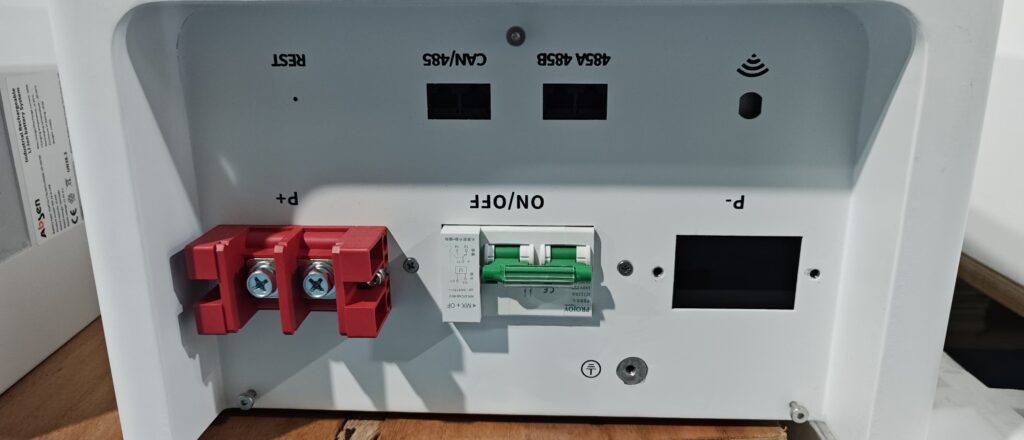
Voltage × configuration × inverter match
| Label you see | Real pack | Inverter expects | Use |
|---|---|---|---|
| “48V system” | 16S LiFePO4 = 51.2V | 48V class input (≈44–58V) | Home / small C&I |
| “51.2V battery” | 16S LiFePO4 = 51.2V | Same 48V class | Same as above |
| “48V lead-acid” | 24 cells × 2V | Lower charge ceiling | Legacy only |
What actually matters when buying
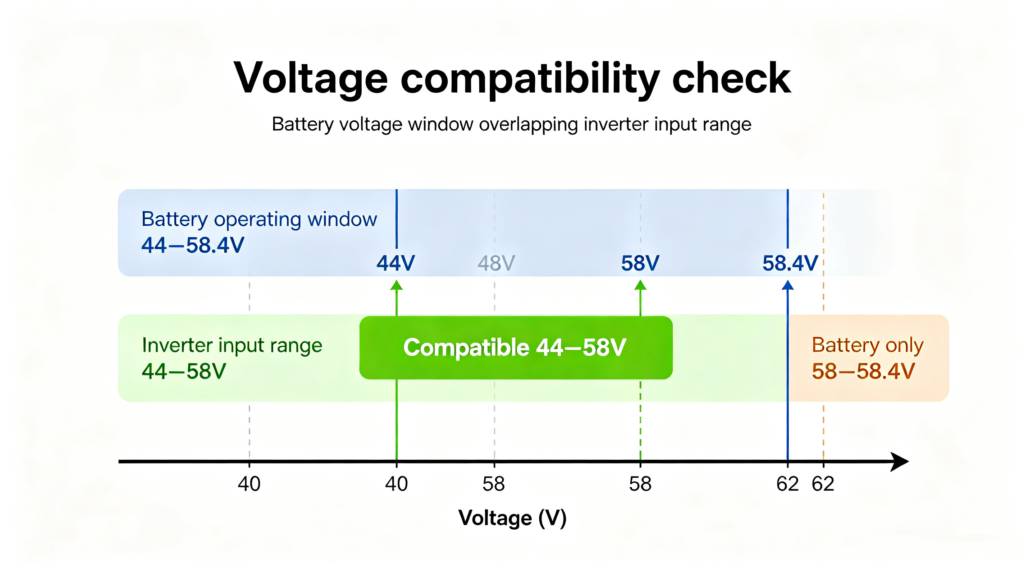
- Inverter input range. Match the battery’s max charge voltage to the inverter’s allowed window. A “48V” label on both does not guarantee match — read the numbers.
- BMS communication. A 51.2V pack must speak the inverter’s protocol (CAN/RS485) or it runs open-loop. Confirm before purchase.
- Series count. 16S is the home standard. Do not assume a “48V” tower is 16S — some low-cost units differ and break inverter pairing.
- Expansion plan. If you will parallel packs later, keep the same BMS and cell grade.
Common mistake: trusting the label
Two products both marked “48V” can still refuse to talk to each other if the BMS protocol or charge ceiling differs. The voltage number is the start of the check, not the end. Ask the supplier for the inverter model you plan to use and confirm a tested pairing.
Step-by-step compatibility check before you buy
- Read the battery label, not the ad. Confirm resting voltage and cell count. A “48V” LiFePO4 with 15 cells rests near 48V; a “51.2V” with 16 cells rests near 51.2V. Both are 16S-class and pair with the same 48V inverter.
- Match the inverter’s operating window. Find the inverter’s battery voltage range (often ~44–58 V). A 16S pack at full charge (~58.4 V) and empty (~44.8 V) must sit inside it.
- Confirm BMS communication. For closed-loop control, the BMS protocol (CAN or RS485) must match the inverter brand. Open-loop works without it but reports less data.
- Verify current limits. The pack’s BMS continuous and peak current must exceed the inverter’s max draw, including motor-start surge.
Why the two numbers exist
The split is historical, not technical. Early LiFePO4 systems were described by nominal pack voltage (48V); later spec sheets and BMS readouts quote the realistic resting voltage of a 16-cell string (51.2V). Neither is wrong — they describe the same battery at different points. Vendors that lead with “51.2V” are simply quoting the voltage a meter shows, which is clearer than nominal. The practical rule: count cells, not the marketing number.
Common mistake and what to ask
Common mistake: worrying that a “51.2V” battery will not fit a “48V” inverter. They are the same system class. The real risk is a 15S (uncommon) or 24V pack on a 48V inverter, which will fault or undercharge. For most home storage, 48V/51.2V is the sweet spot; 24V suits tiny off-grid banks, and 72V/96V appears in large C&I where cable cost drives higher voltage. Also confirm the inverter’s low-voltage cut-off aligns with the pack’s minimum; a mismatch trips the system under load.
What to ask the supplier: request in writing the exact cell count and resting voltage, the BMS protocol and brand compatibility, the continuous/peak current limits, and the inverter models the pack is verified against. A supplier that answers these precisely is easier to trust than one that only repeats “48V compatible.” Keep the confirmation on file for commissioning and warranty claims.
Quick reference before you order
If you remember one thing: 48V and 51.2V LiFePO4 are the same 16-cell class, and the number on the listing is the voltage point being quoted, not a different battery. Match the inverter’s window, confirm the BMS talks to it, and verify current limits — those three checks prevent almost every home-storage compatibility failure. When the listing and the inverter spec disagree, send the supplier your inverter model and get the match in writing before you pay.
Q. Is 51.2V the same as 48V?
Yes, for LiFePO4. 51.2V is the resting voltage of a 16S pack; 48V is the system class name. They describe one and the same battery.
Q. Can I use a 51.2V battery with a 48V inverter?
Usually yes — a 48V-class inverter is designed for exactly this pack. But verify the inverter’s max input voltage (typically ~58V) covers the pack’s full charge voltage before buying.
Q. Why do some “48V” batteries cost far less?
Cheaper units may use different series counts, weaker BMS, or grade-B cells. The label alone does not tell you; check cell grade, BMS, and certifications.
Q. Do I need 48V or higher for a home?
48V (16S) is the home standard — efficient for inverters up to several kW. Go higher only for large C&I loads where a higher bus voltage reduces current.
Q. What voltage does my solar charge controller need?
It must match the battery class (48V) and support LiFePO4 charge profile. A lead-acid-only controller will over- or under-charge an LFP pack.
Choosing a 48V or 51.2V system?
see leekooenergy 48V battery system,or read Solar Battery Bank choose to size capacity and voltage.If inverter pairing is unclear, send the model to the supplier for a compatibility check.