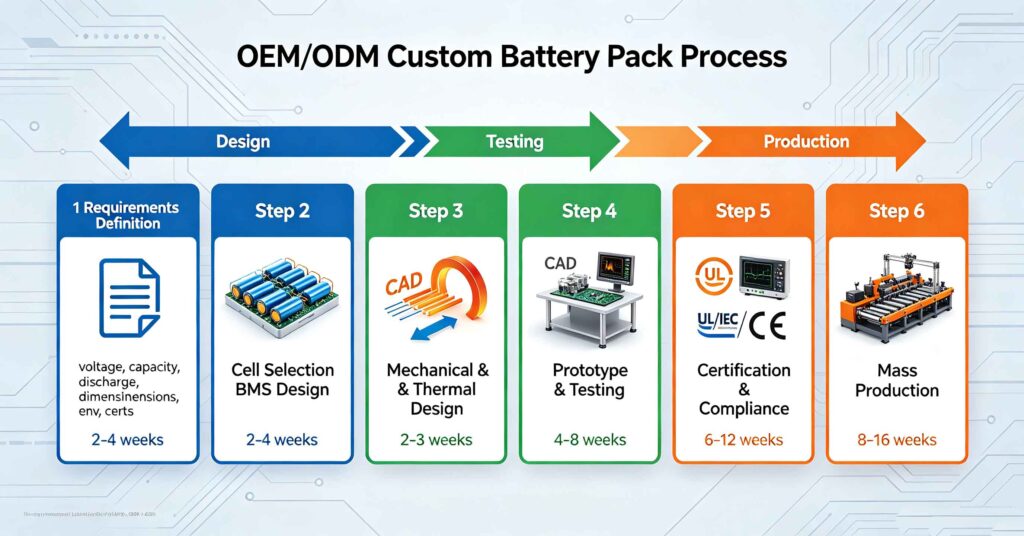
Custom battery packs OEM ODM refers to the process of designing and manufacturing a battery pack to a customer’s specific requirements, rather than purchasing an off-the-shelf standard product. OEM (Original Equipment Manufacturer) means the manufacturer produces a battery pack to the customer’s design and specifications, branded with the customer’s logo; ODM (Original Design Manufacturer) means the manufacturer uses its own existing design and modifies it to meet the customer’s requirements, often with the customer’s branding. A custom battery pack project typically follows a six-step process: (1) requirements definition (voltage, capacity, discharge rate, dimensions, environment, certifications), (2) cell selection and BMS design, (3) mechanical and thermal design, (4) prototype fabrication and testing, (5) certification and compliance, and (6) mass production. The minimum order quantity (MOQ) for custom battery packs typically ranges from 100–1,000 units depending on complexity, with lead times of 8–16 weeks for prototypes and 12–24 weeks for mass production. Key considerations for B2B buyers include: cell sourcing (grade-A cells from reputable manufacturers), BMS capability (overcharge/overdischarge/overcurrent/short-circuit/temperature protection, cell balancing, communication protocols), thermal management (passive vs active cooling), certifications (UL 1973, IEC 62133, UN 38.3, CE, FCC), and quality control (incoming cell inspection, in-process testing, final performance testing).
For B2B buyers in industries like energy storage, telecommunications, medical devices, industrial equipment, and electric vehicles, off-the-shelf battery packs rarely meet all requirements. A custom battery packs oem odm project allows you to specify the exact voltage, capacity, discharge rate, dimensions, connector type, communication protocol, and certification your product needs — but the process is complex, and choosing the wrong manufacturer or cutting corners on testing can lead to product failures, safety incidents, and costly delays. This guide walks through the six-step custom battery pack design process, provides a technical specification checklist for requesting quotes, explains the difference between OEM and ODM, and highlights the most common pitfalls B2B buyers encounter. For supplier evaluation criteria, see #21 how to evaluate a lithium battery manufacturer.
The six-step custom battery pack design process
A well-managed custom battery pack project follows a structured six-step process. Skipping steps or rushing through testing is the most common cause of custom battery failures. Each step has specific deliverables and decision gates.
Step 1: Requirements definition. This is the most critical step — a poorly defined requirements document leads to multiple redesign cycles and delays. The requirements document should include: nominal voltage and voltage range, capacity (Ah) and energy (Wh), continuous and peak discharge current, charge current and voltage, operating and storage temperature range, dimensions and weight limits, enclosure type (IP rating), connector type and pinout, communication protocol (CAN, RS485, SMBus, UART), required certifications, expected annual volume, and target cost.
Step 2: Cell selection and BMS design. Based on the requirements, the manufacturer selects appropriate cells (cylindrical, prismatic, or pouch; LiFePO4, NMC, or LTO chemistry) and designs the BMS. Cell selection considers energy density, power density, cycle life, temperature range, cost, and availability. The BMS must support the required protection features, cell balancing (passive or active), state of charge estimation, and communication protocol.
Step 3: Mechanical and thermal design. The mechanical design includes the pack enclosure, cell mounting, busbars, wiring, and connector placement. Thermal design is critical for high-power packs: it includes heat dissipation analysis, thermal simulation, and selection of cooling method (natural convection, forced air, liquid cooling, or phase change material). The design should also consider vibration and shock resistance for mobile or industrial applications.
Step 4: Prototype fabrication and testing. Prototypes are typically built in small quantities (3–10 units) and subjected to comprehensive testing: capacity verification, charge/discharge cycling, high-rate discharge, overcharge/overdischarge protection, short-circuit protection, temperature cycling, vibration and shock testing, and thermal runaway propagation testing. Test results are documented and any design issues are corrected before proceeding to certification.
Step 5: Certification and compliance. Depending on the target market and application, custom battery packs require certifications such as UL 1973 (stationary/propulsion batteries), IEC 62133 (portable batteries), UN 38.3 (transportation), CE (European Union), FCC (US electromagnetic compatibility), and industry-specific certifications (e.g., IEC 60601 for medical, EN 50549 for grid-connected). Certification typically takes 6–12 weeks and requires submitting samples to accredited testing laboratories.
Step 6: Mass production. Once certification is complete and the design is finalized, the manufacturer sets up the production line, sources materials, and begins mass production. Quality control includes: incoming cell inspection (capacity, internal resistance, voltage matching), in-process testing (welding quality, insulation resistance, BMS function), and final performance testing (capacity, charge/discharge, protection functions). The first production batch should include additional inspection and process validation.
OEM vs ODM: which model is right for your project
The choice between OEM and ODM depends on your design capability, volume, timeline, and budget. Understanding the difference is essential for communicating effectively with battery manufacturers.
OEM (Original Equipment Manufacturer) means you provide the complete design (schematics, PCB layout, mechanical drawings, BOM, firmware) and the manufacturer produces the battery pack to your exact specifications, typically with your branding. OEM is suitable when you have in-house battery design expertise, need a highly customized solution, or want to retain control over the design and intellectual property. The advantage of OEM is full design control; the disadvantage is higher development cost and longer timeline (you are responsible for design validation).
ODM (Original Design Manufacturer) means the manufacturer uses its own existing reference design and modifies it to meet your requirements (e.g., different capacity, connector, enclosure, or firmware features). ODM is suitable when you need a faster time-to-market, have limited in-house battery design expertise, or your requirements are close to an existing product. The advantage of ODM is lower development cost and faster timeline (the base design is already validated); the disadvantage is less design control and potential IP sharing with the manufacturer.
Many custom battery projects use a hybrid model: the manufacturer provides a reference design (ODM) and the customer specifies modifications (custom connector, custom enclosure, custom firmware features), with the final product branded by the customer. This hybrid approach balances speed and customization. When requesting quotes, clearly state whether you are looking for OEM (you provide the design) or ODM (the manufacturer provides the design) — this helps the manufacturer provide an accurate quote and timeline.
| Factor | OEM | ODM |
|---|---|---|
| Design source | Customer provides complete design | Manufacturer provides reference design, modified for customer |
| Development cost | High (customer pays for design validation) | Low (base design already validated) |
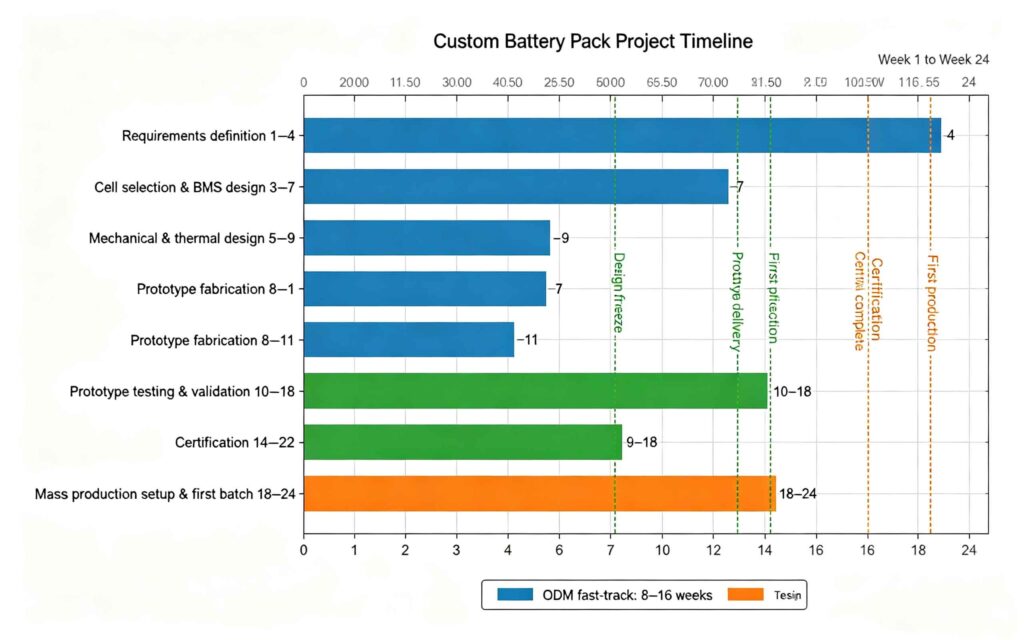
| Timeline | Longer (16–24 weeks to production) | Shorter (8–16 weeks to production) |
| Design control | Full (customer owns design) | Limited (manufacturer owns base design) |
| IP ownership | Customer (if contract specifies) | Shared or manufacturer-owned |
| Customization depth | Unlimited (any design possible) | Limited to modifications of reference design |
| MOQ | Typically 500–1,000+ units | Typically 100–500 units |
| Best for | Highly specialized products, high volume, in-house expertise | Standard products with minor customization, faster time-to-market |
Technical specification checklist for requesting a custom battery quote
The quality of a custom battery quote depends entirely on the quality of the information you provide. A vague request (“I need a 48V battery for my device”) will result in a vague quote or, worse, a quote for a battery that does not meet your requirements. Use this checklist to prepare a complete technical specification for your custom battery pack request.
- Electrical specifications: Nominal voltage (V), minimum/maximum voltage, capacity (Ah), energy (Wh), continuous discharge current (A), peak discharge current (A and duration), charge current (A), charge voltage (V), charge algorithm (CC/CV profile), standby/self-discharge current.
- Environmental specifications: Operating temperature range (charge and discharge separately), storage temperature range, humidity range, altitude, vibration and shock requirements (specify standard: IEC 60068, MIL-STD-810, etc.), ingress protection (IP rating).
- Mechanical specifications: Maximum dimensions (L×W×H), maximum weight, mounting method and location, enclosure material preference, connector type and pinout (include part number if known), cable length and gauge, label and marking requirements.
- BMS and communication: Required protection features (overcharge, overdischarge, overcurrent, short-circuit, over-temperature, low-temperature charge cutoff), cell balancing (passive or active), state of charge estimation accuracy, communication protocol (CAN 2.0B, RS485, SMBus, UART, Bluetooth), communication protocol details (baud rate, address, data map), SOC/SOH reporting, fault codes.
- Cell requirements: Chemistry preference (LiFePO4, NMC, LTO), cell form factor (cylindrical 18650/21700/32700, prismatic, pouch), cell manufacturer preference or restriction, minimum cycle life requirement, grade-A cell requirement, cell matching requirement (capacity, internal resistance, voltage).
- Certifications and compliance: Required certifications (UL 1973, IEC 62133, UN 38.3, CE, FCC, RoHS, REACH), industry-specific standards (IEC 60601 medical, EN 50549 grid, IEC 60079 explosive atmosphere), country-specific requirements, labeling and documentation requirements.
- Commercial terms: Expected annual volume, initial order quantity, target unit cost, required delivery timeline, payment terms, warranty requirements (years and/or cycles), support and service requirements, quality control requirements (inspection reports, traceability).
Q,What is the minimum order quantity for a custom battery pack?
It depends on design complexity and manufacturer. Simple ODM modifications, like a different connector or label, can start at 50-100 units. A fully custom OEM design with new tooling typically needs 500-1,000 units for the first batch. Some manufacturers accept 100-300 units for prototype and initial runs, but unit cost is higher. State your annual volume and initial order size when requesting quotes. Below 50 units, consider a modified standard product instead of a full custom design.
Q.How long does it take to develop a custom battery pack?
Typically 16-24 weeks from requirements finalization to first production. Breakdown: requirements and quote 2-4 weeks, cell and BMS design 2-4, mechanical and thermal design 2-3, prototype 2-3, testing 4-8, certification 6-12 overlapping, and production setup 8-12. ODM projects run faster, around 8-16 weeks, because the base design is validated. Main delay causes: changing requirements, certification failures, cell shortages, and testing failures requiring redesign. Provide a complete spec upfront and avoid changes after prototype approval.
Q.What certifications do custom battery packs need?
It depends on application and target market. UN 38.3 is mandatory for shipping any lithium battery and should come first. IEC 62133 covers portable batteries; UL 1973 covers stationary and propulsion batteries for North America. CE and RoHS are needed for the EU, FCC for the US. Industry-specific ones include IEC 60601 for medical and IEEE 1547 for grid-connected storage. Tell the manufacturer your markets and applications, and ask for a certification plan with costs and timeline.
Q.How do I ensure the manufacturer uses grade-A cells?
Put it in the purchase agreement. Specify the exact cell manufacturer and model, require new grade-A cells with date codes within six months, and matching limits of +/-2% capacity and +/-5% internal resistance. Require 100% incoming inspection with reports and full cell traceability. For high-value projects, hire a third-party inspector. Red flags: prices far below market, refusal to disclose cell source, and no inspection reports. Reject any equivalent cells.
Q.What is the difference between custom battery pack design and standard product modification?
Custom design (OEM) builds a pack from scratch: new cell configuration, new BMS, new enclosure, new tooling, and full validation, right for unique voltages, form factors, protocols, or performance. Standard modification (ODM) tweaks an existing design: branding, connector, cable length, or firmware parameters, faster at 4-8 weeks and cheaper, but limited to what the base design supports. Ask manufacturers for both options and compare total cost of ownership, not just unit price.
Next step: prepare your technical specification and request custom battery quotes
A successful custom battery packs oem odm project starts with a complete, well-defined technical specification. The more detail you provide upfront, the more accurate your quotes will be and the fewer redesign cycles you will encounter. Use the seven-category checklist above to prepare your specification, clearly state whether you need OEM (your design) or ODM (manufacturer design), and provide your expected volume and target cost. Request quotes from at least three manufacturers, and evaluate them on technical capability, certification experience, quality control processes, and total cost of ownership — not just unit price.
- Learn how to evaluate battery manufacturers in #21
- Read the OEM/ODM concept guide in #20
- Understand LiFePO4 chemistry for custom packs in #1
- Review BMS design considerations in #28
- Ask leekooenergy for a custom battery pack specification review and quote that includes: technical requirements review and gap analysis, recommended cell chemistry and configuration (LiFePO4/NMC/LTO, cylindrical/prismatic/pouch), BMS architecture and feature set (protection, balancing, communication protocol), mechanical and thermal design approach (enclosure, IP rating, cooling method), OEM vs ODM recommendation with cost and timeline comparison, certification plan (UL 1973, IEC 62133, UN 38.3, CE, FCC, industry-specific), prototype plan (quantity, timeline, testing scope), mass production plan (MOQ, unit cost, lead time, quality control), and total cost of ownership analysis — so your custom battery pack project is properly scoped, accurately quoted, and set up for successful production