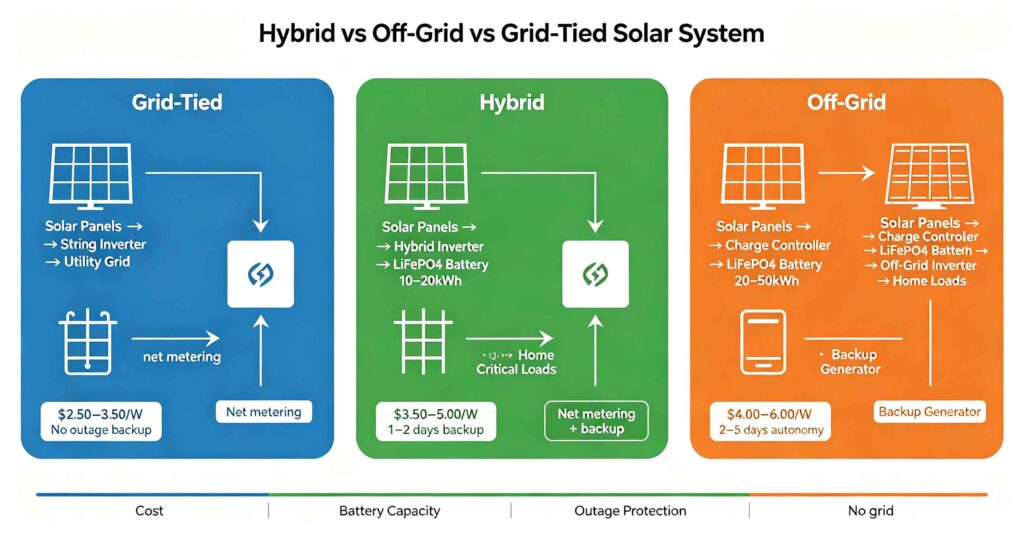
Hybrid solar inverter vs off grid is one of the most important decisions when designing a solar power system, and the answer depends on whether you have access to the utility grid, whether you need backup power during outages, and your budget. A grid-tied system connects directly to the utility grid, uses a string inverter or microinverters, does not include batteries, and exports excess power to the grid for net metering credits — it is the cheapest option ($2.50–$3.50/W installed) but provides no power during outages. An off-grid system is completely independent of the utility grid, uses an off-grid inverter/charge controller, includes a large battery bank (typically 2–5 days of autonomy), and often includes a backup generator — it is the most expensive option ($4.00–$6.00/W installed) but provides complete energy independence. A hybrid system uses a hybrid inverter that can operate both grid-tied and off-grid, includes a battery bank for backup power (typically 1–2 days of critical loads), and can still export excess power to the grid for net metering — it costs $3.50–$5.00/W installed and provides the best of both worlds: grid connectivity with outage backup. The key difference between a hybrid inverter and an off-grid inverter is that a hybrid inverter has a grid-tie function (synchronizes with grid frequency and voltage for net metering) while an off-grid inverter does not — an off-grid inverter creates its own AC waveform and cannot export to the grid.
Choosing between a hybrid solar inverter vs off grid (and grid-tied) system architecture is the foundational decision for any solar project. The wrong choice can leave you without power during an outage (grid-tied), overpay for capacity you do not need (off-grid), or fail to meet your energy independence goals. This guide compares all three system architectures across cost, components, battery backup, net metering, maintenance, and best-use scenarios, then provides a five-question decision framework to help you choose the right system for your situation. For detailed off-grid system design and battery sizing, see #23 off-grid solar system battery guide.
Grid-tied vs hybrid vs off-grid: complete comparison
The three solar system architectures differ fundamentally in their relationship to the utility grid, their component configuration, and their cost. Understanding these differences is essential for making the right choice.
Grid-tied systems are the simplest and most common residential solar configuration. They connect directly to the utility grid through a grid-tie inverter (string inverter or microinverters) and do not include batteries. During the day, solar power first serves home loads, and any excess is exported to the grid for net metering credits (or feed-in tariffs, depending on the utility). At night or during low-solar periods, the home draws power from the grid. The major limitation of grid-tied systems is that they must shut down during a grid outage for safety (anti-islanding protection required by NEC 690.6 and UL 1741), so they provide no backup power.
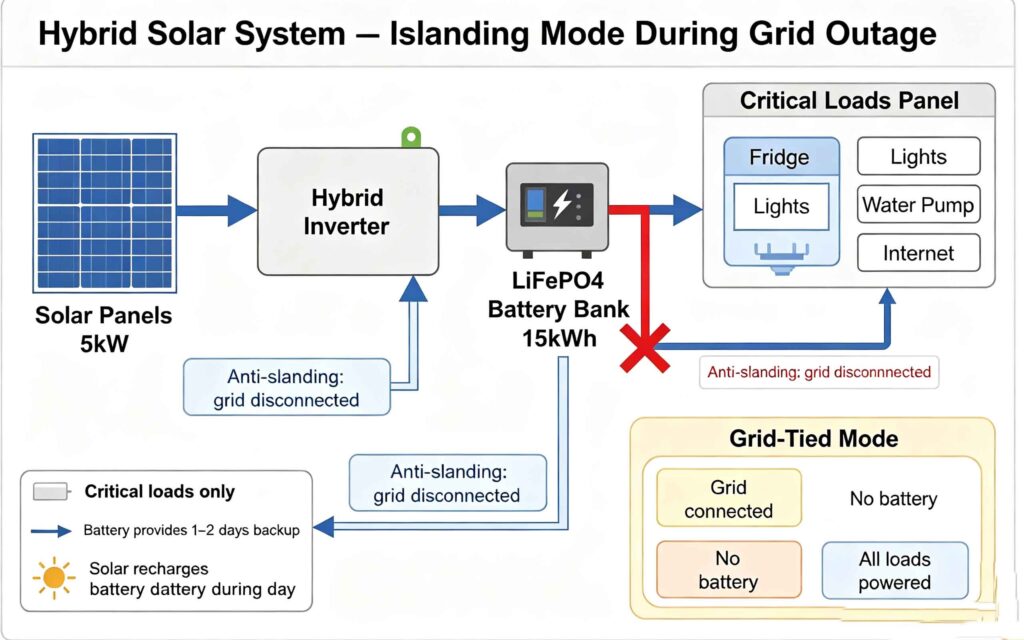
Hybrid systems use a hybrid inverter (also called a battery-ready inverter or multi-mode inverter) that combines a grid-tie inverter, battery charger, and off-grid inverter in one unit. Hybrid systems include a battery bank (typically 10–20kWh LiFePO4 for residential) that provides backup power for critical loads during grid outages. When the grid is up, the hybrid system operates like a grid-tied system (serving loads, exporting excess for net metering, and charging the battery from solar or grid). When the grid goes down, the hybrid inverter automatically disconnects from the grid (islanding mode) and powers critical loads from the battery and solar. Hybrid systems are the fastest-growing segment in residential solar due to increasing outage frequency and declining battery costs.
Off-grid systems are completely independent of the utility grid. They use a charge controller (MPPT or PWM) to charge a large battery bank (typically 20–50kWh LiFePO4, or 2–5 days of autonomy), and an off-grid inverter to convert battery DC to AC for home loads. Off-grid systems often include a backup generator (propane, diesel, or gasoline) for extended cloudy periods. Because there is no grid to fall back on, off-grid systems must be sized conservatively — most off-grid designers use 3–5 days of battery autonomy and a generator backup. Off-grid systems are common in remote locations where grid connection is unavailable or prohibitively expensive (grid extension can cost $15,000–$50,000+ per mile).
| Factor | Grid-Tied | Hybrid | Off-Grid |
|---|---|---|---|
| Grid connection | Required | Required (but can island) | None |
| Inverter type | String / microinverter | Hybrid (multi-mode) | Off-grid inverter + charge controller |
| Battery included | No | Yes (10–20kWh typical) | Yes (20–50kWh typical) |
| Installed cost (per W) | $2.50–$3.50 | $3.50–$5.00 | $4.00–$6.00 |
| 5kW system cost | $12,500–$17,500 | $17,500–$25,000 | $20,000–$30,000 |
| Outage backup | None (must shut down) | 1–2 days critical loads | 2–5 days full loads (+ generator) |
| Net metering | Yes | Yes | N/A (no grid) |
| Maintenance | Low (inverter only) | Medium (inverter + battery) | High (inverter + battery + generator) |
| Best for | Grid access, low budget, no outage concern | Grid access, want backup, budget allows | No grid access, remote location, energy independence |
Five-question decision framework: which system is right for you
Use these five questions to determine which solar system architecture is right for your situation. Answer each question honestly, and the pattern of answers will point to the best choice.
- Do you have access to the utility grid? If no (or grid extension costs more than $15,000), off-grid is your only option. If yes, continue to question 2.
- Do you experience frequent or long power outages? If you experience more than 2–3 outages per year lasting more than 4 hours, or if you have medical equipment or other critical loads that cannot tolerate outages, a hybrid system with battery backup is strongly recommended. If outages are rare and short (less than 1 hour, less than once per year), a grid-tied system may be sufficient — but consider that outage frequency is increasing in many regions due to grid aging and extreme weather.
- What is your budget? Grid-tied systems are the cheapest ($2.50–$3.50/W). Hybrid systems cost 40–60% more ($3.50–$5.00/W) due to the battery and hybrid inverter. Off-grid systems cost 60–100% more than grid-tied ($4.00–$6.00/W) due to the large battery bank, charge controller, and generator. If budget is tight and you have grid access, start with grid-tied and add a battery later (choose a battery-ready inverter to make future upgrade easier).
- What are your energy independence goals? If you want complete energy independence (no utility bills, no grid reliance), off-grid is the only option — but it requires conservative sizing and generator backup. If you want backup power during outages but are happy to remain grid-connected for net metering and reliability, hybrid is the best choice. If you primarily want to reduce your electricity bill and carbon footprint, grid-tied is sufficient.
- What is your net metering situation? If your utility offers favorable net metering (1:1 credit for exported power), grid-tied and hybrid systems are economically attractive. If your utility has reduced or eliminated net metering (exporting at wholesale rates, demand charges, or fixed fees), the economic case for grid-tied weakens, and a hybrid system with more self-consumption (using solar to charge the battery and power loads rather than exporting) becomes more attractive. Off-grid systems are not affected by net metering policy.
Battery configuration for hybrid and off-grid systems
The battery is the most expensive and most critical component in hybrid and off-grid systems. Choosing the right battery chemistry, capacity, and configuration determines system performance, reliability, and lifespan.
For hybrid systems, the battery is typically sized to power critical loads (fridge, lights, water pump, medical equipment, internet router) for 1–2 days. A typical residential hybrid system uses 10–20kWh of LiFePO4 storage (e.g., 2×48V 100Ah = 9.6kWh, or 2×48V 200Ah = 19.2kWh). The hybrid inverter manages battery charging from solar (priority) or grid (if solar is insufficient and battery is below a set threshold), and discharges the battery during peak rate periods or outages.
For off-grid systems, the battery is sized for 3–5 days of autonomy (the number of days the battery can power all loads without solar charging). A typical off-grid residential system uses 30–60kWh of LiFePO4 storage (e.g., 4×48V 200Ah = 38.4kWh). Off-grid batteries are cycled deeply (50–80% DoD daily), so cycle life is critical — LiFePO4 (6,000–10,000 cycles) is strongly preferred over AGM (1,000–2,000 cycles) for off-grid use. For battery chemistry and sizing details, see #2 how to choose a solar battery bank.
Q.Can a hybrid inverter work off-grid?
Yes, most hybrid inverters operate in islanding mode, creating their own AC waveform from battery and solar when the grid is down. But they have limits: lower surge capacity and continuous power than dedicated off-grid inverters, and weaker support for generator charging and large motor loads like well pumps or AC compressors. If you have no grid access at all, choose a dedicated off-grid inverter. If you need backup only during outages, a hybrid is ideal.
Q.What is the difference between a hybrid inverter and an off-grid inverter?
A hybrid inverter combines a grid-tie inverter, battery charger, and off-grid inverter in one unit. It synchronizes with grid frequency and voltage, exports excess solar for net metering, and islands during outages. It needs a grid connection for normal operation. An off-grid inverter only creates AC from battery power, with no grid-tie function and no export. Off-grid systems pair it with a separate charge controller and usually have higher surge capacity and generator support. Choose hybrid for grid backup, off-grid for full independence.
Q.How much does a hybrid solar system with battery backup cost?
About $3.50-$5.00 per watt installed, or $17,500-$25,000 for a typical 5kW residential system with 10-20kWh of LiFePO4 storage. Panels and mounting run $10,000-$12,500; a hybrid inverter $1,500-$3,000; batteries $400-$600 per kWh; and balance of system and labor $3,000-$6,000. After the 30% federal tax credit and local incentives, net cost is typically $12,000-$18,000. Adding battery backup over grid-tied costs roughly $5,000-$8,000 more.
Q.Do I need a hybrid inverter if I want battery backup?
Yes, you need either a hybrid inverter or a separate battery inverter. For new systems, choose a DC-coupled hybrid inverter: solar charges the battery on the DC side, with fewer conversions, higher efficiency, and seamless backup. For retrofitting an existing grid-tied system, an AC-coupled battery system is often more practical: keep your current inverter and add a battery unit with its own inverter. Verify compatibility with your panels, electrical panel, and utility interconnection rules before buying.
Q.Is an off-grid solar system worth it?
Only if you have no grid access, or grid extension costs more than $15,000-$30,000 per mile; want full energy independence; and have 4+ peak sun hours. Off-grid systems run $4.00-$6.00 per watt, 60-100% above grid-tied, and need 2-5 days of battery autonomy plus a generator. If you simply want lower bills with grid access, a grid-tied or hybrid system is far more cost-effective, since the grid acts as your battery. Choose hybrid for backup, off-grid only when the grid is truly unavailable.
Next step: choose your system architecture and size your battery
The decision between hybrid solar inverter vs off grid (and grid-tied) comes down to three factors: grid access, outage backup needs, and budget. If you have grid access and want backup, a hybrid system is the best choice. If you have no grid access, off-grid is your only option. If you have grid access and do not need backup, grid-tied is the most economical. Once you have chosen your architecture, the next step is to size your solar array and battery bank based on your daily energy usage, local peak sun hours, and desired autonomy days.
- Read the off-grid system design guide in #23
- Learn how to size a solar battery bank in #2
- Review DIY solar kit components in #95
- Understand LiFePO4 battery chemistry in #1
- Ask leekooenergy for a solar system architecture recommendation and sizing that includes: recommended system type (grid-tied, hybrid, or off-grid) based on your grid access, outage history, budget, and energy goals, solar array size (kW) based on your daily energy usage and local peak sun hours, battery capacity (kWh) based on your critical loads and desired autonomy days, recommended inverter type and model (hybrid, off-grid, or grid-tie), LiFePO4 battery configuration (voltage, capacity, quantity), cost estimate breakdown (panels, inverter, battery, BOS, installation), available incentives (federal ITC, state, local, utility), payback period calculation, and a comparison of all three system types so you can make an informed decision — so your solar system is correctly architected, properly sized, and aligned with your energy goals and budget