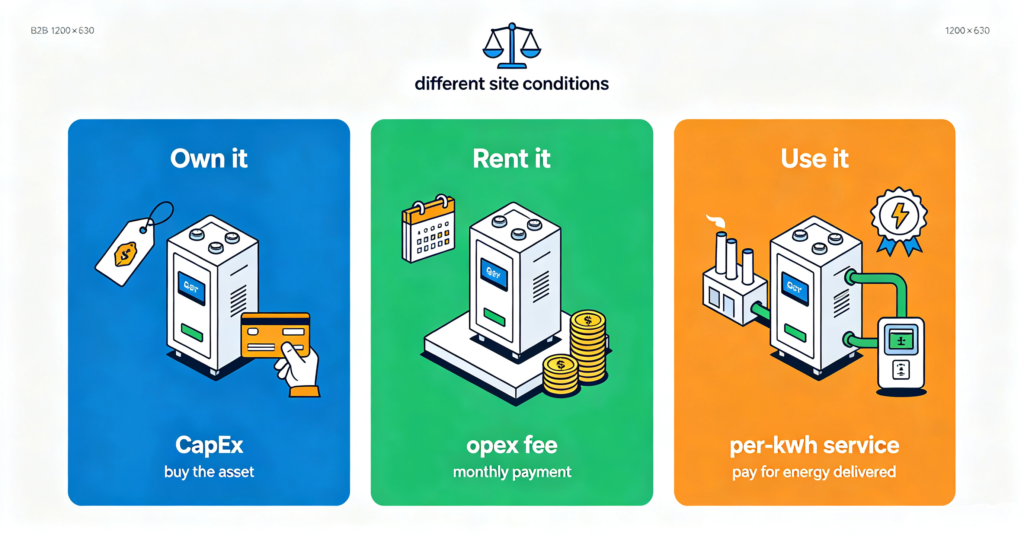
The short answer: a battery energy storage system rental or energy-as-a-service (EaaS) deal lets a business capture storage value without capital expenditure — the provider owns the hardware and the customer pays a monthly, per-kW or per-kWh fee for the outcomes. It is the right tool when the site has real savings to capture but no appetite for the asset: no upfront cash, no O&M staff, no technology risk, and a contract that can be exited at term. It is the wrong tool when the arithmetic of ownership is clearly positive and the business can carry the asset — because the provider’s margin sits inside every fee you pay.
The storage market has quietly split into two economies. In one, buyers own systems and harvest the savings; in the other, buyers rent outcomes and leave the asset to someone else. Neither is superior — they fit different balance sheets, risk appetites and project horizons. This guide maps the models, the pricing structures inside each contract, and the clause-level traps that separate a good rental deal from a disguised lease of problems. The owned-asset side of the same decision is covered in #56 BESS cost and ROI, and the savings mechanism these deals monetise is explained in #57 demand charges and peak shaving.
The models: rental, EaaS and everything between
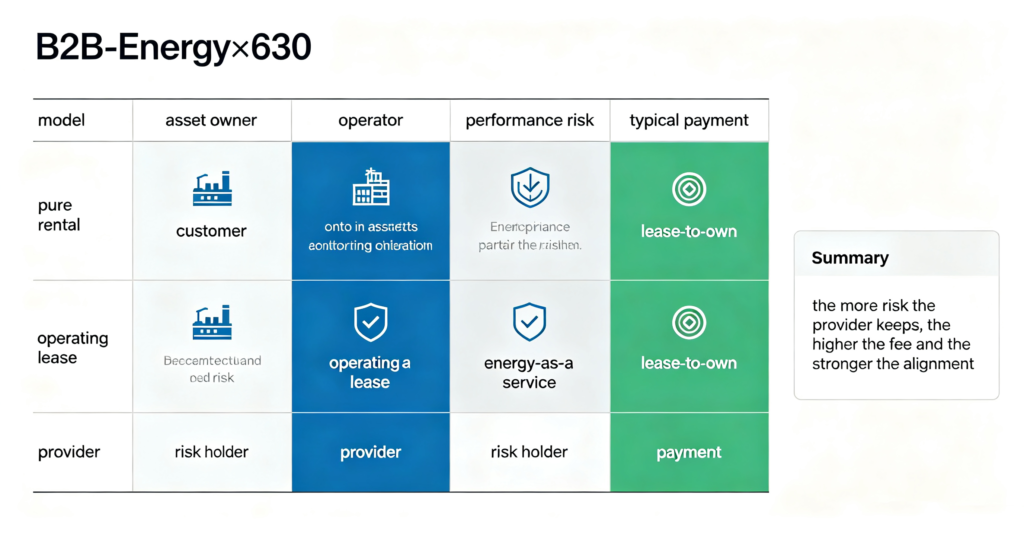
| Model | Customer pays | Provider provides | Fits when |
|---|---|---|---|
| Pure rental | Fixed monthly fee for the hardware | System installed and maintained; customer runs operations | Short-term or seasonal peak needs |
| Operating lease | Monthly fee over 3–10 years | Hardware with agreed maintenance scope | Stable long-term use, no purchase intent |
| Energy-as-a-service (EaaS) | Per-kWh / per-kW outcome fee or shared savings | Hardware, operation, performance guarantees, savings delivery | Customer wants outcomes, not assets |
| Lease-to-own | Fees with a buyout at term | Path to ownership after the contract | Uncertain start, eventual ownership goal |
| Shared / community storage | Allocated capacity fee | One system serving several users | Small users, limited site space |
The names blur in marketing, so the disciplined question is always the same: who owns the asset, who operates it, who keeps the performance risk, and what am I actually paying for? A rental that quietly transfers O&M risk back to you is priced differently from one that keeps it. The configuration of the hardware behind these deals — integrated or split, rack or container — is chosen by the provider in most rental structures, but buyers still benefit from knowing the options in #53 C&I storage formats.
Where rental and EaaS genuinely shine
- Seasonal or event peaks — a food processor with a two-month production crush, or a site with a summer air-conditioning peak, can rent capacity for exactly the months it needs instead of owning hardware that idles for ten.
- Proving the savings before buying — a measured rental period is the cheapest due diligence available: the meter shows the real savings, and the buy decision afterwards is based on data, not a sales model.
- Balance-sheet constraints — sites whose capital is committed elsewhere can convert an opex line into bill savings without a capex approval cycle.
- Technology and warranty risk — the provider carries the degradation and obsolescence risk; if the chemistry disappoints, that is their problem at term end, not a stranded asset on your books.
- Bridging to a better tariff or market — while regulatory or tariff conditions mature, a short-term service deal captures value without locking a 15-year asset decision.
Notice the pattern: rental rewards flexibility; ownership rewards certainty. A site with a stable load, a strong tariff spread and a decade of predictable operation is usually better off buying — the economics of that path, including the lifecycle cost of the battery, are analysed in #46 cycle life vs price.
What the fee actually buys: read the pricing structure
Storage service contracts price risk as much as hardware. Three structures dominate, and each changes who carries what:
- Fixed monthly fee — simplest to budget; the provider carries availability risk only if the contract says so. Watch what happens when the site’s savings turn out smaller than modelled — the fee does not shrink with them.
- Per-kWh or per-kW delivered — the fee follows usage, which aligns cost with value but can make the provider conservative about dispatching in ways that protect their equipment rather than your bill.
- Shared savings / performance split — the provider is paid from measured savings, the strongest alignment and the hardest contract to verify. Insist on the measurement methodology in writing.
Whichever structure is offered, a battery energy storage system rental agreement should state the tariff and load assumptions behind the projected savings, because those assumptions — not the hardware — decide whether the deal works. The full bill and load inputs a provider needs to model any of these deals honestly are the same five facts itemised in the peak-shaving guide’s checklist in #57.
Contract clauses that decide whether the deal is good
- Performance guarantee — is availability or savings guaranteed, and what is the remedy when it is missed?
- Usage and dispatch terms — who decides when the battery operates, and can the provider limit dispatch to protect cycle life at your expense?
- Maintenance and response times — what uptime is promised, and what happens during a fault in your peak window?
- End-of-term options — return, extend, buyout price, and the condition standard for the equipment you return.
- Early exit and assignment — what it costs to leave, and whether the deal transfers with the building or business.
- Insurance, access and liabilities — who insures the asset, who carries fire and liability risk, and who may enter your site.
- Data and metering — who owns the interval data and the savings measurement, and whether you can audit it.
A contract that answers these seven points clearly is a professional deal; one that hedges them in marketing language is a risk transfer dressed as a service. Utility-scale players negotiate the same questions at much larger scale — the pattern is described in #22 utility-scale storage — and the underlying hardware quality that makes any of these contracts safe is set at component level in #52 BESS components.
What a provider needs from you to quote honestly
A credible rental or EaaS quotation is only as good as the site data behind it, and the data burden is smaller than most buyers fear. Providers who model from real inputs return savings bands they can defend; providers who quote from a brochure will adjust the numbers after signature. Before asking for prices, assemble six items:
- Twelve months of interval load data — half-hourly where available, enough to see seasonal and weekly peaks rather than a single annual bill.
- Current tariff sheets — the demand-charge rate and billing interval, TOU periods and any ratchet clauses, in writing from the utility.
- Site electrical context — available space, the connection point or single-line diagram, and any capacity constraints at the service entrance.
- Loads you will and will not protect — which equipment may be shaved or shed during a peak, and which processes must never drop.
- Project horizon and budget format — how long you want the service and whether opex or capex treatment matters to your accounting.
- Internal approval constraints — contract term limits, exit-approval rules and any vendor-approval steps that will shape the negotiation.
The first three items are the same facts that size and value any storage system, and the peak-shaving guide shows exactly how each one changes the answer in #57 demand charges and peak shaving. If a provider asks for less than this list, treat the missing inputs as open questions; if they ask for more, check that the extra data serves a stated purpose rather than building an excuse to revise the price later.
When not to rent
Rental and EaaS carry an invisible cost: the provider’s margin compounds over the contract life, so a deal that looks cheap per month can cost more than ownership over a decade. If the business has capital available, a strong tariff spread and a stable multi-year load, buying remains the value-maximising path. Rental also makes little sense for tiny savings — the fixed costs of contract administration and metering do not shrink with the system. And on sites where the peak is uncontrolled or the load shape is poor, no contract structure rescues the underlying economics; fix the load first, then decide how to finance the fix. The baseline for that judgement — whether storage pays at all on your site — is the three-condition test in the peak-shaving guide, #57.
Q. Can you rent a battery energy storage system?
Yes. Providers offer rental, operating lease and energy-as-a-service structures where the provider owns and often operates the system while the customer pays a monthly or usage-based fee. It is a growing segment of the commercial storage market, aimed at sites that want savings without capital expenditure.
Q. What is energy-as-a-service (EaaS) for storage?
EaaS bundles hardware, operation and performance into an outcome-based service — the customer buys the savings or the kilowatt-hours, not the equipment. Pricing usually follows per-kWh delivery or a share of measured savings, and the provider carries most of the technical and performance risk.
Q. Is renting a BESS cheaper than buying?
Over a short horizon, yes — no upfront capital and no technology risk. Over a full asset life, usually no: the provider’s margin sits inside every fee. Rent when flexibility matters or before committing to ownership; buy when the site economics are proven and capital is available.
Q. Who owns a rented battery system?
The provider owns the asset in a rental or EaaS structure, which is exactly why they carry degradation, warranty and obsolescence risk. Lease-to-own contracts transfer ownership at the end of term for an agreed buyout price.
Q. What should I check before signing a storage service contract?
Seven clauses: performance guarantee and remedy, dispatch control, maintenance response, end-of-term options, early-exit cost, insurance and liabilities, and data ownership. Any provider confident in their service agrees to state performance and measurement methodology in writing.
Next step: model both sides of the decision
Run the owned-asset ROI and the service-fee comparison on the same load data — the gap between them is the real price of flexibility.
- Build the ownership case with #56 BESS cost and ROI
- Verify the savings mechanism in #57 peak shaving
- Understand the asset’s lifecycle cost in #46 cycle life vs price
- Ask leekooenergy for both an owned-system quotation and a service structure on your site data, with contract terms itemised against the seven-point checklist