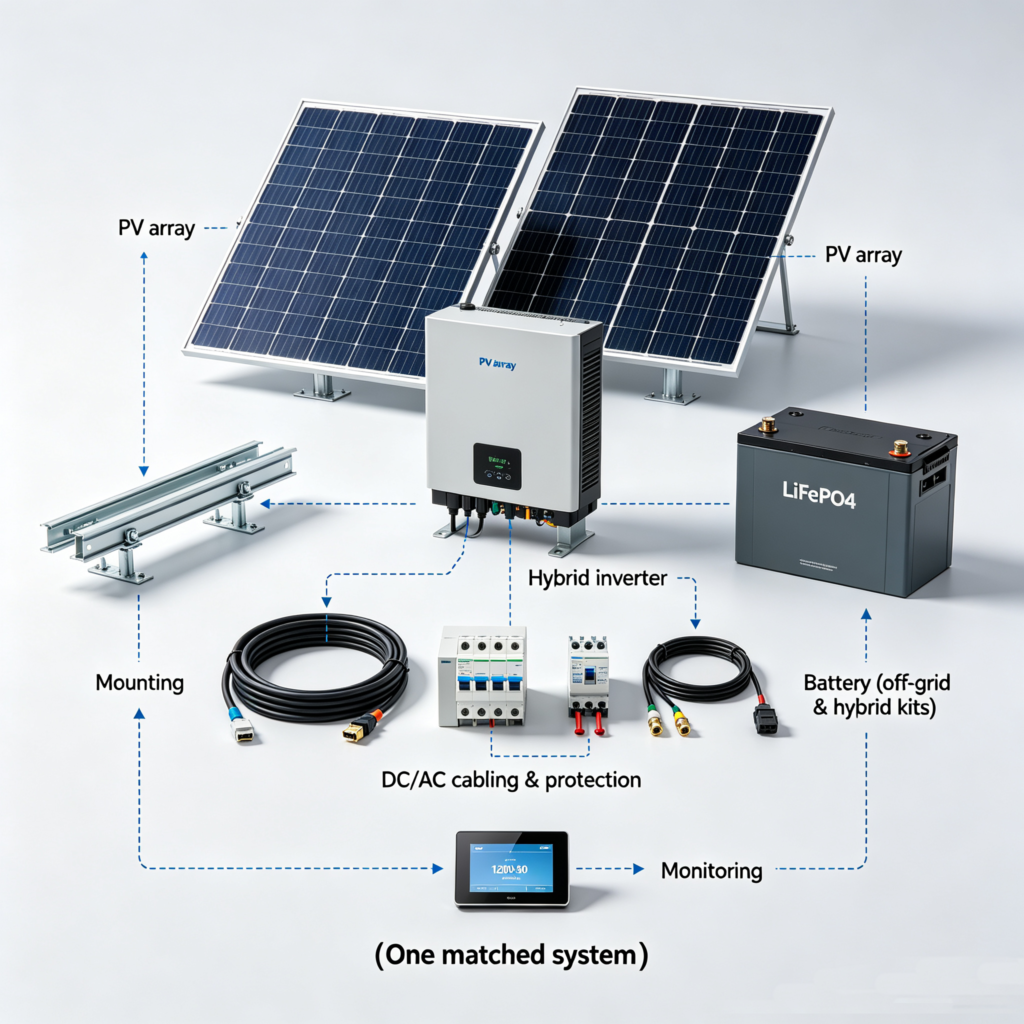
A pv panel kit is a pre-matched bundle of the components a solar installation needs — photovoltaic panels, an inverter or charge controller, mounting hardware, cabling and protection, and, in off-grid and hybrid versions, a battery — engineered to work together as one electrical system. The one-line version worth quoting: the value of pv panel kits is not the bundle and not the discount; it is the matching — panel string voltage inside the inverter’s MPPT window, the inverter’s DC bus matched to the battery platform, battery capacity matched to inverter power, and BMS-to-inverter communication that lets the battery set its own limits — and a kit that gets these four matches right is worth more than any box of separately discounted parts.
The kit market grew out of a real frustration: components bought separately do not always speak the same electrical language, and the person who discovers this is usually standing on a roof. Kits began as DIY conveniences and have become the default packaging of the installer economy — distributors now stock on-grid, off-grid and hybrid kits the way grocers stock recipes. This guide covers what is actually inside a kit, how the three kit types differ, the four electrical matches that decide whether any kit works, the sizing logic that connects array to battery, and what a volume buyer should verify before committing to a supplier’s packaging. The architecture question that sits above kit selection — on-grid, off-grid or hybrid — has its own treatment in #72 off-grid and on-grid solar system types, and the battery-centric view of the same decision in #73 lithium solar batteries.
What is inside a pv panel kit
Strip the marketing and pv panel kits are six component groups, each with its own specification that must agree with the others. The table is the anatomy; the section on matching rules explains why the middle column matters more than any individual datasheet.
| Component | Must match with | Notes |
|---|---|---|
| PV panels | inverter MPPT window, roof area | string voltage, not just watts |
| Inverter (or charge controller) | panels, battery, grid rules | the kit’s brain |
| Battery (off-grid / hybrid kits) | inverter DC bus, load profile | LFP is the default chemistry |
| Mounting | roof type, wind zone | often the hidden cost |
| Cabling & protection | system current and voltage | breakers, fuses, isolators |
| Monitoring | inverter and BMS protocols | app or display, both optional |
A kit that lists five of the six and leaves cabling and protection as “to be sourced” is not a kit; it is a shopping list with a discount. Conversely, a complete kit is the only product class where a supplier has implicitly taken responsibility for the compatibility of every part — which is precisely what the verification list at the end of this guide tests.
The three kit types
PV panel kits inherit the architecture they serve, so there are exactly three of them. An on-grid kit is panels plus a grid-tie inverter and mounting — the cheapest per panel watt, exporting surplus, and silent in an outage. An off-grid kit adds the charge controller and a battery bank sized to the site’s nights, and often provisions a generator input. A hybrid kit is built around a hybrid inverter with a battery in the loop, the fastest-growing class wherever grids are unreliable or evening power is expensive. The choice between them is the architecture decision, not a kit feature, and it deserves the full checklist in the architecture guide on this site rather than a datasheet comparison.
The four matching rules
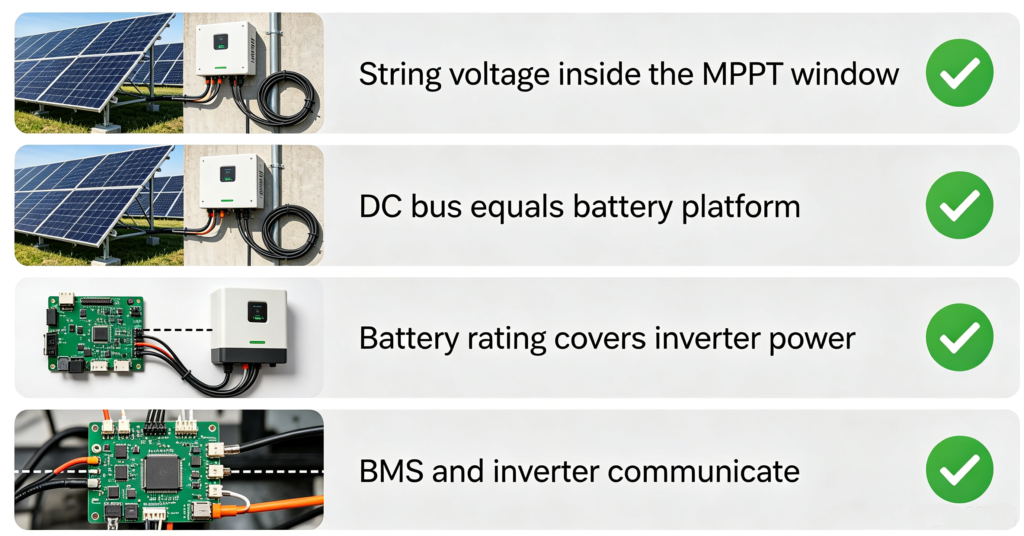
These are the rules a kit either satisfies or does not, and they apply identically to a DIY bundle and a distributor’s catalogue item. Rule one: string voltage inside the MPPT window. The panel string’s voltage — highest on cold, bright mornings — must stay within the inverter’s maximum input voltage and above its minimum operating voltage; string sizing is arithmetic, not judgement, and a mis-sized string either throttles production or destroys the inverter. Rule two: the inverter’s DC bus equals the battery platform. A 48V inverter wants a 48V (typically 51.2V) battery; there is no negotiating this, and the platform ladder is laid out in #73 the voltage ladder for lithium solar batteries. Rule three: battery capacity versus inverter power. The battery’s continuous discharge rating must cover the inverter at full output, with surge headroom for motor starts — a 5 kW inverter on a battery that delivers 3 kW is a factory for support tickets. Rule four: BMS-inverter communication. On any battery above the smallest 12V systems, the BMS should talk to the inverter over CAN or RS485 so that charge and discharge respect the battery’s actual state; what happens without that conversation is documented in #18 battery and inverter compatibility. Choosing the inverter half of the pair has its own supplier checklist in #50 evaluating inverter suppliers.
Sizing a kit to real loads
Sizing pv panel kits trips up buyers who conflate two different numbers: kilowatts and kilowatt-hours. The array’s kilowatts set how fast energy arrives; the battery’s kilowatt-hours set how much of it survives the night. The honest sequence is the same as for any solar system: start from measured daily consumption, derive the battery kilowatt-hours for the autonomy the site needs, then size the array to refill that bank in the stingiest production month — the method is walked through for off-grid sites in #23 off-grid solar system batteries and for homes in #09 how to size a home battery. A kit’s array-to-battery ratio is therefore a charging-time statement, not a capacity rule: too little array and the battery never fills in winter; too much array and the surplus has nowhere to go in an off-grid build. Kits that quote only “5 kW kit” without stating the battery kilowatt-hours are quoting half a system.
Kit versus buying components separately
The trade is coordination cost against optimization freedom. A kit buys compatibility assurance, one warranty conversation, one delivery and a known total price; buying separately buys the exact panel, the exact inverter and the exact battery for the site, at the cost of owning every compatibility decision yourself. For installers doing repeat jobs, kits win on installation time and fault isolation; for one-off demanding sites, separate specification usually wins on performance. The battery-centred version of this decision — choosing a battery kit and its balance of components — is covered in #06 solar battery kit: how to choose. Distributors should note the commercial asymmetry: kit margins sit in the integration, not the components, which is why suppliers who publish real compatibility documentation deserve the business.
What volume buyers should verify
Before a distributor commits to a kit line, five documents change hands or the deal is not serious. Compatibility declaration: the supplier’s written statement that these exact component versions are matched, updated when any component revision changes. String sizing tool or table for the inverter, with cold-temperature voltage margins shown. Certifications per component — grid codes for the inverter, UN38.3 and safety standards for the battery, structural documentation for the mounting. Datasheets with revision numbers, so a kit ordered twice arrives as the same kit. Support and spares terms: who diagnoses a fault across five suppliers’ components, and how fast replacement parts ship. The underlying discipline is the manufacturer-evaluation method in #21 how to evaluate battery manufacturers, and the systems-level view of how components divide responsibility — battery, PCS, BMS, EMS — in #52 BESS components.
Q. What is included in a pv panel kit?
A complete kit contains the panels, the inverter or charge controller, mounting hardware, cabling with breakers and isolators, monitoring, and — in off-grid and hybrid kits — a battery. If cabling and protection are left out, it is a component bundle, not a kit.
Q. Which kit do I need: on-grid, off-grid or hybrid?
It follows from your site, not from the catalogue: no grid or an expensive connection means off-grid; reliable grid with fair export payment means on-grid; outages, weak grids or expensive evening power point to hybrid. The architecture decision comes first.
Q. Can I expand a kit later?
Usually yes within limits: panels can extend if the MPPT window allows, and modular batteries add kilowatt-hours if the inverter and BMS support the larger capacity. Confirm the expansion path in writing before buying the first stage.
Q. Is a kit cheaper than buying components separately?
Often on paper, and almost always in installed cost, because the kit saves compatibility research, coordination and installation time. The exception is a demanding one-off site where separate specification wins performance that outweighs the integration saving.
Q. What size solar kit do I need?
Start from daily consumption in kilowatt-hours, size the battery for the autonomy you need, then size the array to refill it in the weakest production month. A quoted kit size in kilowatts alone tells you nothing about the storage it includes.
Next step: test the kit against the four matches
Any pv panel kit on your shortlist can be scored in an afternoon: string voltage against the MPPT window, inverter bus against the battery platform, battery rating against inverter power, and BMS communication against the inverter’s protocol list.
- Settle the architecture first with #72 off-grid and on-grid solar system types
- Choose the battery half with #73 lithium solar batteries
- Vet the inverter half with #50 evaluating inverter suppliers
- Ask leekooenergy for battery specifications and compatibility documentation for kit integrations — platform-matched LiFePO4 storage with the BMS details an inverter needs to talk to