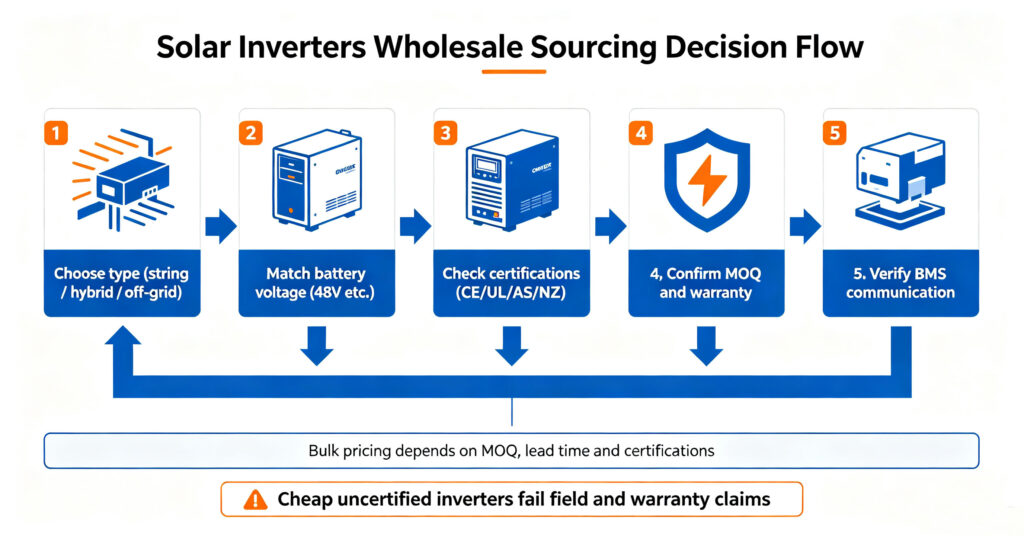
For buyers looking to source solar inverters wholesale, the process starts with choosing the inverter type that matches your market — string inverters for grid-tied utility projects, hybrid inverters for solar-plus-storage, and off-grid inverters for remote systems. You then match the inverter to your battery voltage (commonly 48V), confirm the certifications required in your region (CE, UL, AS/NZS, etc.), and negotiate MOQ, lead time and warranty. The biggest wholesale mistakes are buying uncertified units that fail in the field, choosing an inverter that does not communicate with the battery BMS, or under-specifying the warranty support you will need as a distributor.
As an international B2B buyer, the question of solar inverters wholesale is not just price — it is about building a repeatable supply that supports your installers and customers. This guide covers the types, the sourcing checklist and the risks to avoid. For the split-phase inverter technical detail, see #150 48V split phase inverter.
Solar inverters wholesale: the three main types
When you buy solar inverters wholesale, the first decision is the product type. Each serves a different market and channel.
| Type | Best for | Wholesale note |
|---|---|---|
| String inverter | Grid-tied, no battery | High volume, competitive pricing |
| Hybrid inverter | Solar + storage (battery) | Growing demand, BMS comms required |
| Off-grid inverter | Remote, no grid | Niche, often paired with generator |
For the system configuration behind inverter choice, see #17 hybrid inverter choice.
The wholesale market also rewards suppliers who can support your installers after the sale. Product training sessions, a partner portal with wiring diagrams, and a technical hotline that answers on the first call all reduce your support burden. Distributors who treat the supplier as a partner rather than a vendor tend to build more repeat business. When comparing quotes, add the value of post-sale support to the unit price — a supplier who charges 5% more but saves 20 hours of install time per year is the better deal.
Distributors who buy inverters in volume learn that the product cost is only the start of total landed cost. Shipping, customs, local certification testing, warranty stock, and RMA logistics can add 15–30% to the unit price, and those costs fall on the distributor, not the manufacturer. A $500 inverter that requires you to hold $50,000 of local spare parts and fly a technician to every warranty call is more expensive than a $650 inverter with a local service partner. Before negotiating unit price, ask the supplier what their warranty support looks like in your market: do they stock spare boards locally, can they ship a replacement inverter in 48 hours, and who handles the failed unit return shipping?
What to confirm before you place a bulk order
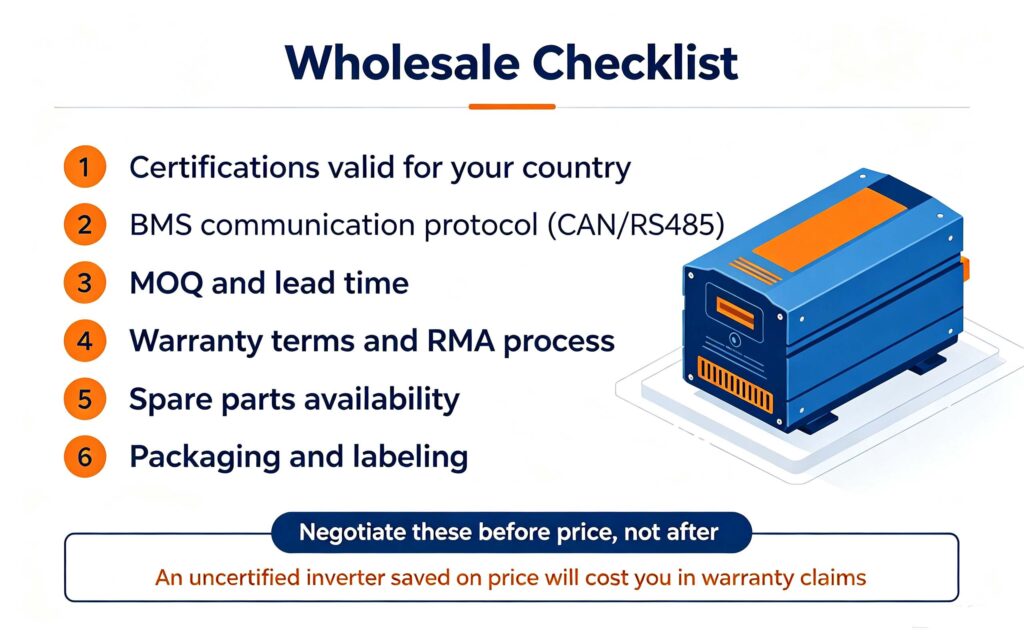
The price you see for solar inverters wholesale is conditional on several terms. Confirm all of them in writing.
- Certifications: valid for your destination country, not just listed on a datasheet.
- BMS communication: the inverter must talk to your battery system (see #18 CAN/RS485 compatibility).
- MOQ and lead time: bulk price tiers and production timing.
- Warranty and RMA: who handles defects, and how long.
- Spare parts: availability for field service.
Risks in wholesale inverter sourcing
Buyers of solar inverters wholesale typically hit three problems that do not show up in a price quote.
Uncertified units: cheap inverters without valid certifications fail field inspections and warranty claims — and you, the distributor, carry the customer relationship.
BMS mismatch: a hybrid inverter that cannot read your battery’s BMS will not charge correctly, causing battery problems blamed on your product.
Warranty no-show: suppliers disappear after shipment, leaving you to handle failures. Confirm RMA terms and spare parts stock before ordering.
Finally, build a relationship rather than chasing the lowest unit price. A distributor who sells 50 inverters a year and a supplier who supports them with training, marketing collateral and fast warranty response will outperform the cheapest manufacturer on repeat sales. Ask what the supplier offers beyond the box: product training for your installers, a partner price list, sample units for your showroom, and a defined escalation path for technical issues. These factors decide whether your customers come back for the next system, and they matter more than a $20 difference on the unit price.
Q. What certifications do I need for solar inverters wholesale?
It depends on your market. CE covers the European Union; UL listings are required for North America; AS/NZS standards apply in Australia. For battery inverters, also check IEC 62109 (safety) and IEC 61727 (grid compliance). Certifications should come as test reports, not just logos on a listing.
Q. What is a typical MOQ for solar inverters wholesale?
MOQ varies by supplier and product. Standard hybrid inverters often start at tens to hundreds of units for wholesale pricing. Custom or high-power models may require larger orders. Ask suppliers for tiered pricing so you know the volume needed for each price level. Start with a sample order before committing to a standing order.
Q. Can I buy one inverter as a sample before wholesale?
Yes, and you should. Most suppliers offer sample units at near-retail price so you can test the inverter with your battery system, check the display and app, and measure installation time. A sample test catches compatibility issues before you order 100 units. This is standard practice and reduces wholesale risk significantly.
Q. How do I know if an inverter communicates with my battery?
Ask for the BMS communication protocol: most modern hybrid inverters use CAN or RS485, and they must support the specific battery BMS profile. Test the sample with your actual battery. Confirm that state of charge, charge limits and fault signals all pass through. Without communication, the inverter charges blindly and risks damage.
Q. What warranty should I expect on wholesale inverters?
Most quality inverters carry a 5-year standard warranty, with extended options. As a distributor, you need a clear RMA process: who handles defects, how long replacements take, and whether spare parts are stocked locally. Put warranty and RMA terms in writing before you place the bulk order. A cheap inverter with no real support costs more long-term.
Next step: source inverters that match your battery system
The best wholesale price for solar inverters wholesale is the one that comes with valid certifications, BMS compatibility and a real warranty — not the lowest unit price. Source the inverter and battery together so they work as a system.
- See split-phase detail in #150
- Check BMS protocol in #18
- Review system config in #17
- Ask leekooenergy for inverter recommendations matched to your battery system, with BMS compatibility, certifications and warranty terms listed before you buy