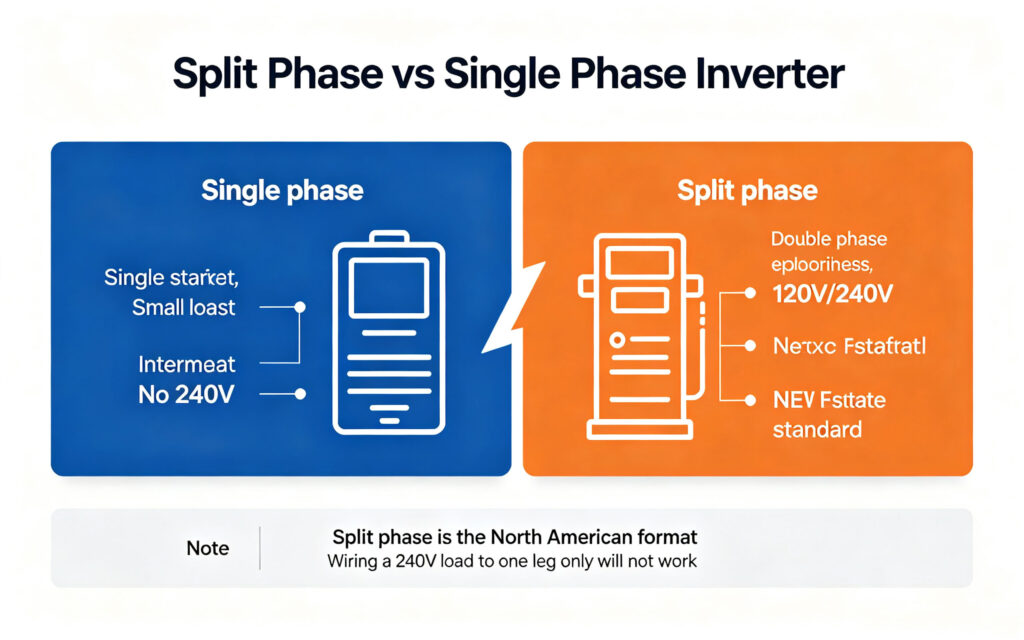
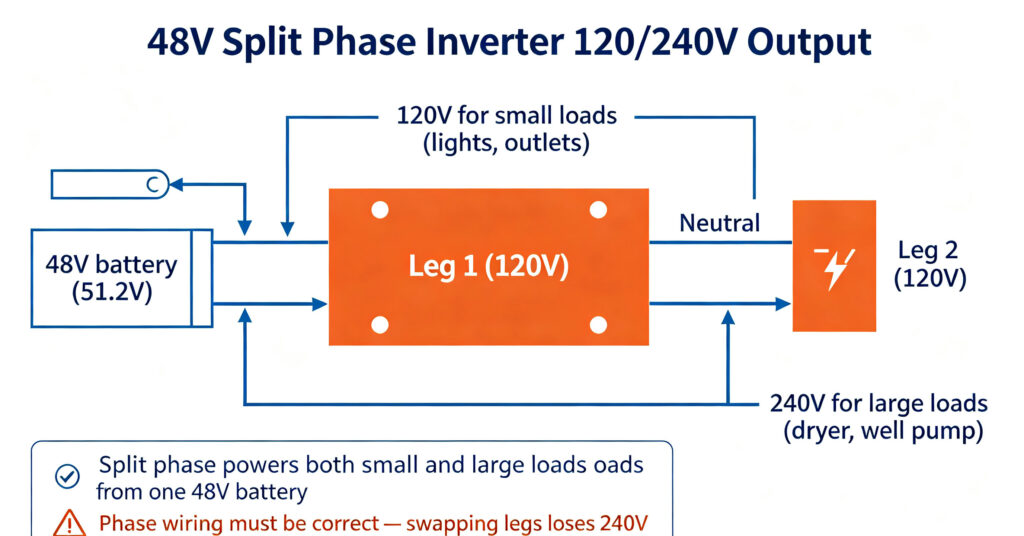
A 48v split phase inverter is a hybrid inverter that takes DC power from a 48V battery bank (typically 48V LiFePO4, around 51.2V full) and converts it into split-phase AC output: two 120V legs relative to neutral, giving 120V for small loads (lights, outlets) and 240V between the two legs for larger loads (dryer, well pump, EV charger). This is the standard North American home power format, which is why a 48V split phase inverter is the common choice for US and Canadian solar-plus-storage systems. The 48V input keeps battery cabling manageable, while the split-phase output matches household wiring — so you do not need a separate transformer or a higher-voltage battery bank.
Buyers searching for a 48v split phase inverter are usually working on North American systems where the home runs on 120/240V. This guide explains the split-phase concept, compares it with single-phase, and lists the specs to check. For the wholesale sourcing context, see #146 solar inverters wholesale.
48v split phase inverter: how the 120/240V output works
Understanding a 48v split phase inverter starts with how it produces two 120V legs from one DC battery.
The inverter generates two 120V AC waveforms that are 180 degrees out of phase. Relative to neutral, each leg is 120V; between the two legs, the voltages add to 240V. This is exactly how the North American grid supplies homes, so household appliances work without modification.
| Output | Voltage | Typical loads |
|---|---|---|
| Leg 1 to neutral | 120V | Lights, outlets, TV, fridge |
| Leg 2 to neutral | 120V | Other outlets, circuits |
| Leg 1 to Leg 2 | 240V | Dryer, well pump, EV charger |
For the system configuration context, see #17 hybrid inverter choice.
Split phase vs single phase: which do you need?
The choice between a 48v split phase inverter and a single-phase inverter depends on your market and loads.
Split phase (120/240V): the standard for North American homes. It powers both small 120V loads and large 240V loads from one inverter. If your wiring uses a 120/240V panel, you need split phase.
Single phase (120V or 230V only): common in many international markets where homes use a single nominal voltage. It cannot provide 240V between legs. If your loads are all single-voltage, a single-phase inverter is simpler and cheaper.
For the 48V battery that pairs with these inverters, see #142 48V 300Ah rack mount battery.
The reason North American homes use split phase rather than single 240V is safety and flexibility. A 120V leg relative to neutral is what every outlet, light and small appliance is designed for; 240V between the two legs is reserved for high-draw loads like dryers, ovens and well pumps. A 48V split phase inverter reproduces this format exactly, so it connects to the existing home panel through a transfer switch without rewiring. In markets that use 230V single phase (most of Europe, Asia, Australia), this split-phase output is unnecessary, which is why the same inverter sold there often comes in a single-phase 230V version. Buying the wrong variant means the home 120V outlets will not work, even if the 240V loads do.
The reason North American homes use split phase rather than single 240V is safety and flexibility. A 120V leg relative to neutral is what every outlet, light and small appliance is designed for; 240V between the two legs is reserved for high-draw loads like dryers, ovens and well pumps. A 48V split phase inverter reproduces this format exactly, so it connects to the existing home panel through a transfer switch without rewiring. In markets that use 230V single phase (most of Europe, Asia, Australia), this split-phase output is unnecessary, which is why the same inverter sold there often comes in a single-phase 230V version. Buying the wrong variant means the home’s 120V outlets will not work, even if the 240V loads do.
How to choose a 48V split phase inverter
When you select a 48v split phase inverter, five specs decide whether it fits your system.
- Rated wattage: must exceed your continuous load; add surge margin for motor startup.
- Battery voltage: confirm it is 48V (not 24V or 60V) and matches your battery.
- BMS communication: must read your battery’s BMS (CAN/RS485) for correct charging (see #18 CAN/RS485 compatibility).
- Solar input: if adding PV, check MPPT voltage range and charging current.
- Certifications: UL for North America, plus local grid code if grid-tied.
What is a 48V split phase inverter used for?
A 48V split phase inverter is used in North American solar-plus-storage and off-grid systems. It converts 48V battery power into two 120V legs relative to neutral, with 240V between them. This powers both standard outlets and 240V appliances. It connects to the home panel through a transfer switch without rewiring.
What is the difference between split phase and single phase?
Single phase provides one AC voltage (120V or 230V) from one leg. Split phase provides two 120V legs relative to neutral, giving 240V between them. Single phase powers either 120V or 240V loads, not both. Split phase powers standard outlets and high-draw appliances. It is standard in North American homes.
Can a 48V split phase inverter run a whole house?
Yes, within its wattage limit. A typical 3kW–8kW continuous inverter runs essential home loads: lights, fridge, internet, a few outlets. It cannot run a central air conditioner and an oven at the same time. Size the inverter to your critical loads, not total connected load. Add a generator for heavy loads or multi-day outages.
Do I need a transformer with a 48V split phase inverter?
No. That is the advantage of the split-phase format: it outputs 120/240V directly, matching standard North American home wiring. You need a transfer switch to disconnect grid power, and breakers sized to the inverter output. No external transformer is required. This is why it is simpler than a 48V inverter that outputs only single-phase 120V.
What battery voltage does a split phase inverter need?
A 48V split phase inverter is designed for a 48V battery bank, usually a 48V LiFePO4 battery (around 51.2V full charge). Do not connect a 12V or 24V battery — the inverter will not start. Match the battery voltage and BMS communication (CAN/RS485) before buying. Confirm the battery supports the inverter maximum charge and discharge current.
Next step: match the inverter to your 48V battery and loads
A 48v split phase inverter powers a North American home from a 48V battery, but it must match your battery voltage, BMS communication, continuous wattage and certifications. Confirm all four before you buy.
- Source inverters in #146
- See matching 48V battery in #142
- Ask leekooenergy for a 48V split phase inverter matched to your battery and loads, with BMS compatibility and certifications confirmed before you order