Buyer’s guide · Seplos C&I application & sourcing team · Last reviewed: 2026-08
Commercial battery storage earns its cost back through four mechanisms: reducing demand charges, shifting energy between price periods, absorbing on-site generation that would otherwise be exported cheaply, and keeping a process running when the grid drops. Which mechanism dominates decides almost everything about the system — its power rating, its energy rating, its cooling, and how the contract should be written.
That ordering is not academic. A project specified as energy-heavy and then operated for peak shaving will underperform for years without anything appearing to be broken. So the first question in a C&I project is never how many kilowatt-hours. It is what the system is being paid to do.
What Commercial Battery Storage Is
Definition. A commercial battery storage system, also called a C&I battery energy storage system, is a grid-connected installation that stores electrical energy in battery cells and releases it under the control of an energy management system, at a scale serving a single commercial or industrial site rather than a household or a utility network. Typical ratings run from tens of kilowatt-hours to several megawatt-hours. The system includes battery racks, a power conversion system, an energy management system, thermal management, fire protection and a grid interface.
Three things separate this from a residential system, and none of them is simply size. The power conversion system operates at higher voltage, often 1000 V or 1500 V DC, which changes cabling, protection and commissioning. Thermal management is usually active — liquid cooling in most modern cabinets — because the duty cycle is harder. And the system falls under a different set of codes: fire separation distances, gas detection, interconnection studies and, in many jurisdictions, a permitting process that takes longer than the equipment lead time.
That last point is worth internalising early. On many industrial battery storage projects the schedule is set by the utility and the fire marshal, not by the factory.
The Four Revenue Models, Compared
Buyers often arrive asking about payback as though it were a single number. It is not. It is the sum of whichever of the following four streams the site can actually access, and access varies by tariff, by country and sometimes by feeder.
| Revenue model | What it does | What the system must be good at | Design consequence |
|---|---|---|---|
| Demand charge reduction peak shaving | Discharges during the site’s monthly demand peaks so the billed maximum kW falls | High power for short bursts; accurate load forecasting; fast EMS response | Power-heavy: high C-rate, PCS sized to the peak, relatively modest kWh |
| Energy arbitrage load shifting, time-of-use | Charges in cheap periods, discharges in expensive ones | High round-trip efficiency; cycle life at daily or twice-daily cycling | Energy-heavy: more kWh per kW, cycle warranty becomes the key commercial term |
| Self-consumption PV or CHP integration | Stores on-site generation instead of exporting it at a low feed-in rate | Matching the generation profile; DC or AC coupling decision | Sized to the daily generation surplus, not to the load peak |
| Process continuity backup, ride-through | Keeps critical production or cold storage running through an outage or voltage event | Transfer behaviour, surge capability, guaranteed availability | Sized to the critical load and the required ride-through duration; redundancy matters more than efficiency |
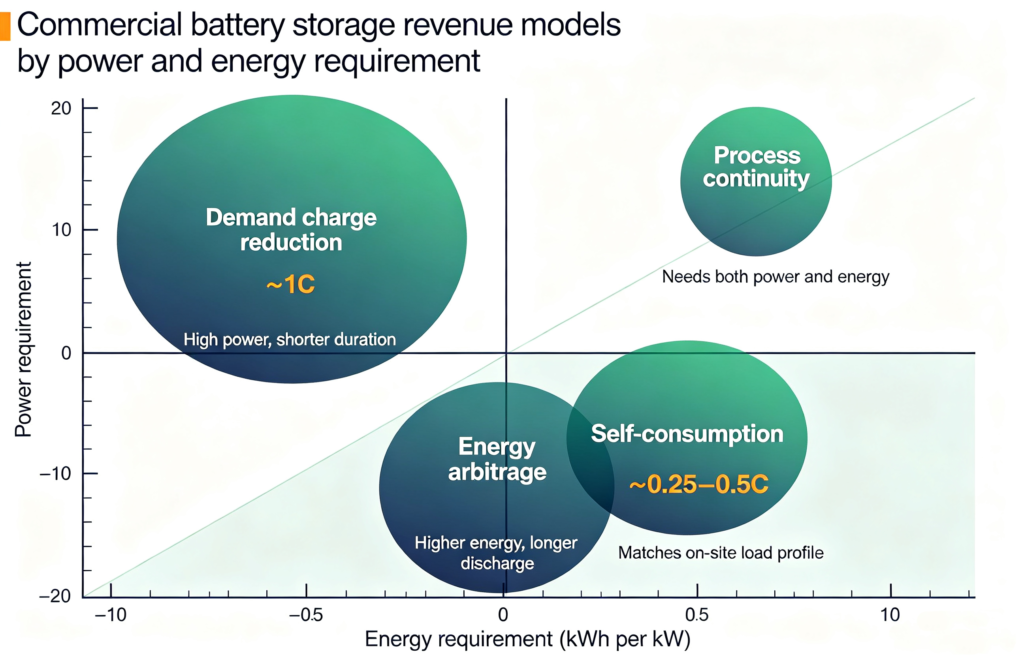
In practice, most viable C&I projects stack two of these. Demand charge reduction plus arbitrage is the most common pairing in markets with both a kW charge and a time differential. Self-consumption plus continuity is common in manufacturing sites that already have a rooftop array and a process that cannot tolerate interruption.
The pairing matters because the two halves can conflict. A battery held at high state of charge for backup readiness cannot also be cycling for arbitrage. Someone has to decide the priority order, and that decision belongs in the EMS configuration and in the contract — not in a conversation after commissioning.
How the Revenue Model Drives the Design
The clearest way to see this is the power-to-energy ratio. A system built for peak shaving might be specified at 1 C — say 500 kW paired with 500 kWh — because it needs to cut a sharp thirty-minute peak. An arbitrage system covering a four-hour price window on the same site might be 250 kW paired with 1000 kWh, a 0.25 C system. Same site, same bill, radically different equipment.
This is where a lot of quotations become incomparable. Two suppliers can both propose “500 kWh” and be offering systems that behave nothing alike, because one has sized the PCS for the peak and the other has not. When comparing commercial energy storage systems, compare the kW and the kWh together, and ask for the continuous C-rate the system can sustain at the ambient temperature of the actual site.
Cycle life follows the same logic. A 6000-cycle rating means something different to a system cycling once a day than to one cycling twice. Twice-daily arbitrage consumes a 6000-cycle warranty in roughly eight years; once-daily peak shaving may not reach it in sixteen. Ask which cycle count the warranty assumes, and at what depth of discharge and temperature it was measured.
Cabinet, Container or Rack: Choosing the Form Factor
Form factor is usually treated as a packaging question. It is closer to a site-constraints question.
| Form factor | Typical scale | Best suited to | Main constraints |
|---|---|---|---|
| Indoor rack / modular cabinet | Tens to low hundreds of kWh | Existing electrical rooms, retrofits, phased expansion | Room fire rating, ventilation, floor loading, service access |
| Outdoor all-in-one cabinet | ~100 kWh to ~500 kWh per unit | Most single-site C&I projects; multiple units in parallel | Concrete foundation, separation distances, IP and corrosion rating |
| Container (20 ft / 40 ft) | MWh scale | Large industrial loads, multi-MW sites, utility-adjacent projects | Crane access, transport permits, longer interconnection study |
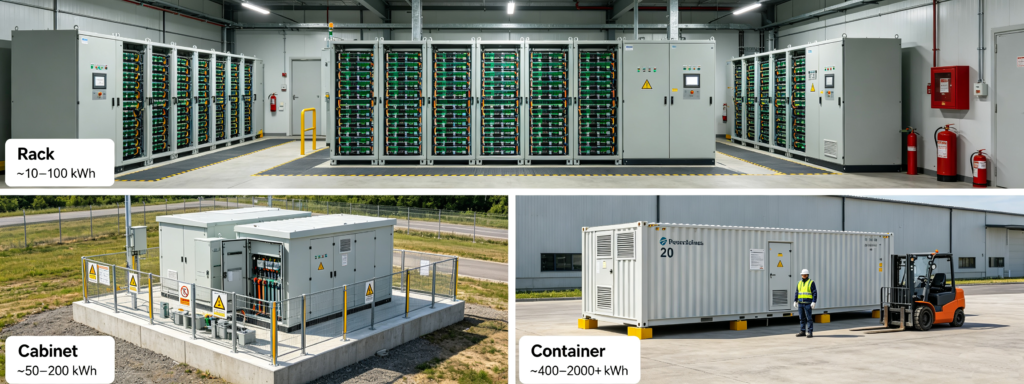
Outdoor cabinets have become the default for most commercial and industrial energy storage projects for one practical reason: they move the fire and ventilation problem outside the building envelope, which usually shortens the permitting conversation. They also allow capacity to be added in defined increments, which suits sites whose load is still growing.
The trade-off is site work. Cabinets need a foundation, a fenced clearance, and a cable route to the switchgear. On a constrained yard, that cost can exceed the difference in equipment price between form factors, which is exactly the kind of item that appears late in a project and damages the business case.
Sizing a C&I System in Four Steps
The sequence below assumes interval data is available. If it is not, getting it is the first step, because sizing from monthly bills alone produces systems that are either oversized or useless.
Step 1 — Get twelve months of interval data
Fifteen-minute or hourly meter data for a full year, plus the tariff structure that applies to it. Twelve months matters because seasonal peaks and summer cooling load change the answer. From this data, identify the monthly billed peaks, their duration, and how often they occur.
Step 2 — Define the objective and its priority order
Write down which revenue models apply, and in what order the EMS should serve them when they conflict. This single decision determines the power-to-energy ratio and should be agreed before any equipment is quoted.
Step 3 — Size power first, then energy
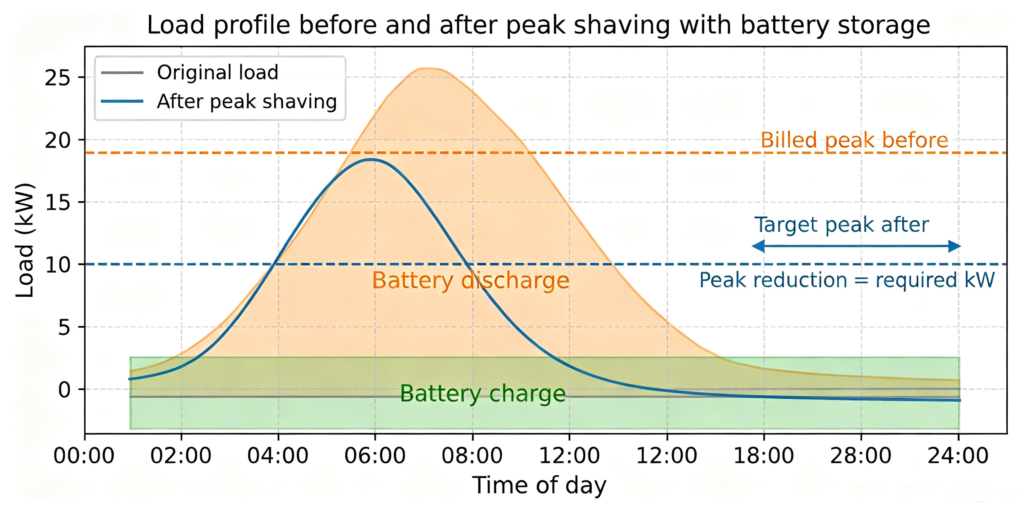
For peak shaving, the required power is the gap between the billed peak and the target peak. For arbitrage, the required energy is the price-window duration multiplied by the power the site can absorb. Then check the resulting C-rate against what the equipment can sustain continuously at site ambient temperature — not the datasheet maximum at 25 °C.
Step 4 — Test the design against the constraints that kill projects
Available space and separation distances. Switchgear capacity and spare breaker positions. The utility interconnection process and whether export is permitted at all. Fire code requirements for the chosen form factor and location. Any one of these can invalidate an otherwise sound design, and all four are cheaper to check now than after the deposit.
Where the Value Shows Up: Four Site Types
The following are the site profiles where C&I storage most often makes sense. They are patterns, not case studies — actual results depend on the tariff and the load.
- Manufacturing with heavy motor starts. Compressors, presses and furnaces create short, sharp peaks that dominate the demand charge. Peak shaving is usually the primary model, and the system is power-heavy. The load profile is repeatable, which makes forecasting easier and the saving more reliable.
- Cold storage and food logistics. A large, steady base load with a hard continuity requirement — product loss during an outage is measurable and often insured. These sites typically stack continuity with arbitrage, and reserve a minimum state of charge for backup.
- Commercial buildings and retail. Cooling-driven afternoon peaks that align well with time-of-use windows. Space is usually the binding constraint, which pushes toward outdoor cabinets or a basement rack installation with a proper fire strategy.
- EV charging depots. Charging power can exceed the site’s grid connection, and upgrading the connection is often slower and more expensive than adding storage. Here the battery is buying capacity, not just shaving a bill, and the comparison should be made against the quoted cost of a connection upgrade.
The depot case deserves emphasis because it is the one where storage frequently wins outright. When the alternative is a transformer upgrade with a multi-year utility queue, a battery is not competing on payback. It is competing on whether the project happens at all.
Certification, Fire Safety and Grid Compliance
Compliance requirements for C&I storage are market-specific and change. What follows is the structure of the question rather than a list of answers, and the certificate numbers should always be verified against the current issuing body.
- Cell and system safety. Cell-level and system-level safety standards are separate. A cell certificate does not cover the assembled system, and buyers should ask for both.
- Fire performance and separation. Large-scale fire testing and installation codes govern separation distances, indoor placement, gas detection and suppression. These determine where the system can physically go.
- Grid interconnection. The inverter must comply with the local grid code for anti-islanding, voltage and frequency ride-through and power quality. This is normally proven by a type certificate for the PCS.
- Transport. Lithium batteries are dangerous goods. Shipping documentation and packaging requirements affect lead time and freight cost, particularly for container-scale systems.
Two practical notes. First, ask for certificates as documents with numbers and issuing bodies, not as logos on a datasheet. Second, confirm which market each certificate is valid in — a certificate that satisfies one jurisdiction may not be accepted in another, and discovering that at customs is expensive.
What Actually Changes the Price of a C&I Quote
Two quotes for the same nominal capacity can differ substantially, and the difference is rarely margin. It is usually one of these.
- Usable versus nominal energy. A system quoted at nominal kWh with an 80 % usable window is a different product from one quoted at usable kWh.
- PCS rating and whether it is included. Some quotes exclude the PCS, the transformer or the grid cabinet.
- Cooling method. Liquid cooling costs more up front and generally delivers better cell temperature uniformity, which affects life and available power at high ambient temperature.
- Warranty terms. Cycle count, capacity retention at end of term, and whether the warranty is throughput-based or year-based.
- Scope of supply and O&M. Commissioning, spare parts, remote monitoring, response times and who holds the availability obligation.
- Certification set. Systems certified for more markets carry that cost.
For projects where the financial case is tight, the more useful comparison is levelised cost of storage rather than price per kWh: total lifetime cost divided by total energy throughput over the warranted life. It penalises a cheap system with a short cycle warranty, which price per kWh does not.
Procurement Checklist
Request these in writing before comparing quotations. Every item here has changed the outcome of a real tender at some point.
- Usable kWh and nominal kWh, stated separately, with the DOD assumed
- Continuous kW and continuous C-rate at site ambient temperature, plus the derating curve
- Round-trip efficiency with its measurement conditions and whether PCS losses are included
- Cycle life with DOD, temperature and C-rate of the test, plus end-of-warranty capacity retention
- Cell manufacturer, cell model and whether one system uses a single production batch
- Cooling method and the ambient temperature range for full-power operation
- Fire protection design and the standards it was tested to
- PCS grid-code certificate for the target market
- EMS capability: which revenue models it can run, priority logic, and whether it integrates with the site’s existing monitoring
- Complete scope of supply, with exclusions listed explicitly
- Lead time by configuration, and transport classification and documentation
- Warranty structure, availability commitment and spare-parts response time
FAQ
Q. How does commercial battery storage make money?
Through four mechanisms: reducing billed demand charges, shifting energy from cheap to expensive periods, storing on-site generation instead of exporting it, and avoiding the cost of an outage. Most viable projects combine two of the four; which ones are available depends on the site’s tariff and local market rules.
Q. What is the difference between peak shaving and load shifting?
Peak shaving reduces the maximum power drawn in a billing period, so it targets the kW charge and needs high power for a short time. Load shifting moves energy consumption between price periods, so it targets the kWh charge and needs more energy capacity. A system optimised for one is not optimised for the other.
Q. How large does a commercial battery storage system need to be?
Size follows the objective, not the site’s annual consumption. Peak shaving is sized to the gap between the current billed peak and the target peak; arbitrage is sized to the duration of the price window. Both require twelve months of interval meter data to specify properly.
Q. Is a cabinet or a container better for an industrial site?
Cabinets suit most single-site projects up to a few hundred kilowatt-hours per unit and allow capacity to be added in stages. Containers become more economical at megawatt-hour scale but require crane access, transport permits and usually a longer interconnection process.
Q. How long does a C&I storage project take?
The equipment lead time is often not the limiting factor. Utility interconnection studies and fire or building permits frequently take longer, and both should be started in parallel with equipment selection rather than after it.
Specifying a C&I system?
Send us twelve months of interval meter data, the tariff structure, the available installation area and the grid connection capacity. Our application team will return a configuration with power and energy sized separately, the C-rate the system sustains at your site’s ambient temperature, and the assumptions behind every number so your engineer can check them.