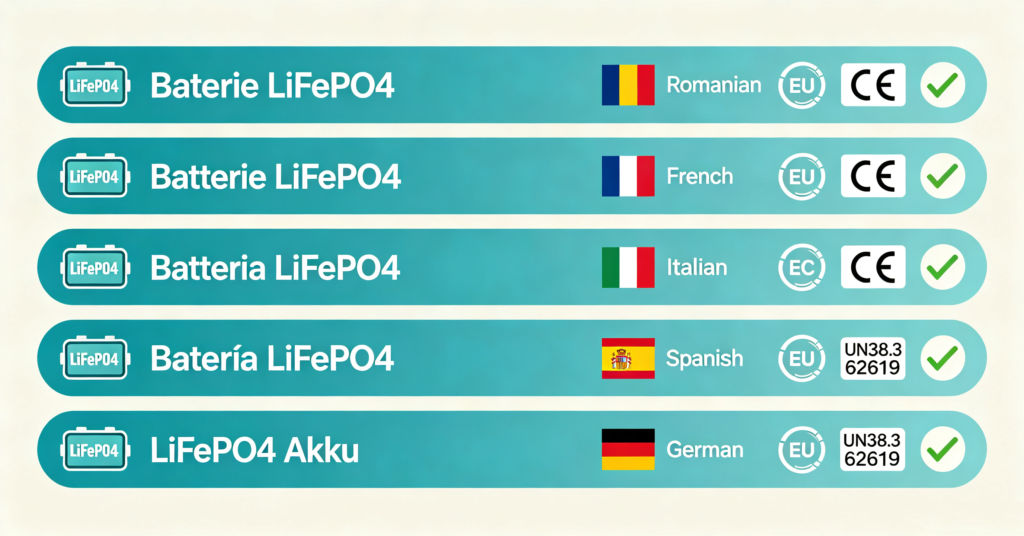
A baterie lifepo4 is the EU spelling of a lithium iron phosphate (LiFePO4) battery — the same chemistry marketed across Europe under five local labels: baterie lifepo4 (Romanian, single-t), batterie LiFePO4 (French), batteria LiFePO4 (Italian), batería LiFePO4 (Spanish) and LiFePO4 Akku (German). Search volume across those five spellings reaches tens of thousands per month in the EU, alongside misspelled variants such as lifep04, lifep04 battery and lifemgpo4. For an EU LiFePO4 buyer, the spelling on the search box tells you almost nothing about their chemistry knowledge and almost everything about the language and the channel that brought them in.
EU buyers do not search differently because they want a different battery — they type in the language they grew up typing in. The product is the same LiFePO4 chemistry the world calls by its English name; the marketing pages, datasheets and certifications just need to land in the searcher’s language. The full chemistry primer is in #1 lithium iron phosphate batteries: the complete guide; this article stays on the EU axis.
The five spellings, side by side
The product is the same in every row. What changes is the label and, with it, the search volume by language, the datasheet language and the local compliance symbols the buyer expects.
| Language | Spelling | Typical EU buyers | Local compliance |
|---|---|---|---|
| Romanian | baterie lifepo4 | off-grid cabins, telecom backup, agricultural pumping | CE · UN38.3 · IEC 62619 |
| French | batterie LiFePO4 | DIY solar, RV, boat, off-grid cabins | CE · UN38.3 · IEC 62619 |
| Italian | batteria LiFePO4 | off-grid villas, marine, small C&I | CE · UN38.3 · IEC 62619 |
| Spanish | batería LiFePO4 | off-grid rural, solar pumping, telecom backup | CE · UN38.3 · IEC 62619 |
| German | LiFePO4 Akku / Batterie | home storage, balcony solar, small commercial | CE · UN38.3 · IEC 62619 · VDE-AR-E 2510-2 |
Read the table as a localisation checklist. A French DIY buyer typing batterie lifepo4, a Romanian searcher typing baterie lifepo4 and an Italian installer typing batteria lifepo4 all look at the same datasheet.
Common misspellings and where they come from
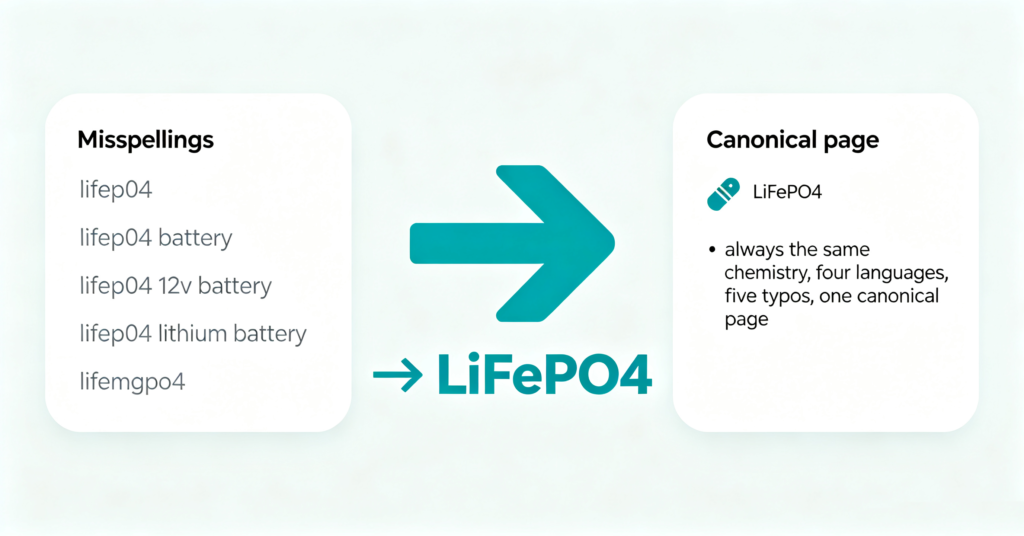
The misspellings cluster around two patterns: the o → 0 substitution (lifep04) and the o → m substitution (lifemgpo4).
| Typed in search box | What it means | How to handle |
|---|---|---|
| lifep04 | LiFePO4, with letter o replaced by digit 0 | redirect to canonical LiFePO4 page; mention on the page |
| lifep04 battery | same as above, plus the noun “battery” | redirect to canonical; treat as long-tail query |
| lifep04 12v battery | same plus the 12V form factor | redirect to 12V LiFePO4 page |
| lifep04 lithium battery | same plus the chemistry noun | redirect to lithium battery page |
| lifemgpo4 | autocorrect artefact of LiFePO4 | redirect to canonical; never write the typo in body copy |
The rule is simple: do not put misspellings in the body; put them in the URL slug, metadata or FAQ as a “did you mean” entry.
EU compliance: what the buyer actually asks for
An EU LiFePO4 buyer asks for the same documents regardless of language, and the supplier who cannot produce them loses the deal before the chemistry is discussed. The minimum set:
- UN38.3 — transport safety summary, required for any lithium battery shipped by air, sea or road.
- IEC 62619 — secondary lithium cells for industrial applications; the standard EU installers quote.
- CE marking and EU Declaration of Conformity — the regulatory baseline for any product sold in the EU.
- Datasheet and MSDS in the buyer’s language — French, Italian, Spanish, German or Romanian.
- For German residential storage — VDE-AR-E 2510-2 is the additional safety standard many installers request.
Which LiFePO4 profile fits each EU application
Each EU sub-market asks a different question, and the answer uses the same cell with different BMS settings and packaging.
| EU application | Typical voltage | Typical capacity | Form factor | EU market note |
|---|---|---|---|---|
| DIY, RV, small boat | 12V | 100–200 Ah | Group 24/31 case | highest search volume, lowest entry price |
| Home storage, balcony solar, small off-grid | 48V | 100–300 Ah | rack or wall-mount | VDE-AR-E 2510-2 often required |
| Small commercial / telecom backup | 48V | 200–600 Ah | 19″ rack or cabinet | IEC 62619 mandatory |
| Off-grid villa, agricultural pumping | 24V / 48V | 200–400 Ah | floor-standing cabinet | Spanish / Italian / South-EU demand |
The platform-level comparison is in #35 48V lithium batteries explained and #70 12V LiFePO4 battery; the cycle-life economics in #46 cycle life vs price; the chemistry vs NMC comparison in #33 LiFePO4 vs lithium-ion NMC.
Buying for an EU importer, dealer or distributor
The question is not whether to stock LiFePO4 — it is which cell grade, which BMS generation and which labelling language to commit to. Three rules keep the decision honest:
- One chemistry, one cell grade: mixing cell grades in one bank is the most common source of field failures. Disclose cell supplier (A-grade automotive vs B-grade) and BMS firmware version per batch.
- One localisation file per language: keep the French, Italian, Spanish, German and Romanian datasheets version-locked to the cell and BMS shipped; if the firmware changes, the datasheet changes.
- Compliance stack ready to ship: UN38.3 summary, IEC 62619 test report, CE declaration and MSDS in the destination language should leave the warehouse with every order — not as a download a week later.
Q. Is “baterie lifepo4” (single-t Romanian spelling) a typo or a real word?
It is a correct EU spelling — baterie is the Romanian form of “battery”, with a single ‘t’. Other EU spellings: batterie (French), batteria (Italian), batería (Spanish), Akku/Batterie (German). LiFePO4 is the chemistry name and stays the same.
Q. What about “lifep04”?
A common misspelling of LiFePO4 where “o” is typed as “0”. The product the searcher wants is the same LiFePO4 battery; redirect the misspelling to the canonical page.
Q. Does a baterie lifepo4 (Romanian) need CE marking?
Yes. Any LiFePO4 battery sold in the EU — regardless of spelling — must carry the CE mark and an EU Declaration of Conformity. UN38.3 and IEC 62619 are the additional standards almost every importer requests.
Q. What is the difference between lifepo4 and NMC?
Both are lithium chemistries. LiFePO4 (lithium iron phosphate) is more stable, longer cycle life, used in stationary storage; NMC (nickel manganese cobalt) packs more energy per kilogram, more common in mobility. Full comparison in #33.
Q. How do I order LiFePO4 batteries with EU documentation?
Ask for the UN38.3 summary, the IEC 62619 report, the CE declaration and a datasheet in the destination language, version-locked to the cell grade and BMS firmware shipped.
Next step: ship one product, five languages, one compliance pack
The right baterie lifepo4 page — under any of the five EU spellings — lands in the searcher’s language, ships with the EU compliance stack ready, and points at the canonical chemistry page for the buyer who wants to go deeper.
- Chemistry primer in #1 lithium iron phosphate batteries: the complete guide
- Platform basics in #70 12V LiFePO4 battery and #35 48V lithium batteries explained
- Compare with NMC for mobility buyers via #33 LiFePO4 vs lithium-ion NMC
- Evaluate the supplier on documentation discipline via #21 how to evaluate battery manufacturers
- Ask leekooenergy for the EU compliance pack (UN38.3 + IEC 62619 + CE + MSDS in RO / FR / IT / ES / DE) version-locked to the cell grade and BMS firmware shipped