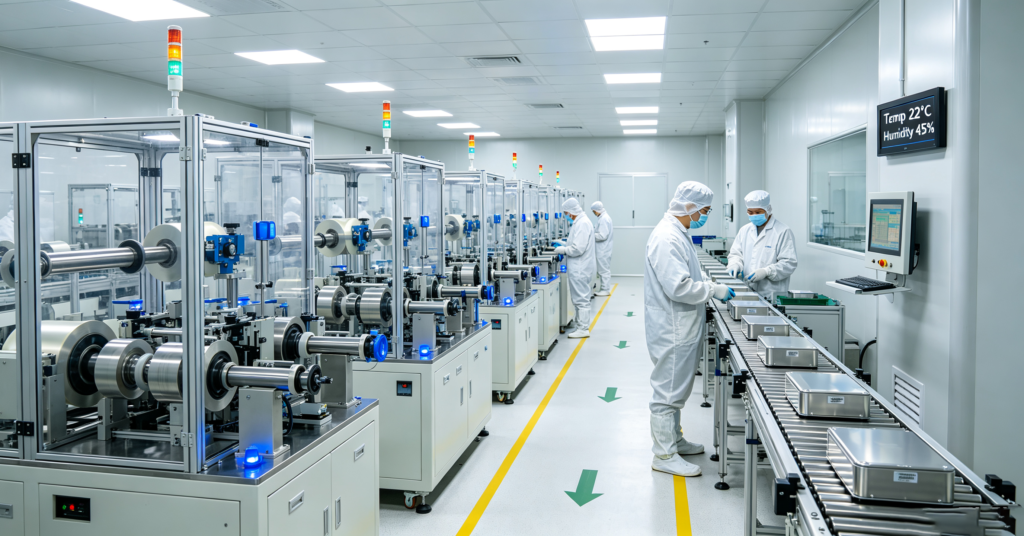
A serious battery cleanroom manufacturer is identified by five things: an ISO-classified dust-free production space (ISO Class 7 or better for cell production, ISO Class 8 for module assembly), a documented humidity and temperature envelope, a traceability system that ties every cell back to its electrode batch, an audit-ready set of certifications (ISO 9001, ISO 14001, IEC 62619, UN38.3 at minimum), and a sample-to-mass-production workflow that proves the lab line matches the production line. The battery cleanroom manufacturers that pass those five tests are the ones that ship to North America, Europe and Australia without the buyer inheriting a recall risk. The rest of this guide walks through what to look for, how to audit it, and how to structure an RFQ that filters out the suppliers who cannot meet those five tests.
For an importer, distributor or OEM buyer, picking a Chinese lithium battery supplier is a sourcing decision with three layers: commercial (price, MOQ, lead time, payment terms), technical (cell chemistry, BMS, certifications) and operational (cleanroom, traceability, capacity). The commercial layer is what most public guides cover; the operational layer — what the factory actually looks like inside — is what determines whether the order ships on time and survives a customer audit six months later. This hub exists to put the operational layer on the table, alongside the commercial and technical layers, so a buyer can write an RFQ that filters out the suppliers who fail any of the three.
What “cleanroom” actually means for a battery factory
A battery cleanroom is a dust-controlled, humidity-controlled, temperature-controlled production space in which the cells are wound, stacked, electrolyte-filled and sealed. The ISO classification (ISO Class 7 = 10,000 particles per cubic foot at 0.5 μm; ISO Class 8 = 100,000) is the operational benchmark, and the higher the class number the cleaner the air. For prismatic LiFePO4 cells the cell-winding and stacking steps need ISO Class 7 or better; module assembly and pack integration can run at ISO Class 8 with adequate controls on the upstream cell handling.
The cleanroom matters because lithium cell contamination is the upstream cause of most field failures. A metal particle inside a cell — a shaving from a winding machine, a flake from a calendered electrode — creates an internal short that survives the factory’s formation cycles but causes thermal runaway weeks or months into the field. A dust-controlled production line is the cheapest insurance against that failure mode, and a serious supplier will have the ISO classification documented and the humidity / temperature readouts visible on the production-floor wall. A supplier that cannot show the readouts is one whose internal traceability cannot be trusted.
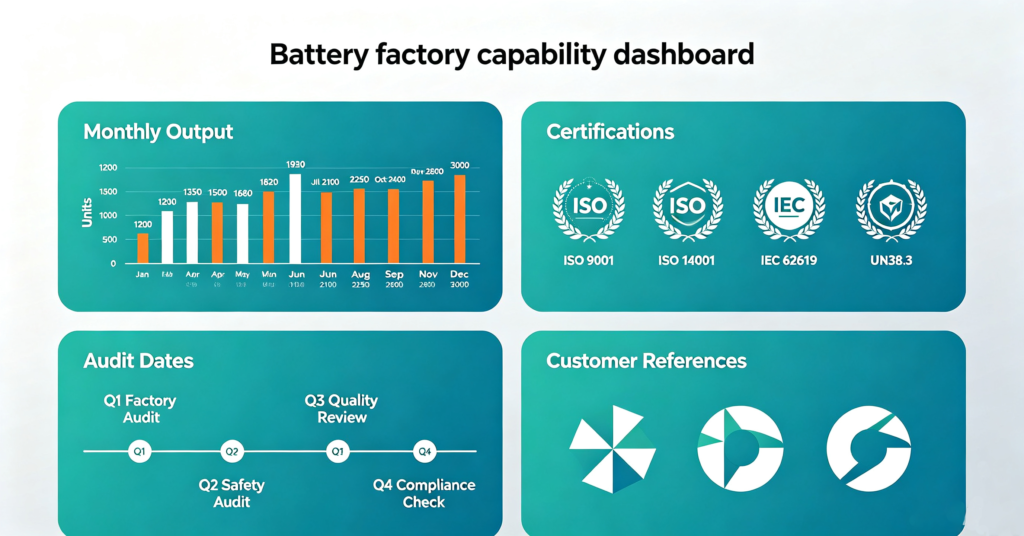
The factory capability table
| Capability | What to ask for | Pass criterion | Why it matters |
|---|---|---|---|
| Cleanroom classification | ISO Class certificate (cell winding area) | ISO Class 7 or better for cells | Upstream contamination control |
| Humidity / temperature control | Documented envelope + on-floor readouts | Dew point ≤ −40 °C in dry rooms; 20–25 °C assembly | Moisture = cell failure; thermal = formation stability |
| Monthly output (cells) | Throughput in MWh or Ah per month | Capacity ≥ 3× your peak monthly order | Capacity buffer against your demand spikes |
| Monthly output (packs) | Pack-level throughput in units per month | Capacity ≥ 3× your peak monthly order | Pack line is the bottleneck, not cells |
| Cell chemistry capability | Confirmed chemistries in production | LFP for stationary; NMC optional for mobility | Cross-contamination between LFP and NMC lines |
| Certifications (cell) | IEC 62619, UL 1973, UN38.3, CE | Current certs, issued in last 24 months | Carrier and customer requirements |
| Certifications (factory) | ISO 9001, ISO 14001, ISO 45001 | Current certs with annual surveillance | Quality / environmental / safety system |
| Traceability | Batch-level tracking from electrode to pack | Visible system, sample traceability audit | Recall scope, warranty enforcement |
| Sample-to-mass workflow | Documented pilot run before mass production | Sample line same as mass line (no separate lab) | Pilot-to-mass drift is a recall cause |
| Customer references | 3+ referenceable customers in your region | References that match your volume / chemistry | Comparable track record is the proof |
| Audit access | On-site or remote video audit available | Audit within 30 days of RFQ | Audit refusal is the strongest negative signal |
Those eleven capabilities are the operational layer of an RFQ. A supplier that answers all eleven with documents rather than verbal promises is one that will survive a customer audit six months after the first PO. The supplier-evaluation methodology is in #21 evaluating battery manufacturers; this page is the operational depth behind each capability.
The factory audit, in person or remote
A serious Chinese lithium battery supplier will accept a factory audit — either an on-site visit by the buyer’s quality team or a live remote video walk-through. The audit checklist is short:
- Cleanroom entry: the airlock, the gowning procedure, the pressure gauges between the cleanroom and the corridor. The pressure differential is what tells you the cleanroom is actually clean.
- Cell winding / stacking line: the operator density per line, the changeover time between SKUs, the visible cleanliness of the electrode handling.
- Formation area: the temperature-controlled aging racks, the capacity grading equipment, the data acquisition system. This is where the cell’s first cycles are recorded and where most latent defects surface.
- Traceability system: ask for a sample traceability exercise — pick a finished pack at random and ask the team to walk you back to the electrode batch. A working system answers in minutes; a paper-based system answers in hours or not at all.
- Quality lab: the capacity tester, the impedance analyser, the abuse-test chamber. The lab’s calibration certificates are what validate the test results.
- Shipping area: the UN38.3 packaging workflow, the carrier coordination, the dangerous-goods documentation. The shipping area is where the factory’s promises meet the carrier’s reality.
- EHS (environment, health, safety): the electrolyte handling, the fire suppression, the personal protective equipment. A serious factory treats these as production tools, not compliance paperwork.
For an OEM or distributor buying their first container from a new Chinese lithium battery supplier, the audit is non-negotiable. For a repeat buyer with a multi-year relationship, the audit moves to annual surveillance — but the first-time audit always happens in person or via live remote video, never on paper alone.
How to structure an RFQ that filters out the weak suppliers
A good RFQ does the filtering for the buyer before the supplier replies. The five sections of a clean RFQ for a Chinese lithium battery supplier:
- Volume and timeline: target monthly volume, pilot run size, mass-production start date, ramp curve. Suppliers without capacity for the peak month should self-select out at this stage.
- Specification envelope: cell chemistry, capacity, voltage, dimensions, BMS handshake, certifications required, warranty length. The envelope is what makes quotes comparable.
- Operational requirements: ISO cleanroom class, traceability depth, audit access, sample-to-mass workflow. The operational requirements are what filter out the trading companies that resell other factories’ cells.
- Commercial terms: Incoterm, payment terms, MOQ, lead time, warranty claim process. The commercial terms are what filter out the suppliers whose prices look attractive but cannot survive the post-PO operational reality.
- Audit and reference: on-site audit window, customer references in the buyer’s region, sample report requirements. The audit section is what filters out the suppliers who will not let the buyer verify the other four sections.
Suppliers that answer all five sections with documents and dates are the shortlist; suppliers that answer one or two and dodge the others are the long-list at best. The full RFQ-to-PO workflow, including the pilot-run validation steps, is in #20 OEM/ODM custom battery pack.
What the cleanroom actually buys you
The cleanroom is the visible sign of an upstream discipline that the buyer rarely sees directly. A cleanroom is expensive to install and expensive to maintain, which means a factory that has invested in one has invested in the upstream process control — electrode moisture, electrolyte purity, cell formation grading — that the cleanroom is designed to protect. A factory without a cleanroom may still produce good cells occasionally; a factory with one produces them consistently, and the buyer’s warranty claim rate is the metric that makes that consistency visible.
For a buyer who is comparing two factories at the same price, the same chemistry and the same capacity, the cleanroom is the tiebreaker. For a buyer who is comparing a cleanroom factory and a non-cleanroom factory at a 5% price difference, the cleanroom factory is almost always the right choice: the 5% buys the warranty-claim-rate difference that compounds over the next ten years. That is the operational case for the higher upfront cost, and the operational case is what the buyer’s CFO needs to see to approve the price premium.
Q. What is a battery cleanroom manufacturer?
A battery cleanroom manufacturer is a lithium battery supplier whose cell production line runs inside a dust-controlled, humidity-controlled, temperature-controlled space — typically ISO Class 7 or better for cell winding and stacking. The cleanroom is the operational signal that the factory invests in upstream process control, which translates to lower field failure rates and lower warranty claim rates for the buyer.
Q. How do I evaluate a Chinese lithium battery supplier?
Use the eleven-capability table above. Ask for ISO cleanroom class certificates, the humidity / temperature envelope, monthly cell and pack output, certifications (IEC 62619, UL 1973, UN38.3, ISO 9001 / 14001), batch-level traceability, sample-to-mass workflow, customer references and audit access. A supplier that answers all eleven with documents is shortlist-worthy; one that dodges any of the eleven is long-list at best.
Q. How many battery manufacturers are there in China?
Industry estimates put the number above 200 for lithium-ion cell producers and several thousand for pack assemblers, but the population that meets the eleven-capability table above is far smaller — typically in the low tens for serious export-grade stationary storage suppliers. The volume of options is not the constraint; the discipline to filter is.
Q. Can I buy lithium batteries direct from a Chinese factory?
Yes for orders above the supplier’s MOQ (typically a 20- or 40-foot container for cell-level orders), and yes for smaller orders through an OEM/distributor partner. Direct purchases skip the distributor margin but require the buyer to handle the certification, freight, customs and after-sales coordination themselves; distributor purchases trade margin for those services.
Q. What certifications should a Chinese lithium battery supplier have?
For cell-level exports: IEC 62619 (industrial cells), UL 1973 (stationary storage, where required), UN38.3 (transport) and CE (Europe). For the factory itself: ISO 9001 (quality), ISO 14001 (environmental), ISO 45001 (occupational health and safety). Current certifications issued within the last 24 months, with annual surveillance reports available.
Next step: request a factory capability pack
The eleven-capability table above is the audit framework; the next step is a capability pack from the supplier — cleanroom certificate, ISO 9001 / 14001 / 45001, IEC 62619 / UN38.3, monthly throughput, customer references and a sample audit window. Send the RFQ and we will return the capability pack within five working days, with an on-site audit slot if you want to verify in person.
- Walk the supplier evaluation methodology in #21 evaluating battery manufacturers
- Walk the OEM/ODM workflow in #20 OEM/ODM custom battery pack
- Walk the order execution steps in #06 solar battery kit
- Request a factory capability pack and an audit slot