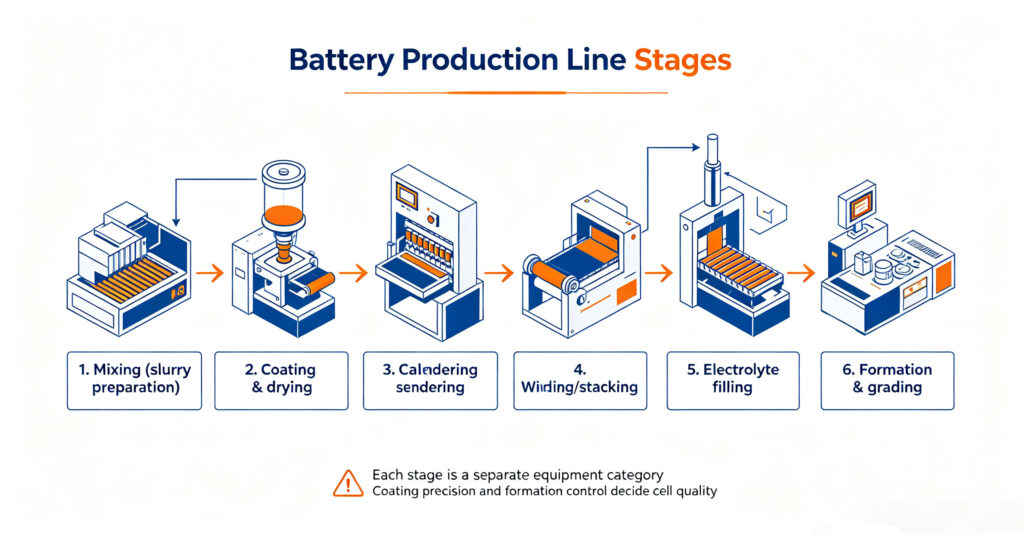
Battery manufacturing equipment refers to the machinery and production lines that turn raw materials (lithium chemicals, copper, aluminum, separators) into finished battery cells and packs. The six core stages are slurry mixing, electrode coating and drying, calendering, winding or stacking, electrolyte filling, and formation/grading. A complete cell line requires all six plus dry-room infrastructure, and the cost ranges from pilot-scale (millions of dollars) to gigawatt-scale factories (hundreds of millions). For a buyer, the key is matching the equipment stage to the product you want to make, and evaluating suppliers on precision, consistency and after-sales support.
Buyers searching battery manufacturing equipment are usually either planning a factory
The equipment market has two segments that buyers often confuse. Cell-making equipment — coaters, winders, formation cyclers — is high-precision, capital-intensive and supplied by a small group of specialized vendors; a commercial cell line is not assembled from off-the-shelf machines. Pack assembly equipment — stacking, busbar welding, BMS testing, cabinet wiring — is more modular and can be scaled up as output grows. A buyer who wants to make finished packs but not cells can start with pack assembly, which is far cheaper and faster, and still control quality on the final product. A buyer who wants to make cells needs the full line plus the process know-how to run it, which is a multi-year learning curve even with the best equipment supplier.
Buyers searching battery manufacturing equipment are usually either planning a factory, evaluating a supplier’s production capability, or researching the industry. This guide covers the stages, the investment range and how to judge equipment suppliers. For the process flow, see #135 how are batteries made.
The reason equipment selection matters is that the same cells built on different lines can behave differently. A coater held to tighter tolerance, a formation cycle tuned to the specific chemistry, and a BMS test that catches early defects all show up in cycle life and warranty returns. A buyer evaluating equipment should ask for sample cells made on the line under consideration, then cycle-test them for a few hundred cycles before committing. This costs weeks but saves months of debugging after installation.
Battery manufacturing equipment: the six core stages
The battery manufacturing equipment market is organized by stage. Each stage has dedicated machine makers, and precision at each stage directly affects cell quality.
| Stage | Equipment | Critical metric |
|---|---|---|
| 1. Mixing | Vacuum mixer, slurry disperser | Slurry consistency, particle size |
| 2. Coating | Slot-die coater, drying oven | Coating weight precision, uniformity |
| 3. Calendering | Roll press | Electrode density, thickness tolerance |
| 4. Winding/stacking | Winder, stacker | Alignment, tension control |
| 5. Electrolyte filling | Filling machine, degassing | Moisture control, accuracy |
| 6. Formation | Formation cycler, grading | First-cycle efficiency, sorting |
For why coating and formation matter for final quality, see #144 high-quality LiFePO4 batteries.
The equipment market has two segments that buyers often confuse. Cell-making equipment — coaters, winders, formation cyclers — is high-precision, capital-intensive and supplied by a small group of specialized vendors; a commercial cell line is not assembled from off-the-shelf machines. Pack assembly equipment — stacking, busbar welding, BMS testing, cabinet wiring — is more modular and can be scaled up as output grows. A buyer who wants to make finished packs but not cells can start with pack assembly, which is far cheaper and faster, and still control quality on the final product. A buyer who wants to make cells needs the full line plus the process know-how to run it, which is a multi-year learning curve even with the best equipment supplier.
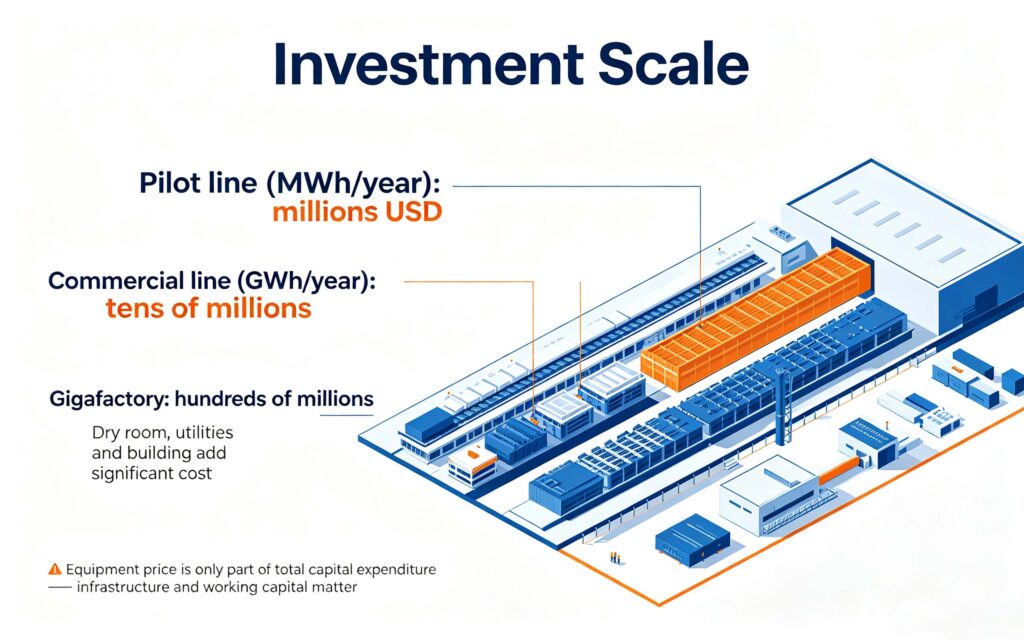
Investment range: what does a line cost?
The cost of battery manufacturing equipment scales with output, and the headline number is only part of the total capital.
Pilot line (MWh/year): a small line for product development or niche production costs in the low millions, with simpler automation.
Commercial line (GWh/year): a full line for commercial cell production costs tens of millions, including dry room, utilities and quality systems.
Gigafactory (multi-GWh): large-scale production runs to hundreds of millions, with fully integrated automation and grading.
Beyond equipment, the dry room (very low humidity), cleanroom, utility power and working capital add substantial cost.
How to evaluate battery manufacturing equipment suppliers
When you compare battery manufacturing equipment suppliers, the machine price is not the deciding factor. Five questions matter.
- Track record: how many lines are running, and at what output consistency?
- Precision specs: coating weight tolerance, alignment accuracy, moisture control numbers.
- Turnkey support: do they install, commission and train, or just deliver machines?
- Spare parts and service: response time and parts availability after handover.
- Process integration: can they tie the stages into a coherent line, or do you stitch vendors yourself?
Q. What equipment is needed to manufacture batteries?
A cell line needs six core stages: slurry mixing, electrode coating and drying, cell assembly (winding/stacking), electrolyte filling, formation (initial charging), and testing. A pack assembly line needs stacking, busbar welding, BMS integration and cabinet wiring. Cell-making is high-precision; pack assembly is more modular.
Q. How much does battery manufacturing equipment cost?
Cost scales with output. A pilot line at MWh-per-year scale costs in the low millions of dollars. A commercial GWh-scale line is a major investment. Pack assembly lines start at a fraction of cell-making lines. Exact pricing depends on automation level, output and whether you make cells or only packs.
Q. What is the most important equipment in battery manufacturing?
Coating and formation decide cell quality most directly. Coating precision determines electrode uniformity and energy density. Formation cycling sets the initial capacity and cycle life. A small coating defect or a wrong formation profile ruins entire batches. These two stages deserve the most supplier attention.
Q. Can I buy battery manufacturing equipment and start a factory?
Technically yes, but a successful factory is not just machines. You need process know-how, a qualified team, a dry room environment, and supply chain for raw materials. Many new factories spend months debugging process parameters after delivery. Start with pack assembly if you are new to the industry.
Q. What should I ask a battery equipment supplier before ordering?
Ask five things: how many similar lines are in production and their output consistency; the precision specs (coating tolerance, formation current accuracy); whether they provide process integration and commissioning; local service and spare parts; and references from operating factories. Machines without process know-how sit unused.
Next step: separate equipment price from total project cost
Battery manufacturing equipment is a capital project, not a purchase order. Get turnkey quotes that include dry room, utilities and training, and evaluate suppliers on track record and process integration before comparing price.
- Review the process in #135
- See quality signals in #144
- Compare cells in #136
- Ask leekooenergy about production capability and cell quality controls, as a reference point for how finished LiFePO4 products should be manufactured