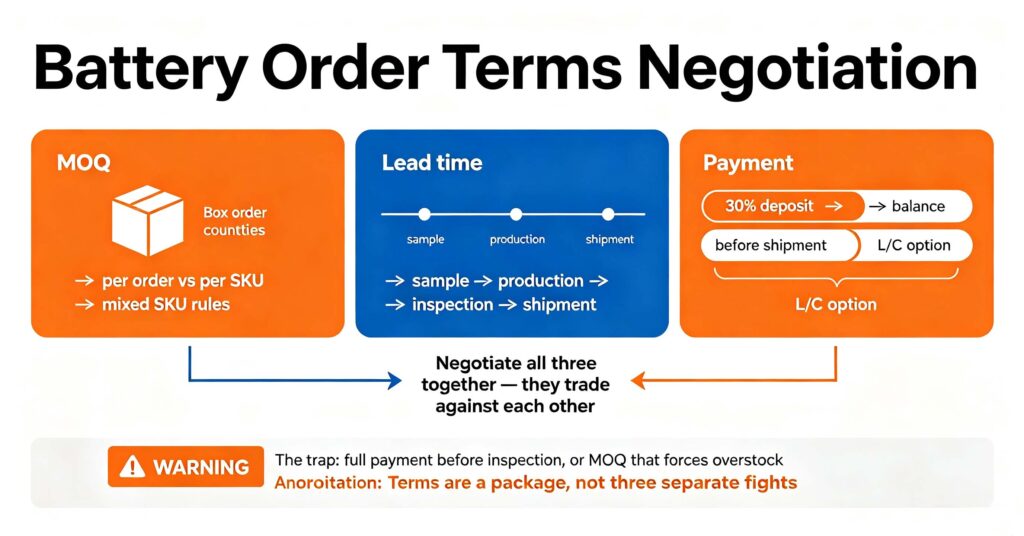
Battery MOQ, lead time, payment terms are the three commercial clauses that decide whether a battery order works for your cash flow and schedule — MOQ is the minimum order quantity a supplier will produce or ship (often quoted per order, sometimes per SKU, and sometimes negotiable when you commit to repeat orders); lead time is the time from order confirmation to shipment, split into standard production time and custom work like BMS settings, labels or certification changes; payment terms are the schedule of money moving — typically a 30% deposit with the balance before shipment, or a letter of credit for large orders, with open account only after a payment history. The three clauses trade against each other: a higher MOQ usually buys a better unit price and sometimes a shorter lead time; a longer lead time may unlock lower deposits; committing to a rolling order schedule can reduce both MOQ and lead time. The classic traps are paying the full balance before any inspection stage, accepting a per-SKU MOQ that forces overstock of slow lines, and treating a verbal lead time as a contract — the discipline is to get all three in writing with the conditions attached, and to negotiate them as a package, not three separate fights.
Buyers who treat battery MOQ, lead time, payment terms as fixed are leaving money and risk on the table. This guide breaks down each clause, how they trade against each other, and the traps that cost buyers most. For evaluating the supplier before the negotiation, see #21 how to evaluate battery manufacturers.
Battery MOQ, lead time, payment terms: the three clauses that decide an order
The MOQ is rarely a single number. The professional question is what it applies to.
Per order vs per SKU: a MOQ quoted per order lets you mix SKUs to reach the quantity; a per-SKU MOQ means each model must hit the minimum separately. Per-SKU MOQs force overstock of slow lines — a common trap for distributors.
What counts: confirm whether accessories, spare BMS units or packaging count toward the MOQ, and whether a repeat-order commitment can lower it. Many suppliers trade a lower MOQ for a purchase schedule.
What changes MOQ: standard packs have the lowest MOQ; custom BMS settings, custom labels, new certifications or private-label branding raise it. The MOQ discussion should be split into “standard SKU MOQ” and “customisation MOQ”, because they behave differently. For the private-label angle, see #117 lithium ion battery wholesale models.
Lead time: the number that hides in the schedule
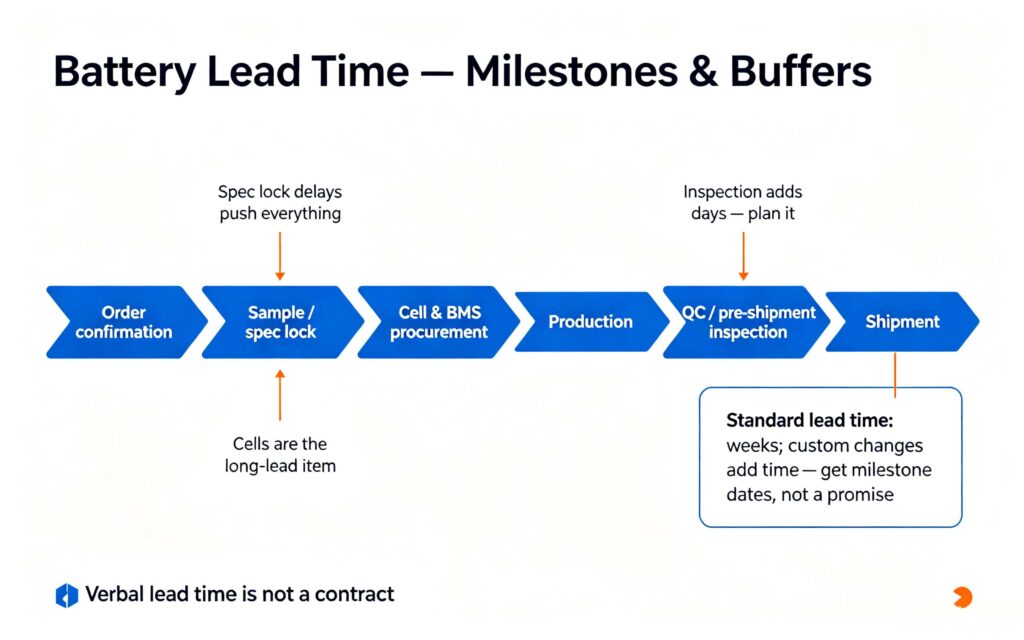
Battery MOQ, lead time, payment terms behave differently, and lead time looks simple and is not. The professional split is standard vs custom, and inside each, the milestones that actually drive the date.
Standard lead time applies to SKUs the supplier produces regularly — cells and BMS are in stock, the pack design is proven. It is usually quoted in weeks and includes production plus QC.
Custom lead time adds everything new: BMS settings, labels, packaging, certification changes. Each addition has its own duration, and certification work is often the longest. A “custom pack” order can take materially longer than the standard quote, which is why the lead time must be split at the quote stage, not discovered after the order.
Milestones, not a promise: ask for the dates of spec lock, production start, inspection and shipment. The cell supply is usually the long-lead item, so orders placed when cells are scarce need the most buffer. Get the lead time in the contract with a penalty or at least an agreed notification duty — and plan your own buffer on top, because batteries move on schedules, not wishes.
Payment terms: the structure that protects both sides
Payment terms are where trust is built or lost, and the professional structure of battery MOQ, lead time, payment terms protects the buyer without insulting the supplier., and the professional structure protects the buyer without insulting the supplier.
The common structure: a deposit (often 30%) to start production, with the balance due before shipment, or a letter of credit for larger orders. Some suppliers offer open account after a payment history; new buyers should not expect it.
The inspection gate: the balance payment should come after the pre-shipment inspection, not before it. A supplier who demands full payment before any QC gate is the classic risk pattern — this is where problems often start.
What to negotiate: the deposit percentage (some suppliers accept 20-30% for repeat customers), the balance timing (before shipment vs after loading), and the payment method fees (T/T, L/C, and who pays the bank charges). The negotiation is a package: a higher deposit may buy a better price; a longer payment window costs the supplier money and usually raises price.
For the certification documents that should accompany the payment milestone, see #107 battery export certification explained.
Negotiating the three as a package
The mistake is negotiating battery MOQ, lead time, payment terms as three separate fights. They trade against each other, and the package is where the value is.
| Trade | What you give | What you get |
|---|---|---|
| Volume for price & lead time | Higher MOQ / schedule commitment | Better unit price, shorter lead time |
| Deposit for terms | Higher deposit | Better price or priority production slot |
| Flexibility for commitment | Rolling order schedule | Lower MOQ, guaranteed allocation |
The professional sequence: know your own numbers first — realistic order volume, acceptable lead time, cash position for deposits — then negotiate battery MOQ, lead time, payment terms as the package, not the individual clause. Suppliers respond to buyers who bring volume and a schedule, and they give better terms to those who negotiate like partners rather than adversaries.
Order checklist before you sign
Before committing, run this checklist so the terms you negotiated are the terms you receive.
- MOQ in writing: per order or per SKU, and what counts toward it.
- Lead time in milestones: spec lock, production start, inspection, shipment — with the custom-work adders identified.
- Payment schedule with the inspection gate: deposit, inspection, balance — in that order.
- Specifications attached: the datasheet, BMS settings, labels and certifications referenced in the order.
- Warranty and return terms: defect definition, return window, freight responsibility.
- Force majeure and change rules: what happens if specs change mid-production or delivery slips.
For the supplier evaluation that should precede this checklist, see #21 how to evaluate battery manufacturers again.
Q. What is a typical battery MOQ?
It depends on the product: standard lithium packs often have a moderate MOQ per order, while custom BMS settings, labels or certification changes raise it. The key question is whether the MOQ is per order or per SKU, and whether a repeat-order commitment can lower it. Per-SKU MOQs force overstock of slow lines.
Q. How long does a battery production lead time take?
Standard SKUs are typically quoted in weeks from order confirmation to shipment, covering production and QC. Custom work — new BMS settings, labels, certifications — adds time, and certification is often the longest item. Ask for milestone dates (spec lock, production start, inspection, shipment) rather than accepting a single promise.
Q. What payment terms are normal for battery orders?
The common structure is a deposit, often 30%, to start production, with the balance before shipment, or a letter of credit for large orders. Open account comes only after a payment history. The important protection is that the balance payment follows the inspection gate, not precedes it.
Q. Can I negotiate a lower MOQ?
Often yes, in exchange for something the supplier values: a rolling order schedule, a longer-term commitment, or a higher deposit. The trade is package negotiation — MOQ, lead time and payment terms move together. A supplier who refuses any flexibility on a first order may still trade for a volume commitment.
Q. What is the biggest trap in battery order terms?
The classic trap is paying the full balance before any inspection stage — once the money moves, leverage is gone. Others include accepting a per-SKU MOQ that forces overstock, treating a verbal lead time as a contract, and skipping the specification attachment so the delivered product differs from the quoted one. Get all terms in writing with conditions attached.
Next step: negotiate the package, not the clause
Battery MOQ, lead time and payment terms are a package that trades against itself: volume buys price and schedule, deposits buy priority, commitment buys flexibility. Know your numbers, negotiate the package, and put every condition in writing before the first deposit moves.
- Evaluate the supplier first with #21
- Attach the right certifications with #107
- Choose the wholesale model in #117
- Ask leekooenergy for a written order package: MOQ per order and per SKU, lead time split into standard and custom milestones, a payment schedule with the inspection gate, and the specification attachments — so the terms you negotiate are the terms you receive