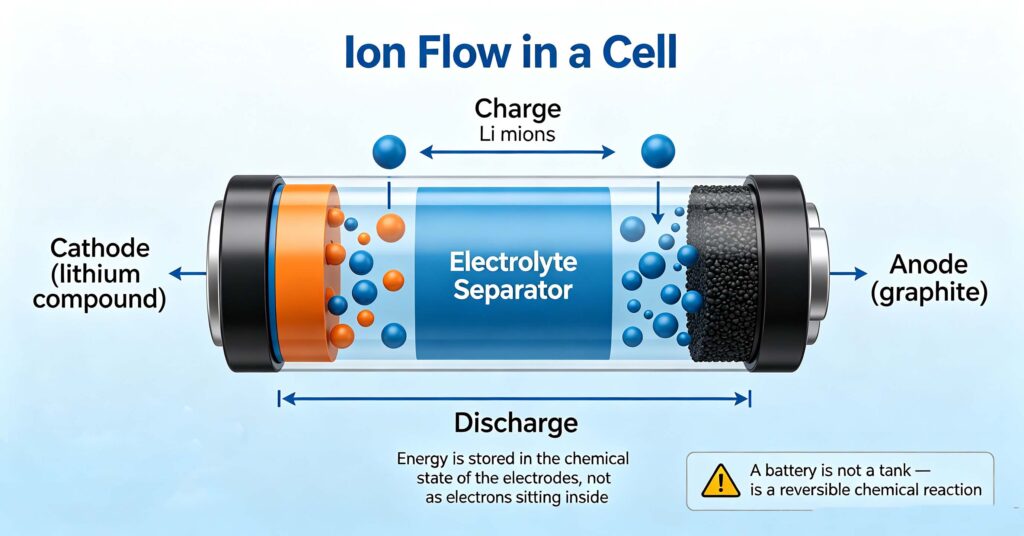
How do batteries store electricity? They do not store electricity like a tank stores water. A battery stores energy chemically: in a lithium-ion cell, lithium ions are held in the structure of the cathode (the positive electrode) when the battery is discharged. During charging, the ions move through the electrolyte to the anode (the negative electrode), where they are stored. During discharging, the ions move back from the anode to the cathode, and the electron flow that accompanies this movement powers your devices. The energy is in the chemical state of the electrodes, and the battery works by reversibly moving ions between them through the separator and electrolyte.
For someone new to energy storage, how batteries store electricity is the first question, and the answer is simpler than the terminology suggests. This guide explains the process in plain language and connects it to how real systems work. For the system-level definition of BESS, see #55 BESS definition and full form.
How do batteries store electricity: the four cell parts that make it work
The question how do batteries store electricity starts with the four components inside every rechargeable cell. Each has a specific role in the ion movement.
Cathode (positive electrode): the lithium compound (lithium iron phosphate in LiFePO4, lithium nickel manganese cobalt in NMC) that holds lithium ions in its structure. It determines the cell’s voltage and capacity.
Anode (negative electrode): typically graphite, which stores lithium ions during charging. The ions occupy spaces between the graphite layers.
Electrolyte: a liquid or gel that lithium ions move through between the electrodes. It must conduct ions but not electrons, so electrons flow through the external circuit instead.
Separator: a thin porous membrane that keeps the electrodes from touching (which would short-circuit) while letting ions pass through.
For the detailed internal structure, see #63 what is inside a lithium-ion battery.
Charging: how energy goes into storage
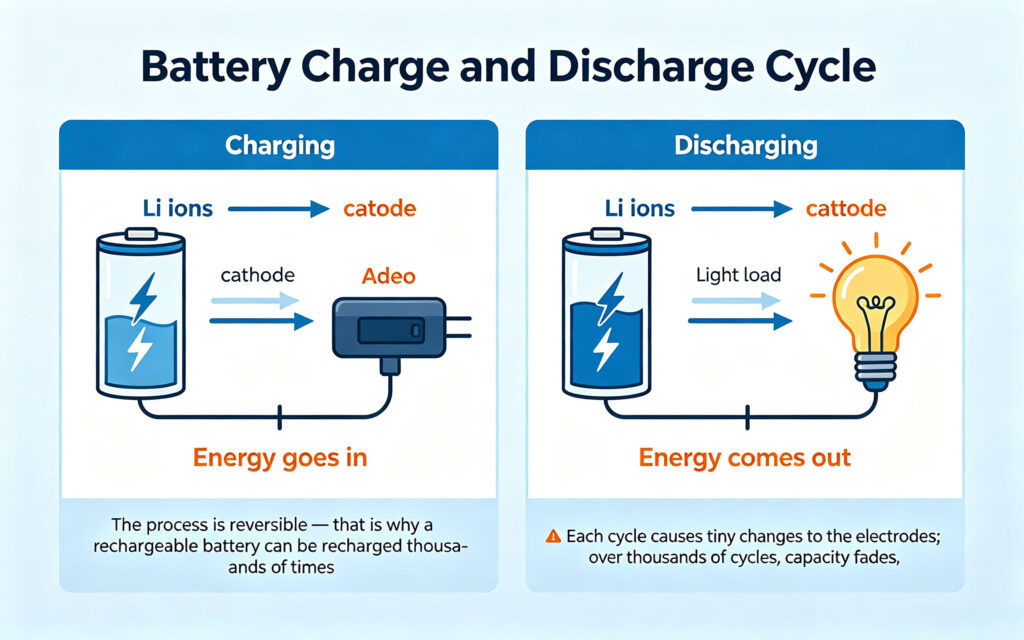
When you plug in a charger, the process that answers how do batteries store electricity begins. The charger forces ions to move from the cathode to the anode.
- The charger applies a voltage higher than the cell’s open-circuit voltage, which drives the reaction.
- Lithium ions leave the cathode structure and move through the electrolyte toward the anode.
- The ions insert themselves into the graphite layers of the anode.
- Electrons flow through the external circuit from cathode to anode to balance the charge.
The battery is now “charged”: the ions are stored in the anode, and the energy is in this chemical state. The capacity of the battery is how many such ions the electrodes can hold. For how charging behavior works in home systems, see #105 how home battery charging works.
Discharging: how stored energy comes out
When you connect a load — a light, an inverter, a motor — the reverse happens. The process answers how do batteries store electricity in the discharge direction and powers the device.
- The load creates a circuit between the two electrodes.
- Lithium ions move back from the anode through the electrolyte to the cathode.
- Electrons flow through the external circuit from anode to cathode, powering the load as they go.
- When the ions return to the cathode, the battery is “discharged”.
This back-and-forth movement is reversible, which is why rechargeable batteries can be recharged. It is not perfectly efficient — some energy is lost as heat each cycle, and the electrodes change slightly over thousands of cycles, which is why capacity fades over time. For the chemistry that underpins this, see #01 lithium iron phosphate batteries guide.
Q. Where exactly is energy stored in a battery?
Energy is stored in the chemical state of the electrodes, not as electrons sitting inside a tank. In a lithium-ion cell, lithium ions are held in the structure of the positive electrode (cathode) when discharged, and move to the negative electrode (anode) during charging. The energy is in this reversible chemical arrangement; releasing it means moving the ions back, which creates the electron flow that powers devices.
Q. How does a lithium-ion battery store energy chemically?
A lithium-ion battery stores energy by reversibly moving lithium ions between two electrode materials. During charging, ions move from the cathode (a lithium compound) through the electrolyte to the anode (graphite), where they insert into the layered structure. During discharging, they move back. The electrons that accompany this movement flow through the external circuit and power devices. The capacity is determined by how many ions the electrodes can hold.
Q. Why can’t you store electricity directly in a battery?
Because a battery is an electrochemical device, not an electrical tank. Electricity is the flow of electrons, and storing that flow directly is the job of capacitors, which hold only tiny amounts of energy. Batteries store energy in chemical form, which allows much larger storage, and convert it to electrical energy through the controlled movement of ions and electrons. The conversion is what makes the battery useful and rechargeable.
Q. What is the difference between a battery and a battery cell?
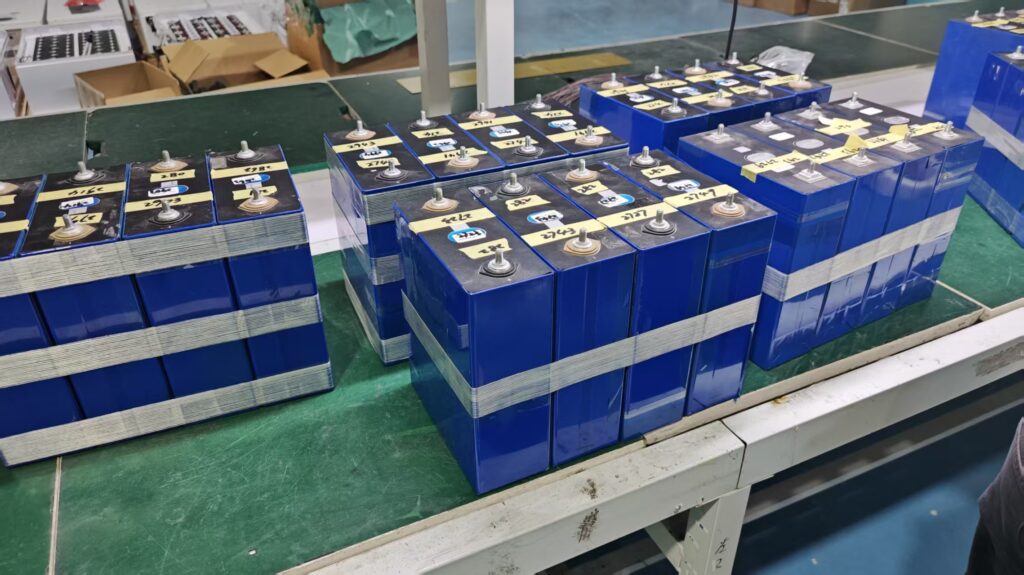
A battery cell is the basic electrochemical unit — a single cathode, anode, electrolyte and separator sealed in a can or pouch. A battery is a collection of cells connected in series and parallel to achieve the desired voltage and capacity, with a BMS and enclosure. The cell is where the chemistry happens; the battery pack is the engineered system that delivers safe, usable power. “Battery” is often used loosely for both.
Q. Does charging and discharging wear out the battery?
Yes, gradually. Each charge-discharge cycle causes tiny physical and chemical changes to the electrodes: the anode structure degrades slightly, the cathode loses some active material, and the electrolyte ages. Over thousands of cycles, these changes reduce the number of ions the electrodes can hold, which shows up as lower capacity. LiFePO4 cells are designed for 4,000–8,000 cycles before reaching 80% capacity; how fast you reach that point depends on depth of discharge, temperature and charging habits.
Next step: understand the chemistry behind the system
Knowing how batteries store electricity turns a black box into an understandable system: ions move between electrodes, energy is in the chemical state, and every cycle causes gradual wear. This understanding helps buyers ask better questions and make better-informed choices.
- See the system definition in #55
- Look inside the cell in #63
- Learn LiFePO4 chemistry in #01
- Ask leekooenergy for a storage system backed by cells whose chemistry and cycle life match your use case, with the BMS configured to protect the electrodes over the long term