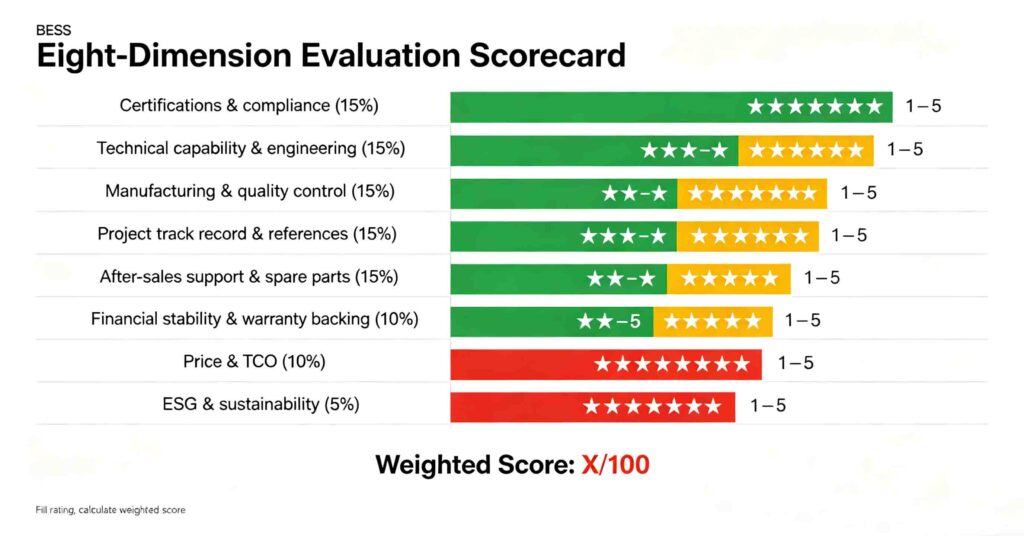
Choosing an energy storage integrator or battery storage supplier is a procurement decision that determines whether your BESS project delivers the expected performance, warranty support and total cost of ownership — or becomes a multi-year dispute over underperforming equipment and unresponsive after-sales. The selection process should evaluate eight dimensions: certifications and standards compliance, manufacturing capability and capacity, reference projects and track record, financial stability, technical support and engineering capability, after-sales service and warranty terms, quality control processes, and supply chain resilience. A supplier that scores well on all eight dimensions is more likely to deliver a system that performs as specified and remains supported throughout its 10–15 year operating life. The most common procurement mistake is selecting on price alone — a 10% upfront saving can be erased by a single unplanned service visit or a warranty claim that is denied because the supplier has gone out of business.
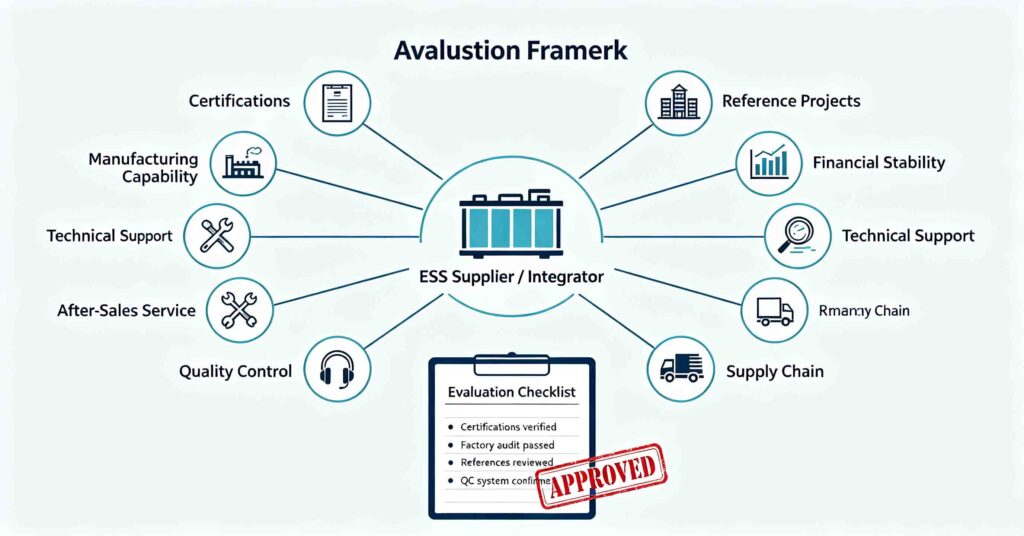
The energy storage market has grown rapidly, and the number of companies offering BESS equipment, integration and EPC services has grown with it. Not all of these companies are equal. Some are vertically integrated manufacturers with their own cell production, battery pack assembly, BMS development and system integration capability. Others are resellers that brand equipment manufactured by a third party. Still others are project integrators that design and build systems using components sourced from multiple suppliers. Each type has its own strengths and weaknesses, and the right choice depends on the project’s size, complexity, technical requirements and the buyer’s in-house capability. This guide explains how to evaluate and select an energy storage integrator or supplier, what questions to ask during the RFI/RFQ process, and what red flags should cause a buyer to walk away.
Integrator, supplier, manufacturer and EPC: understanding the differences
Before evaluating candidates, it is important to understand what type of company you are dealing with, because the evaluation criteria and the risk profile differ.
- Manufacturer. A company that designs and produces the battery cells, packs or systems in its own factory. Manufacturers typically offer the deepest technical support, the most direct warranty relationship, and the greatest ability to customise. However, not all manufacturers offer turnkey system integration — some only sell components.
- Integrator (or system integrator). A company that designs and assembles complete energy storage systems using components (cells, BMS, inverter, thermal management, enclosure) sourced from one or more manufacturers. Integrators add value through system design, component selection, integration testing, and project management. They may or may not manufacture any components themselves.
- Supplier / distributor / reseller. A company that sells energy storage equipment manufactured by others, often with branding or basic configuration. Suppliers typically offer the lowest technical depth and the weakest warranty relationship (the warranty is with the manufacturer, not the supplier), but they may offer competitive pricing and local inventory.
- EPC contractor (Engineering, Procurement, Construction). A company that provides turnkey project delivery: engineering design, equipment procurement, civil works, installation, commissioning and handover. EPCs may subcontract the equipment supply to a manufacturer or integrator. For large projects, the EPC is the primary contractor and the equipment supplier is a subcontractor.
For most B2B buyers, the ideal partner is either a manufacturer that also offers system integration (vertically integrated) or a system integrator with a strong track record and direct relationships with reputable component manufacturers. Pure resellers should be approached with caution unless they offer significant local support, inventory or pricing advantages that justify the additional layer in the warranty chain.
Eight dimensions for evaluating an energy storage integrator or supplier
| Dimension | What to evaluate | Why it matters |
|---|---|---|
| 1. Certifications & standards | UL 9540, UL 9540A, IEC 62619, IEC 62933, UN 38.3, CE, ISO 9001 (quality), ISO 14001 (environment), ISO 45001 (safety). Verify certificates are current and cover the exact model being quoted. | Certifications demonstrate that the product has been independently tested and meets safety and performance standards. A supplier without the required certifications may not be able to connect the system to the grid or obtain insurance. |
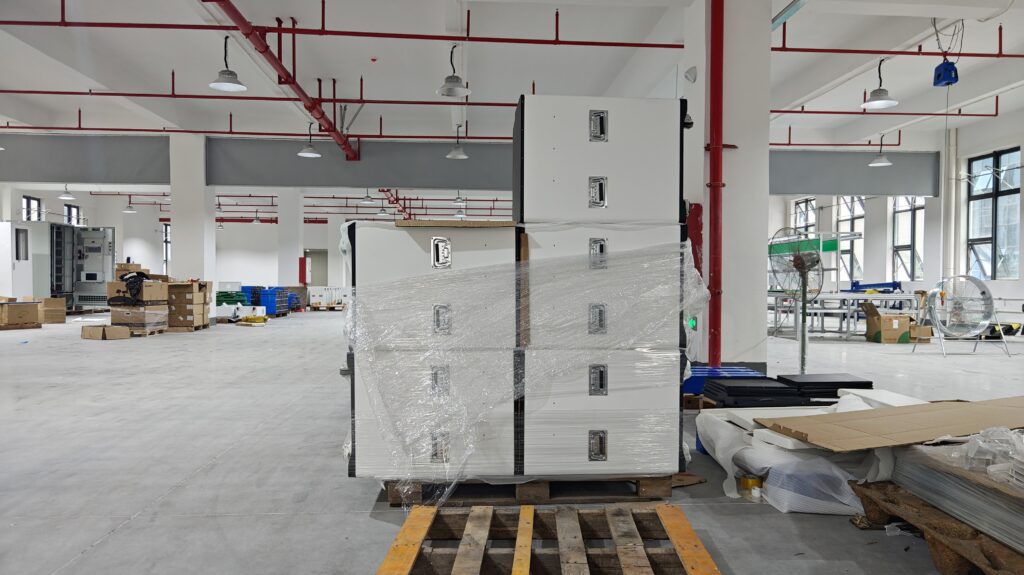
| 2. Manufacturing capability | Factory ownership (own vs contract), annual production capacity (GWh/year), production line automation, cell sourcing (in-house vs purchased), quality control equipment (cyclers, environmental chambers, X-ray), and factory audit reports. | A supplier’s manufacturing capability determines its ability to deliver on time, maintain consistent quality, and scale for large orders. A supplier that outsources all manufacturing has less control over quality and lead times. |
| 3. Reference projects & track record | Number of installed systems, total installed capacity (MWh), project types (residential, C&I, utility), project locations, years in operation, and reference contact details. Prioritise references that match your project type, size and environment. | A supplier with a long list of installed systems that are actually operating (not just “sold”) has demonstrated that its products work in the field. Request references that you can contact directly — not just logos on a website. |
| 4. Financial stability | Company age, revenue trend, profitability, debt level, credit rating (if available), major investors or parent company, and bankruptcy or restructuring history. Request audited financial statements for the past 2–3 years. | A 10-year warranty is only as good as the company that backs it. If the supplier goes out of business, the warranty becomes worthless and spare parts may become unavailable. Financial stability is especially important for long-lifespan assets like BESS. |
| 5. Technical support & engineering | Size and qualifications of the engineering team, system design capability (sizing, simulation, integration), BMS customisation, communication protocol support (Modbus, CAN, RS485, Ethernet), response time for technical queries, and availability of local technical support. | BESS projects often require custom engineering: system sizing, integration with existing equipment, communication protocol mapping, and troubleshooting during commissioning. A supplier with weak technical support will cause delays and may deliver a system that does not perform as expected. |
| 6. After-sales service & warranty | Warranty duration (years or cycles), warranty coverage (parts, labour, travel, on-site service), response time for service requests, availability of spare parts, firmware/software update policy, and existence of a local service partner or office. | A BESS system operates for 10–15 years. During that time, components will fail, firmware will need updating, and performance may degrade. A supplier that does not provide responsive after-sales support will leave the buyer to manage failures independently, at significant cost. |
| 7. Quality control processes | Incoming material inspection (cell testing, BMS testing), in-process quality checks, finished product testing (capacity test, cycle test, safety test), traceability (batch tracking, serial numbering), defect rate, and corrective action process. Request quality control records or a factory audit report. | Consistent quality is the difference between a system that performs to specification for 10 years and one that experiences premature failures. A supplier with rigorous quality control processes will have lower defect rates and fewer field failures. |
| 8. Supply chain resilience | Cell sourcing (multiple suppliers vs single source), component inventory levels, lead times for key components, geographic diversification of suppliers, and contingency plans for supply disruptions. | The energy storage industry has experienced significant supply chain disruptions (cell shortages, shipping delays, price volatility). A supplier with a resilient supply chain is more likely to deliver on time and at the quoted price, even when market conditions are difficult. |
RFI/RFQ questions every buyer should ask
When issuing a Request for Information (RFI) or Request for Quotation (RFQ), include the following questions to ensure that proposals are comparable and that critical information is not omitted: For manufacturer-specific evaluation criteria, see #21 how to evaluate battery manufacturers.
- Provide the exact model number, configuration and specifications of the system being quoted, including cell chemistry, cell manufacturer, BMS manufacturer, inverter/PCS manufacturer, and thermal management type.
- Provide copies of all current certifications (UL 9540, UL 9540A, IEC 62619, etc.) and confirm that they cover the exact model being quoted.
- Provide a list of at least three reference projects of similar type, size and environment, including contact details for the owner/operator.
- Provide audited financial statements for the past two fiscal years, or a letter from a recognised financial institution confirming creditworthiness.
- Describe the warranty terms in detail: duration, coverage (parts/labour/travel), claim process, response time, and exclusions.
- Describe the after-sales service organisation: location of service centres, number of service technicians, average response time, and availability of spare parts (including end-of-production support).
- Provide the expected lead time from order to delivery, and the penalty for late delivery.
- Describe the factory acceptance test (FAT) and site acceptance test (SAT) procedures, including what tests are performed, what pass/fail criteria apply, and whether the buyer can witness the FAT.
- Provide the system’s expected round-trip efficiency (AC-AC) at the specified operating conditions, and the degradation rate (capacity fade) per year/cycle.
- Describe the communication protocols supported (Modbus TCP/RTU, CAN, RS485, Ethernet/IP, DNP3) and whether the system can integrate with the buyer’s existing SCADA/BMS/EMS.
- Provide the operating temperature range (charge and discharge), and any derating that applies outside the optimal range.
- Describe the cybersecurity measures: secure boot, encrypted communication, authentication, firmware update security, and compliance with any applicable cybersecurity standards.
- Provide the total cost of ownership estimate, including upfront cost, installation cost, annual maintenance cost, expected replacement parts cost, and end-of-life recycling cost.
- Describe the end-of-life and recycling programme: whether the supplier will take back the system at end of life, whether recycling is included in the purchase price, and what recycling certifications the recycler holds.
- Confirm that the supplier carries product liability insurance and professional indemnity insurance, and provide the coverage limits.
Red flags: when to walk away from a supplier
Certain behaviours and responses during the evaluation process should cause a buyer to seriously reconsider a supplier, or walk away entirely:
- Refusal to provide references or financial statements. A legitimate supplier with a solid track record will have no difficulty providing references and financial information. Refusal is a sign that the track record or financial position is weaker than claimed.
- Certifications that cannot be verified or do not match the quoted model. A supplier that provides a UL certificate for a different model, or an expired certificate, is either careless or deliberately misleading. Either way, it is a risk.
- Unrealistically low price. If a supplier’s quote is 20–30% below the market average, the price advantage is likely achieved by cutting corners on component quality, manufacturing quality, or after-sales support. The total cost of ownership will be higher, not lower.
- Vague or incomplete warranty terms. A warranty that says “10-year warranty” without defining what is covered, what is excluded, how claims are processed, or what the remedy is (repair, replacement, refund) is not a warranty — it is a marketing claim.
- No local service presence or partner. For projects in regions where the supplier has no office, service centre or authorised partner, service response times will be long and expensive. A supplier that cannot explain how it will provide on-site service in your region is not ready to support your project.
- Pressure to sign quickly or “take it or leave it” pricing. A supplier that pressures you to sign a contract without adequate time for evaluation, or that refuses to negotiate key terms, is demonstrating a lack of confidence in its own offering or a disregard for the buyer’s due diligence process.
- Inability to explain the BMS, cell sourcing or system architecture. If the supplier’s technical representative cannot clearly explain where the cells come from, how the BMS works, or how the system is architected, it suggests that the supplier is a reseller with limited technical depth — and that you will be dealing with the actual manufacturer for any technical issues, through an intermediary.
Q.What is the difference between an energy storage integrator and a battery manufacturer?
A battery manufacturer designs and produces battery cells, modules, and packs (e.g., CATL, BYD, EVE). An energy storage integrator assembles complete systems by combining batteries from one or more manufacturers with inverters, BMS, EMS, thermal management, enclosures, and controls. Integrators handle system design, component sourcing, integration testing, commissioning, and after-sales support. Some large manufacturers also offer integrated systems, but a pure integrator provides multi-vendor flexibility and system-level expertise. For buyers, integrators are typically the primary point of contact for the complete system.
Q.How do I verify that a supplier’s certifications are valid?
Request the actual certificate documents and verify them directly with the certifying body (UL, TUV, IEC, CSA). Check the certificate number on the issuer’s online database, confirm the certificate covers your specific product model and configuration, and verify it has not expired or been withdrawn. For UL 9540/9540A, check the UL Online Certifications Directory. Also request test reports and confirm the testing was done by an accredited third-party lab, not self-certified. Be wary of suppliers that only provide ‘certificate copies’ without verifiable numbers.
Q.What warranty terms should I expect for a BESS system?
A standard BESS warranty covers 10 years or 6,000–10,000 cycles (whichever comes first), with a capacity guarantee of 70–80% of rated capacity at end of warranty. Key terms to check: (1) Does it cover the complete system or just batteries? (2) What is the capacity degradation guarantee? (3) Is it pro-rata or full replacement? (4) What is the response time for service? (5) Are spare parts guaranteed for the warranty period? (6) Does the warranty require manufacturer-approved maintenance? Avoid warranties shorter than 5 years or with vague capacity terms.
Q.How important is local after-sales support for a BESS system?
Critical. A BESS is a complex electromechanical system that will require firmware updates, component replacement, troubleshooting, and periodic maintenance over its 10–15 year life. A supplier with local support (in-country or in-region technicians, spare parts inventory, local phone/email support) can resolve issues in hours or days; a supplier without local support may take weeks or months, during which your system is offline or degraded. For commercial and utility-scale systems, downtime costs money. Evaluate: local technician availability, spare parts depot location, response time SLAs, and whether support is in-house or subcontracted.
Q.Should I choose the lowest-priced BESS supplier?
No — the lowest upfront price often leads to the highest total cost of ownership. Cheap systems may use lower-grade cells (shorter life, higher degradation), skip UL 9540A testing (fire risk, insurance problems), use generic BMS/EMS (poor performance, no updates), provide weak warranties, and lack after-sales support. A system that costs 20% less upfront but fails after 5 years (vs 10–15) and has poor support will cost far more over its life. Focus on total cost of ownership, certified safety, track record, and support capability. Price should be one factor among many, not the deciding one.
Next step: run a structured supplier evaluation before you issue the PO
The cost of choosing the wrong energy storage integrator or supplier is not just the price difference — it is the cost of underperformance, warranty disputes, downtime, and the risk that the supplier is no longer in business when you need support. A structured evaluation process that covers all eight dimensions, asks the right RFI questions, and watches for red flags will reduce these risks and increase the probability that your BESS project delivers the expected performance and total cost of ownership.
- Read the battery manufacturer evaluation guide in #21 how to evaluate battery manufacturers
- Review the EPC contractor selection in #66 BESS EPC contractor
- Understand the OEM/ODM custom process in #20 custom battery pack OEM/ODM
- Ask leekooenergy for a supplier evaluation response package that includes: our UL 9540 / UL 9540A / IEC 62619 certificates (covering the exact model you are evaluating), our reference project list with contact details (including projects of similar type, size and environment), our audited financial statements for the past two years, our warranty terms (10-year / 6,000+ cycle, capacity guarantee, claim process, exclusions), our after-sales service organisation (service centre locations, technician count, response time, spare parts inventory), our quality control process documentation, and our supply chain resilience plan — so you can evaluate us against the same eight-dimensional framework you would apply to any other supplier