A van lifter swaps a 22 kg lead-acid box for a 9 kg LiFePO4 unit and frees a drawer for food. The trip did not change. The weight did.
Lightweight solar batteries are compact rechargeable packs — most often LiFePO4 — that store roughly 0.3 to 2 kWh in a unit weighing 5 to 25 kg, frequently with a built-in inverter. They run phones, laptops, fridges and small appliances away from the grid: camping, RVs, boats, market stalls and short home outages. The deciding factor is not the word “portable” on the box, but how many watt-hours sit in each kilogram.
What “lightweight” actually measures
Energy density is watt-hours per kilogram (Wh/kg). A LiFePO4 cell delivers about 90–160 Wh/kg; a finished pack with BMS, case and ports lands near 80–130 Wh/kg. That math puts a 1 kWh pack at roughly 8–13 kg. When a listing says “portable,” check the kilograms per kWh, not the marketing photo. A 25 kg “portable” unit only makes sense if you roll it, not carry it.
This single ratio explains most buyer regret. Two packs can both claim “lightweight” while one carries twice the energy per kilogram. The number on the spec sheet that predicts real-world convenience is energy density — and almost no consumer ad leads with it.
Where a lightweight pack earns its place
- Camping and backpacking — a 0.3–0.5 kWh pack keeps lights, a phone and a small cooler alive for a weekend, and you barely notice it in the bag.
- RVs and vans — 1–2 kWh covers lighting, a 12V fridge and device charging without a second house battery dragging down payload.
- Boats and market stalls — sealed, vibration-tolerant packs beat flooded lead-acid, which leaks and hates angles.
- Home emergency — a 1–2 kWh unit bridges a few hours of an outage for routers, medical devices and lights.
- Trade shows and field work — reps carry demo power instead of hunting for sockets.
The pattern is consistent: these are situations where someone has to lift, carry or stow the battery. If it never moves, weight stops mattering and a wall-mounted home unit wins instead.
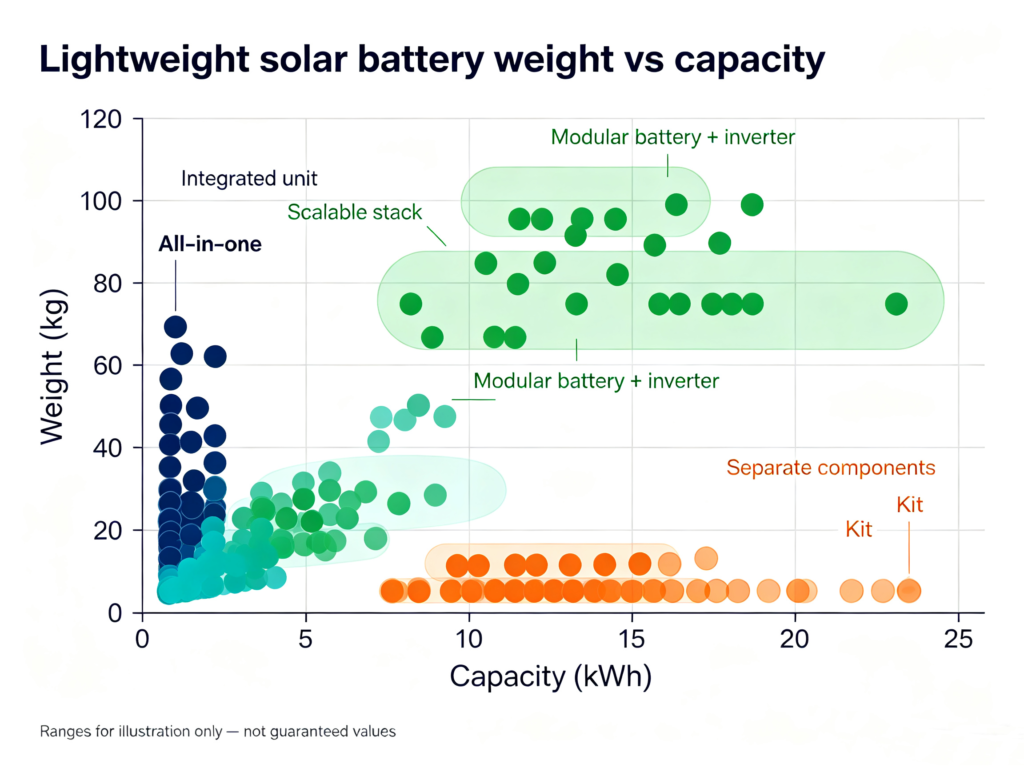
Three form factors compared
| Form factor | Capacity | Weight | Built-in inverter | Best for | Price band* |
|---|---|---|---|---|---|
| All-in-one portable power station | 0.3–2 kWh | 3–25 kg | Yes | Plug-and-play camping / RV | Standard–Premium |
| LiFePO4 battery + separate inverter | 0.5–5 kWh | 5–30 kg | No | Flexible DIY / expandable | Budget–Standard |
| Lightweight solar generator kit | 0.2–1 kWh | 2–12 kg | Yes (small) | Beginners / gift | Budget–Standard |
How to choose the right one
- Match capacity to load, not to dreams. List what you must run, add their watts, and size for the hours you need. A phone-and-light weekend is not a fridge-and-kettle week.
- Weigh your carry limit. If you hike it in, sub-5 kg matters more than extra kWh you will leave in the car.
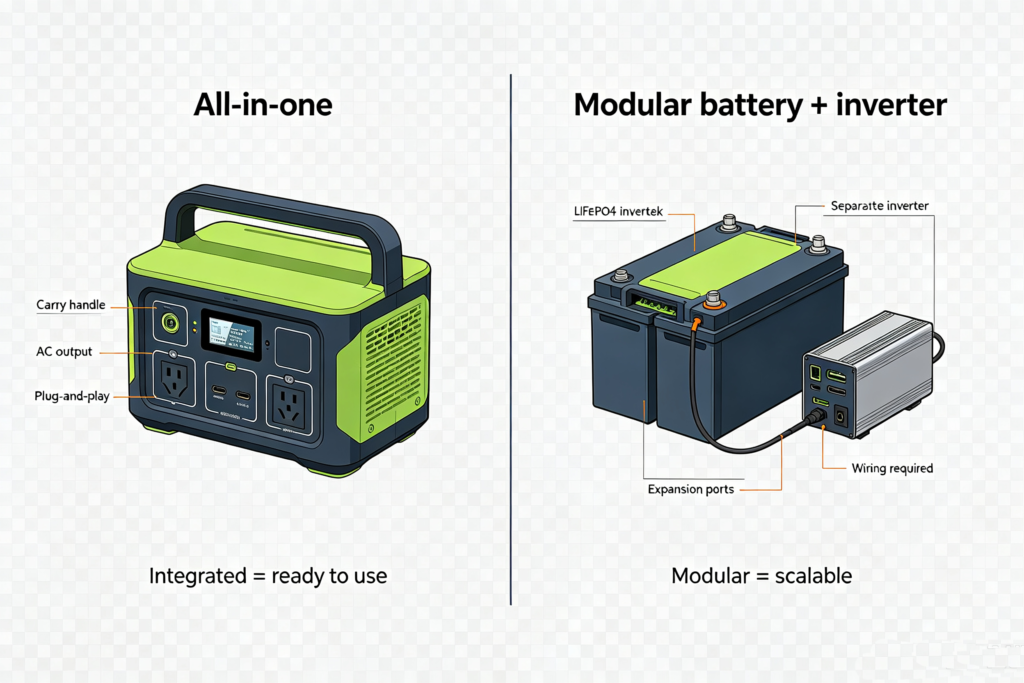
- Built-in inverter or modular? All-in-one trades flexibility for convenience; modular scales and repairs more easily but needs wiring.
- Cycle life and depth of discharge. LiFePO4 typically survives far more cycles than NMC at the same price point — check the rated cycles at 80% DoD.
- Ports you actually use. USB-C PD, 12V cigar, pure-sine AC — match the devices, not the brochure.
- Certification for your market. UL 2743 (portable), UN 38.3 (transport), IEC 62133 — required, not optional, for resale.
Built-in inverter or separate?
An all-in-one station trades flexibility for convenience. A modular LiFePO4 pack plus a separate inverter weighs a little more and asks for wiring, but scales and repairs more easily. For a one-bag camping trip, built-in wins. For a van you keep rebuilding, modular wins. The harder question is what you will power in year two — and a stationary inverter outlives a glued-in one.
Mistakes that add dead weight
- Buying by advertised “portable” without checking kg per kWh.
- Ignoring inverter rating — a 300 W unit will not start a fridge compressor.
- Forgetting cycle life — a cheap pack can halve its capacity within a year.
- Skipping certification for transport (UN 38.3) and market (UL 2743 / IEC 62133).
What is the lightest type of solar battery?
Small LiFePO4 or NMC packs in the 0.2–0.5 kWh range weigh 2–5 kg and travel easily. They trade runtime for carry comfort — enough for phones, lights and a laptop, not a fridge.
How much does a lightweight solar battery weigh?
Most land between 5 and 25 kg. The useful figure is weight per kWh: around 8–13 kg per kWh for a finished LiFePO4 pack. A “25 kg portable” unit is really a rolled, not carried, device.
Do lightweight solar batteries have a built-in inverter?
All-in-one portable power stations do — that is their selling point. Modular LiFePO4 packs usually do not and need a separate inverter, which is the trade-off for scaling and repair.
How long do lightweight LiFePO4 batteries last?
Typically 2,000–6,000 cycles at 80% depth of discharge, far beyond lead-acid. Lifespan depends on how deep you discharge and how hot you store them — check the rated cycles, not just the price.
Can I use a lightweight solar battery for my RV?
Yes. A 1–2 kWh unit covers lighting, a 12V fridge and device charging. Match the inverter’s continuous wattage to your heaviest startup load, and size kWh for the nights you spend off hookup.Solar Batteries: Portable & Mobile Options
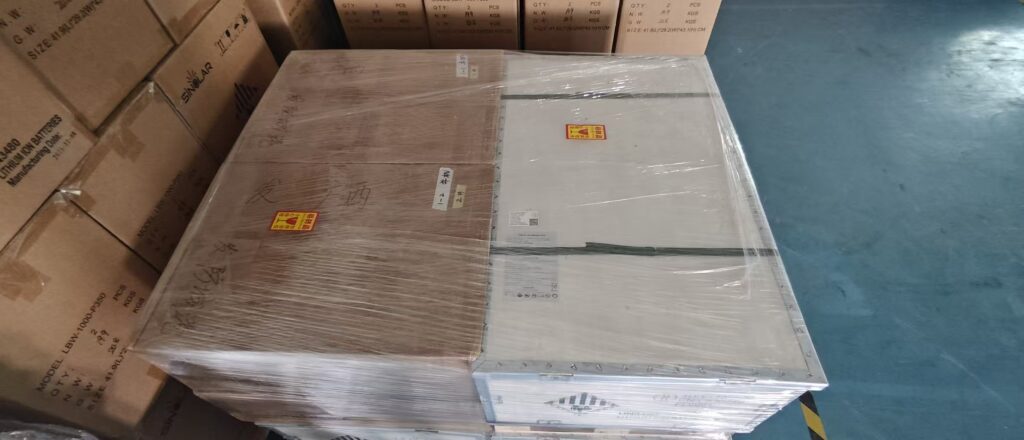
A van lifter swaps a 22 kg lead-acid box for a 9 kg LiFePO4 unit and frees a drawer for food. The trip did not change. The weight did.
Lightweight solar batteries are compact rechargeable packs — most often LiFePO4 — that store roughly 0.3 to 2 kWh in a unit weighing 5 to 25 kg, frequently with a built-in inverter. They run phones, laptops, fridges and small appliances away from the grid: camping, RVs, boats, market stalls and short home outages. The deciding factor is not the word “portable” on the box, but how many watt-hours sit in each kilogram.
What “lightweight” actually measures
Energy density is watt-hours per kilogram (Wh/kg). A LiFePO4 cell delivers about 90–160 Wh/kg; a finished pack with BMS, case and ports lands near 80–130 Wh/kg. That math puts a 1 kWh pack at roughly 8–13 kg. When a listing says “portable,” check the kilograms per kWh, not the marketing photo. A 25 kg “portable” unit only makes sense if you roll it, not carry it.
This single ratio explains most buyer regret. Two packs can both claim “lightweight” while one carries twice the energy per kilogram. The number on the spec sheet that predicts real-world convenience is energy density — and almost no consumer ad leads with it.
Where a lightweight pack earns its place
- Camping and backpacking — a 0.3–0.5 kWh pack keeps lights, a phone and a small cooler alive for a weekend, and you barely notice it in the bag.
- RVs and vans — 1–2 kWh covers lighting, a 12V fridge and device charging without a second house battery dragging down payload.
- Boats and market stalls — sealed, vibration-tolerant packs beat flooded lead-acid, which leaks and hates angles.
- Home emergency — a 1–2 kWh unit bridges a few hours of an outage for routers, medical devices and lights.
- Trade shows and field work — reps carry demo power instead of hunting for sockets.
The pattern is consistent: these are situations where someone has to lift, carry or stow the battery. If it never moves, weight stops mattering and a wall-mounted home unit wins instead.
Three form factors compared
| Form factor | Capacity | Weight | Built-in inverter | Best for | Price band* |
|---|---|---|---|---|---|
| All-in-one portable power station | 0.3–2 kWh | 3–25 kg | Yes | Plug-and-play camping / RV | Standard–Premium |
| LiFePO4 battery + separate inverter | 0.5–5 kWh | 5–30 kg | No | Flexible DIY / expandable | Budget–Standard |
| Lightweight solar generator kit | 0.2–1 kWh | 2–12 kg | Yes (small) | Beginners / gift | Budget–Standard |
How to choose the right one
- Match capacity to load, not to dreams. List what you must run, add their watts, and size for the hours you need. A phone-and-light weekend is not a fridge-and-kettle week.
- Weigh your carry limit. If you hike it in, sub-5 kg matters more than extra kWh you will leave in the car.
- Built-in inverter or modular? All-in-one trades flexibility for convenience; modular scales and repairs more easily but needs wiring.
- Cycle life and depth of discharge. LiFePO4 typically survives far more cycles than NMC at the same price point — check the rated cycles at 80% DoD.
- Ports you actually use. USB-C PD, 12V cigar, pure-sine AC — match the devices, not the brochure.
- Certification for your market. UL 2743 (portable), UN 38.3 (transport), IEC 62133 — required, not optional, for resale.
Built-in inverter or separate?
An all-in-one station trades flexibility for convenience. A modular LiFePO4 pack plus a separate inverter weighs a little more and asks for wiring, but scales and repairs more easily. For a one-bag camping trip, built-in wins. For a van you keep rebuilding, modular wins. The harder question is what you will power in year two — and a stationary inverter outlives a glued-in one.
Mistakes that add dead weight
- Buying by advertised “portable” without checking kg per kWh.
- Ignoring inverter rating — a 300 W unit will not start a fridge compressor.
- Forgetting cycle life — a cheap pack can halve its capacity within a year.
- Skipping certification for transport (UN 38.3) and market (UL 2743 / IEC 62133).
Q. What is the lightest type of solar battery?
Small LiFePO4 or NMC packs in the 0.2–0.5 kWh range weigh 2–5 kg and travel easily. They trade runtime for carry comfort — enough for phones, lights and a laptop, not a fridge.
Q. How much does a lightweight solar battery weigh?
Most land between 5 and 25 kg. The useful figure is weight per kWh: around 8–13 kg per kWh for a finished LiFePO4 pack. A “25 kg portable” unit is really a rolled, not carried, device.
Q. Do lightweight solar batteries have a built-in inverter?
All-in-one portable power stations do — that is their selling point. Modular LiFePO4 packs usually do not and need a separate inverter, which is the trade-off for scaling and repair.
Q. How long do lightweight LiFePO4 batteries last?
Typically 2,000–6,000 cycles at 80% depth of discharge, far beyond lead-acid. Lifespan depends on how deep you discharge and how hot you store them — check the rated cycles, not just the price.
Q. Can I use a lightweight solar battery for my RV?
Yes. A 1–2 kWh unit covers lighting, a 12V fridge and device charging. Match the inverter’s continuous wattage to your heaviest startup load, and size kWh for the nights you spend off hookup.
Looking for lightweight portable power for distribution or OEM?
leekooenergy supplies 0.3 to 2 kWh lightweight LiFePO4 batteries and integrated units, with small-batch trade and custom branding / connector options. See Portable product page, or combine with Solar Battery Bank selection guide and Solar Battery Kit assembly guide to plan your off-grid configuration.
- small-batch traders: ask for MOQ and FOB quote (see price tier table above; specific amounts to be filled)
- end users: follow the 6-step checklist above to verify capacity, weight, and certification before ordering