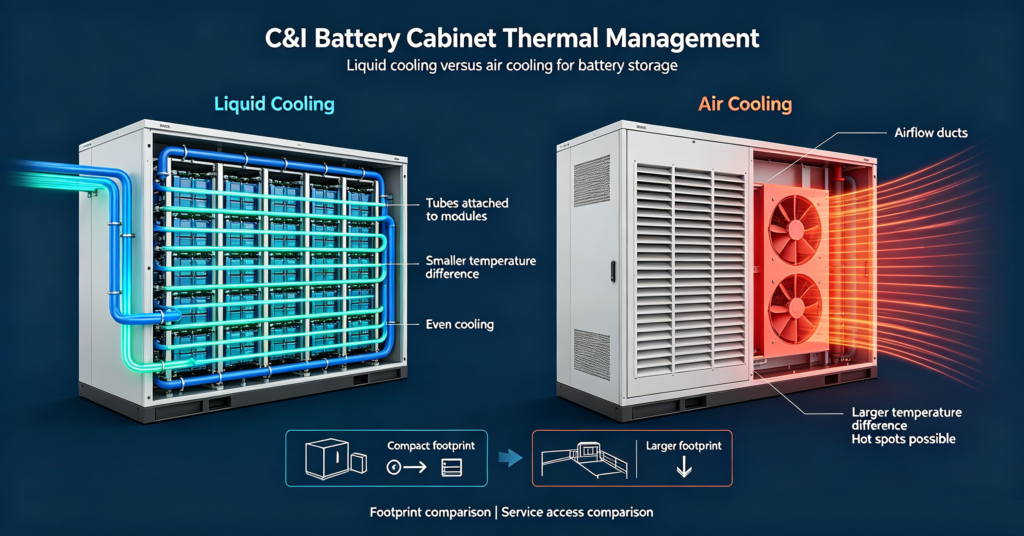
For C&I battery storage, liquid cooling tightens cell-to-cell temperature spread and supports higher charge/discharge rates (1C) with longer cycle life, at higher upfront and maintenance cost; air cooling is cheaper and simpler for lighter-duty 0.5C cycles where the temperature spread stays acceptable. Choose by duty: high-rate, dense, hot-climate cabinets lean liquid; moderate 0.5C duty leans air. The cooling method is a life and footprint decision, not a checkbox.
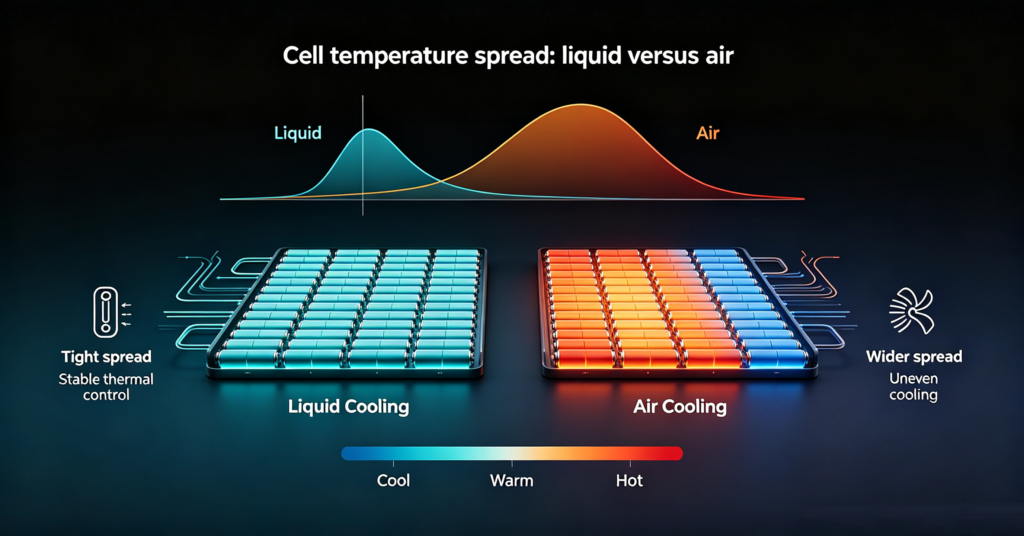
Thermal management decides how long a C&I pack lasts and how much space it needs. Cell temperature spread — not just average temperature — drives aging, so the cooling method that controls spread wins on life.
Why cooling matters for C&I BESS
C&I cabinets cycle harder and sit in hotter rooms than home units. A wide cell-temperature spread makes the hottest cell fade first, dragging usable capacity down. Cooling that keeps cells within a tight band extends cycle life and lets the pack run at higher C-rate safely.
Liquid cooling, explained
Liquid cooling runs a coolant loop in contact with the modules, pulling heat out efficiently and holding cell spread narrow — often a few degrees. That supports 1C (full charge/discharge in ~1 hour) duty and dense packing. The cost is the loop, pumps, and more maintenance; the payoff is life and footprint.
Air cooling, explained
Air cooling moves air through the cabinet with fans. It is cheaper and simpler, with no coolant loop to maintain, but cell spread is wider under hard cycling, which caps sustainable C-rate and shortens life somewhat. For moderate 0.5C duty in a climate-controlled room, air cooling is often enough.
Comparison at a glance
| Dimension | Liquid cooling | Air cooling |
|---|---|---|
| Cell temperature spread | Small (within a few °C) | Larger |
| Supported C-rate | High (~1C) | Medium (~0.5C) |
| Cycle life | Longer | Moderate |
| Footprint | Small (dense packing) | Large (needs airflow) |
| CapEx / O&M | High | Low |
0.5C vs 1C: which cooling
| Condition | Typical scenario | Recommended cooling |
|---|---|---|
| 0.5C light cycling | Self-consumption, mild climate | Air (sufficient, lower cost) |
| 1C heavy cycling | Demand response, frequent cycling | Liquid (controls spread, protects life) |
| High-temp environment | Room without AC | Liquid (more stable temp) |
| High density, tight space | Urban server room | Liquid (dense packing) |
What to confirm with the supplier
- Stated cell-temperature spread under your duty cycle (not just average).
- Cycle-life curves at 0.5C and 1C with your depth of discharge.
- Cooling maintenance needs (coolant loop vs fan service).
- Enclosure fire rating and room ventilation requirements.
Common mistakes
Buyers pick air cooling for a 1C duty and watch the hottest cell age out early, or over-spec liquid cooling for a 0.5C cabinet and pay for capacity they never use. Match cooling to the actual C-rate and climate; the C&I guide frames the application side.
Cooling and warranty
Cooling method shows up in the warranty because temperature spread drives aging. A liquid-cooled cabinet that holds cells within a few degrees typically carries a longer or higher-throughput warranty than an air-cooled one at the same duty. Read the warranty basis – years or throughput – and the stated spread, not just the headline life. The liquid cooled bess 0.5c vs 1c cycle life comparison is the core trade that the warranty quietly prices in.
How to read a thermal spec sheet
Look for three numbers: stated cell-to-cell temperature spread under your duty, max sustained C-rate, and the cooling medium and flow. A spec that gives only average temperature hides the spread that ages cells. Ask for the spread at 1C, not at idle – that is where air and liquid diverge most.
Climate and room design
In a hot, unconditioned room, liquid cooling holds temperature far better than fans fighting ambient heat. In a climate-controlled equipment room with light duty, air cooling often suffices. Design the room and the cooling together; a great liquid system in a sealed hot box still struggles. Ventilation and ambient are part of the cooling decision, not separate.
Total cost of ownership view
Liquid cooling costs more upfront and to maintain, but can return that through longer life and smaller footprint in dense sites. Air cooling is cheaper to own until hard cycling ages the pack early. The right call follows duty and climate, not the lower sticker. Request cycle-life curves at both 0.5C and 1C to see the gap for your project.
Decision summary
| If | Choose |
|---|---|
| 0.5C, climate-controlled room | Air cooling |
| 1C, frequent cycling | Liquid cooling |
| High-temp environment | Liquid cooling |
| Tight on space | Liquid cooling |
Real project examples
A small office with 0.5C self-consumption in a cooled equipment room typically runs air cooling well – the duty is light and the room is stable. A factory doing 1C peak-shaving in a hot warehouse leans liquid, where narrow temperature spread protects life and density saves floor. The cooling choice is a project decision, not a catalog default; match it to duty and climate.
Cooling maintenance schedule
Air cooling needs fan checks and filter cleaning on a calendar; liquid needs coolant-loop inspection, pump checks, and leak watch. Neither is free, but liquid’s loop is the extra task. Budget the maintenance when you choose – a liquid system skipped on coolant service loses its life advantage fast.
Comparing quotes apples to apples
When two vendors quote, compare stated temperature spread at your C-rate, cycle-life curves at 0.5C and 1C, footprint, and warranty basis – not just price per kWh. A cheaper air-cooled cabinet that ages early can cost more per cycle than a liquid one. The comparison buyers should run is total cost of ownership, not sticker.
The cost of getting cooling wrong
Pick air for 1C duty and the hottest cell ages out early, cutting usable capacity and triggering warranty questions. Pick liquid for light duty and you pay for capacity you never use. Either mistake is avoidable by matching cooling to the actual C-rate and climate before order – the spec sheet spread is the number that predicts it.
The energy penalty: what cooling draws
Cooling is not free in kWh. Air cooling spends fan power; liquid cooling spends pump and often chiller power on top. At light 0.5C duty the fan draw is small enough to ignore; at sustained 1C duty the liquid loop’s energy can be a visible slice of the battery’s own throughput, especially if a chiller is involved. The honest comparison is the cooling energy as a share of cycled energy, not just the hardware cost. Request the cooling power draw at your duty from each vendor – a number air-cooled cabinets rarely publish but liquid ones should – and fold it into the ownership math.
This is where liquid cooling’s life gain can be partly offset: you trade some energy for tighter temperature and longer life. Whether that trade pays depends on duty and climate, which is exactly why the choice should follow the project, not the catalog.
Cooling and cell-degradation modeling
Cell aging is driven less by average temperature than by the hottest cell and how often it runs hot. A degradation model that uses only mean temperature will over-promise life for an air-cooled pack with a wide spread. Liquid cooling narrows that spread, so its real-world aging tracks the model better. When a vendor shows a 10- or 15-year life curve, ask whether it is built on cell-spread or cell-average – the answer changes how much of that curve you can believe at 1C in a warm room.
For the buyer, the usable test is simple: ask for cycle-life at your C-rate and ambient from both cooling types, on the same cell chemistry, and compare the curves rather than the headlines.
Hybrid and immersion cooling: where they fit
Beyond the liquid-vs-air split, two approaches appear in larger C&I and utility projects. Hybrid cooling runs liquid on the hot modules and air on the rest, trimming cost where the load is uneven. Immersion cooling drops cells in a dielectric fluid for the tightest temperature control and best fire containment, at the highest complexity and service cost. Neither is a default for a standard cabinet; they earn their place at very high C-rate, very dense, or very safety-critical sites where air and basic liquid both fall short.
Treat these as the next step up the cooling ladder, not a replacement for matching basic liquid or air to your actual duty first.
Q. Does liquid cooling extend BESS cycle life?
It tends to, because it holds cell-temperature spread narrow, so the hottest cell fades slower. The gain shows most at high C-rate (1C) and hot climates; at light 0.5C duty the difference shrinks. Confirm with cycle-life curves at your duty.
Q. Is air cooling enough for C&I storage?
For moderate 0.5C cycles in a climate-controlled room, often yes — it is cheaper and simpler. For 1C duty, high ambient heat, or dense packing, liquid cooling controls spread better and protects life.
Q. What does 0.5C vs 1C mean for a battery?
C-rate is charge/discharge speed: 0.5C fills or empties the pack in ~2 hours, 1C in ~1 hour. Higher C-rate makes cooling matter more, because heat rises with power.
Q. Which cooling uses less space?
Liquid cooling usually allows denser module packing (smaller cabinets) because it removes heat efficiently; air cooling needs airflow paths and more volume. If footprint is tight, liquid cooling wins.
Q. Is liquid cooling harder to maintain?
It adds a coolant loop and pumps to service, versus just fans for air cooling. The trade is longer life and higher density. Weigh maintenance against the life and footprint gain for your duty.
Next step: choose cooling by C-rate and climate
Write your duty cycle (C-rate) and room climate, then match cooling to spread and life — not to the cheapest cabinet. Ask suppliers for spread and cycle-life curves at your rate.
ask the supplier for the 0.5C / 1C cycle-life curve
Read #5 C&I Pillar
See the leekooenergy C&I / container product page (thermal-management specs)