The shortest answer: switch to a lithium deep cycle battery when the bank is cycled regularly, weight or space matters, and cost can be compared over life rather than on the invoice; stay with lead-acid when the upfront budget is the hard constraint and the duty is light standby. In cycled applications — solar storage, telecom backup, floor machines, off-grid systems — lithium’s higher usable capacity per amp-hour and far longer cycle life usually repay the difference within one lead-acid replacement cycle. For rarely-cycled standby duty on a tight budget, lead-acid remains defensible.
The question arrives at almost every site running a lead-acid bank: the technology is mature and cheap per purchased amp-hour, but what each chemistry delivers over its service life — in the duty the bank actually performs — decides the purchase. And that is a deep cycle question: “deep cycle” is the industry label for batteries built to be discharged and recharged repeatedly rather than kept full like a starter battery.
What “deep cycle” means — and why the real comparison is lithium vs lead-acid
Both families make deep cycle products: flooded, AGM and gel lead-acid on one side, and almost every lithium iron phosphate (LiFePO4) battery on the other. The buyer’s real choice is therefore between a lead-acid deep cycle bank and a lithium deep cycle battery bank — same job, two different sets of physics. The chemistry background that makes LiFePO4 the default lithium choice is covered in #01 the LiFePO4 buyer’s guide; this article stays on the lead-acid comparison.
The battery chemistry comparison that decides the purchase
| Criterion | Lead-acid (flooded / AGM / gel) | Lithium (LiFePO4) |
|---|---|---|
| Usable depth of discharge | Typically about half of nameplate capacity; deeper discharge shortens life sharply | Most of nameplate capacity usable within warranty terms |
| Cycle life at deep discharge | Hundreds of cycles when worked hard | Thousands of cycles at comparable or deeper discharge |
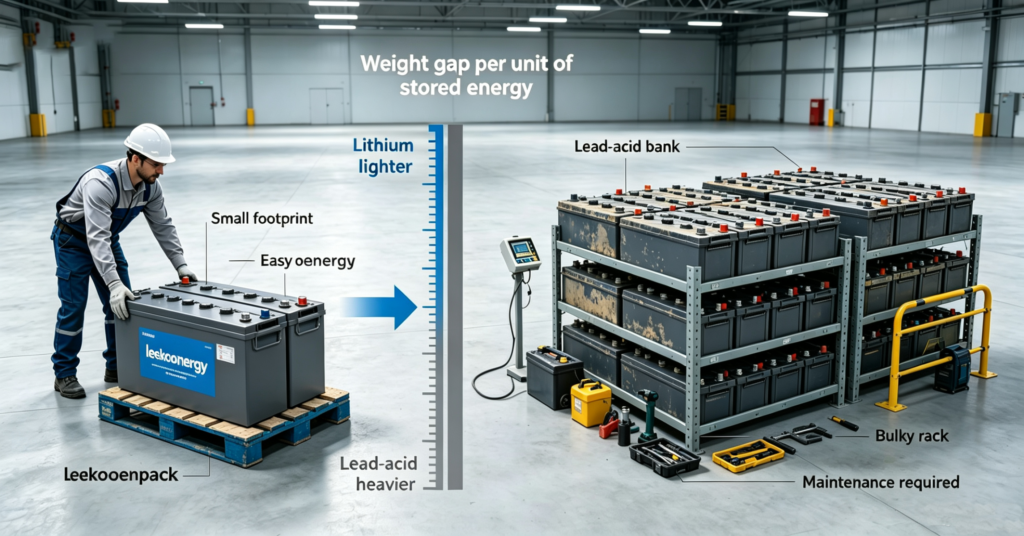
| Weight per unit of energy | Heavy; often needs structural support and machinery | A fraction of the weight for the same usable energy |
| Charge acceptance | Slow final stage; hours of topping charge | Accepts high charge current through most of the range |
| Round-trip efficiency | Meaningful energy lost as heat during charge | Higher proportion of charged energy returned on discharge |
| Maintenance | Flooded types need watering and terminal cleaning | Essentially none; battery management system handles cell balancing |
| Partial-state-of-charge operation | Sulfation risk when held below full charge | Tolerates partial charge without damage |
| Cold-weather charging | Charges, with reduced capacity delivery when cold | Discharges well in cold but needs charge-temperature limits below freezing |
| Installation environment | Flooded types need ventilation for hydrogen; orientation limits | Sealed; indoor-safe within code; flexible mounting |
| Cost structure | Low upfront; repeated replacement and maintenance cost over life | Higher upfront; cost per usable kilowatt-hour over life typically much lower |
Two rows carry most of the switching decision. Usable depth of discharge: because a lead-acid bank is normally sized to use only about half of its nameplate amp-hours, a buyer who needs 5 kWh of usable energy must purchase roughly a 10 kWh lead-acid bank, while a lithium bank needs less nameplate for the same job. And cycle life at deep discharge: a daily-cycled lead-acid bank reaches replacement in a few years, while lithium runs for many more. Multiply the two effects and the ranking flips — which is why the lithium battery vs regular battery question almost always ends in a total-cost answer, not a price-tag answer.
Where lead-acid still makes sense
Say it plainly: lead-acid wins when the purchase is capital-constrained and the duty is light. A standby bank discharged a few times a year never runs up enough cycles to punish its shorter life; a remote site may prefer a battery any electrician can handle without cables or configuration; and a budget that cannot absorb the lithium premium is a real constraint, not a failure of analysis. Lead-acid recycling is also mature in most markets.
Where a lithium deep cycle battery wins
The lithium case concentrates in four situations. Regular cycling: solar self-consumption, telecom sites, floor machines and off-grid systems cycle the bank weekly or daily — precisely the duty where thousands of cycles versus hundreds repay the premium. Weight and space: a lithium ion deep cycle battery bank weighs a fraction of its lead-acid equivalent, removing a mechanical problem along with the battery problem. Partial-state-of-charge duty: solar-fed banks spend much of their life between full and empty, a condition lead-acid tolerates poorly and lithium treats as normal. Energy efficiency: every kilowatt-hour lost inside the battery must be supplied again, so round-trip efficiency compounds over the whole system life. Within the lithium family, how to weigh 6,000-cycle versus 8,000-cycle versus 10,000-cycle products is worked through in #46 cycle life versus price.
The payback logic, without invented numbers
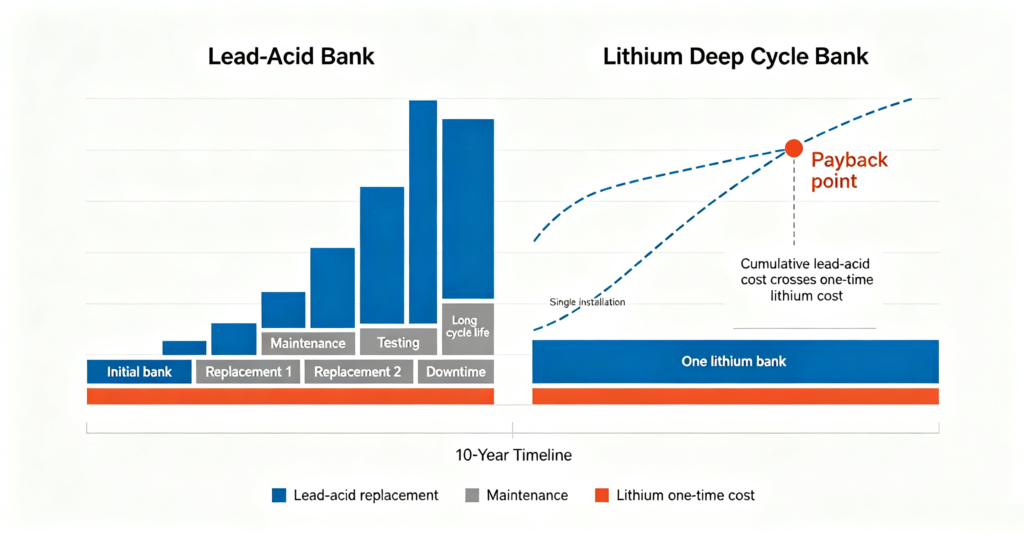
The structure of the calculation is universal: divide the delivered cost of the bank by the usable kilowatt-hours it delivers over its life — nameplate capacity, times the depth of discharge actually used, times the cycles the chemistry survives at that depth. Lead-acid enters that formula with roughly half its nameplate and a cycle count in the hundreds when worked deep; a lifepo4 deep cycle battery enters with most of its nameplate and a cycle count in the thousands. Add the running items — charge losses, maintenance labour, replacement labour — and the crossover for regularly cycled banks typically lands within the first lead-acid replacement cycle. Rarely-cycled sites push the crossover out until it may never arrive.
Before you switch: a six-point checklist
- Audit the real duty cycle first. Pull a year of discharge logs or estimate cycling frequency honestly; the payback argument lives or dies on this number.
- Check charging compatibility. Existing lead-acid chargers follow a different profile; confirm the lithium bank accepts them or budget for new charge control.
- Respect cold-charge limits. Lithium banks charge happily in most conditions but need low-temperature charge protection below freezing — verify the battery management system provides it.
- Recalculate the bank size. Because usable depth of discharge differs, a like-for-like swap buys more usable energy; right-sizing often funds part of the switch.
- Plan the old bank’s exit. Lead-acid recycling is available in most markets; contract the removal and recycling before the new bank arrives.
- Confirm integration downstream. Inverters that lived with lead-acid voltage behaviour should be checked against the lithium bank’s flatter discharge curve; the matching method in #17 choosing a storage inverter applies to retrofits too.
Can I drop a lithium deep cycle battery into my existing lead-acid system?
Physically often yes, electrically only with checks: the charger must deliver a lithium-compatible profile, and absorption or equalisation behaviour designed for lead-acid must be disabled. Where solar controllers or inverters are involved, confirm the settings suit the new bank first.
How long does switching to lithium take to pay back?
It depends almost entirely on cycling frequency. For daily-cycled solar or telecom duty, lithium’s lifetime cost per usable kilowatt-hour usually crosses below lead-acid within the old bank’s first replacement cycle. For standby banks cycled a few times a year, the payback may never arrive — and lead-acid remains rational.
Does a lithium deep cycle battery work in cold weather?
Discharge in cold is generally strong — often better than lead-acid. The constraint is charging below freezing, which lithium should not do unless the pack provides low-temperature charge protection; verify it for unheated sites.
Is the extra usable capacity real, or just marketing?
It comes from depth of discharge. A lead-acid bank cycled to about half of nameplate protects its life; a lithium bank cycles far deeper and still delivers its rated count. The same usable energy therefore takes less lithium nameplate.
What should I do with the old lead-acid bank?
Recycle it through an established lead-acid stream — mature and in many jurisdictions legally required. Contract the removal before the new bank arrives so the site is not left storing spent batteries.
Next step: price your own switch
Take your bank’s nameplate capacity, your honest cycling frequency and quotes for both chemistries, then run the lifetime division from the payback section. One page of arithmetic settles the decision.
- Ground the chemistry choice in #01 the LiFePO4 buyer’s guide
- Weigh lithium cycle-life tiers with #46 cycle life versus price
- Separate the lithium-family debates in #33 LiFePO4 vs lithium-ion and #38 lithium vs lithium-ion
- See the residential form factors in #45 rack, stackable and wall-mounted batteries
- Ask leekooenergy for LiFePO4 deep cycle configurations sized to replace your existing lead-acid bank