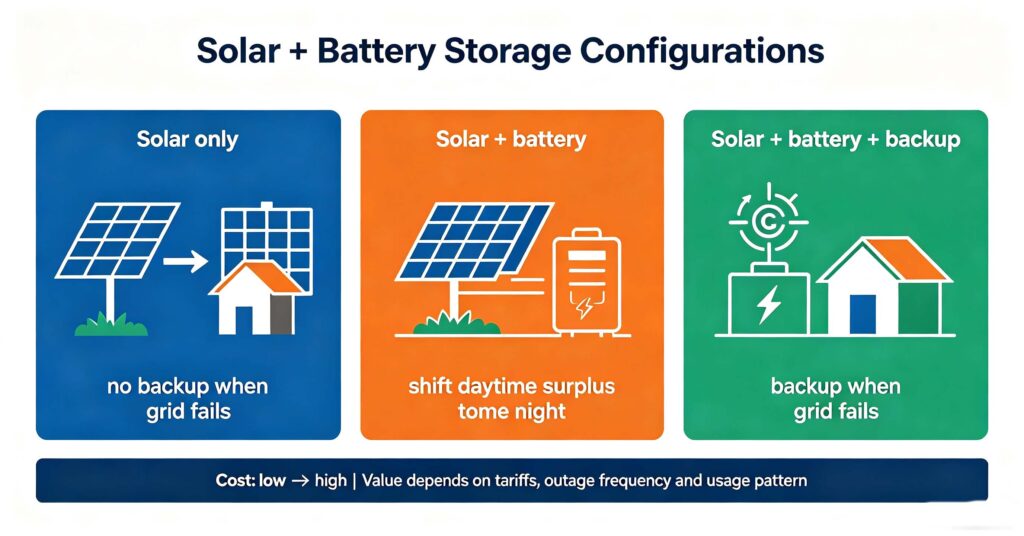
Solar panels with battery storage capture daytime surplus solar energy and release it later — typically in the evening or during a grid outage — instead of exporting it to the grid. Whether the battery pays for itself depends on three things: how your utility values exported solar (net metering versus low export rates), how your electricity is priced over the day (flat versus time-of-use), and how often you need backup power. The battery earns money when it lets you use cheap or surplus solar instead of buying expensive evening power, and it earns security when it keeps critical loads running during outages. It is usually not worth adding when export rates are high, the tariff is flat with no evening premium, and outages are rare — in that profile the payback stretches past the battery’s useful life. The right answer is configuration-specific, not universal.
Most homeowners and small commercial buyers start with the same question: do I add a battery now, or stay with solar only? This guide walks through what solar panels with battery storage actually change, the three configurations on the market, and the conditions that make each one the right choice. For how the system is built and wired, see #54 building a hybrid solar and storage system.
What solar panels with battery storage actually change
Solar panels alone reduce how much grid power you buy during daylight hours; adding a battery changes the timing of that saving.
Without a battery: surplus generation is exported to the grid. If export compensation is low — common with modern net metering policies — the surplus is nearly free power given away, and your evening consumption still buys grid power at full price.
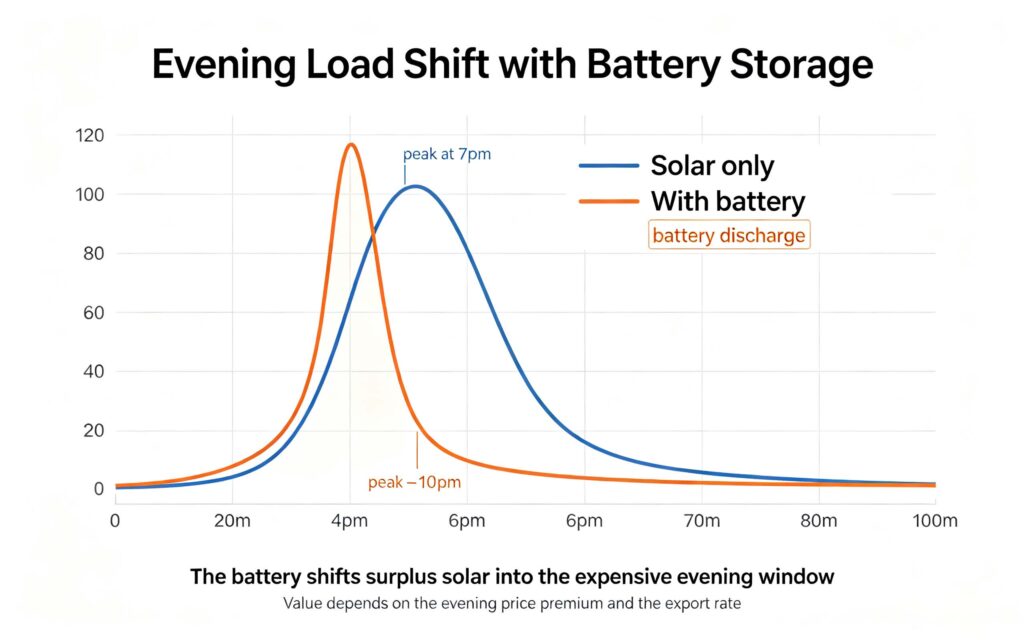
With a battery: surplus charges the battery first, and the stored energy covers evening load, shifting your consumption away from the most expensive part of the day. The battery also provides a layer of backup during grid outages, which solar-only systems generally cannot do on their own.
The value is not “more solar”; it is better timing of the solar you already have. For how batteries store solar energy at a system level, see #19 how to store solar energy.
The three configurations and who each fits
Configuration choice usually comes down to whether the priority is bill reduction, outage backup, or both.
| Configuration | Best for | Key trade-off |
|---|---|---|
| Solar only | High export rates, flat tariffs, rare outages | Lowest cost; no evening shift, no backup |
| Solar + battery (self-consumption) | Time-of-use tariffs, low export rates, evening load | Shifts surplus to evening; backup is a bonus, not the design goal |
| Solar + battery + backup | Frequent outages, critical loads, medical or work needs | Highest cost; backup capacity may exceed what daily cycling needs |
The middle configuration is the most common recommendation, because it earns money on normal days and provides partial backup by design. For a full comparison of whether a battery earns its place versus other options, see #47 home battery versus generator.
When solar panels with battery storage pay for themselves
Payback is driven by the gap between what the grid pays you for surplus solar and what it charges you for evening power. The wider the gap, the faster the battery pays.
- Time-of-use tariffs: if evening rates are meaningfully higher than daytime rates, the battery earns on every cycle.
- Low export compensation: when exported solar earns little, storing it for self-use preserves its value.
- High evening consumption: homes that use most power after dark capture the most from a battery.
- Outage value: for businesses and homes where lost power is costly, the battery’s backup function carries a value beyond bill savings.
When none of these conditions apply, the battery becomes a cost center rather than an investment. For the full cost picture before you decide, see #7 how much does a solar battery cost.
When the battery is probably not worth adding
There are honest cases where solar panels with battery storage are the wrong purchase right now.
High export rates: if your utility pays near-retail for exported solar, the grid is effectively your battery, and adding a second battery rarely wins on payback.
Flat tariffs with no evening premium: every kWh costs about the same all day, so shifting usage saves little.
Rare outages and no critical loads: if the grid is stable and you have no load that must stay on, the backup premium is not buying anything.
Aging solar system: pairing a new battery with panels near end of life can mean replacing both before the battery pays off — check panel condition and remaining life first.
For sizing help if you decide to proceed, see #9 how to size a home battery.
Q. Is a solar battery worth it for home use?
It depends on your tariff structure, export compensation and outage frequency. A battery is usually worth it when evening rates are higher than daytime rates, exported solar earns little, or outages are a real cost. If your utility pays near-retail for exports and your tariff is flat, the payback typically stretches past the battery’s useful life. The answer is specific to your usage pattern.
Q. What does solar battery storage do?
Solar battery storage captures surplus generation during the day and releases it later — usually in the evening when prices are higher, or during a grid outage when the grid is unavailable. It shifts your consumption away from expensive daytime-import windows and provides backup when the grid fails. Solar panels alone export surplus and generally cannot power your home during an outage.
Q. How much do solar panels with battery storage cost?
Total cost depends on panel size, battery capacity, inverter type and installation. The battery adds a significant share of the system cost, and the total is often two to three times the cost of panels alone depending on configuration and market. Actual pricing varies by region, installer and equipment choices, so compare itemized quotes rather than advertised package prices.
Q. Can I add a battery to my existing solar panels?
Often yes, but the existing inverter determines the options. AC-coupled batteries can generally be added to an existing solar system, while DC-coupled designs integrate with the inverter differently. Check the inverter model, its communication protocol and the available upgrade path with your installer before buying, since compatibility drives both cost and capability. See #78 for the retrofit detail.
Q. How long does a solar battery last?
Most lithium batteries are rated for a certain number of cycles and a calendar life, typically a decade or more of daily use depending on chemistry and depth of discharge. Battery capacity degrades gradually rather than failing suddenly. The actual life depends on cycling depth, temperature and how the system is managed, so the warranty terms matter more than the advertised cycle count.
Next step: decide based on your numbers, not the marketing
Solar panels with battery storage are a timing tool, not a guarantee of savings. Compare your export rate, your tariff curve, your evening load and your outage cost — then choose the configuration that matches. A supplier that asks about these numbers before recommending a battery is a supplier worth talking to.
- See how the hybrid system is built in #54
- Compare the cost breakdown in #7
- Size the system properly in #9
- Ask leekooenergy for a configuration recommendation: send your tariff structure, export rate, typical evening load and outage history, and receive a solar + battery sizing proposal matched to your numbers