Definition. Battery storage, formally a battery energy storage system (BESS), is a system that converts electrical energy into chemical energy in battery cells, holds it, and converts it back to electricity when required. A BESS is defined by two independent ratings: its power, in kilowatts or megawatts, which is how fast it can charge or discharge, and its energy, in kilowatt-hours or megawatt-hours, which is how much it can hold. Modern grid-connected systems predominantly use lithium iron phosphate or nickel-manganese-cobalt lithium-ion cells.
The two-rating distinction is the part most often missed. A 500 kW / 500 kWh system and a 250 kW / 1000 kWh system store different amounts of energy and deliver it at different speeds, and neither is described adequately by a single number.
How a BESS Works
A complete charge-discharge cycle has four stages.
- Charging. Alternating current from the grid or from a generation source enters the power conversion system, which rectifies it to direct current at the battery’s voltage and feeds the cells.
- Storage. Energy is held electrochemically. The battery management system monitors each cell’s voltage, current and temperature, and balances cells within the string.
- Discharging. The power conversion system inverts direct current back to alternating current, synchronised to the grid’s voltage and frequency, and supplies the load.
- Control. The energy management system decides when to charge and discharge, based on tariffs, load, generation forecasts or grid signals.
Energy is lost at each conversion. The proportion returned is the round-trip efficiency, and it is only comparable between systems when the measurement conditions — current rate, temperature, and whether conversion losses are included — are stated alongside it.
The Five Core Components
- Battery cells, modules and racks. Cells are grouped into modules, modules into racks. This is where the energy capacity lives.
- Battery management system (BMS). Protects and balances the cells, and reports state of charge and state of health.
- Power conversion system (PCS). The bidirectional inverter. It sets the system’s power rating and must comply with the local grid code.
- Energy management system (EMS). The control layer that decides what the system does and when, and therefore determines how much of the system’s theoretical value is actually realised.
- Thermal management and fire protection. Air or liquid cooling to hold cells within their operating window, plus detection and suppression. On larger systems these determine where the installation is permitted to go.
A system missing any one of these is not a BESS. It is a battery.
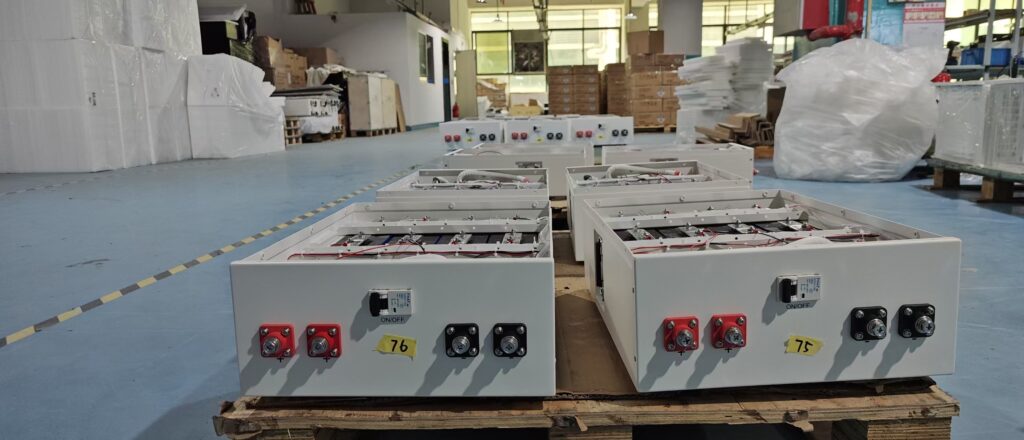
Battery Storage, ESS, BESS and a Storage Facility
Four terms appear interchangeably in the market. They are not equivalent.
| Term | What it means |
|---|---|
| Energy storage system (ESS) | Any technology that stores energy for later release — batteries, pumped hydro, flywheels, compressed air, thermal storage. The broadest of the four terms. |
| Battery energy storage system (BESS) | An ESS that stores energy in batteries specifically. A subset of ESS. |
| Battery storage | Everyday usage, generally meaning the same thing as BESS. |
| Battery storage facility | A site-scale installation, typically utility-scale, comprising many containerised or racked BESS units at a single location connected to the transmission or distribution network. |
Solar energy storage is a further narrowing: a BESS whose primary charging source is a photovoltaic array rather than the grid. The hardware is the same; the charging source and the control logic differ.
Where Battery Storage Is Used
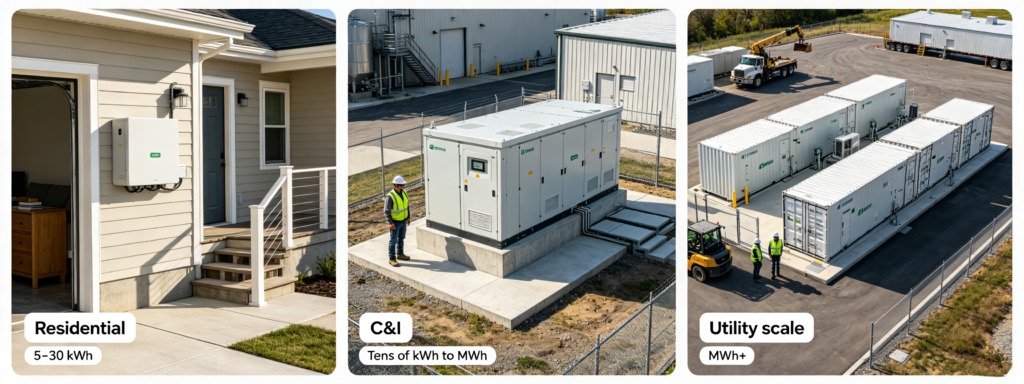
Systems fall into three scale bands, and the band determines the codes that apply as much as the size.
- Residential — roughly 5 kWh to 30 kWh, serving one dwelling for backup, self-consumption or tariff shifting.
- Commercial and industrial — tens of kilowatt-hours to several megawatt-hours, serving one site for demand charge reduction, energy shifting or process continuity.
- Utility-scale — megawatt-hours upward, connected to the network for grid services, renewable integration or capacity deferral.
Specifications That Define a System
Six figures describe a BESS. Each is only meaningful with its conditions stated.
- Power rating (kW / MW) — maximum rate of charge or discharge.
- Energy capacity (kWh / MWh) — quantity stored. Nominal and usable capacity are different figures.
- C-rate — power divided by energy. A 1 C system can discharge its full energy in one hour.
- Depth of discharge (DOD) — the proportion of nominal capacity that is usable.
- Round-trip efficiency — energy out divided by energy in, over a full cycle.
- Cycle life — cycles to a defined remaining capacity, at a stated DOD, temperature and C-rate.
FAQ
Q. What does BESS stand for?
BESS stands for battery energy storage system. It refers to a complete system — cells, battery management system, power conversion system, energy management system and thermal and fire protection — rather than to the batteries alone.
Q. What is the difference between an ESS and a BESS?
An ESS is any energy storage system, including pumped hydro, flywheels, compressed air and thermal storage. A BESS is an ESS that stores energy in batteries. Every BESS is an ESS; not every ESS is a BESS.
Q. What is a battery storage facility?
A battery storage facility is a site-scale installation containing many battery energy storage units at one location, connected to the transmission or distribution network. The term describes the site rather than the equipment.
Q. How long does battery storage last?
Service life is defined by cycle life rather than by years, and cycle life is only meaningful with its test conditions: depth of discharge, temperature and charge rate. A system cycled twice daily consumes its warranted cycles in roughly half the time of one cycled daily.
Q. Does battery storage need solar panels?
No. A BESS can charge from the grid alone and operate as a grid-charged system. Solar changes the charging source and the economics, not the requirement.
Looking for a specific application rather than a definition?
Our commercial and industrial guide covers revenue models and sizing for site-scale systems, and the residential guides cover backup scope and capacity sizing for single dwellings.