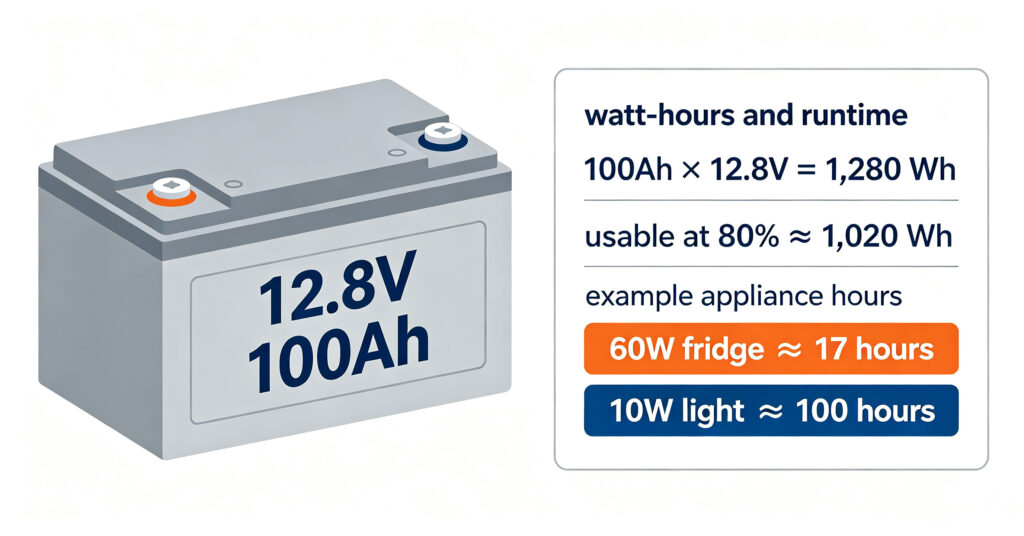
A 100Ah solar battery stores 100 amp-hours of charge, which is only meaningful once it is multiplied by the battery’s voltage: at 12V that is roughly 1.2 kilowatt-hours of nameplate energy, at 24V roughly 2.4 kWh, and at 48V roughly 4.8 kWh. Of that nameplate figure, only the usable fraction is available in service — a lithium iron phosphate battery typically allows a deep usable window, while a lead-acid battery of the same amp-hour rating delivers far less before its voltage collapses and its life shortens. The one-line version worth quoting: amp-hours are not energy; amp-hours times voltage is energy, and usable energy times your load is runtime.
This guide is for someone choosing their first storage bank and trying to work out whether one 100Ah unit is enough, or four, or whether a single larger battery is the better buy. It covers the conversion, the runtime you can expect from common loads, the four-step count calculation, and the paralleling rules. The full comparison across capacity classes is in #141 12V lithium battery comparison; the choice of voltage platform is in #157 24V solar battery and #12 48V vs 51.2V.
The conversion: amp-hours to watt-hours
One multiplication, and it is the one that makes every other decision easy.
| Nominal voltage | Nameplate energy for 100Ah | Typical usable energy, LFP | Typical usable, lead-acid |
|---|---|---|---|
| 12 V | About 1.2 kWh | Roughly 1.0 kWh | Roughly 0.6 kWh |
| 24 V | About 2.4 kWh | Roughly 2.0 kWh | Roughly 1.2 kWh |
| 48 V | About 4.8 kWh | Roughly 4.0 kWh | Rarely used at this rating |
The usable column is the one to plan with. It differs between chemistries because the depth of discharge a battery tolerates differs, and it is the reason a 100Ah lithium battery and a 100Ah lead-acid battery are not the same product despite the identical number on the label. Reading the specification properly is covered in #115 how to read LiFePO4 battery specs.
What 100Ah runs, and for how long
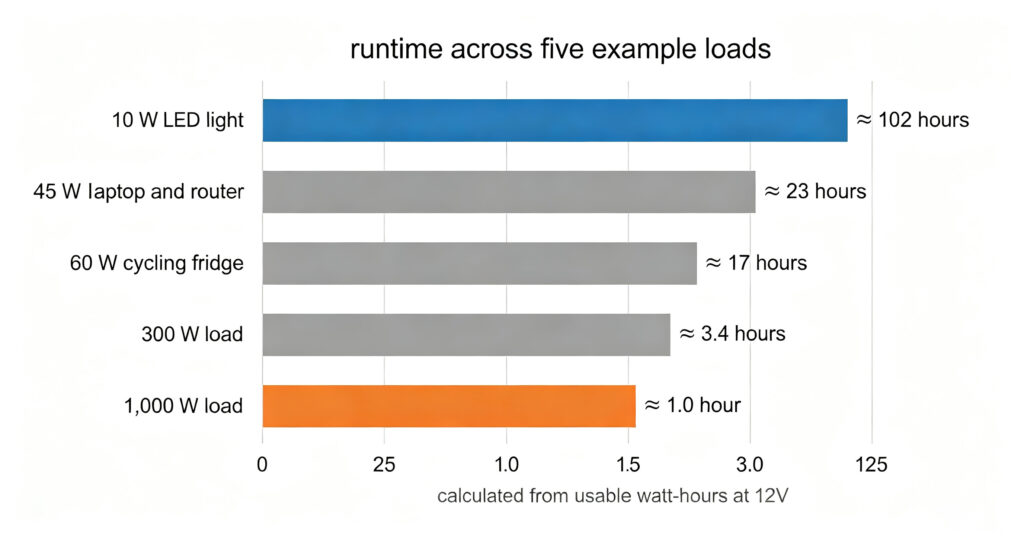
To see what a 100Ah solar battery will run, divide usable watt-hours by the load in watts. A few reference points at 12V lithium, using roughly one kilowatt-hour usable:
- A 60 W efficient fridge cycling at a typical duty: well over half a day.
- A 10 W LED light: on the order of a hundred hours.
- A 45 W laptop and router: most of a working day.
- A 300 W load: roughly three hours.
- A 1,000 W load: under an hour, and the battery’s discharge rating becomes the constraint before the capacity does.
That last line is the important one. High-power loads are limited by the battery’s continuous discharge rating and by the inverter, not by capacity. A single 100Ah 12V battery will not run a kettle, a microwave or a large power tool for long regardless of how much energy it holds, and at that point the right answer is a higher-voltage bank rather than more amp-hours at 12V — because the same power at 48V is a quarter of the current.
How many 100Ah batteries you need
Four steps, in order.
- List the loads with watts and hours per day, and total the watt-hours.
- Decide the autonomy: how many sunless days the bank must cover. One day suits a system recharged daily; two to three suits weekend or backup use.
- Divide by usable energy per unit: total watt-hours times autonomy days, divided by the usable watt-hours of one 100Ah unit at your chosen voltage.
- Check the power limit separately: confirm the bank’s continuous discharge rating and the inverter rating cover the largest simultaneous load including surge.
Worked example: 1,000 Wh per day of load, two days of autonomy, at 12V lithium with roughly 1,000 Wh usable per unit — that is two 100Ah units for energy. If the largest load is 1,500 W, the check in step four will probably push the design to 24V or 48V with a different unit count, which is exactly the point of doing the steps in this order. The sizing worksheet approach is in #132 DIY battery sizing, and the home-system version is in #09 how to size a home battery.
One big battery or several 100Ah units
Both work with a 100Ah solar battery, and the trade is worth making explicitly.
- Several 100Ah units are easier to carry, easier to replace individually, and let a system grow in stages. They need matched units, correct paralleling and more connections to maintain.
- One larger unit has fewer connections, one management system and a simpler installation, at the cost of weight, a single point of failure, and no staged expansion.
Temperature is worth one more line in the calculation. A battery sited in an unheated garage or an outdoor enclosure delivers less than its rating in cold weather, and a bank that must charge below freezing needs low-temperature protection, so a winter installation in a cold climate should carry more margin than the arithmetic alone suggests. For banks above two or three units, moving up a voltage platform is usually the better answer than adding parallel units at 12V, because it reduces current, cable size and balancing complexity at the same time. The staged-expansion argument for modular growth is set out in #155 modular solar power.
Three rules for paralleling 100Ah units
- Match them. Same capacity, same chemistry, same age and ideally the same batch. Mismatched units in parallel circulate current between each other and age faster.
- Charge and discharge the bank as one. Connect the bank’s positive at one end and negative at the other, or use a proper busbar, so every unit sees the same path resistance. The safe method is described in #93 parallel battery packs.
- Fuse each unit. A fault in one unit should not be fed by all the others.
Two more checks close a purchase: the charger profile must suit lithium rather than lead-acid, and the cable and protection must be sized for the current the bank will actually deliver. Charging behaviour is covered in #105 how home battery charging works, and the maintenance that keeps a bank healthy is in #84 solar battery maintenance. For marine and vehicle use the vibration and terminal requirements are higher; that context is in #97 marine and RV deep cycle guide.
One more comparison is worth making before ordering: price per usable kilowatt-hour rather than price per battery. Two units with the same amp-hour label can differ substantially in usable energy once depth of discharge and rated cycle life are accounted for, and the cheaper unit is frequently the more expensive one once both are included in the arithmetic.
Capacity also drifts with age. A bank sized exactly to today’s load will fall short as the cells lose capacity over the years, so leaving a margin of roughly a fifth above the calculated requirement costs little at purchase and buys several years of comfortable operation.
Q. How many watts is a 100Ah solar battery?
It depends on the voltage. At 12V a 100Ah battery holds about 1,200 watt-hours of nameplate energy; at 24V about 2,400 Wh; at 48V about 4,800 Wh. The usable figure is lower, and for lithium iron phosphate it is a large majority of the nameplate while for lead-acid it is roughly half.
Q. How long will a 100Ah battery run a fridge?
Divide the usable watt-hours by the fridge’s average draw rather than its nameplate wattage, because a fridge cycles. A 12V 100Ah lithium battery with roughly one kilowatt-hour usable will run an efficient 60 W fridge for well over half a day, and a less efficient or warmer-sited unit for considerably less.
Q. How many 100Ah batteries do I need?
Total your daily watt-hours, multiply by the number of sunless days you want to cover, then divide by the usable watt-hours of one unit at your chosen voltage. Check separately that the largest simultaneous load including startup surge is within the bank’s discharge rating and the inverter’s rating.
Q. Is 100Ah better than 200Ah?
Neither is better in the abstract; it depends on whether you want staged expansion, easy handling and individual replacement, or fewer connections and a simpler installation. Above two or three units, moving to a higher voltage platform is usually better than adding more capacity at the same voltage.
Q. Can I parallel two 100Ah lithium batteries?
Yes, provided they are the same chemistry, capacity and age, preferably from the same batch, connected so each sees equal path resistance and protected with its own fuse. Mismatched units in parallel will circulate current between each other and wear out faster than they would alone.
Next step: convert to watt-hours before you compare prices
A 100Ah solar battery at 12V and one at 48V are not the same product. Convert to usable watt-hours, check the discharge rating, then compare.
- Compare capacity classes in #141 12V lithium battery comparison
- Work the sizing in #132 DIY battery sizing
- Parallel safely in #93 parallel battery packs
- Tell leekooenergy your daily watt-hours, your largest load including surge and your chosen voltage platform — and ask for a recommendation that states usable watt-hours per unit, the number of units, the continuous discharge rating, and the charger and protection specification