Battery Storage Cabinet: Fireproof C&I Enclosure & NFPA 855 Compliance Guide
Battery storage cabinet is a purpose-built enclosure that houses lithium-ion battery modules, a battery management system (BMS), power conversion system (PCS), thermal management, and fire suppression in a compact, pre-integrated unit for commercial and industrial (C&I) energy storage. C&I battery cabinets are available in three main form factors: indoor cabinets (100–300kWh, designed for installation in equipment rooms or battery rooms), outdoor cabinets (100–500kWh, weatherproof IP54/IP55 enclosures for outdoor pad mounting), and containerized systems (500kWh–10MWh+, ISO shipping container or custom enclosure for utility-scale and large C&I). A critical requirement for all battery storage cabinets is fire safety: NFPA 855 (Standard for the Installation of Stationary Energy Storage Systems) and UL 9540A (Test Method for Evaluating Thermal Runaway Fire Propagation in Battery Energy Storage Systems) define the fire protection, separation distance, ventilation, and suppression requirements for lithium battery installations. A fireproof battery storage cabinet typically includes: a steel enclosure with 1–2 hour fire rating (or concrete/block construction for battery rooms), thermal runaway detection (gas sensors, smoke detectors, rate-of-rise heat detectors), fire suppression (water mist, clean agent, or sprinkler per NFPA 855), thermal management (HVAC or liquid cooling to maintain 15–30°C), explosion venting (for indoor installations), and access control. Typical C&I battery cabinet capacities range from 100kWh to 1MWh, with 50–500kW PCS, and are used for peak shaving, energy arbitrage, demand response, backup power, and renewable energy firming. For the economic analysis of C&I battery storage (peak shaving ROI), see #103 peak shaving & energy arbitrage C&I BESS ROI playbook.
As C&I battery storage deployments accelerate, the battery storage cabinet has become the standard form factor for pre-integrated, code-compliant energy storage systems. Unlike residential batteries (which are typically wall-mounted or floor-standing units in a garage), C&I battery cabinets are purpose-built enclosures that integrate batteries, power electronics, thermal management, and fire suppression in a single unit designed to meet NFPA 855 and local fire code requirements. This guide explains the three main cabinet types, the fire safety requirements defined by NFPA 855 and UL 9540A, the key components of a fireproof battery cabinet, and the installation and permitting requirements. For battery thermal runaway and fire suppression fundamentals, see #87 battery thermal runaway & fire suppression NFPA 855.
Three types of C&I battery storage cabinets
C&I battery storage cabinets are available in three main form factors, each suited to different capacities, installation environments, and use cases. Choosing the right type depends on your available space, capacity requirements, local climate, and fire code requirements.
Indoor cabinets are designed for installation in dedicated battery rooms, equipment rooms, or industrial facilities. They are typically 100–300kWh capacity, with a 50–250kW PCS, and are designed to be installed on a concrete floor with adequate clearance. Indoor cabinets rely on the building’s HVAC for ambient temperature control but include internal fans or liquid cooling for battery thermal management. Indoor installations must comply with NFPA 855 requirements for fire-rated construction, separation distances, ventilation, and spill containment. Indoor cabinets are preferred for facilities with existing equipment room space and controlled environments (data centers, manufacturing plants, hospitals).
Outdoor cabinets are weatherproof enclosures (IP54/IP55 rating) designed for outdoor pad mounting. They are typically 100–500kWh capacity, with a 50–500kW PCS, and include integrated HVAC or liquid cooling to maintain battery temperature in extreme climates (-30°C to 50°C ambient). Outdoor cabinets include a steel enclosure with corrosion-resistant coating (C3/C4 marine grade for coastal areas), a concrete pad or skid mount, and integrated fire suppression. Outdoor cabinets are preferred for facilities without indoor space, for quick deployment (no building construction required), and for installations where fire separation from the main building is desirable. Outdoor cabinets must be installed on a concrete pad with proper drainage, and must comply with local setback requirements and NFPA 855 separation distances.
Containerized systems are large-scale energy storage systems housed in ISO shipping containers (20ft or 40ft) or custom enclosures. They are typically 500kWh–10MWh+ capacity, with 250kW–5MW+ PCS, and are used for utility-scale, large C&I, and microgrid applications. Containerized systems include fully integrated battery racks, PCS, transformer, EMS, thermal management (HVAC or liquid cooling), and fire suppression. They are pre-assembled and tested at the factory, reducing on-site installation time. Containerized systems must comply with NFPA 855, UL 9540, and local fire codes, and require significant setback distances from buildings and property lines (typically 10–50ft depending on capacity and fire rating).
| Type | Capacity | PCS | Environment | Best for |
|---|---|---|---|---|
| Indoor cabinet | 100–300 kWh | 50–250 kW | Equipment room, battery room | Data centers, manufacturing, hospitals (controlled environment) |
| Outdoor cabinet | 100–500 kWh | 50–500 kW | Outdoor pad mount | Commercial buildings, schools, retail (no indoor space) |
| Containerized | 500 kWh–10 MWh+ | 250 kW–5 MW+ | Outdoor, concrete pad | Utility-scale, large C&I, microgrids |
NFPA 855 and UL 9540A: fire safety requirements for battery cabinets
Fire safety is the most critical consideration for C&I battery storage cabinet installation. Two standards define the requirements: NFPA 855 (Standard for the Installation of Stationary Energy Storage Systems) and UL 9540A (Test Method for Evaluating Thermal Runaway Fire Propagation in Battery Energy Storage Systems).
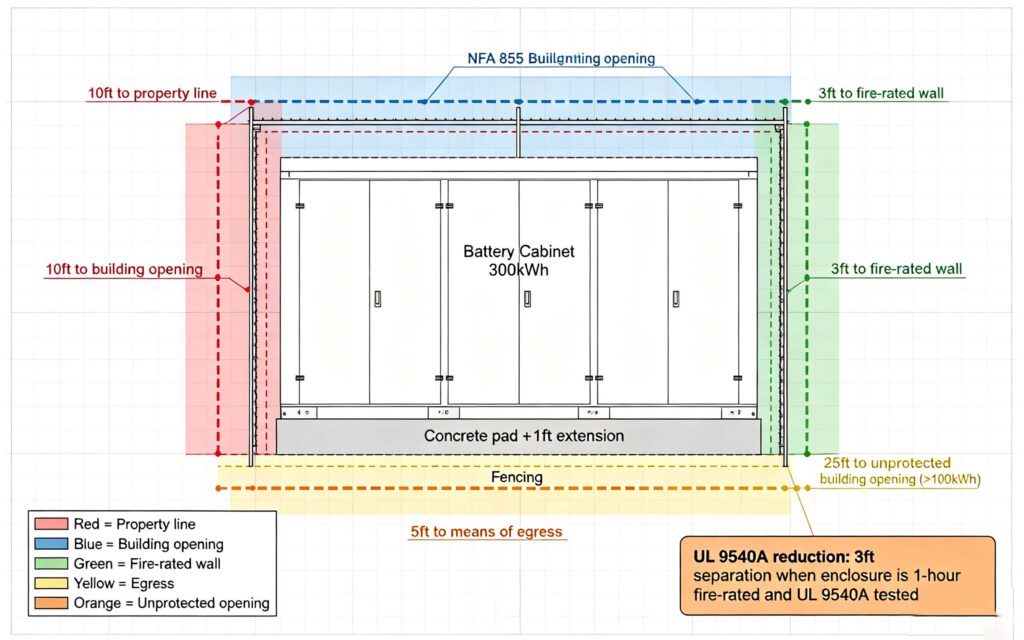
NFPA 855 defines the installation requirements for stationary energy storage systems, including: fire-rated construction (battery rooms must have 1–2 hour fire rating depending on capacity), separation distances (minimum distance from buildings, property lines, and means of egress — typically 3–10ft for indoor, 10–50ft for outdoor depending on capacity), ventilation (required for indoor installations to prevent hydrogen gas accumulation and heat buildup), spill containment (for batteries with liquid electrolyte — LiFePO4 is sealed but containment may still be required), fire suppression (sprinkler, water mist, or clean agent systems per the standard’s requirements), and maximum capacity per room/area (limits on total kWh per fire compartment).
UL 9540A is a test method that evaluates whether a battery energy storage system can prevent thermal runaway propagation (i.e., if one battery cell goes into thermal runaway, will the fire spread to adjacent cells and modules?). The test involves intentionally inducing thermal runaway in one cell and monitoring whether the fire propagates to other cells, modules, or racks. Systems that pass UL 9540A (no propagation or limited propagation) may qualify for reduced separation distances and alternative fire protection under NFPA 855. UL 9540A testing is specific to each battery chemistry, module design, and cabinet configuration — a system is only “UL 9540A tested” for the exact configuration tested.
Key fire safety features of a compliant battery storage cabinet include: thermal runaway detection (gas sensors for detecting venting battery electrolyte, smoke detectors, rate-of-rise heat detectors, and cell voltage monitoring via BMS), fire suppression (water mist systems are most common for lithium battery fires — water cools the cells and prevents propagation; clean agent systems may be used for smaller systems but are less effective for lithium battery fires), explosion venting (for indoor installations — vent panels that direct any explosion or pressure buildup to a safe exterior location), and fire-rated construction (1–2 hour fire-rated walls, doors, and penetrations for indoor battery rooms).
Key components of a fireproof battery storage cabinet
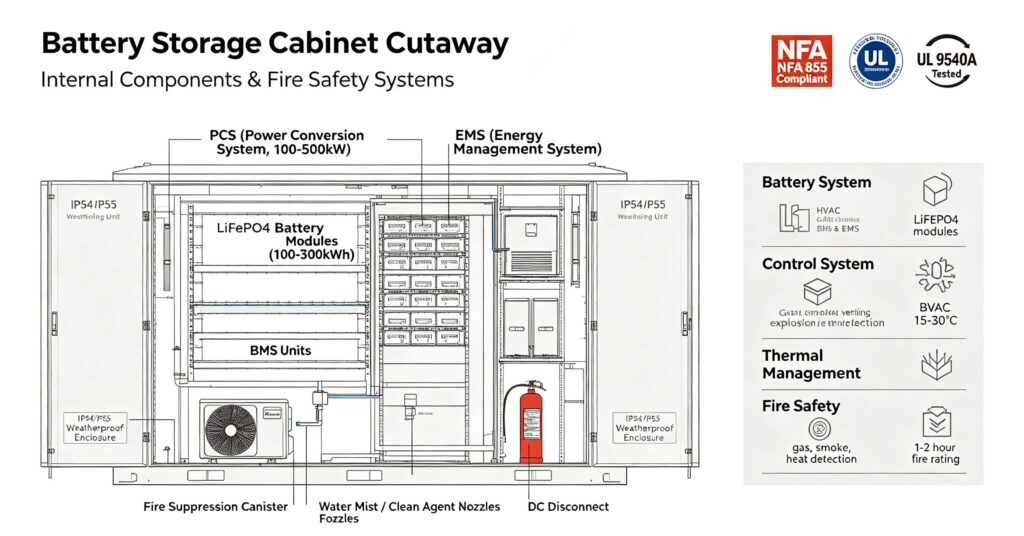
A properly specified C&I battery storage cabinet integrates multiple subsystems to ensure safe, reliable, and code-compliant operation. The key components are:
- Battery modules and racks: LiFePO4 battery modules (typically 51.2V 100Ah–300Ah) mounted in steel racks with proper spacing for airflow and thermal management. Modules should be UL 1973 certified and from a reputable manufacturer with grade-A cells.
- Battery Management System (BMS): Monitors and controls each battery module: cell voltage (overcharge/overdischarge protection), temperature (over-temperature and low-temperature charge cutoff), current (overcurrent and short-circuit protection), cell balancing (passive or active), state of charge estimation, and fault reporting. The BMS communicates with the EMS via CAN or RS485.
- Power Conversion System (PCS): Bidirectional inverter that converts DC battery power to AC for the facility, and AC grid/solar power to DC for battery charging. C&I PCS ratings: 50kW–5MW, 97–98% efficiency, supports grid-tie and islanding modes. PCS should be UL 1741 certified.
- Energy Management System (EMS): The system controller that optimizes battery charge/discharge based on utility rates, facility demand, solar production, and weather. The EMS also monitors system health, generates reports, and provides remote access. A sophisticated EMS can increase savings by 10–20%.
- Thermal management: Maintains battery temperature within the optimal range (15–30°C for LiFePO4). Options include: forced air cooling (HVAC with fans, for low-to-medium density systems), liquid cooling (cold plates or immersion, for high-density systems >200kWh per cabinet), and passive cooling (natural convection, only for very small systems in mild climates). Thermal management is critical for battery life and safety — high temperatures accelerate degradation and increase thermal runaway risk.
- Fire detection and suppression: Multi-layer detection: BMS cell voltage/temperature monitoring (earliest warning), gas sensors (detect battery venting before thermal runaway), smoke detectors, and rate-of-rise heat detectors. Suppression: water mist systems (most effective for lithium battery fires — water cools cells and prevents propagation), clean agent systems (for small systems where water damage is a concern), or sprinkler systems (per NFPA 855 requirements). Always verify the suppression system is compatible with the battery chemistry and has been tested to UL 9540A or equivalent.
- Enclosure and structure: Steel cabinet with corrosion-resistant coating (C3 for standard, C4/C5 for coastal/industrial), IP54/IP55 rating for outdoor cabinets, 1–2 hour fire rating for indoor installations, reinforced door with lock and access control, cable entry glands (IP-rated), and lifting points for installation. The enclosure should be designed to contain any battery thermal runaway event and direct venting to a safe location.
- Switchgear and protection: DC disconnect (battery side), AC disconnect (grid/load side), breakers and fuses (properly rated for DC voltage and current), surge protection (DC and AC SPDs), and grounding/bonding (per NEC and local code). All switchgear should be UL listed and properly coordinated.
Q. What are the NFPA 855 requirements for battery cabinet installation?
NFPA 855 sets the rules for stationary energy storage installation: fire-rated construction, 1-hour for small rooms and 2-hour for larger systems; separation distances from buildings and property lines, typically 3-50ft depending on capacity, reducible if the system passes UL 9540A; mechanical ventilation for indoor rooms; spill containment where required; fire suppression per NFPA 13 or approved alternatives; capacity limits per room, commonly 600kWh, higher with UL 9540A; signage and emergency shutdown; and UL 9540 listing. Always check with your local Authority Having Jurisdiction.
Q. What is UL 9540A and why does it matter for battery cabinets?
UL 9540A is a test method for thermal runaway fire propagation. It deliberately forces one cell into thermal runaway and checks whether the fire spreads to adjacent cells, modules, and racks, at cell, module, rack, and sometimes installation level. Passing systems can qualify for reduced separation distances and alternative fire suppression under NFPA 855, and higher capacity per room. Crucially, results apply only to the exact configuration tested, including chemistry, cell, module, cabinet, and suppression. Verify your specific cabinet model has a valid UL 9540A report before purchasing.
Q. What cooling system is best for an outdoor battery storage cabinet?
It depends on climate, density, and capacity. Forced-air HVAC suits cabinets up to 300-500kWh in moderate climates; it is cheap and proven but consumes 3-8% of capacity as parasitic load and can create hot spots. Liquid cooling fits high-density cabinets and hot climates: cold plates on each module keep cells within plus or minus 1-2C, parasitic load drops to 1-3%, and it handles ambient temperatures above 35C, at higher upfront cost and more complex maintenance. Passive cooling suits only small, low-rate systems. Keep cells at 15-30C and ask for thermal simulation for your climate.
Q. How much does a C&I battery storage cabinet cost?
Turnkey costs typically run: indoor 100-300kWh cabinets at $300-$450 per kWh, or $30,000-$135,000; outdoor 100-500kWh cabinets at $350-$500 per kWh, or $35,000-$250,000; containerized 500kWh-10MWh systems at $250-$400 per kWh. A 300kWh outdoor cabinet with 250kW PCS, HVAC, and water mist suppression lands around $105,000-$150,000 turnkey. Cost split: batteries 45-55%, PCS 10-15%, cooling 5-10%, suppression 5-10%, enclosure 5-8%, installation 8-12%. Interconnection, transformer upgrades, and site prep add $10,000-$100,000 or more. The 30% federal credit lowers net cost by 30-50%.
Q. What fire suppression system is required for a lithium battery cabinet?
It depends on size, location, and local code, but the effective options are: water mist, the best for lithium fires, cooling cells with fine droplets and stopping propagation, available as pre-engineered cabinet systems; sprinklers, required by NFPA 13 for indoor battery rooms unless an alternative is approved, effective but water-heavy; clean agents and aerosol, which extinguish flame but do not cool cells, so thermal runaway can reignite, use only for small systems with approval. Whatever the choice, add multi-layer detection, automatic shutdown, and venting.
Next step: specify your battery cabinet and verify fire code compliance
A battery storage cabinet is more than a box for batteries — it is a purpose-built, code-compliant energy storage system that integrates batteries, power electronics, thermal management, and fire suppression. Specifying the right cabinet requires understanding your capacity needs, installation environment (indoor/outdoor), local climate, and fire code requirements (NFPA 855, UL 9540A, local amendments). Always work with a reputable BESS provider that can provide UL 9540A test reports, NFPA 855 compliance documentation, and reference installations similar to yours.
- Read the C&I peak shaving ROI playbook in #103
- Learn battery thermal runaway and fire suppression in #87
- Understand liquid cooling for BESS in #88
- Review industrial energy storage applications in #15
- Ask leekooenergy for a C&I battery storage cabinet specification that includes: recommended cabinet type (indoor/outdoor/containerized) based on your space and capacity needs, battery capacity (kWh) and PCS rating (kW) optimized for your application, LiFePO4 battery module specifications (UL 1973, grade-A cells, cycle life), thermal management system (forced air vs liquid cooling) sized for your climate, fire detection and suppression system (water mist/sprinkler/clean agent) compliant with NFPA 855, UL 9540A test report verification for the specific cabinet model, enclosure specifications (IP rating, fire rating, corrosion protection), installation requirements (concrete pad, setback distances, ventilation, access), interconnection and switchgear specifications, total installed cost estimate (equipment + installation + permitting + interconnection), available incentives (federal ITC, state, utility), and maintenance plan (inspection schedule, replacement parts, warranty) — so your battery storage cabinet is properly specified, code-compliant, and safe for your facility