Industrial battery storage is a C&I system sized for a site’s load — typically 100 kWh to several MWh in cabinets. The same LiFePO4 hardware does three different jobs by site: a factory cuts peak demand charges, a campus shares storage across buildings, and a data center needs seamless backup. Match the job, not the brand.
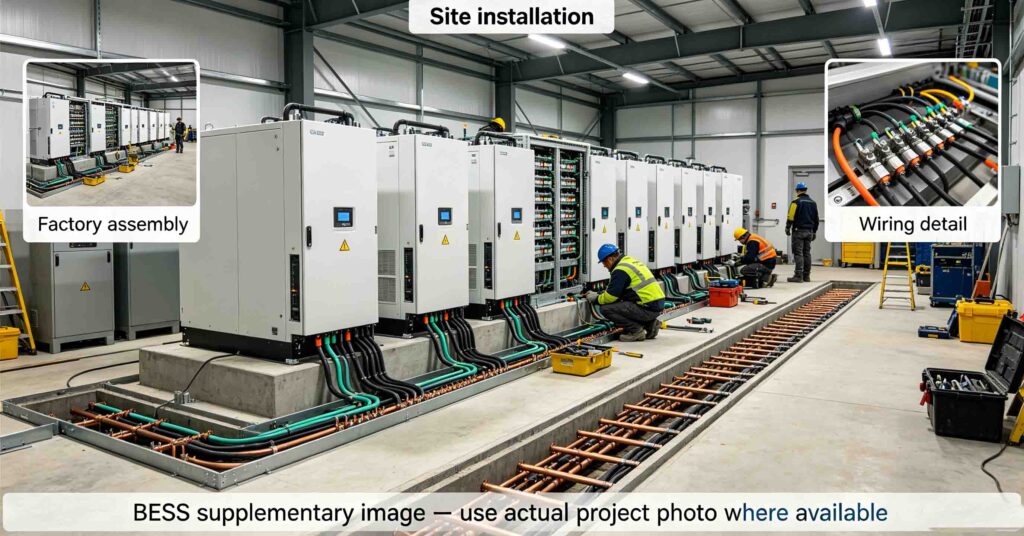
Factory: peak shaving and demand control
Peak demand charge is the fee a utility charges on your single highest 15-minute draw in a month — it can dominate a factory’s bill. A battery discharges during those peaks so the grid never sees the spike. Think of it as a buffer that flattens the top of your load curve.
Sizing starts from the site’s peak kW and the tariff’s demand window. A factory with a sharp daily peak but modest total energy needs a high-power, shorter-duration system — not the biggest kWh.
Campus: shared storage across buildings
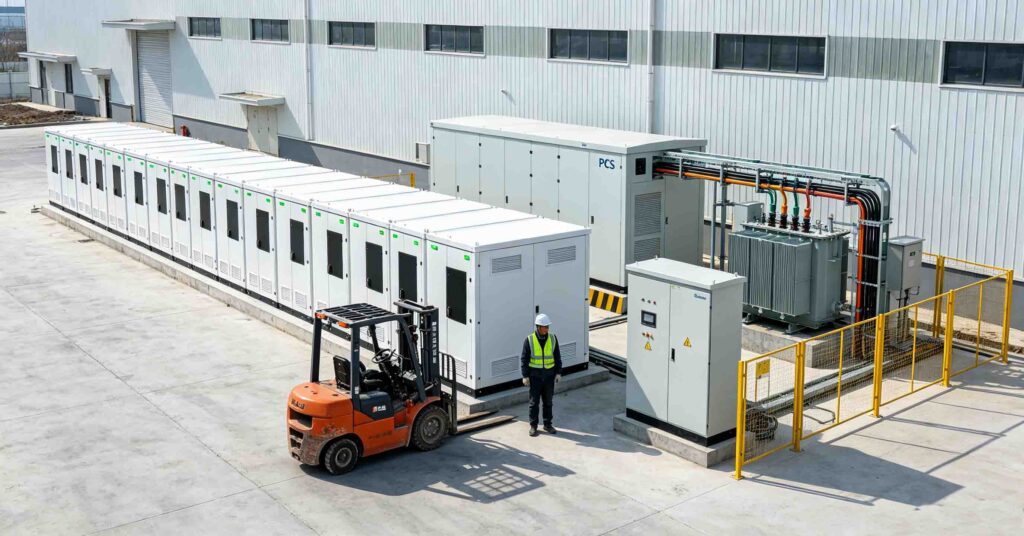
A campus (multiple buildings on one meter or microgrid) can pool storage to serve the whole site, charge from on-site solar, and ride through local outages. The win is coordination: one larger system often beats several small ones bolted to separate buildings.
Data center: seamless backup
Here the job is different — continuity, not savings. A data center cannot tolerate a transfer gap, so storage bridges the seconds between grid loss and generator start, then supports longer runtime. Power quality and response time matter more than daily arbitrage.
Site comparison
| Site | Primary job | What to size on | Key spec |
|---|---|---|---|
| Factory | Peak shaving | Peak kW + demand window | High continuous power |
| Campus | Shared solar + backup | Total site load | Scalable cabinets |
| Data center | Seamless backup | Critical IT load | Fast response, high availability |
ROI in plain terms
A factory pays back through lower demand charges and shifted solar; a campus through shared capacity and self-consumption; a data center through avoided downtime, which is often worth more than the energy saved. The payback driver differs by site, so the business case must be built per use case — not copied from a residential calculator.
Factory: peak-demand charge shaving
A factory pays a demand charge based on its highest 15-minute draw each month. A C&I battery injects power during those peaks, clipping the bill. The size follows the peak shape, not the roof. A 200 kW / 400 kWh cabinet can cut a meaningful share of a mid-size plant’s demand charge with a 2 h daily discharge.
Campus: self-consumption and resilience
A business park or school campus with rooftop solar uses storage to eat its own generation instead of exporting cheap and rebuying dear. It also rides through flickers that would stall a production line. Cabinets stack as load grows, which is why many campuses start at 100 kWh and expand.
Data center: continuity and grid services
A data center cannot tolerate a millisecond gap. Storage bridges the seconds between grid loss and generator start, and can also earn revenue in markets that pay for fast response. Here, power (MW) and response time matter more than hours of duration.
ROI by scenario
| Scenario | Primary driver | Typical duration | What to confirm |
|---|---|---|---|
| Factory | Peak demand charge | 1–2 h | Tariff shape, peak window |
| Campus | Solar self-use + resilience | 2–4 h | Load growth, roof area |
| Data center | Continuity + grid service | Sub-hour bridge | Response time, UPS interface |
Peak demand charge, in plain terms
Think of the demand charge like a taxi’s peak fare: the meter records your highest spike, and you pay for that spike all month. A battery is a buffer that caps the spike — like a friend who lends you cash at the exact expensive moment so the meter never catches it. The bigger and more frequent your spikes, the more a battery pays back.
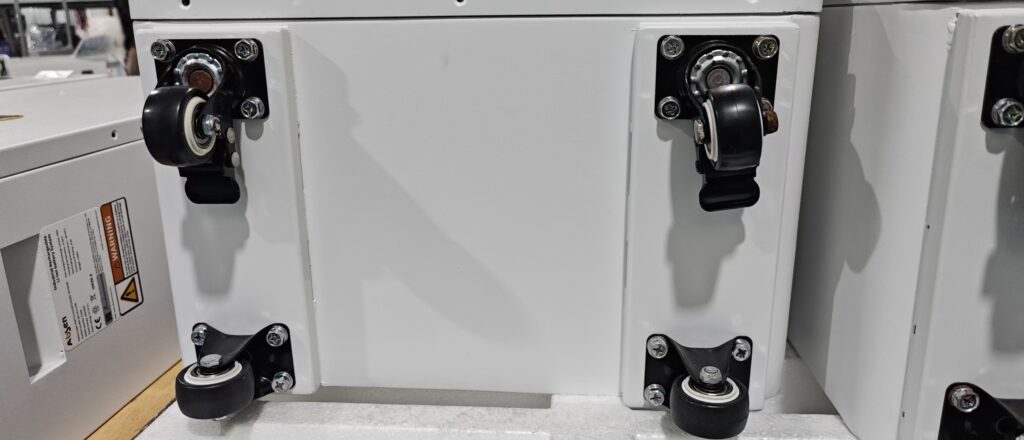
Why cabinets stack instead of one big block
Industrial load is rarely static. Cabinets let you add capacity as the site grows, spreading capital and avoiding a single oversized unit that sits half-empty. Modular also simplifies service: one cabinet can be taken offline without killing the whole site.
What an industrial buyer should verify
- PCS power vs the peak you intend to shave or bridge.
- Cycle life at your daily throughput, not the brochure number.
- Cooling and fire safety at enclosure level for your site class.
- Grid-code and communication compliance for any market participation.
- Delivery lead time — enclosure supply, not cells, is usually the long pole.
Safety and enclosure class
Industrial sites span warehouses, workshops, and clean rooms, each with different fire codes. Confirm the enclosure’s thermal and gas management meets your site class; cell-level certificates alone do not cover a rack in a dusty plant.
Common pitfalls
Buyers size to nameplate energy and forget the PCS power that actually clips the peak; or they skip grid-code compliance and cannot join the revenue market they counted on. Confirm both the power and the paperwork before sign-off.
A stacking plan in practice
A campus starting at 100 kWh might add 50 kWh per year as load grows. Because cabinets are modular, each addition is a separate, commissionable block — no redesign of the first. The buyer’s job is to confirm the PCS and site wiring were specified with headroom for the planned final size, so later cabinets simply plug in. Ask the supplier for the “max stack” the design supports before you commit. The cheapest way to scale is to avoid a premature oversized block that sits half-empty for years; modular lets capital follow need.
Grid-code readiness
If you intend to earn market revenue (frequency response, arbitrage), the system must speak the protocol your grid operator requires and meet their certification. This is a procurement item, not an afterthought — a battery that cannot comply sits idle on the revenue side. Confirm grid-code compliance in the RFQ and verify it at acceptance, not at go-live.
How to read a vendor’s claim
When a vendor says “pays back in three years,” ask for the model: which tariff, which load profile, which incentives. A credible claim shows the crossover point and the assumptions; a vague one hides them. The same discipline applies to cycle-life and efficiency numbers — request the test condition, not the headline.
One more check: the load study
Before signing, ask for a written load study, not a verbal estimate. A one-page profile of your peak, daily throughput, and growth forecast is what turns a sales pitch into a sized system you can defend to finance. If the vendor won’t produce it, that is itself the answer.
Q. What is industrial battery storage used for?
Mostly peak demand shaving, solar self-consumption, and backup. The mix depends on the site: factories lead with demand charges, data centers with continuity.
Q. How is industrial storage different from home storage?
Same cells, but far higher power and modular cabinets, with PCS and software for site control. Sizing is driven by tariff and process, not by roof size.
Q. How do you size a factory battery?
From the peak kW the site wants to shave and the utility’s demand window. A sharp short peak needs power and short duration; all-day shifting needs more kWh.
Q. Can one system serve a campus?
Often yes — a shared central system is usually cheaper and more flexible than per-building units, especially with on-site solar.
Q. Why does a data center need batteries if it has a generator?
Generators take seconds to start; storage bridges that gap with zero transfer interruption, protecting IT loads that cannot blink.
Planning industrial storage?
See C&I Solution page,review Commercial & Industrial Energy Storage Overview to build the ROI model, then choose Cabinet-Type Residential Energy Storage。send the electricity bill to leekooenergy for a demand-response sizing.