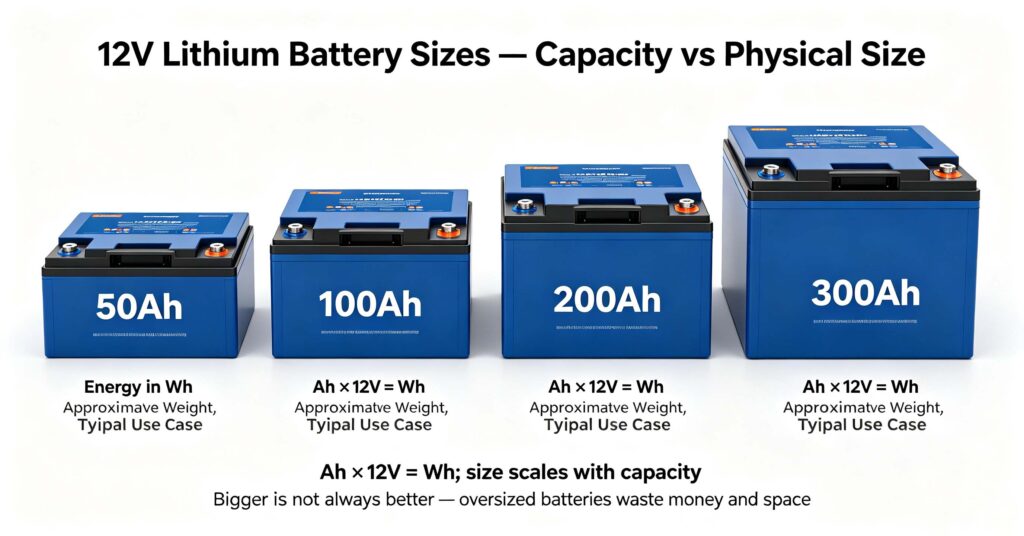
The question of which 12v lithium battery 100ah 200ah 300ah 50ah size you need comes down to daily energy use: 50Ah (about 640 Wh) suits small electronics and brief outages, 100Ah (1,280 Wh) is the most popular RV and solar backup size, 200Ah (2,560 Wh) handles larger loads or longer autonomy, and 300Ah (3,840 Wh) is for serious off-grid or high-draw systems. The math is simple: amp-hours times 12 volts gives watt-hours, and that number should cover your daily load plus a margin for depth of discharge. Choosing too small means the battery cycles hard and dies early; choosing too large wastes money and space.
For a buyer comparing the 12v lithium battery 100ah 200ah 300ah 50ah range, the choice is not about brand preference — it is about matching capacity to load. This guide compares the four sizes, their typical use cases and the trade-offs. For the 12V LiFePO4 technical background, see #70 12V LiFePO4 battery.
12v lithium battery 100ah 200ah 300ah 50ah: the four sizes compared
Each size serves a different load profile. The table below gives the energy, weight class and typical use case for each.
| Size | Energy (12V) | Typical weight | Best for |
|---|---|---|---|
| 50Ah | ~640 Wh | Light (~6–8 kg) | Electronics, brief backup, small trolling motor |
| 100Ah | ~1,280 Wh | Medium (~11–13 kg) | RV basics, solar backup, medium trolling motor |
| 200Ah | ~2,560 Wh | Heavy (~22–26 kg) | Larger RV, off-grid cabin, multiple loads |
| 300Ah | ~3,840 Wh | Very heavy (~35–40 kg) | Serious off-grid, high-draw systems, long autonomy |
For the deep-cycle application context, see #96 12V LiFePO4 deep cycle battery hub.
In practice, buyers often land on the 100Ah unit because it is the sweet spot: light enough to carry, cheap enough to double for redundancy, and compatible with nearly every 12V inverter, charger and DC-to-DC setup on the market. The 50Ah unit makes sense only when space and weight are the hard constraint — a kayak, a small solar shed, or a backup that sits idle most of the year. The 200Ah and 300Ah units are where buyers start to hit diminishing returns: a single 300Ah 12V battery can pull 150A or more on a large inverter, which means the cabling, fuse and charger all have to be upsized. If your load is genuinely that large, it is often worth stepping up to a 48V system rather than pushing 12V to its limit.
How to choose: match capacity to daily load
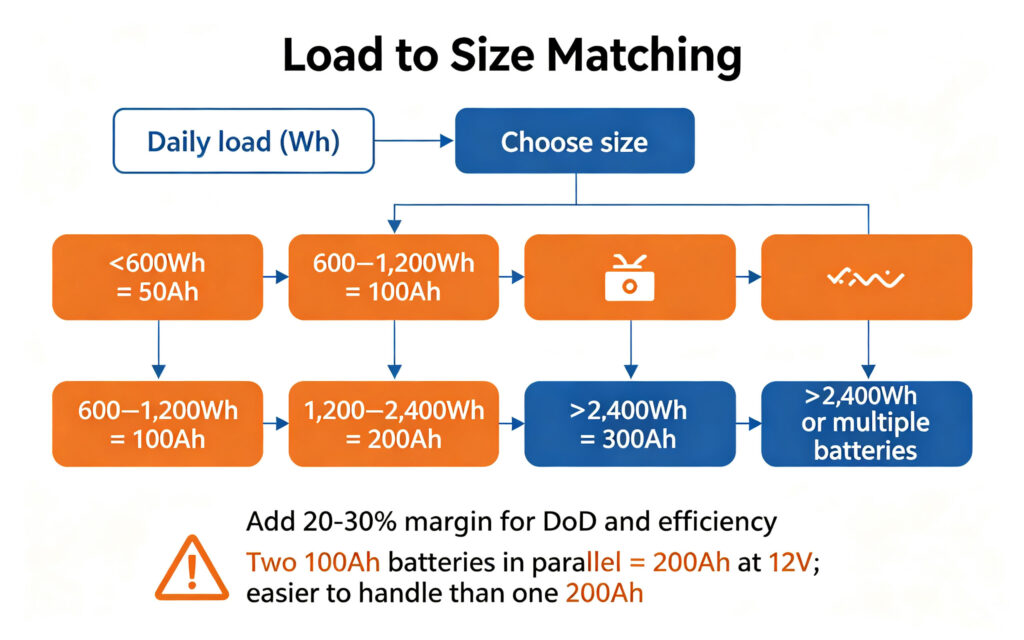
The practical answer to the 12v lithium battery 100ah 200ah 300ah 50ah question is a quick load calculation.
- List daily loads: add up the watt-hours each device uses per day (watts × hours).
- Divide by usable fraction: LiFePO4 can use about 80% of its capacity, so divide by 0.8 and by system efficiency (~0.9).
- Match to the nearest size: the result tells you which capacity range you need.
- Consider parallel options: two 100Ah batteries in parallel give 200Ah at 12V and are easier to handle than one 200Ah unit.
For the sizing method behind this, see #132 DIY battery sizing calculator.
A worked example makes the method concrete. Suppose a camper runs a 40W LED light for 4 hours (160 Wh), a 50W laptop for 3 hours (150 Wh), a 40W fan for 6 hours (240 Wh), and a 12V fridge that averages 30W over 24 hours (720 Wh). Daily load is about 1,270 Wh. Divide by 0.8 (usable depth) and 0.9 (round-trip efficiency) and you need roughly 1,760 Wh of stored energy — which points to a 200Ah 12V battery (2,560 Wh) rather than a 100Ah. This is why the “one 100Ah for every camper” rule of thumb fails: it ignores the fridge, which is usually the single largest load and the one that scales the system.
Weight and handling: the practical constraint
Beyond energy, the 12v lithium battery 100ah 200ah 300ah 50ah choice has a physical dimension that buyers often underestimate: weight.
50Ah and 100Ah are typically single-person portable, which matters for RV and marine use where the battery is removed or serviced.
200Ah and 300Ah require two people or a trolley. If the installation is fixed (cabinet, rack), weight is less of a concern; if it moves, parallel smaller units are easier.
For the rack-mount format that handles larger capacities, see #142 48V 300Ah rack mount lithium battery.
Charging current is the other practical constraint buyers miss. A 100Ah LiFePO4 battery charges comfortably at 50A; a 300Ah unit wants 100A or more to recharge in a reasonable time. If you are charging from a 20A DC-to-DC alternator charger, a 300Ah battery will take most of a driving day to refill, which defeats the purpose. Match the charger rating to the battery capacity — a common rule is 0.2C to 0.5C, so a 300Ah battery wants a 60–150A charger. This is also where parallel smaller batteries help: two 100Ah units can be charged by two smaller chargers, or split across separate charge sources, which is harder to arrange on a single 300Ah enclosure.
Q. What size 12V lithium battery do I need for an RV?
Most RV setups need 100Ah (about 1,280 Wh) for basic off-grid nights, including lights, a fridge and small electronics. If you run an air conditioner, microwave or longer autonomy, step up to 200Ah. Two 100Ah batteries in parallel give 200Ah at 12V and are easier to move than one 200Ah unit. Calculate your daily watt-hours first, then match the nearest size with a 20% margin.
Q. How long does a 12V 100Ah lithium battery last?
A 12V 100Ah LiFePO4 battery holds about 1,280 Wh. A fridge using 800 Wh per day runs for roughly 1.5 days before needing recharge, though real numbers vary with efficiency and temperature. On typical cycle life (4,000–8,000 cycles), the battery lasts 10–20 years if maintained within its operating range. The capacity determines runtime; the chemistry and care determine lifespan.
Q. Is a 200Ah battery better than two 100Ah batteries?
They deliver the same 200Ah at 12V. One 200Ah unit has a single enclosure and BMS, while two 100Ah batteries in parallel give flexibility (remove one for service, easier handling) but require a parallel connection and matched batteries. Fixed installations often prefer one 200Ah; portable or upgradable systems often prefer two 100Ah. The total capacity is the same.
Q. Can I use a 300Ah 12V battery in my RV?
Yes, but a 300Ah 12V battery is very heavy (often 35–40 kg) and physically large. It suits fixed RV installations or serious off-grid use where high-draw loads (air conditioning, appliances) need long autonomy. For typical RV use, 100Ah or 200Ah is usually sufficient. If the weight and dimensions fit the install location, a 300Ah battery simply provides more runtime; it does not charge faster or improve efficiency.
Q. What is the difference between 50Ah and 100Ah 12V lithium batteries?
The difference is capacity and energy: a 50Ah battery holds about 640 Wh while a 100Ah holds about 1,280 Wh — double the runtime for the same loads. The 50Ah is lighter and cheaper, suited to small electronics and brief backup; the 100Ah is the mainstream size for RV, solar and trolling motor use. They use the same 12V system voltage; the choice is how much energy you need stored.
Next step: size for your actual load
The right 12v lithium battery 100ah 200ah 300ah 50ah size is the one that matches your daily watt-hours with margin. Calculate first, then choose — and remember that parallel smaller batteries give the same capacity with easier handling.
- Read 12V LiFePO4 basics in #70
- Calculate load in #132
- See deep-cycle hub in #96
- Ask leekooenergy for a 12V LiFePO4 battery sized to your load, with the capacity, weight and dimensions documented before you buy