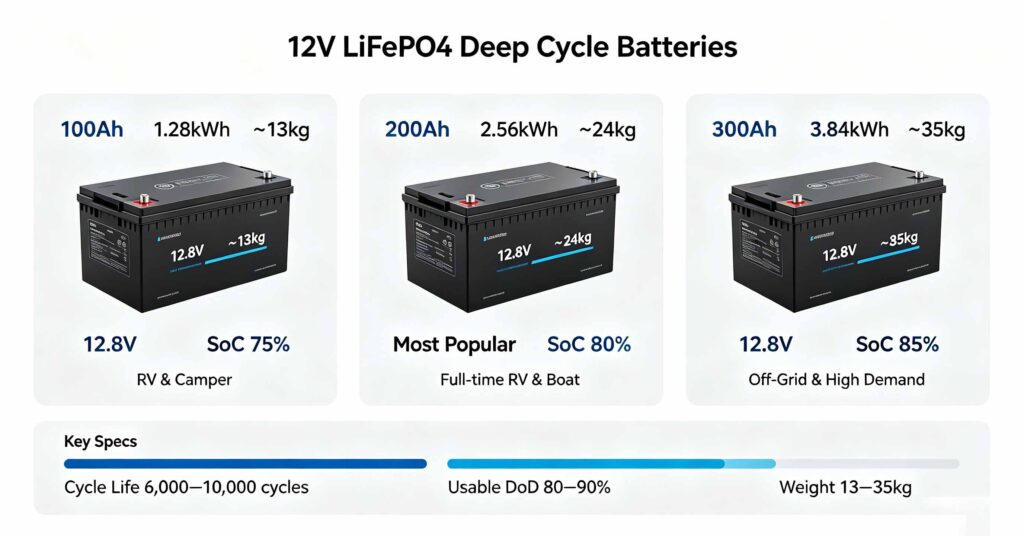
12V LiFePO4 deep cycle battery is a 12.8V nominal lithium iron phosphate battery designed for deep discharge cycles in RV, marine, off-grid solar, golf cart, and forklift applications. The three most common capacities are 100Ah (1.28kWh), 200Ah (2.56kWh), and 300Ah (3.84kWh), each delivering 80–90% usable depth of discharge and 6,000–10,000 cycle life — compared to 50% DoD and 1,000–2,000 cycles for equivalent AGM batteries. A 100Ah battery is suitable for small RVs, camper vans, and weekend use; a 200Ah battery is the most popular choice for full-time RVs, boats, and small off-grid cabins; a 300Ah battery is for high-demand applications like large boats, off-grid homes, and equipment power. All 12V LiFePO4 batteries require a charger with a LiFePO4-specific charge profile (14.2–14.6V bulk, no float or 13.5–13.8V maintenance float), and most include a built-in BMS for overcharge, overdischarge, overcurrent, and short-circuit protection.
The 12V deep cycle battery market is undergoing a fundamental shift from lead-acid (AGM, gel, flooded) to lithium iron phosphate (LiFePO4). A 12v lifepo4 deep cycle battery costs 2–3× more upfront than an equivalent AGM battery, but lasts 4–6× longer, delivers 60–80% more usable capacity, requires zero maintenance, and weighs 50–60% less. For RV, marine, and off-grid users who cycle batteries daily, the payback period is typically 2–4 years. This hub compares the three most popular 12V LiFePO4 capacities (100Ah, 200Ah, 300Ah), explains how to calculate the right capacity for your application, and covers charging requirements and common mistakes. For the broader 12V LiFePO4 system architecture, see #70 12V LiFePO4 batteries complete guide.
12V LiFePO4 deep cycle battery specifications: 100Ah vs 200Ah vs 300Ah
All 12V LiFePO4 deep cycle batteries use a 4-cell series configuration (4 × 3.2V = 12.8V nominal), with a built-in battery management system (BMS) that protects each cell. The primary difference between capacities is the number of parallel cell groups, which determines amp-hour capacity, weight, physical size, and maximum discharge current.
The table below compares the key specifications for the three most common 12V LiFePO4 deep cycle battery capacities. Note that exact specifications vary by manufacturer — these are typical values for high-quality batteries with prismatic or cylindrical LiFePO4 cells.
| Specification | 100Ah | 200Ah | 300Ah |
|---|---|---|---|
| Nominal voltage | 12.8V | 12.8V | 12.8V |
| Usable energy | 1.02–1.15 kWh | 2.05–2.30 kWh | 3.07–3.46 kWh |
| Cycle life (80% DoD) | 6,000–10,000 | 6,000–10,000 | 6,000–10,000 |
| Max continuous discharge | 50–100A | 100–200A | 150–300A |
| Max charge current | 50A | 100A | 150A |
| Weight | 11–14 kg | 22–26 kg | 33–38 kg |
| Typical dimensions (L×W×H) | 330×170×215mm | 520×270×220mm | 520×270×320mm |
| Typical price (USD) | $300–$500 | $550–$900 | $800–$1,300 |
| Best for | Camper van, weekend RV, trolling motor, small solar | Full-time RV, boat, off-grid cabin, golf cart | Large boat, off-grid home, equipment, high-demand |
How to calculate the right 12V LiFePO4 battery capacity
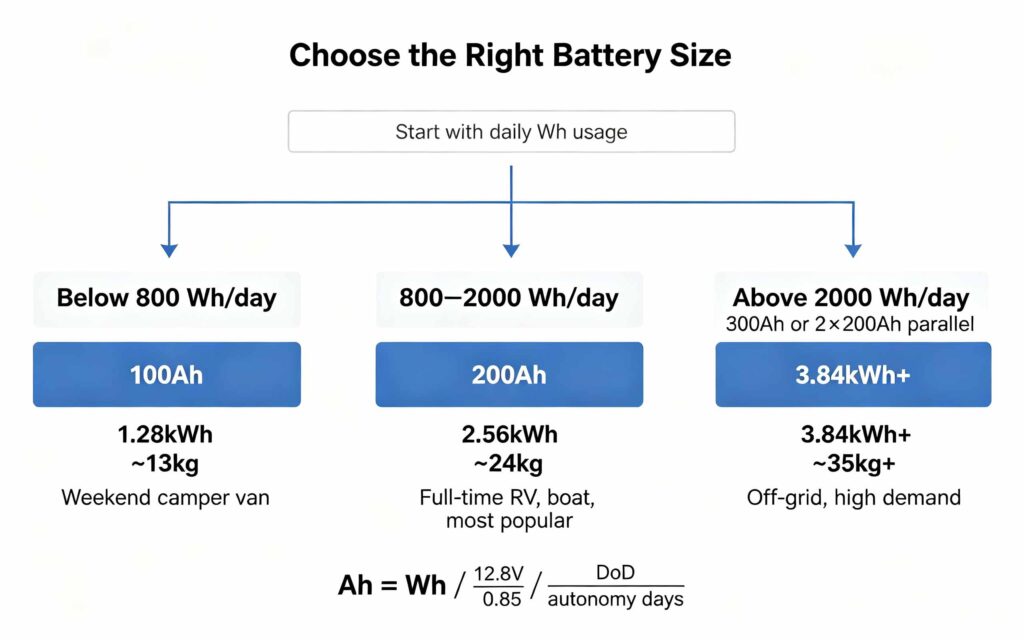
Choosing the right capacity for a 12v lifepo4 deep cycle battery requires calculating your daily energy consumption, desired autonomy days, and depth of discharge. The formula is: Required capacity (Ah) = Daily energy consumption (Wh) / Nominal voltage (12.8V) / Depth of discharge (0.80–0.90) / Desired days of autonomy.
For example, a camper van using 800Wh per day with 1 day of autonomy and 85% DoD needs: 800 / 12.8 / 0.85 / 1 = 73.5Ah → round up to 100Ah. A full-time RV using 2,500Wh per day with 1.5 days of autonomy needs: 2,500 / 12.8 / 0.85 / 1.5 = 153Ah → round up to 200Ah. An off-grid cabin using 4,000Wh per day with 2 days of autonomy needs: 4,000 / 12.8 / 0.85 / 2 = 184Ah → but for off-grid, most users install 2×200Ah (400Ah total) for redundancy and future expansion.
Key factors that increase your capacity requirement: inverter inefficiency (85–95%), cold weather (capacity drops below 0°C), high-draw appliances (air conditioning, microwave, electric water heater), and future load growth. A common rule of thumb is to calculate your requirement and then add 20–30% margin. It is always better to have more capacity than you need than to run out of power during a cloudy day or extended boondocking trip.
- List all 12V appliances and their wattage. Include lights, water pump, fridge, fan, phone chargers, TV, and any 12V devices. For AC appliances (microwave, coffee maker), divide wattage by inverter efficiency (0.90).
- Estimate daily usage hours for each appliance. Be realistic — a fridge may run 8 hours/day (compressor cycles), lights 4 hours/day, water pump 0.5 hours/day.
- Calculate total daily Wh. Multiply wattage × hours for each appliance and sum.
- Apply the formula. Ah = Wh / 12.8V / 0.85 DoD / autonomy days. Round up to the next standard capacity (100, 200, 300Ah).
- Add 20–30% margin for inefficiency, cold weather, and future loads.
12V LiFePO4 charging requirements and common mistakes
Charging a 12V LiFePO4 battery correctly is essential for maximizing cycle life and safety. The charge profile differs significantly from lead-acid: LiFePO4 requires a bulk charge at 14.2–14.6V (depending on manufacturer), followed by either no float stage or a low maintenance float at 13.5–13.8V. A standard AGM charger using 14.8V absorption and 13.2V float will undercharge or potentially damage a LiFePO4 battery.
The maximum charge current is typically 0.5C (50A for 100Ah, 100A for 200Ah, 150A for 300Ah), but charging at 0.2–0.3C extends cycle life. For solar charging, use a solar charge controller with a LiFePO4 setting (MPPT recommended for efficiency). For alternator charging in RVs and boats, use a DC-DC charger with LiFePO4 profile — do not connect the battery directly to the alternator, as the alternator voltage may be too high or too low.
The most common charging mistakes are: using an AGM charger (wrong voltage profile), overcharging (exceeding 14.6V for extended periods), charging below freezing (LiFePO4 should not be charged below 0°C — the BMS will prevent it, but you should plan for it), and using an undersized charger (a 10A charger on a 300Ah battery takes 30+ hours to fully charge).
Q.What is the difference between 12V LiFePO4 and 12V AGM deep cycle batteries?
12V LiFePO4 batteries offer 4–6× longer cycle life (6,000–10,000 vs 1,000–2,000 cycles), 60–80% more usable capacity (80–90% vs 50% DoD), 50–60% less weight, zero maintenance, and faster charging. AGM batteries are cheaper upfront, more tolerant of cold weather charging, and do not require a special charger. For daily-cycling applications (RV, marine, off-grid), LiFePO4 typically pays back in 2–4 years through longer life and higher usable capacity. For occasional-use or standby applications, AGM may be more cost-effective.
Q.How long will a 12V 200Ah LiFePO4 battery last?
A 12V 200Ah LiFePO4 battery provides 2.56kWh nominal and 2.05–2.30kWh usable energy (at 80–90% DoD). How long it lasts depends on your load: a 50W load (lights + phone charging) lasts 40–46 hours; a 200W load (fridge + lights + water pump) lasts 10–11.5 hours; a 500W load (microwave + TV + lights) lasts 4–4.6 hours; a 1000W load (air conditioner or electric heater) lasts 2–2.3 hours. In cycle life terms, a 200Ah LiFePO4 battery lasts 6,000–10,000 cycles, which is 16–27 years if cycled once daily — though most users see 10–15 years of practical life due to partial cycling and calendar aging.
Q.Can I charge a 12V LiFePO4 battery with a regular car battery charger?
No, not unless the charger has a selectable LiFePO4 or lithium charge profile. A regular car battery charger (lead-acid/AGM) typically uses 14.4–14.8V absorption and 13.2–13.4V float, which can undercharge or potentially damage a LiFePO4 battery. LiFePO4 requires 14.2–14.6V bulk and either no float or a 13.5–13.8V maintenance float. Many modern smart chargers have a “lithium” or “LiFePO4” mode — if yours does, select it. If not, purchase a LiFePO4-specific charger or a charger with selectable chemistry. Never use a constant-voltage charger set above 14.6V for LiFePO4.
Q.Can I connect two 12V LiFePO4 batteries in parallel?
Yes, but only if they are identical (same model, capacity, age, and internal resistance) and matched to within 0.05V (50mV) before connecting. Parallel connection doubles capacity while keeping voltage the same (e.g., 2×200Ah in parallel = 12.8V 400Ah). Each battery must have its own BMS, and the BMS units should be designed for parallel operation (typically master-slave or CAN bus coordination). Use individual fuses on each battery positive terminal, equal-length cables, and a common busbar. Do not parallel batteries from different manufacturers or with different capacities, as this causes uneven current sharing and accelerated degradation. For more details, see #93 parallel battery packs safe capacity scaling.
Q.What is the best 12V LiFePO4 deep cycle battery for RV use?
The best 12V LiFePO4 battery for RV use depends on your budget and power needs, but key features to look for are: built-in BMS with low-temperature charge cutoff (essential for cold weather camping), Bluetooth monitoring (to track state of charge and cell balance), a metal or durable plastic case (for vibration resistance), and a reputable manufacturer with a 5–10 year warranty. For most RVs, a 200Ah battery is the sweet spot — it provides 2+ days of basic use (fridge, lights, water pump, device charging) and can be paired with 200–400W of solar for indefinite off-grid use. For small camper vans or weekend use, a 100Ah battery is sufficient. For full-time RVs with high power demands (air conditioning, electric cooking), consider 2×200Ah or a 300Ah battery. Always verify the battery is UL 1973 certified for safety.
Next step: size your 12V LiFePO4 battery and verify charger compatibility
Choosing the right 12v lifepo4 deep cycle battery capacity is the difference between running out of power on a cloudy day and having reliable energy for your entire trip. Calculate your daily usage honestly, add 20–30% margin, and verify that your charger, solar controller, and alternator charging system all support LiFePO4 charge profiles. The most expensive mistake is buying a battery that is too small or charging it with an incompatible charger — both shorten battery life and can create safety risks.
- Read the 12V LiFePO4 system guide in #70
- Learn about AGM to LiFePO4 upgrades in #86
- Understand parallel battery connections in #93
- Review LiFePO4 chemistry fundamentals in #1
- Ask leekooenergy for a 12V LiFePO4 deep cycle battery specification that includes: recommended capacity (Ah) based on your daily energy calculation, exact battery dimensions and weight for your installation space, required charger type and charge profile (bulk/float voltages), solar charge controller compatibility (MPPT/PWM and voltage settings), alternator charging solution (DC-DC charger or VSR), parallel/series configuration options, BMS features (low-temp cutoff, Bluetooth, cell balancing), and UL 1973 certification verification — so your 12V LiFePO4 battery is correctly sized, safely charged, and compatible with your entire RV, marine, or off-grid system