The shortest answer: evaluate an inverter supplier the way you would evaluate a platform partner, not a component vendor — on product-line coverage and roadmap, on certifications for every market you sell into, on the depth of their battery compatibility programme, on warranty structure and the service network behind it, on firmware and monitoring quality, and on manufacturing track record. The inverter is the piece of a storage system that talks to everything else, and the switching cost of a bad choice is a full fleet. Most PV inverter manufacturers look similar on a datasheet; the differences appear in compatibility lists, warranty terms and what happens when you need support in year four.
Choosing the inverter itself — topology, sizing, single versus three-phase — is a technical exercise covered in #17 how to choose a storage inverter. This guide is about the decision before and around that one: which manufacturer earns a place in your supply chain. The distinction matters because installers and distributors do not buy one inverter; they standardise on a platform, train teams on it, stock spares for it, and answer to customers when it misbehaves. A supplier evaluation is therefore an evaluation of a multi-year relationship, and it deserves a structured method.
Dimension 1: Product line coverage and roadmap
The first check is whether the manufacturer’s catalogue matches where your market is going, not just where it is. A supplier whose hybrid range stops at the residential boundary cannot follow you into small commercial projects; a supplier with no low-voltage battery platform strands your retrofit business. Look for range coherence: power ratings that step cleanly from residential to commercial, a common monitoring platform across the range, and accessories — meters, rapid shutdown, energy management gateways — that complete real installations. Then look at the roadmap conversation: established PV inverter manufacturers publish where their platform is heading, and a supplier who cannot describe next year’s range is a supplier whose range you are inheriting without a map.
The catalogue conversation should also cover the transition points. Where does the residential range hand over to the commercial range, and what does a customer gain or lose at that boundary — monitoring continuity, battery reuse, installer tooling? Suppliers whose ranges were assembled by acquisition often have seams at exactly these points, and the seams are where multi-site installers feel them.
Dimension 2: Certifications for your markets
Inverter certification is market-specific and non-negotiable: grid codes differ, and an inverter approved for one grid is not automatically legal on another. For each market you sell into, verify the grid-compliance certification for the exact model and firmware version, plus the safety certifications the market requires. Two practical cautions: certification applies to firmware versions, so a field-updated inverter can drift from its approved state — ask how version control works; and certification scope varies by model within a range, so check the certificate, not the brochure. The same discipline applies on the battery side of the system, which is covered from the buyer’s perspective in #21 how to evaluate battery manufacturers.
Dimension 3: Battery compatibility depth
For storage-focused buyers this is the dimension that most often decides the evaluation. An inverter’s battery compatibility list is not a checkbox — it is the supplier’s statement of which combinations they have tested and will support. Evaluate its breadth (how many battery platforms, including the ones you actually sell), its depth (which functions survive the pairing: full charge control, state-of-charge accuracy, load management), and its governance (who maintains the list, how often it updates, what happens when a firmware release breaks a pairing). The communication protocols behind those pairings — CAN, RS485 and the vendor protocols layered on them — are covered in detail in #18 battery-inverter compatibility. A supplier whose compatibility answer is “it should work with anything” is telling you they have not tested it with anything.
Dimension 4: Warranty structure and the service network behind it
Warranty evaluation has three layers. The headline term is the years or energy throughput promised. The conditions are what voids it — installation by certified installers only, registration deadlines, firmware-update obligations, transferability when the customer sells the property. The execution is the part most buyers never check until it is too late: who diagnoses the fault, who ships the replacement, in what time, and who pays the labour. A strong warranty executed through an understaffed service channel is a slow warranty. Ask for the actual claims process document, the advance-replacement policy if any, and the name of the local service contact — in writing, before the order.
Spares logistics deserve their own question. Inverters fail rarely but not never, and when one fails the customer measures your business in days of downtime. Ask where the regional spare stock sits, what the lead time is on a replacement unit versus a repair, and whether advance replacement is offered for units under warranty. A supplier whose spares strategy is “ship from the factory” is workable for planned projects and punishing for installed fleets.
Dimension 5: Firmware, software and monitoring
Modern inverters are software products with power stages attached. Evaluate the monitoring platform the way you would evaluate any SaaS tool you are about to depend on: is there a fleet view for installers, alarm routing, remote diagnostics, export of historical data? Evaluate the firmware practice: how are updates delivered, can they be deferred and scheduled, and is there a documented regression path? An update that improves one market’s grid code can break a battery pairing — this is exactly where dimension 3 and dimension 5 meet, and where established PV inverter manufacturers with disciplined release processes separate themselves from catalogue assemblers.
Dimension 6: Manufacturing track record and supply reliability
The final dimension is the least glamorous and the most decisive at scale: can this supplier deliver, consistently, for years? Look at production footprint and vertical integration, field-fleet size and years in operation, failure and return patterns disclosed in distributor references, and lead-time stability across a full ordering cycle. The battery-pairing angle matters here too: a supplier whose delivery of the inverter and your battery platform’s delivery are mismatched turns every project into a sequencing problem. Distributors running multi-brand programmes should also ask about channel policy — pricing transparency, territory rules, and whether the manufacturer sells around its partners in your market.
Turning the dimensions into a decision
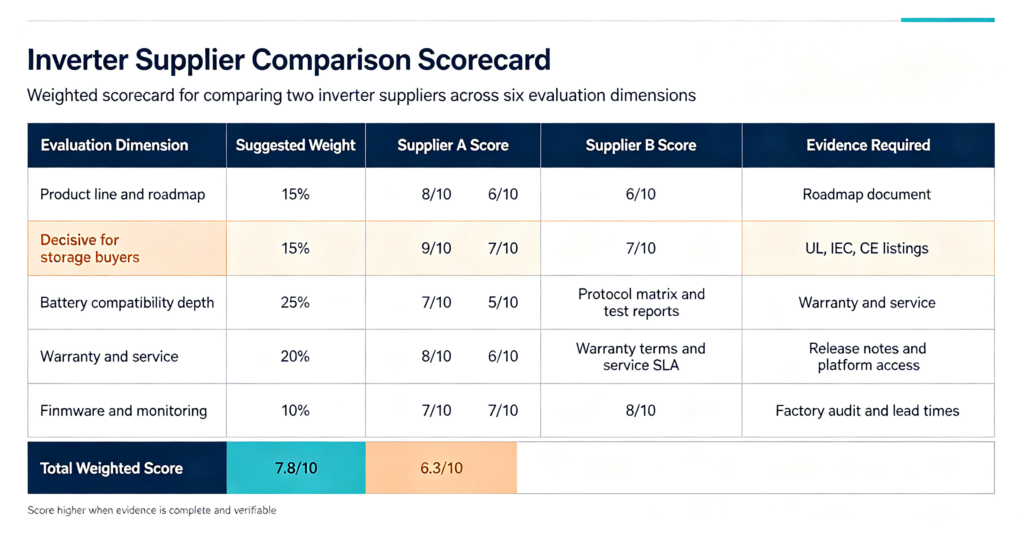
| Dimension | Suggested weight | Evidence to demand |
|---|---|---|
| Product line and roadmap | 15% | Full catalogue, platform roadmap briefing, accessory availability |
| Market certifications | 20% | Certificates per model and firmware version, per market |
| Battery compatibility depth | 25% | Published compatibility matrix, tested-pairing documentation, update policy |
| Warranty and service execution | 20% | Warranty document, claims process, local service contact, references |
| Firmware and monitoring | 10% | Fleet platform demo, release notes history, update policy |
| Manufacturing and supply reliability | 10% | Production footprint, delivery performance, channel policy |
The weights above are a starting point, not a rule — a pure residential retrofit business should shift weight toward compatibility and service execution; a utility-adjacent EPC should shift toward certifications and supply reliability. What the table forces is the discipline of scoring evidence rather than impressions: a dimension with no document behind it scores zero, whatever the sales conversation felt like.
Red flags that end evaluations early
- Compatibility by assertion: no published battery list, or a list that cannot be versioned or dated.
- Certificates that do not match: brochure claims a market the certificate does not cover, or the model on the certificate is not the model quoted.
- Warranty without process: a term sheet with no claims procedure, no response times and no named service channel.
- Firmware surprises: mandatory updates with no release notes, or field reports of pairings breaking after updates.
- Channel ambiguity: the manufacturer competes with its own distributors in your territory, or pricing is opaque to your customers.
- Reference silence: no installer or distributor willing to talk about year-three experience with the supplier.
Q.Should I standardise on one inverter supplier or split across two?
One supplier buys you training efficiency, spares simplicity and negotiating weight; two suppliers buy you resilience and leverage. The common pattern is a primary platform carrying most installations, plus a qualified secondary for the segments or markets the primary does not cover well. Evaluate both with the same scorecard so the split is a decision, not an accident.
Q.How much do inverter brands matter versus battery brands?
In a storage system they matter as a pair: the battery-inverter compatibility is what the field experiences, more than either name alone. A strong battery on an untested pairing behaves worse than a modest battery on a well-supported one. Evaluate the pairing evidence first and the individual brands second; the compatibility guide linked above covers what that evidence looks like.
Q.What is the single most under-checked item in inverter procurement?
Warranty execution. The term and conditions get read; the claims process — who diagnoses, who ships, how fast, who pays labour — gets discovered during the first failure. Ask for the process document and a reference who has actually been through a claim before signing.
Q.Do PV inverter manufacturers certify their batteries too?
Some manufacturers operate across both product classes, but most inverters and most batteries come from different companies, which is exactly why compatibility programmes exist. What matters to a buyer is not who manufactures what, but who has tested the specific pairing and who supports it in the field. Treat the compatibility matrix and its governance as a first-class procurement document.
Q.How often should a supplier evaluation be repeated?
Formally, whenever something material changes: a firmware platform transition, a market entry, a certification lapse, or a shift in your own project mix. Practically, a light annual review of the scorecard — certificates still valid, compatibility list still current, service performance still on terms — catches most drift before it reaches a customer.
Next step: score your candidates on evidence
Take the six dimensions and the weights to your next supplier meeting, and score documents rather than impressions. On the battery side of the pairing, the same discipline applies.
- Choose the machine itself with #17 how to choose a storage inverter
- Master the pairing rules in #18 battery-inverter compatibility
- Apply the factory audit method from #21 evaluate battery manufacturers
- Settle the topology question via #43 AC vs DC coupling
- Ask leekooenergy for the current battery-inverter compatibility matrix covering your platform and markets