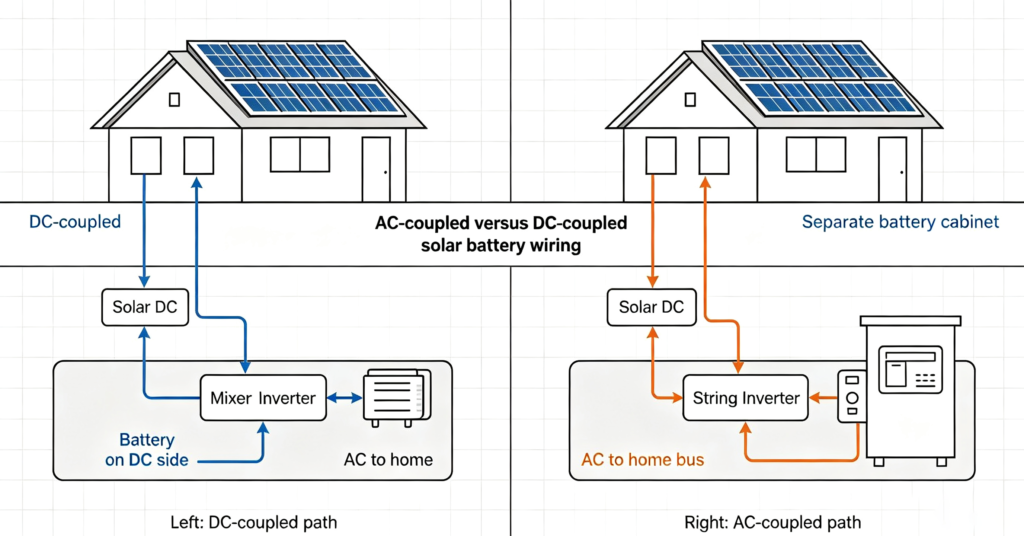
The shortest answer: choose a DC-coupled solar PV battery storage system when you are building new or replacing the inverter anyway, because the battery shares the DC bus with the solar charge path, uses a single hybrid inverter, and loses the fewest percentage points when solar charges the battery. Choose an AC-coupled system when you already own a solar inverter you want to keep, because the battery connects on the AC side with its own built-in inverter and can be added to almost any existing PV installation, string or microinverter. In most cases the buyer is not really choosing between two equal products; they are choosing between “new build, one integrated system” and “retrofit, add a battery to equipment I already own.”
Every solar PV battery storage quote you receive will assume one of these two topologies, and the difference is invisible until installation day, when it decides which cables, which inverter and which upgrade path you get. This guide explains what the coupling point is, walks through both architectures step by step, and then translates the difference into efficiency, cost and expansion decisions an installer or homeowner can act on. Related buying questions are linked inline.
What “coupling” means in a solar battery system
Coupling describes the electrical bus that the battery connects to. A solar-plus-storage home has two buses: a DC bus, where solar panels and batteries exchange DC power directly, and an AC bus, where the home and the grid exchange AC power. A solar PV battery storage system is DC-coupled when the battery sits on the DC side of the inverter, and AC-coupled when the battery carries its own inverter and connects on the AC side. The coupling point matters because it decides how many times power is converted between solar generation and battery charge, and conversion stages are where efficiency is lost.
One adjacent question deserves naming so it stays separate. “All-in-one versus split” asks whether the battery and inverter share a cabinet; coupling asks which electrical bus the battery talks on. A split system can be DC-coupled, an all-in-one cabinet is usually DC-coupled internally, and an AC-coupled battery is by definition a separate AC device. The cabinet question is covered separately in #42 all-in-one vs split systems.
How a DC-coupled system works
In a DC-coupled layout the solar DC output feeds a charge path that charges the battery directly on the DC bus, and one bidirectional hybrid inverter converts DC to AC for the home. The energy flow for self-consumption is: solar DC to the battery as DC (one conversion-free transfer inside the DC bus), then battery DC to AC through the inverter when the home needs it. When the sun is shining and the home load is low, solar charges the battery without ever becoming AC in between; that single-stage path is the reason DC coupling posts better solar-to-battery round-trip efficiency.
Component count is small: panels, one hybrid inverter with an integrated or external MPPT, a battery on the inverter’s DC port, and the home AC panel. That makes DC coupling the natural choice for new construction and full retrofits where no legacy inverter survives. It is also the layout inside most all-in-one energy storage cabinets. Two practical constraints come with it. First, the battery must be electrically and communicatively compatible with the hybrid inverter — same voltage platform and protocol — because they share a DC bus; the rules are the ones in #18 battery-inverter compatibility. Second, the inverter is the system’s only power-conversion brain, so if you later want a different inverter feature set, you replace the brain that the battery depends on.
Because the solar array and battery share one DC bus, DC-coupled sizing is chosen as one system: MPPT voltage window, battery platform and inverter rating are matched by design. Buyers who want to shop battery brands independently will find the choice constrained to the inverter family’s DC-port compatibility list — a constraint that is the trade-off for the efficiency. The 48 V versus 51.2 V platform question that usually follows is treated in #12 48V vs 51.2V.
How an AC-coupled system works
In an AC-coupled layout the existing solar inverter keeps doing exactly what it did before: it converts solar DC to AC for the home and the grid. The battery is added as a separate AC device — a battery cabinet with its own bidirectional inverter and BMS — that connects to the home AC bus. When solar production exceeds the home load, the AC surplus flows backward into the battery’s inverter, which rectifies it to DC and charges the cells. At night or during a grid outage, the battery’s inverter does the reverse and powers the home.
The defining advantage is that the battery does not care what produced the AC it receives. It works behind a string inverter, behind microinverters, behind an older inverter that has no battery port, and even behind a solar array added years after the battery. That makes AC coupling the standard answer to the most common retrofit question: “I already have solar — can I add a battery?” The solar asset is not stranded, no rewiring of the DC array is required, and the battery can be sized, expanded and replaced independently of the PV inverter. Brand mixing is also easier, since the two sides meet only as AC — though communication still matters for features like self-consumption optimisation, which is why the compatibility checklist in #18 covers the CAN/RS485 handshake between an AC battery and a smart meter or gateway.
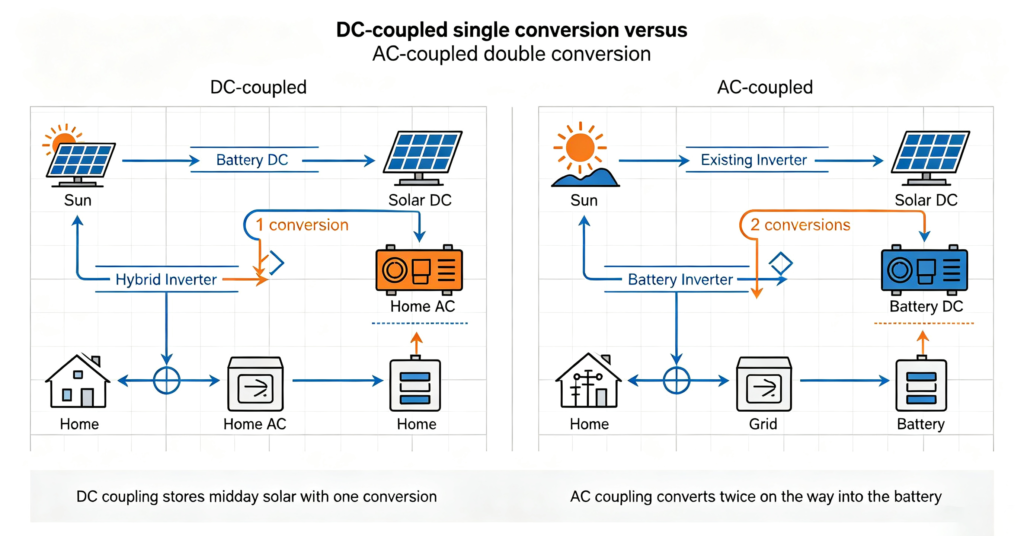
The cost of that independence is an extra conversion. Solar energy that ends up in the battery has already been converted once by the solar inverter (DC to AC) and is converted a second time inside the battery (AC to DC). Each stage carries losses, so the solar-to-battery path of an AC-coupled system loses more percentage points than the equivalent DC-coupled path. The battery’s grid-charging path, by contrast, is a single AC-to-DC conversion and is broadly comparable in both topologies — which is why an AC-coupled battery used mainly for time-of-use arbitrage and backup loses less of its advantage than one used mainly to store midday solar surplus.
Where the efficiency difference actually comes from
Datasheets quote round-trip efficiency as one number, but buyers should split it into two paths. The solar-to-battery path is where AC and DC coupling diverge: DC coupling moves solar energy into the battery with one conversion, AC coupling with two, and the cumulative difference is a few percentage points in real installations. The battery-to-home path is nearly identical in both topologies — stored DC becomes AC once, through the hybrid inverter or the battery’s own inverter. An AC-coupled battery charged from midday solar and discharged in the evening pays the double-conversion penalty every cycle; one charged mainly from the grid in off-peak hours does not.
The honest comparison is therefore the round-trip figure for the path the battery will actually use most, measured at the operating band rather than peak rating. Independent efficiency lists from testing and certification bodies — for example the CEC eligible equipment database — are a better cross-check than marketing figures. In absolute terms, do not expect a wide whole-system gap: both topologies lose most of their energy in the same power electronics, and a well-installed AC system can beat a poorly installed DC system. The topology sets the ceiling; hardware and installation decide how close you get.
Retrofit, cost and expansion trade-offs
Start with the asset on the wall. If a healthy solar inverter is installed and mid-life, AC coupling preserves it and adds storage for the price of the battery unit plus light AC wiring. Replacing that working inverter with a hybrid only to gain DC coupling is usually the most expensive route to storage — new inverter, disposal and rewiring on top of the battery. If the inverter is old, out of warranty or being upgraded anyway, DC coupling removes the efficiency penalty and leaves one inverter instead of two.
First cost follows the same logic. A new DC-coupled build typically quotes with fewer power-electronics boxes: one hybrid inverter instead of a solar inverter plus a battery inverter. An AC-coupled retrofit typically quotes lower because it reuses the largest existing component. Expansion behaves differently too: a DC-coupled battery grows within its inverter’s DC-port limits and voltage platform, while an AC-coupled battery grows by adding more AC battery capacity or a second AC battery unit, bounded mainly by export rules and the home panel rather than by inverter DC-port headroom. Monitoring and support are the last consideration: DC coupling usually means one vendor, one app and one firmware family, whereas AC coupling means two vendors whose systems must at least agree on meter readings and charge timing.
One configuration trap deserves a warning before any quote is signed. Some hybrid inverters marketed as “DC-coupled” also accept an AC-coupled second battery, and some AC batteries pair with a smart meter to manage surplus. Mixed topologies work, but each extra coupling point adds a conversion stage and a communication dependency. Keep the topology count as low as the site allows, and write down which path each device will use before comparing efficiency claims.
AC-coupled vs DC-coupled at a glance
| Decision factor | DC-coupled | AC-coupled |
|---|---|---|
| Battery connection point | DC bus, inside the inverter | AC bus, with its own inverter |
| Best starting point | New build or full inverter replacement | Retrofit onto an existing solar inverter |
| Solar-to-battery conversion | One stage | Two stages |
| Typical equipment count | One hybrid inverter | Solar inverter + battery inverter |
| Works with microinverters | Not directly | Yes |
| Battery brand mixing | Limited by DC-port compatibility | Easier at the AC bus |
| Battery expansion path | Within inverter DC-port limits | Add AC battery capacity |
| Vendor / app count | Usually one | Usually two |
| Best for solar surplus storage | Yes, fewer losses | Works, slightly less efficient |
| Best for grid arbitrage + backup | Equal | Equal |
A five-question decision checklist
Run these five questions against your site and the topology recommends itself:
- Is there a working solar inverter I am keeping? Yes → AC coupling preserves it. No → DC coupling is on the table.
- Is this a new build where nothing exists yet? Yes → DC coupling with a hybrid inverter is usually the cleaner, more efficient starting point.
- Will the battery mainly store midday solar surplus? Yes → the DC-coupled single-conversion path pays for itself over the battery’s life.
- Is the site on microinverters or an older string inverter? Microinverters or legacy hardware → AC coupling is effectively the only clean option.
- Who services the system and how many vendors can they handle? One remote vendor → DC coupling’s single-ecosystem support has real value; a capable local installer → AC coupling’s mix-and-match flexibility is safe.
Whichever topology wins, the battery and its power electronics must be able to talk to each other for metering, charge control and export limiting. Verify the protocol and role match before purchase rather than after — the checks in #18 battery-inverter compatibility apply to both the DC handshake inside a coupled system and the AC-side meter communication of a retrofit battery.
Which is more efficient, AC-coupled or DC-coupled solar battery storage?
DC coupling is more efficient on the solar-to-battery path because the energy is converted once instead of twice. The difference is a few percentage points of round-trip loss in real installations. On the battery-to-home path and on grid charging, the two topologies are broadly comparable. If the battery mainly stores midday solar surplus, the DC-coupled advantage compounds every cycle.
What is the difference between AC coupling and DC coupling?
The difference is where the battery connects. DC coupling puts the battery on the DC side of a hybrid inverter, sharing the DC bus with the solar array. AC coupling gives the battery its own inverter and connects it to the home AC bus, so it can work behind any existing solar inverter, including microinverters.
Can I add a battery to my existing solar panel system?
In most cases yes, and the usual route is AC coupling: the battery connects on the AC side and does not disturb the existing solar inverter. A DC-coupled addition is possible only if your current inverter has a battery port and supports the battery’s voltage platform and protocol. Check the inverter model before buying anything.
Is AC coupling or DC coupling better for off-grid systems?
Most off-grid builds use DC coupling with a hybrid or off-grid inverter, because the single DC bus makes solar charging efficient and simplifies generator and backup logic. AC coupling appears in off-grid sites mainly when an existing AC solar inverter is being reused, and then a battery inverter that supports generator input should be chosen carefully.
Do AC-coupled batteries work with microinverters?
Yes. Microinverters output AC, so an AC-coupled battery with its own inverter connects on the same AC bus without touching the microinverters. This is one of the most common retrofit configurations. The main requirement is that the battery can read the home’s import and export to decide when to charge and discharge, usually through a meter or current transformer.
Next step: fix the topology, then size and match the parts
The coupling decision narrows the catalogue but does not size the system or confirm the parts will talk to each other. Work through the sizing, voltage and compatibility guides before comparing quotes.
- Size the battery with #09 home battery sizing
- Choose the hybrid inverter in #17 storage hybrid inverter selection
- Check the DC voltage platform in #12 48V vs 51.2V
- Confirm battery-inverter handshakes in #18 compatibility guide
- Compare the cabinet question in #42 all-in-one vs split systems
- Browse leekooenergy hybrid-inverter-ready batteries and AC-coupled storage options for home