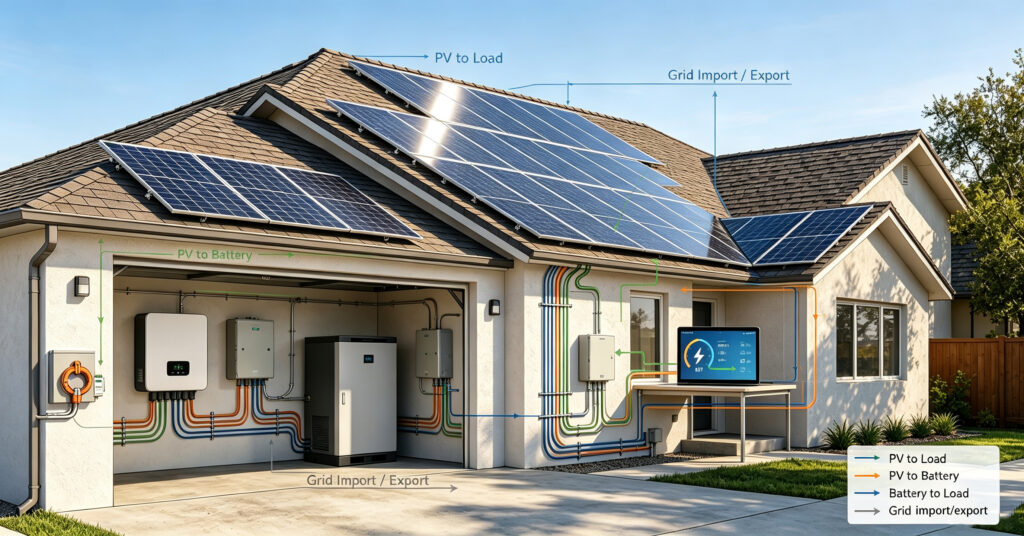
The shortest answer: a hybrid solar plus battery storage system is built as a sequence of five decisions, not a shopping trip. Define what the system must do — self-consumption, backup, or both. Pick the coupling architecture — one hybrid inverter, AC coupling, or DC coupling — before buying anything. Size the array and the battery against the same load profile. Choose equipment that shares one communication stack. Commission in an order that proves each layer before the next depends on it. Projects that start with hardware and work backwards are the ones that get rebuilt; projects that start with a one-page energy plan usually get built once.
The word hybrid does the heavy lifting here: it means the generation side and the storage side are engineered as one project, with one control strategy, instead of a solar installation that happens to have a battery bolted on later. That single framing changes everything downstream — the inverter topology, the sizing math, the wiring, and even the order in which the system is powered up. This guide walks the whole path from blank page to commissioned system: scoping, architecture, sizing, the equipment checklist, the build order and the economics check that justifies the budget. The electrical coupling question gets a deeper treatment in #43 AC vs DC coupling, the off-grid variant has its own guide in #23 off-grid solar systems, and the day-to-day payoff of self-consumption is covered in #27 solar self-consumption.
Start with the energy plan, not the equipment
Every buildable system begins with three numbers and one sentence. The numbers: the site’s daily energy use, the share of that use that happens after the sun is down, and the critical loads that must survive an outage. The sentence: what the system is for. A system built for self-consumption is sized to catch the evening peak. A system built for backup is wired around a critical-loads panel. A system meant for both needs a control strategy that can tell the difference — and a buyer who wants both without saying so pays for capabilities twice.
The load profile also decides the honest answer to a question buyers often ask too late: how much of the bill can storage actually touch? A site that consumes most of its energy during daylight — an office, a workshop on day shifts — has little evening load for a battery to serve, and a larger array exporting under a favourable tariff may serve it better. A household with a fat evening peak, or a cold-storage facility running overnight, is the opposite case. The measurement is cheap; the design built on a guess is not. Recording a week of half-hourly data before any purchase is the highest-return hour of the whole project.
Choose the coupling architecture before anything else
The architecture decision — how the array and the battery connect electrically — sets the inverter shopping list, so it must come before any equipment is chosen. A single hybrid inverter handles both PV conversion and battery charge-discharge in one unit, which simplifies installation and control logic; the constraint is that the array and battery are then married to that unit’s voltage windows and power ratings. AC coupling keeps an existing PV system’s inverter untouched and adds a battery inverter on the AC side — the natural retrofit path, and the most flexible for phased projects. DC coupling runs the array and the battery on a shared DC bus, which is efficient and elegant in new builds with a single equipment brand. The full trade-off analysis lives in the coupling guide; the practical short version: new build with a unified brand stack leans toward a hybrid inverter, retrofits lean toward AC coupling, and sites planning expansion should design for the possibility of both.
The inverter is also where compatibility lives or dies. The hybrid unit must speak the battery’s protocol natively — CAN or RS485 with matched profiles — or the system runs in a degraded compatibility mode with missing data and coarse control. The selection criteria for that decision are in #17 choosing a storage hybrid inverter, and the verification checklist for the communication handshake is in #18 battery-inverter compatibility. Treat protocol matching as a purchase gate, not a commissioning discovery — it is the single most common reason hybrid projects stall on site.

Size generation and storage as one system
Sizing a hybrid system is a joint optimisation, not two independent purchases. The array is sized by daylight production; the battery by the evening load it must serve and the backup duration required; and each changes the other’s economics. An oversized array with an undersized battery wastes midday surplus; an oversized battery with a small array never fills, sits at partial state of charge, and ages without working. The battery-side method — profiling evening load, usable depth, and backup days — is laid out in #09 how to size a home battery. The hybrid-specific addition is the poor-sun check: on a heavily overcast day, can the array realistically refill the battery while still serving daytime load? A battery that only charges on good days is a backup system with weather dependency, and the design should say so out loud.
Backup duration deserves a deliberate decision rather than a default. Whole-property backup for a multi-day outage calls for a very different battery than an evening bridge of a few hours. Critical-loads backup — refrigeration, network gear, a well pump, medical equipment — is usually the honest middle path, and it is decided at the distribution board, not at the battery. Declare the backed-up circuits at design time: rewiring a panel after installation is the most common source of schedule slip on otherwise clean projects.
The equipment checklist
- PV array — modules, roof or ground racking, string layout matched to the inverter’s MPPT windows
- Conversion — one hybrid inverter, or a PV inverter plus battery inverter, with islanding capability if backup is in scope
- Battery — LiFePO4 chemistry in a wall or stack format that fits the site, with an integrated BMS whose protocol the inverter supports natively
- Metering — an energy meter or CT clamp at the grid connection point, so the system sees imports and exports in real time
- EMS / monitoring — the layer that turns hardware into a strategy: schedules, tariff response, backup thresholds, remote diagnostics
- Balance of system — DC and AC protection, disconnects, cabling sized for both charge and discharge directions, conduit runs, labelling to code
- Backup switchgear — transfer switch or backup loads panel, sized to the critical circuits declared at design time
Install and commission in the right order
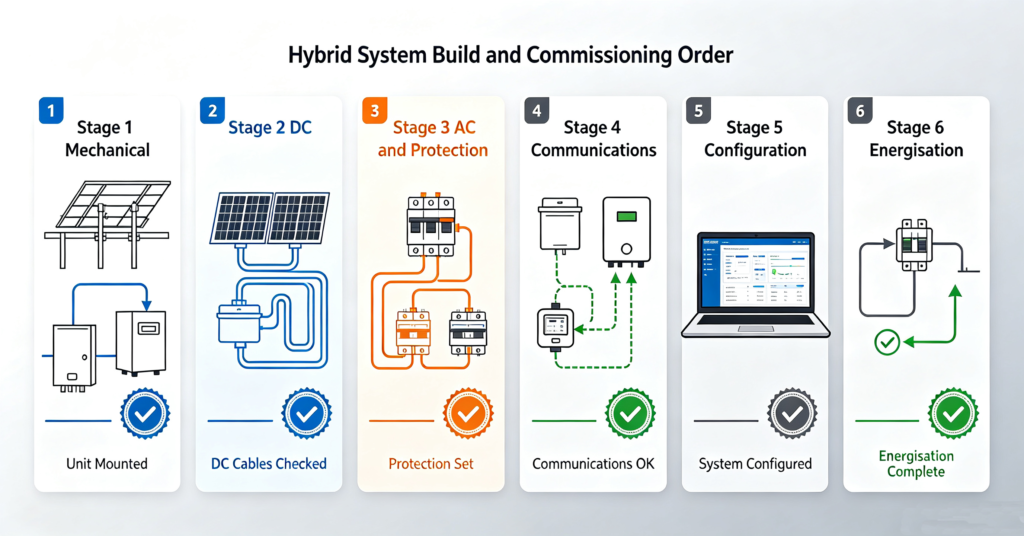
The build order that minimises rework: mechanical work first — racking, battery mounting, inverter placement — then DC work, then AC and protection, then communications, then configuration, and only then energisation. Commissioning should verify each layer against the one beneath it: insulation and polarity checks before any breaker closes; inverter-to-battery communication verified before the EMS is trusted; the meter’s reading of grid flow confirmed against a reference before self-consumption logic is enabled.
The final acceptance test for a hybrid solar plus battery storage system is behavioural, not electrical. Simulate a grid outage and watch the backup transition — how fast it is, what stays up. Force a full charge cycle and watch the cells balance and the BMS report honestly. Export to the grid and confirm the meter reads the direction correctly. A system that passes those three tests is commissioned; one that passes only the electrical checks is merely installed.
Make the economics explicit before signing
The financial case for a hybrid solar plus battery storage system is the arithmetic of three value streams stacked on one hardware budget. Self-consumption savings: every kilowatt-hour of evening load served from the battery instead of the grid. Backup value: avoided outage losses, priced honestly rather than dramatically. Export or tariff mechanisms: whatever the local scheme pays for grid services or exported energy. Two rules keep the projection honest: count only the energy the battery can actually capture given its usable capacity and round-trip losses, and treat backup value as insurance — real, but not a revenue line. Buyers who inflate either number sign for a system that never pays for the reason they believed in it.
Goals and the design decisions they drive
| Project goal | Design decision it drives | What it changes |
|---|---|---|
| Cut the evening bill | Size the battery to evening load, not to the array | Battery kWh, metering accuracy |
| Ride through outages | Declare critical loads; add backup panel | Wiring, inverter islanding capability |
| Go fully off-grid | Oversize the array; plan a generator input | Whole architecture — see the off-grid guide |
| Answer a time-of-use tariff | Allow scheduled grid charging in the EMS | EMS settings, tariff structure |
| Add an EV later | Reserve panel capacity and conduit | Switchboard headroom, battery sizing margin |
| Keep an existing PV system | AC-couple the battery | Inverter shopping list, retrofit wiring |
| Expand in phases | Design the bus and comms for the end state | Architecture choice, EMS licensing |
| Monitor everything | Choose an EMS with a real portal and API | Equipment stack, data ownership |
Q. Can I add a battery to my existing solar system?
Yes, and AC coupling is the standard path: the existing PV inverter stays, a battery inverter joins the AC side, and the EMS coordinates both. Check two things before committing — the switchboard’s spare capacity for the new unit, and whether the metering arrangement can measure grid flow at the right point. A solar-plus-storage retrofit done this way avoids touching the working PV side at all.
Q. Is one hybrid inverter better than separate units?
Neither is universally better. A single hybrid inverter means one installation, one control logic and one warranty conversation — best for new builds with a settled design. Separate PV and battery inverters cost more wiring and coordination but allow each side to be replaced, expanded or re-branded independently — better for retrofits and phased projects. Decide by the expansion plan, not by the spec sheet.
Q. How long can the battery back up my property?
It depends entirely on which circuits are backed up and how big the battery is — which is why the critical-loads decision happens at design time. A battery that bridges a household’s essential loads for an evening is a different purchase from one that runs a property for days. Frame the requirement as circuits × hours, and the sizing follows directly.
Q. Can a hybrid system go off-grid later?
Partially, with planning. A grid-tied hybrid system with islanding can run through outages, but true off-grid operation needs array oversizing, larger storage, usually a generator input, and a different design mindset from day one. If off-grid is a realistic future rather than a daydream, say so in the original energy plan — retrofitting that intent is expensive.
Q. What is the most common way these projects fail?
Protocol mismatch: an inverter and a battery that technically work together but communicate poorly, leaving the EMS blind or the charging logic crude. It is discovered at commissioning, when it is hardest to fix. The defence is unglamorous — verify the exact firmware and protocol-profile pairing before purchase, with the supplier’s written confirmation.
Next step: write the one-page energy plan
Three numbers, one sentence. From there, the deeper guides take over.
- Set the architecture with #43 AC vs DC coupling
- Pick the conversion hardware via #17 hybrid inverter selection
- Size the storage with #09 battery sizing
- Sanity-check the payback with #27 self-consumption economics
- Ask leekooenergy for a battery matched to your hybrid inverter’s protocol list and load profile