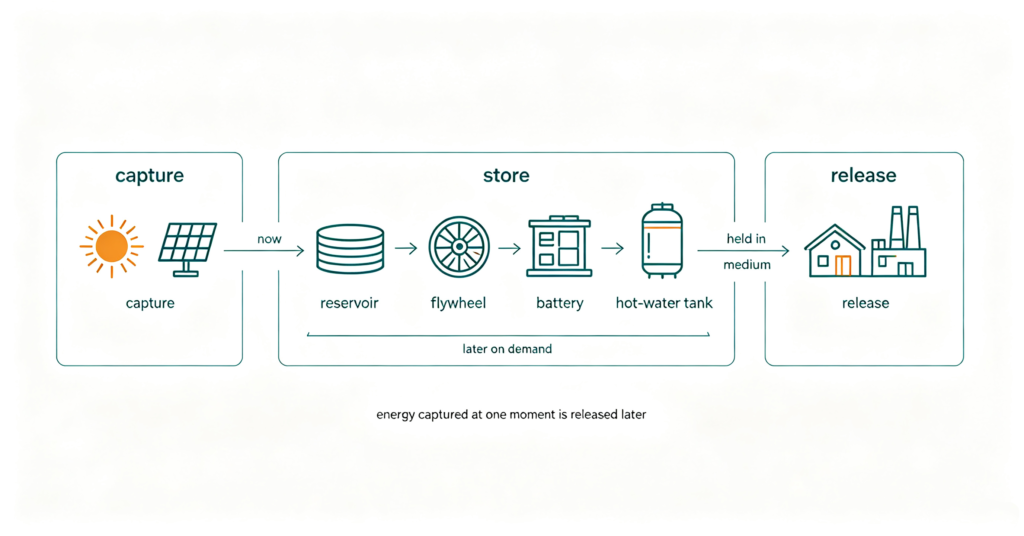
The short answer to what is stored energy is: energy that has been captured at one moment and held, in some form, so it can be released at another. Water held behind a dam, heat banked in a hot-water tank, the compressed spring in a mechanical clock and the charge in a phone battery are all examples of the same idea. In every case, energy is collected when plentiful, kept in a medium, then given back when wanted. The one-line version worth quoting: stored energy is energy that waits — it is captured at one time, held in a physical or chemical medium, and released at a chosen later moment to do work.
That simple idea sits under most conversations about grids, solar homes and electric vehicles. Sunlight arrives only during the day, wind only when it blows, but people want power on their own schedule — so the gap between when energy appears and when it is wanted has to be bridged by storing it. Once the pattern is clear, most of the technical discussion becomes a question of which medium does the waiting, for how long, and at what cost. This guide defines the term, walks through the main forms of stored energy, and ends with the four questions that decide which medium fits a real site. The full catalogue of complete storage systems built on these media is in #11 types of energy storage systems, while the battery-specific definition of a BESS is covered in #55 BESS definition.
Where stored energy shows up in everyday life
Two everyday examples show the range of what counts as stored energy. A water tower stores gravitational energy: a pump lifts water when electricity is cheap, and the weight of the water pushes it through the pipes when taps open. The water itself is the medium and the height is the energy — nothing has been burned or converted, only lifted. A rechargeable battery stores electrochemical energy: charge forces ions into one electrode, and discharge lets them return while electrons travel through the circuit to do work. The first example stores energy you can see; the second hides it inside chemical bonds — which is why batteries pack so much into so little space.
The same logic appears everywhere once you look for it. A flywheel in a bus or a data-centre UPS banks kinetic energy in a spinning rotor and gives it back in seconds. Ice made at night and used to cool a building the next afternoon is stored energy in the form of cold. A tank of hydrogen made from surplus solar power is stored energy that can wait for weeks. The medium changes; the pattern of capture, hold and release does not.
The main forms of stored energy
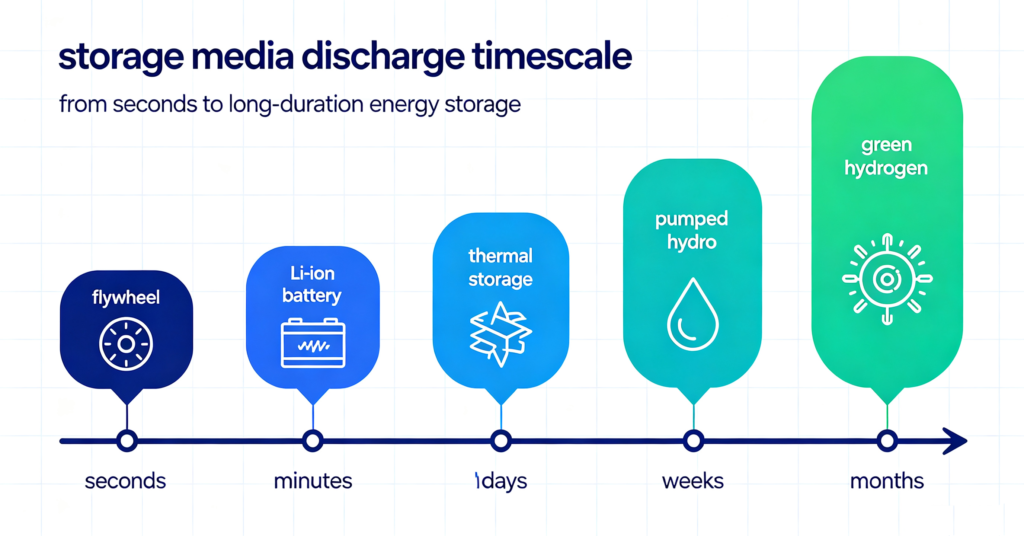
Engineers group storage media by the physical form the energy takes while it waits. Six groups appear in real products and projects. The table below is the working map; holding times and efficiency are stated as classes rather than precise figures, because real numbers depend on plant size, design and operating practice.
| Storage medium | Form of stored energy | Time it typically waits | Main role | Round-trip efficiency class |
|---|---|---|---|---|
| Pumped hydro | Gravitational — water at height | Hours to months | Grid-scale balancing | High |
| Compressed air | Pressure in a cavern or vessel | Hours | Grid-scale | Medium |
| Flywheel | Kinetic — a spinning rotor | Seconds to minutes | Power quality, short bursts | High |
| Li-ion battery (incl. LFP) | Electrochemical — ions held in electrodes | Minutes to days, by design | Solar storage, UPS, C&I, EVs | High |
| Thermal storage | Heat or cold in water, ice, rock or salt | Hours to days | Buildings, solar thermal plants | Medium |
| Green hydrogen | Chemical — energy in fuel bonds | Days to months | Seasonal and industry pilots | Low |
Three takeaways matter more than memorising the table. First, no medium wins on every axis: the fastest responders (flywheels, batteries) handle short, sharp duties, while the slowest (hydro, hydrogen) carry bulk energy across seasons — and batteries sit in the middle band where most homes and factories need service. Second, holding time is a design property, not a fixed law: a battery system can be built to discharge in minutes or across a whole day, which is why one chemistry serves UPS boxes and multi-hour solar storage. Third, efficiency class only tells part of the story: a high-efficiency medium still wastes its advantage when used for a duty of the wrong duration. How the battery member of this family stores and releases energy is explained in #59 what is a lithium ion battery.
What is stored energy measured in
Two numbers describe any storage installation, and confusing them is the most common mistake in the field. Capacity is how much energy the medium holds — watt-hours (Wh), kilowatt-hours (kWh) for a home battery, or megawatt-hours (MWh) for a grid project. Think of it as the size of the tank. Power is how fast the energy can be released — watts (W), kilowatts (kW) or megawatts (MW). Think of it as the width of the pipe. A system can hold a full day of energy yet release it slowly, or hold little and release it in seconds — read both numbers on every datasheet.
Round-trip efficiency is the third number: the share of energy that comes back out compared with what went in, after capture, storage and release losses. No medium is free on the round trip — every one loses something to friction, heat, conversion or self-discharge. When media with very different holding times are compared, efficiency must be read together with how long the energy waits: a fast, efficient medium pressed into a seasonal job leaks value while it sits, and can waste more than a slower medium sized correctly. That is why honest comparisons are made per application, not per headline figure. The practical version of these trade-offs for solar storage economics is worked through in #56 BESS cost and ROI.
Why “stored energy” usually means batteries in practice
Physically, stored energy covers water behind dams, heat in tanks, spinning rotors and pressurised air. In the language of buyers, consultants and incentive programmes, though, “stored energy” on a site almost always means one medium: the battery. Batteries need no river, mountain or cavern, so they sit beside the building that uses the power. They respond in milliseconds, they are modular — capacity grows by adding cabinets rather than re-engineering a plant — and they charge directly from rooftop solar with no large rotating parts to maintain.
So when a home or factory says it is “adding storage”, the delivered product is a battery energy storage system (BESS): battery cells wrapped in the management electronics and power conversion that keep them safe across thousands of cycles. Utilities still lean on pumped storage for bulk balancing — the point is where new stored-energy conversations happen: at the meter, next to the solar array, behind the factory gate. The acronym is defined in #55 BESS definition and full form, and the anatomy of battery, PCS, BMS and EMS in #52 BESS components.
How stored energy earns its keep
Storing energy pays when the timing of energy matters more than the cost of capturing it. Four everyday cases cover most of the value: solar self-consumption (store midday surplus and run the home at night), backup (hold energy for the hours the grid drops), peak-shaving (release during the short, expensive demand window rather than pulling the whole peak) and grid services (sell the fast response a battery can provide). In every case the value is not the energy itself — it is the ability to choose when to release it. The peak-shaving arithmetic behind commercial electricity bills is the subject of #57 demand charges and peak shaving.
Choosing a storage medium: the four questions that decide
Faced with a real site, engineers narrow the menu with four questions; the answers usually point to one or two candidates.
1. How long between charge and use? Bursts of seconds to minutes point to a flywheel or a battery; an overnight shift points to a battery or thermal storage; gaps of weeks point to hydro or hydrogen, which few building owners can host. 2. How fast must it release? Power-hungry short duties need a medium that responds in milliseconds; slow bulk duties do not. 3. Where can it sit? Footprint, weight, fire codes and planning rule out most media before cost is discussed — a reservoir cannot be built in a car park. 4. What does a useful kWh cost over the asset’s life? Efficiency, cycle life and maintenance over time, not the sticker price of the medium.
For homes and commercial buildings, the four answers converge on lithium iron phosphate (LFP) batteries in most cases, which is why LFP dominates the products aimed at those sites. The chemistry deep-dive is in #01 the LiFePO4 guide, and turning the choice into a working, sized system is the job of #61 battery energy storage system design.
Q. What is stored energy in simple words?
Energy captured at one moment, held in some medium, and released later when it is wanted. A phone battery charged in the morning and used at night, water behind a dam, heat in a tank — all everyday examples. Only the pattern of capture, hold and release defines it.
Q. What are the main types of stored energy?
Mechanical (gravitational, like pumped hydro; kinetic, like flywheels; pressure, like compressed air), electrochemical and chemical (batteries and hydrogen), and thermal (heat or cold in water, ice, rock or salt). Batteries are one member of that family, and the one most used on building sites. A full system-by-system catalogue is in #11 types of energy storage systems.
Q. Is stored energy the same as a battery?
No. A battery is one medium among many. Hydro, flywheels, thermal tanks and hydrogen also store energy. The words have drifted together because on-site projects are overwhelmingly batteries, but the concept is wider than any single technology.
Q. How much energy can a storage system hold?
Capacity is quoted in watt-hours — kWh for a home battery, MWh for larger systems — and is set by how much medium is installed. Power, in kW or MW, is separate and says how fast that energy can come out. Read both, plus round-trip efficiency, on any datasheet you compare.
Q. Where is energy stored inside a lithium battery?
As chemical potential: charging pushes lithium ions into the negative electrode, where they are held; discharging lets them flow back to the positive electrode while electrons power the circuit. The energy waits in the arrangement of ions, not in any moving part. The full working mechanism is in #59 what is a lithium ion battery.
Next step: from the definition to the right system
Understanding stored energy is the first step; choosing the medium, size and system for your site is the second.
- See the full menu of systems in #11 types of energy storage systems
- Decode the acronym in #55 BESS definition and full form
- Go deeper on how batteries hold energy in #59 lithium ion battery guide
- Ask leekooenergy for LFP storage datasheets with capacity, power and round-trip figures stated together — the four questions above are exactly what its engineers will walk you through