The honest answer to the 48v 200ah lifepo4 battery price question is that it is a price for an assembled system of parts, not for “a battery” — and it varies with four things: the grade of the cells inside, the capability of the BMS, the warranty and support behind the brand, and the freight and duties to your door. A 48V 200Ah unit holds roughly 9.6–10.24 kWh of energy depending on whether it is built on a 48V or 51.2V nominal stack, so the price is best compared per kilowatt-hour and per cycle, not per box. The one-line version worth quoting: the 48v 200ah lifepo4 battery price is set by cell grade, BMS functionality, certification, warranty and landed cost — compare quotes on an identical specification, and judge price per usable kWh over the rated cycle life, never by the sticker alone.
Two nearly identical-looking 48V 200Ah batteries can be quoted at very different prices, and the difference is usually not markup — it is what is inside and what happens after the sale. This guide takes a price quote apart line by line, explains why suppliers land where they do on the price scale, and gives a comparison method that survives contact with a real RFQ. The broader system view — what the same battery costs once an inverter, installation and financing are added — is in #56 BESS cost and ROI.
What a 48V 200Ah battery price quote actually includes
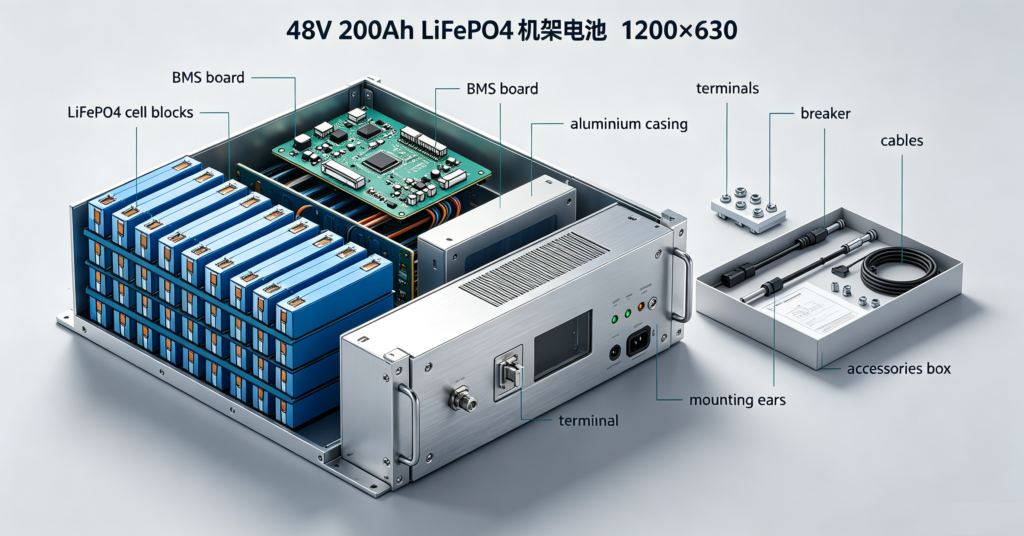
When a supplier quotes a 48V 200Ah LiFePO4 battery, the price normally covers five building blocks. The cell stack is the largest cost share: sixteen LiFePO4 cells (or fifteen on a true 48V design) welded or bolted into a series string. The BMS is a separate, significant cost item — its balancing current, protection set and communication ports decide how safely and how long the string runs. The casing and hardware — rack or wall-mount box, front panel, breaker, terminals — protect the stack and carry the approvals. Testing and certification (cell and pack level, transport and safety marks) is built into the price of responsible suppliers. And the warranty and support is a real cost: the difference between a price that includes a local contact and spare parts and one that ends at the factory gate.
Before comparing prices, confirm what each quote’s specification actually is. The same nominal “48V 200Ah” can mean 9.6 kWh or 10.24 kWh depending on nominal voltage, and usable capacity depends on the BMS’s depth-of-discharge setting and the discharge rate at which capacity is rated. Reading these numbers together is covered in #01 the LiFePO4 guide, and the voltage-architecture choice behind “48V” labels is explained in #12 48V vs 51.2V.
Why identical-looking quotes differ
The table below maps the main price drivers and the question that exposes each one. If two quotes differ by more than a modest margin on the same specification, the difference is almost always hiding in one of these rows.
| Price driver | Why it moves the price | Question to ask the supplier |
|---|---|---|
| Cell grade and brand | A-grade cells from tier suppliers cost more than B/C-grade or unbranded cells; grade drives cycle life and consistency | Which cell brand and grade? Can you show the cell datasheet? |
| BMS capability | Balancing current, protection set, communication (CAN/RS485), and brand all change cost | What are the BMS specs and which protocols does it speak? |
| Cycle-life claim and test evidence | A verified 6,000-cycle rating costs more to engineer and prove than a copied claim | Is the cycle figure from a third-party or in-house test? |
| Certification | Safety, transport and code marks add testing cost | Which certificates are included in this price? |
| Warranty and support | Local stock, technical support and a clear claim process are paid for somewhere | Who honours the warranty in my country, and how? |
| Freight, duties and lead time | Landed cost can differ sharply by region and shipping mode | Is this EXW, FOB or delivered? What is the lead time? |
Notice what is not on the list: the brand’s website, the thickness of its marketing, or the number of free accessories. Suppliers who compete on those while staying vague on the rows above are usually signalling that the specification itself is the flexible part — which is where “cheap” batteries become expensive. The ownership arithmetic behind that idea is in #46 cycle life vs price.
Budget, standard and premium: what each tier buys
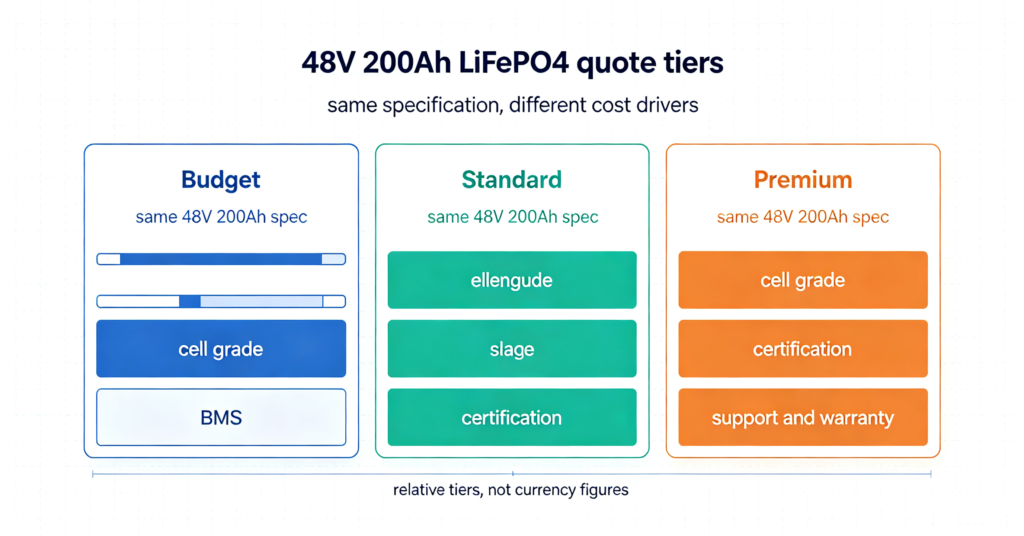
Rather than quoting currency figures — which move with raw-material markets and your delivery country — it is more useful to describe what each price tier buys, and to treat the tiers as relative steps. A budget quote typically pairs lower-grade or unbranded cells with a basic BMS, minimal certification and a short or pass-through warranty; it can be a workable choice for non-critical, low-cycle use where replacement is easy. A standard quote — where most serious residential and C&I buyers land — uses A-grade LFP cells, a reputable BMS with balancing and communication, the certificates your market needs, and a multi-year warranty backed by an accessible support channel. A premium quote adds verified cycle data, stronger BMS margins, faster technical response, local stock or service, and contract terms that protect you on performance. In most cases the gap between standard and budget is repaid in the first years of use, because the cost difference is a small fraction of one avoided failure.
Price per kilowatt-hour is the fairest unit of comparison, but only when the specification is frozen first. Send every supplier the same requirement: capacity at a stated discharge rate, nominal voltage, BMS functions, communication protocol, certificates, warranty period and delivery terms. The discipline of a single specification is what turns a price comparison into an apples-to-apples exercise. The chemistry behind “which LFP cell is actually in the box” is expanded in #01 the LiFePO4 buying guide.
The hidden costs that change the real price
Three costs sit outside the battery price itself and frequently double the gap between quotes. Freight: a 48V 200Ah unit is heavy and is often shipped as dangerous goods, so delivered price can differ substantially by supplier location and shipping mode. Duties and taxes: import duty, VAT and local levies apply on the landed value and can change the ranking of suppliers from different origins. Integration and support: configuring the battery to your inverter, mounting hardware, spare BMS, and the cost of your own time diagnosing a problem are all part of the real price. When suppliers quote different incoterms, convert everything to delivered cost before comparing — otherwise you are comparing list prices, not prices.
How to compare 48V 200Ah quotes fairly
A practical comparison method has five steps. First, freeze the specification and send it to at least three suppliers. Second, ask for evidence: cell datasheet, BMS spec, cycle-life test report, and certificate numbers — not marketing language. Third, convert to one unit: delivered cost per usable kWh over the warranted cycle life, not per box. Fourth, check the support path: who answers technical questions, from which time zone, and what the warranty claim process actually requires. Fifth, verify the supplier: factory audits, reference installations and payment terms tell you more than the quote page. The supplier-evaluation angle is developed further in #50 evaluating inverter suppliers, whose checklist applies to battery suppliers as well.
Q. What affects the 48v 200ah lifepo4 battery price?
Cell grade and brand, BMS capability, certification, warranty and support, and freight and duties. Two quotes for the same nominal spec differ mainly on these rows — ask for each one in writing before comparing.
Q. How much does a 48V 200Ah LiFePO4 battery cost?
There is no single figure: prices move with lithium raw-material markets, your delivery country and the specification. Compare quotes as delivered cost per usable kWh, and treat published figures as orders of magnitude only — confirm the current price with a written quotation.
Q. Is a cheaper 48V 200Ah battery a worse battery?
Not automatically, but a suspiciously low price usually means a lower cell grade, a simpler BMS, thinner certification or a weaker warranty. Judge the specification, not the price; a budget tier can be fine for light-duty use where replacement is easy.
Q. Why is price per kWh better than price per battery?
Because “48V 200Ah” is not one product: usable energy depends on nominal voltage and discharge rate, and the cost that matters is per kilowatt-hour delivered over the battery’s warranted cycle life. Per-box prices hide both differences.
Q. What should my RFQ include to get comparable prices?
Capacity at a stated discharge rate, nominal voltage, BMS functions and communication protocol, required certificates, warranty period, delivery terms and quantity. Send the same spec to every supplier so the prices you receive describe the same product.
Next step: get a quotation you can compare
Now that you know what the price should include, the next step is a specification that forces comparable quotes.
- See the wider system cost picture in #56 BESS cost and ROI
- Weigh cycle life against price before you choose in #46 cycle life vs price
- Decide 48V vs 51.2V for your site in #12 48V vs 51.2V
- Ask leekooenergy for a 48V 200Ah quotation with cell brand, BMS spec, certificates and delivered terms stated together — the five rows above are exactly what its engineers quote against