The short answer is that bess projects are the complete undertakings — from feasibility study to operating asset — that put battery energy storage systems onto real sites. A project is more than the hardware: it is the business case, the site and connection, the engineering, the procurement, the construction, the commissioning and the years of operation that follow. The one-line version worth quoting: a BESS project turns stored-energy hardware into a working, revenue-bearing or cost-saving asset by sequencing feasibility, design, procurement, construction, commissioning and operation — and its success is decided by a handful of early choices: use case, duration, site, safety and supplier.
Storage hardware has become a product you can buy off a datasheet; projects are where that product meets a specific bill, a specific building and a specific grid connection — and where most of the value and most of the risk actually live. This guide maps the three segments in which BESS projects happen, the cast of roles that delivers one, the lifecycle every project follows, and the five decisions that decide whether it succeeds. For the detailed engineering of sizing a system, see #61 BESS design in six steps; for choosing the firm that builds it, #66 the EPC contractor guide is the companion piece.
The three segments where BESS projects happen
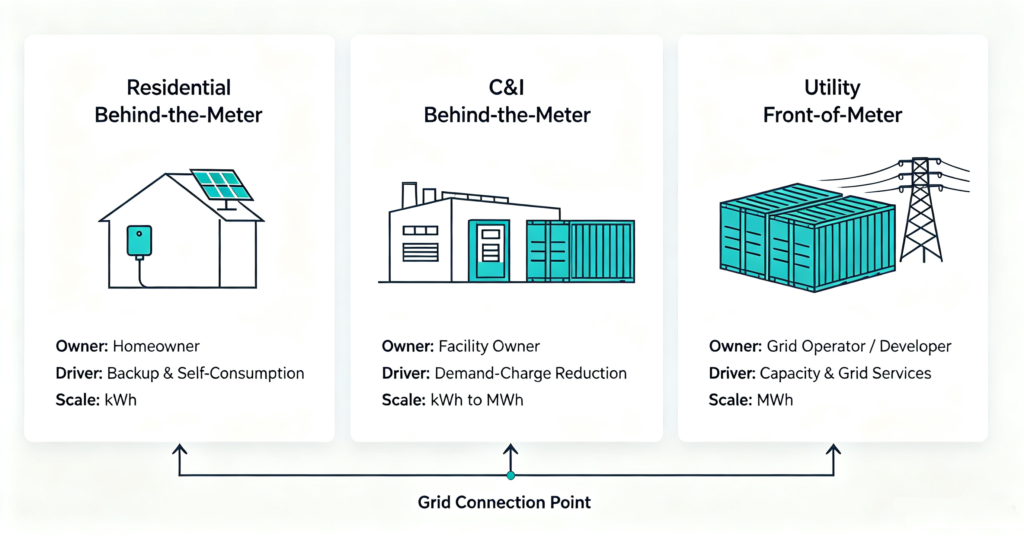
Almost every storage project fits one of three segments, which differ in who pays, what the battery is for and how big it gets. Knowing which segment you are in settles the vocabulary for everything that follows — a residential project and a utility project share the word “BESS” and almost nothing else.
| Segment | Who pays and owns | Main driver | Typical scale | Example duty |
|---|---|---|---|---|
| Residential | Homeowner | Solar self-consumption, backup | 5–30 kWh | Power the home overnight from midday solar |
| C&I behind the meter | Factory, warehouse or building owner | Demand-charge reduction, backup, solar firming | 30 kWh–several MWh | Shave the monthly peak drawn from the grid |
| Utility front-of-meter | Grid operator, utility or merchant developer | Grid services, capacity, renewables firming, arbitrage | Tens to hundreds of MWh | Hold frequency or shift solar output to evening peak |
The boundaries blur in practice — large commercial sites sometimes behave like small utilities, and community storage sits between segments — but the table explains why a “BESS project” conversation must always start with scale and owner. The two ends of that scale are detailed separately in #22 utility-scale storage and in the physical-form guide #53 C&I storage formats.
Who does what in a BESS project
A BESS project is delivered by a small cast of roles, and projects go wrong when the roles are confused. The owner carries the business case and the asset; the developer (sometimes the owner itself) assembles the site, the connection rights and the permits. The integrator engineers the system — battery, PCS, BMS, EMS, controls — into a coherent whole; in small projects the integrator and the supplier may be the same company. The EPC contractor manages design, procurement, construction and commissioning; the equipment supplier (the battery or BESS manufacturer) provides the core hardware with its warranties; and the O&M provider keeps the asset performing after handover. On larger projects a consultant or owner’s engineer reviews the design and tests on the owner’s behalf. Where the equipment supplier ends and the EPC begins is a frequent source of gaps — which is why the equipment-vs-EPC boundary is treated as a contract question in #66 the EPC guide.
The lifecycle of a storage project
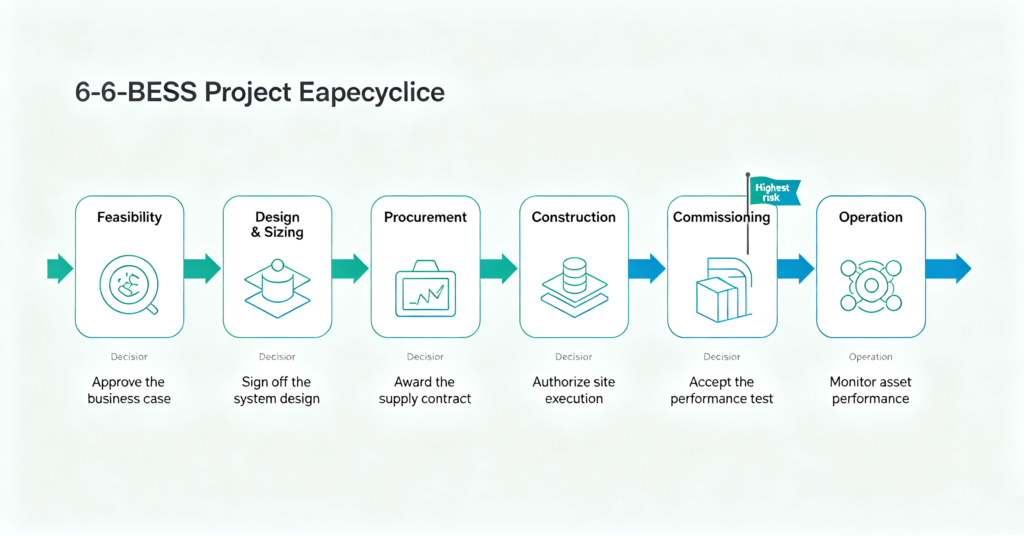
Every BESS project, at any scale, follows the same arc from idea to operating asset. The stages are worth naming because skipping one shows up later as a cost, not a saving.
Feasibility tests the business case: the bill or tariff structure, the solar profile, the backup requirement and the value of the battery’s services. Design and sizing turns the use case into power, energy and duration, and chooses the architecture — the subject of #61 design in six steps. Procurement selects the equipment and the construction partner against a frozen specification. Construction installs the hardware and connects it. Commissioning is where most of the real engineering happens: functional tests of the BMS, the inverter, the EMS and the safety system, ending in a performance test against the contract. Operation then runs the asset for years, with the revenue or saving actually landing. The gap that hurts owners most is between “the system works” and “the system performs as contracted” — which is why the commissioning test protocol should be written into the contract, not improvised at the end.
The five decisions that decide success
Within that lifecycle, five early decisions do most of the work. Use case and dispatch: what the battery will actually do — self-consumption, peak shaving, backup or grid services — sets the sizing logic and the control strategy; mixing goals without ranking them is the classic way to oversize or under-perform. Power, energy and duration: getting the kW/kWh ratio right for the duty; a backup system and an arbitrage system need different shapes. Site and connection: where the system sits, how it connects, and what the grid operator allows decide more than any component choice. Safety and code: fire codes, spacing, ventilation and the certification chain are design inputs, not afterthoughts. Supplier and warranty: the durability of the asset rests on the cell grade, the BMS and the warranty behind them. The revenue side of these choices is quantified in #57 demand charges and peak shaving, and the safety side in #44 BESS fire safety.
Why BESS projects fail — and how owners avoid it
The failure modes of storage projects are remarkably consistent. Procurement on price alone delivers hardware without the engineering or the commissioning depth the project needed. Specification mismatch — buying a product configured for a different use case, then forcing it into the site’s duty — produces chronic under-performance. Over-promised EMS: control software that claims dispatch strategies it cannot actually execute, discovered only at commissioning. Rushed commissioning: tests compressed to meet a date, with the performance acceptance signed off on paper rather than proven. Weak warranty interfaces: when the cell, the BMS and the inverter come from different suppliers, a failure can land in the gap between their warranties. Owners who succeed typically freeze a functional specification early, appoint one accountable party for system performance, and pay for independent testing at commissioning. The component anatomy behind “system performance” is laid out in #52 BESS components.
Where to start with a real project
For a first-time owner the practical starting point is a feasibility sheet, not a battery quote: the site’s load profile or bill, the goal (which service the battery must deliver), the space and connection options, and the budget envelope. From that sheet the sizing work in #61 the design guide produces a specification, and the specification — not a brand — is what you take to suppliers and to EPC candidates. Treating the project as a sequence of decisions rather than a shopping trip is the difference between an asset that performs for fifteen years and a cabinet that never quite earns its place.
Q.What are BESS projects?
Complete undertakings that put battery energy storage systems onto real sites: feasibility, design, procurement, construction, commissioning and operation. The hardware is a product; the project is everything that makes it work for a specific owner, site and use case.
Q.What types of BESS projects exist?
Three main segments: residential (homeowner, backup and self-consumption, kWh scale), commercial and industrial behind the meter (facility owner, demand reduction, kWh–MWh), and utility front-of-meter (grid services and capacity, MWh scale). Segments differ in owner, driver and scale more than in technology.
Q.How long does a BESS project take?
It depends heavily on scale and permitting. Small behind-the-meter projects can move from order to operation in weeks to a few months; utility-scale projects typically run one to three years from development to commercial operation, with most of the time spent on interconnection, permitting and financing rather than hardware.
Q.Who builds battery energy storage projects?
A cast of roles: owner, developer, integrator, EPC contractor, equipment supplier and O&M provider, with an owner’s engineer on larger projects. Small projects often merge roles; the important thing is that one accountable party owns system performance end to end.
Q.What makes a BESS project fail?
The usual causes are buying on price alone, a specification that does not match the site’s duty, control software that cannot deliver its promised dispatch, commissioning rushed to a date, and warranty gaps between different suppliers’ components.
Next step: from project map to working asset
You now have the map of the project; the next step is a specification and a partner who can build to it.
- Size the system properly with #61 BESS design in six steps
- Choose the firm that builds it with #66 the EPC contractor guide
- See the utility-scale end of the spectrum in #22 utility-scale storage
- Talk to leekooenergy about project-stage support — feasibility datasheets, container or cabinet BESS specifications and reference architectures are what its project team provides to owners and developers