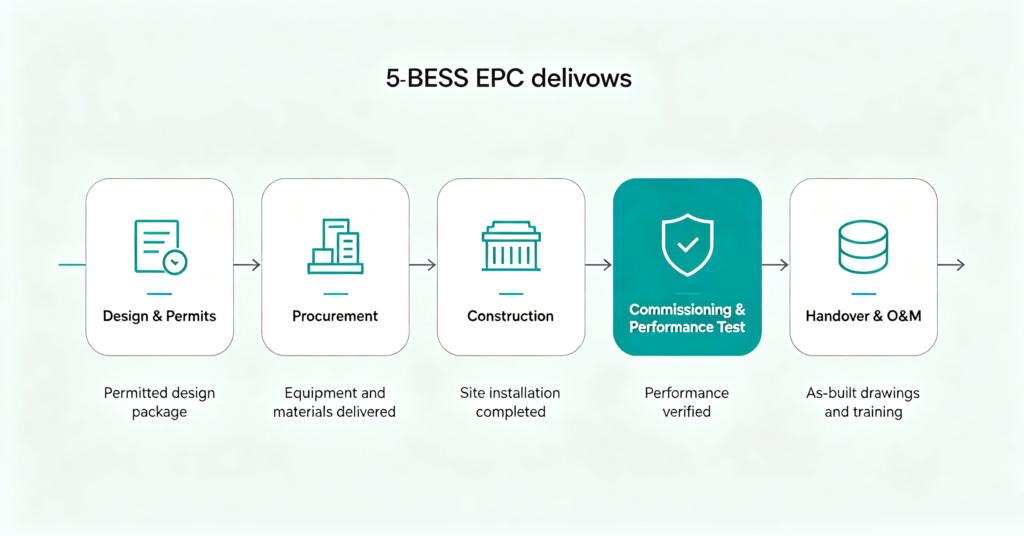
The practical answer is that a bess epc contractor is the firm that engineers, procures and builds your storage project — and the right one is chosen on storage-specific evidence, not on solar experience. EPC stands for engineering, procurement and construction, and for a battery project that means: taking a functional specification, turning it into a detailed design, buying the equipment, installing it, commissioning it against a test protocol, and handing over an asset that performs as contracted. The one-line version worth quoting: a capable bess epc contractor proves itself with commissioned storage megawatt-hours, in-house commissioning and testing capability, a performance guarantee written into the contract, and a clear answer on where the equipment warranty ends and its work begins.
Most owners who end up disappointed did not fail to find a contractor; they failed to define what the contractor was responsible for. Storage projects sit at the meeting point of high-voltage DC, control software, fire safety and utility rules, and a firm that installs solar arrays beautifully can be out of its depth on battery commissioning. This guide sets out the scope a storage EPC should carry, the evidence that separates capable firms from the rest, the red flags in proposals, and the questions to ask before you sign. For the wider project picture — segments, roles and lifecycle — start with #65 BESS projects.
What a BESS EPC scope should include
A complete storage EPC scope runs from engineering to handover and usually contains eight deliverables. Detailed design: the layout, single-line diagram, thermal and ventilation design, and structural work built on a frozen functional specification. Permits and approvals: planning, electrical and fire permits, and the grid connection application managed on your behalf. Procurement: sourcing the battery, PCS, BMS, EMS, switchgear, cabling and containers — either from your chosen suppliers or theirs, with the specification enforced. Construction: site works, installation and mechanical and electrical completion. Commissioning: functional testing of every protection layer and the control system, ending in a performance test. Handover: as-built drawings, test reports, operation manuals and operator training. Warranty management: a single point of contact for defects across the assembled system. Optional O&M: ongoing monitoring and maintenance. When a proposal is vague on any of these eight, the gap will surface later as a change order.
Storage is not solar: where EPCs go wrong
The most expensive mistake is hiring a contractor whose storage experience is really solar experience with a battery bolted on. Four differences separate the two disciplines. First, DC system design: storage runs high DC voltages with different protection, isolation and arc-flash considerations than a PV array feeding an inverter. Second, control and software: a battery’s value lives in its EMS dispatch logic — charge control, peak management, grid-service responses — which must be configured, tested and proven, not just installed. Third, commissioning depth: a battery’s safety depends on the BMS, the fire system and the inverter responding correctly together, which requires a test protocol that solar projects never needed. Fourth, warranty interfaces: the cell warranty, the pack warranty and the EPC’s workmanship warranty must line up, or a mid-life failure lands in the gap. The component and control layers behind these differences are described in #52 BESS components.
How to evaluate a bess epc contractor
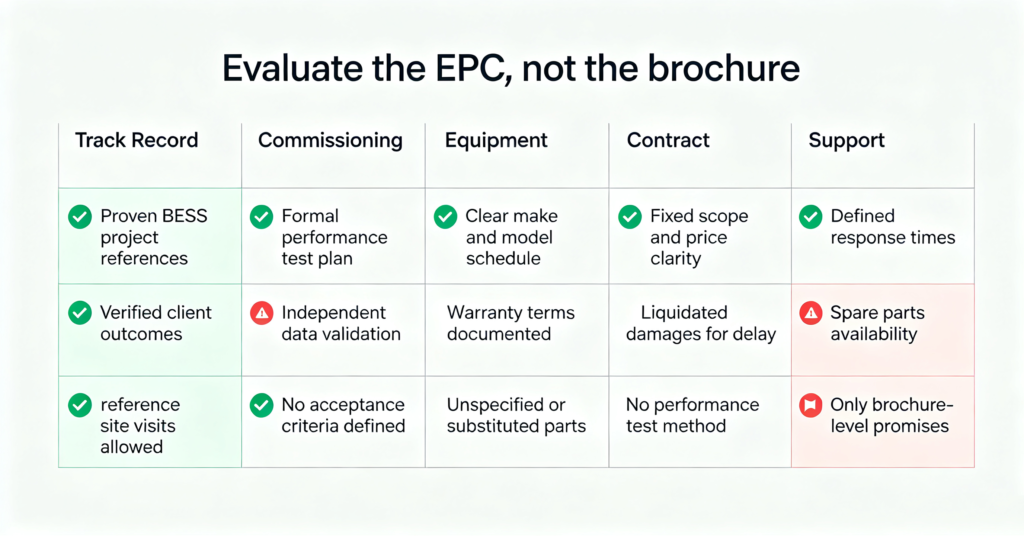
Capable storage EPCs are a small group, and the evidence that separates them is specific. The table below turns the evaluation into checkable criteria.
| Criterion | What good looks like | Red flag |
|---|---|---|
| Storage track record | Commissioned MWh with named, contactable references | Solar-only portfolio or “battery experience” without reference visits |
| In-house commissioning and testing | Own engineers who run functional and performance tests | Testing subcontracted with no named test protocol |
| Equipment relationships | Working history with battery, PCS and EMS brands; can enforce specs | Vague on which equipment and who warrants it |
| Performance guarantee | Contractual guarantee of usable energy and availability | “Best effort” language or guarantee without a test method |
| Safety and code competence | Fire-code knowledge, approved layouts, commissioning of fire systems | Treats the battery as “just another cabinet” |
| Financial substance | Balance sheet that can carry warranty and defect obligations | Shell structure with no local substance |
References matter more than brochures: ask each candidate for two completed projects of comparable scale, and call the owners with specific questions — did commissioning finish on the promised date, did the system hit its performance test, and who answered when something failed? The same discipline used for inverter suppliers is laid out in #50 evaluating inverter suppliers and applies here with even more force.
The data pack your RFQ must contain
An EPC can only price and design what it understands, so the quality of your request for quotation decides the quality of the responses. Send every candidate the same pack: the site (address, space, access, structural constraints); the use case (which service the battery must deliver, ranked if there are several); the energy data (load profile or the tariff bill for peak-shaving projects, solar output for self-consumption); the connection (existing service, single-line diagram, grid operator rules); the code and safety requirements that apply locally; the target timeline; and the commercial envelope (budget range or financing structure, if you are willing to share it). Compare proposals against a scoring sheet built from the table above, not against the price line. The sizing logic that should sit behind the use case is in #61 BESS design in six steps.
Questions to ask before you sign
Shortlist interviews should be built around ten questions. Who is the named project manager and what have they commissioned? Which engineers run commissioning and are they employed by you? Which battery, PCS and EMS will be used, and who selected them? What is the performance guarantee — usable energy, efficiency, availability — and how is it tested? Who writes the commissioning test protocol and who approves it? What happens if the system misses the performance test? Where does the equipment warranty end and your workmanship warranty begin? Who manages the battery supplier relationship after handover? What spare parts are held and where? And what does the change-order process look like — what is in scope and what is extra? A contractor who answers these fluently with documents is signalling competence; one who answers with reassurance is not. The safety-code context for what must be commissioned is in #44 BESS fire and safety codes.
Contract clauses that protect the owner
Five clauses do most of the legal work. The performance guarantee should state a testable number (usable energy at a stated discharge rate, round-trip efficiency, or availability) with the test protocol attached as a schedule. Liquidated damages should attach to delay and to missed performance, so both failure modes have a price. The warranty interface matrix should name who answers for each component and failure mode, eliminating the gap between suppliers. The change-order process should define what counts as a variation before work starts. And milestone payments should hold enough retention until the performance test passes — typically a meaningful share of the contract released only on proven performance. Owners who negotiate these five items before signing rarely regret it; owners who rely on goodwill usually do.
What does a bess epc contractor do?
Engineers, procures and builds a battery storage project: detailed design, permits, equipment procurement, construction, commissioning, performance testing and handover. The EPC is the single accountable party for delivering a working, performing asset — not just installing cabinets.
Why can’t a solar EPC just build a BESS?
Storage adds high-voltage DC design, EMS control software, fire-system integration and multi-layer commissioning that solar projects do not require. A solar EPC can install the hardware yet fail at the commissioning and performance stages where storage value and safety are decided.
How do I check an EPC’s storage experience?
Ask for commissioned storage megawatt-hours with named references, visit or call the owners, and ask whether commissioning finished on time and whether the system passed its performance test. Verify that commissioning engineers are in-house and that a test protocol exists.
What should the contract guarantee?
Usable energy at a stated discharge rate, round-trip efficiency or availability — with the test protocol attached as a schedule, liquidated damages for delay and missed performance, and a warranty interface matrix naming who answers for each component.
Who supplies the battery in an EPC project?
Either the owner names the equipment or the EPC procures it against the specification. The important point is the boundary: the battery maker warrants the product, the EPC warrants the assembled system — and the contract must make clear who answers when a failure sits between the two.
Next step: equip your EPC tender with a real specification
A capable EPC is only half the equation — the other half is a specification and a battery partner that perform as promised.
- Frame the whole project with #65 BESS projects
- Write the sizing behind the tender with #61 BESS design in six steps
- Understand the safety codes the design must meet in #44 BESS fire and safety codes
- Ask leekooenergy for the equipment side of your tender — container or cabinet BESS specifications, datasheets and reference architectures that your EPC can build and commission against