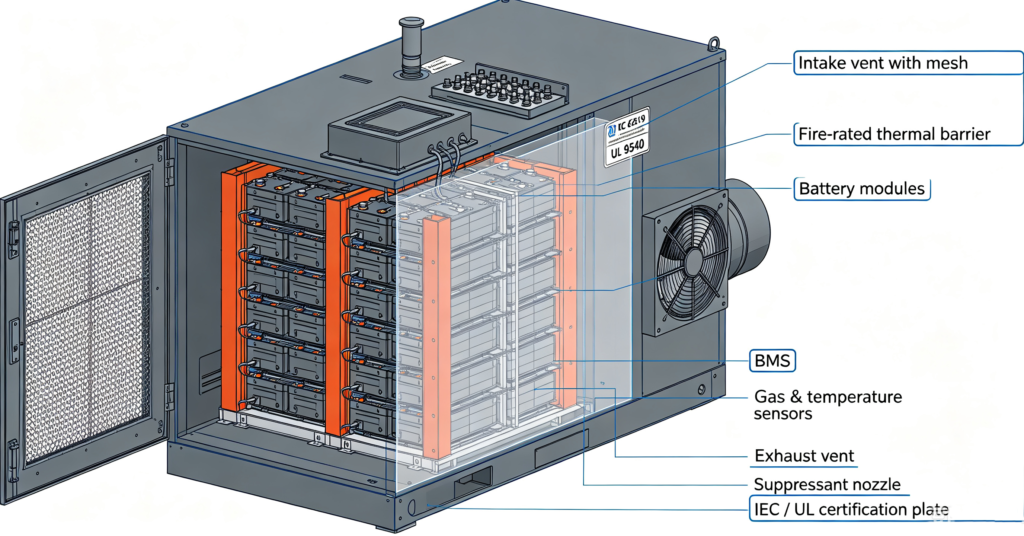
The shortest answer: BESS fires are rare in certified, well-installed systems, and the risk is manageable when the project is built in layers — safe cell chemistry, a battery management system that stops abuse before it becomes heat, thermal barriers and venting that slow or contain a thermal runaway, and installation practices that match the local fire code. The buyers who should care about BESS fires are the ones who skip any of those layers. This guide turns the headlines into a checklist so you can verify what actually matters on a datasheet, a submittal or a site walk.
Every energy storage project carries some fire risk, just as every solar inverter, transformer and cable does. The question is not whether the risk can be reduced to zero — it cannot — but whether the system is designed, certified and installed so that a single cell failure does not become a cabinet fire, and a cabinet event does not become a facility event. The standards that define “safe enough” are published by organisations such as IEC, UL, UN and NFPA. This guide explains what those standards cover, what a buyer can see on a quote, and what questions still need an expert’s sign-off.
What BESS fires are and why they matter
A BESS fire starts with thermal runaway, an uncontrolled release of heat from a lithium-ion cell that raises the temperature of neighbouring cells and can spread through a module or rack. Thermal runaway can be triggered by internal defects, mechanical damage, overcharging, sustained high temperature or a short circuit. The term “BESS fires” therefore covers everything from a single cell that vents hot gas inside a module to a multi-cabinet event that requires emergency services. The difference between the two is usually decided by how the system was engineered.
The reason the topic matters to buyers is that fire risk is one of the few failure modes that can shut down a project after it is commissioned. A failed inverter can be replaced; a fire event can void insurance, stop commissioning, trigger an authority inspection and damage the brand of the installer. Buyers who treat BESS fires as a procurement question — not just an engineering detail — are the ones who avoid those surprises.
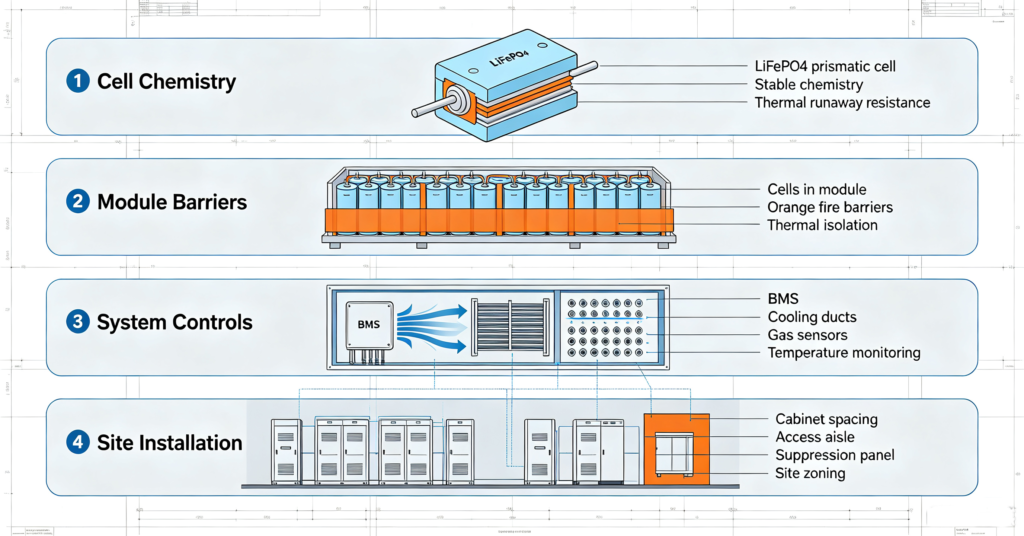
The four protection layers
Safety is built in layers, and each layer has a different job. The cell layer chooses a chemistry that is less likely to enter thermal runaway and that releases less heat if it does. LiFePO4 is widely preferred for stationary BESS because of its thermal stability relative to nickel-manganese-cobalt chemistries; the chemistry comparison is covered in #33 LiFePO4 vs NMC. The module layer adds spacing, fire-retardant materials and fusing that stop a single cell from feeding its neighbours. The system layer is the battery management system, thermal management and enclosure: it monitors temperature and voltage, opens contactors when limits are approached, and keeps the battery within its safe operating window. The site layer is spacing, ventilation, access aisles, suppression and the emergency response plan required by the local authority.
A weak point in any layer can undo the others. A thermally stable cell with no module spacing can still propagate. A strong BMS cannot prevent a puncture caused by careless handling during shipping. And a perfectly designed cabinet installed in a room with no ventilation or fire separation can still create a site problem. The checklist at the end of this guide asks about all four layers, not just the battery brand.
Standards and codes that matter
Standards fall into two groups: product standards that a battery or ESS is tested to, and installation codes that the project must follow. Product standards tell you what the hardware can survive. Installation codes tell you where and how it can be installed. Both are needed, and a certificate for one does not replace compliance with the other.
| Standard / code | Type | What it covers |
|---|---|---|
| IEC 62619 | Product standard | Safety of lithium cells and batteries for industrial use; abuse, thermal propagation and marking requirements |
| UL 1973 | Product standard | Safety of batteries for stationary and vehicle auxiliary power; short-circuit, overcharge, thermal runaway and environmental tests |
| UL 9540 | Product standard | Safety of energy storage systems and their integration; system-level hazards and controls |
| UL 9540A | Test method | Large-scale fire test for evaluating thermal runaway fire propagation between modules, racks or cabinets |
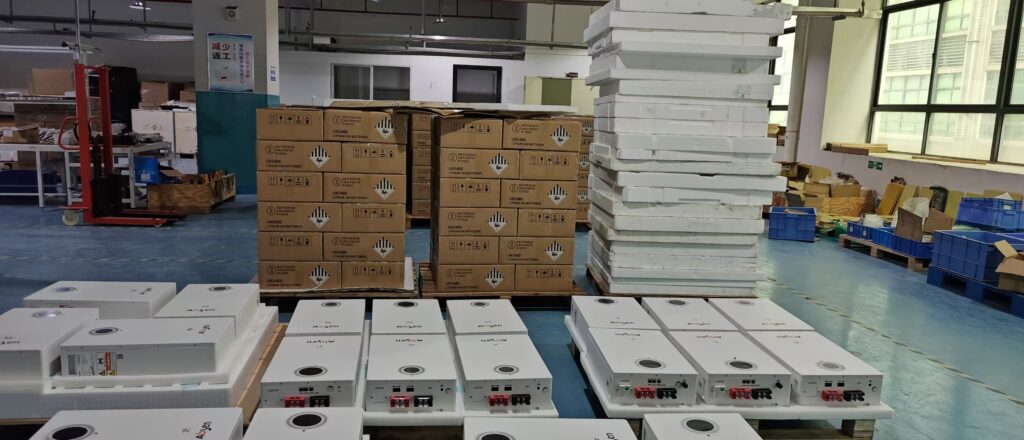
| UN38.3 | Transport standard | Lithium battery transport safety; abuse tests before cells or batteries can be shipped |
| NFPA 855 | Installation code | Installation of stationary energy storage systems; spacing, ventilation, suppression, access and maximum energy capacity per room or container |
| UL 9540A vs UL 9540 | Distinction | UL 9540 certifies the system; UL 9540A is the large-scale fire propagation test data often required by authorities |
| Local building / fire code | Installation code | Adopts or modifies NFPA 855 / IEC equivalents; always jurisdiction-specific |
The practical takeaway is to ask for the test reports that sit behind the certificates. A vendor can say a battery is “UL 9540 listed,” but the authority having jurisdiction may still want the UL 9540A test report that shows what happens when a cell goes into thermal runaway inside the cabinet. The exact documents required vary by country and project size, so the URLs and report references in this article are marked for manual verification.
What actually causes a BESS fire
Root causes fall into three categories: electrical abuse, thermal abuse and mechanical abuse. Electrical abuse is the most common in installed systems: overcharging, overdischarging, or an external short that drives current through a cell until it heats up faster than it can cool. A BMS is designed to detect these conditions and open the contactors, which is why BMS architecture is covered separately in #28 BMS 101. Thermal abuse happens when the battery is operated or stored outside its rated temperature range, often because of a failed cooling system or direct sun exposure. Mechanical abuse is puncture, crush or water ingress, usually from shipping damage, installation mishandling or a site incident.
Once one cell enters thermal runaway, the heat it releases can push adjacent cells past their own threshold. The speed of that propagation depends on cell chemistry, module spacing, thermal barriers and whether the BMS has already disconnected the string. Water alone does not stop the chemical reaction; it cools surrounding cells and suppresses flames, but the failed cell may continue to vent until it is fully discharged and cooled. That is why containment, venting and emergency access are as important as the suppression agent.
Fire protection design choices
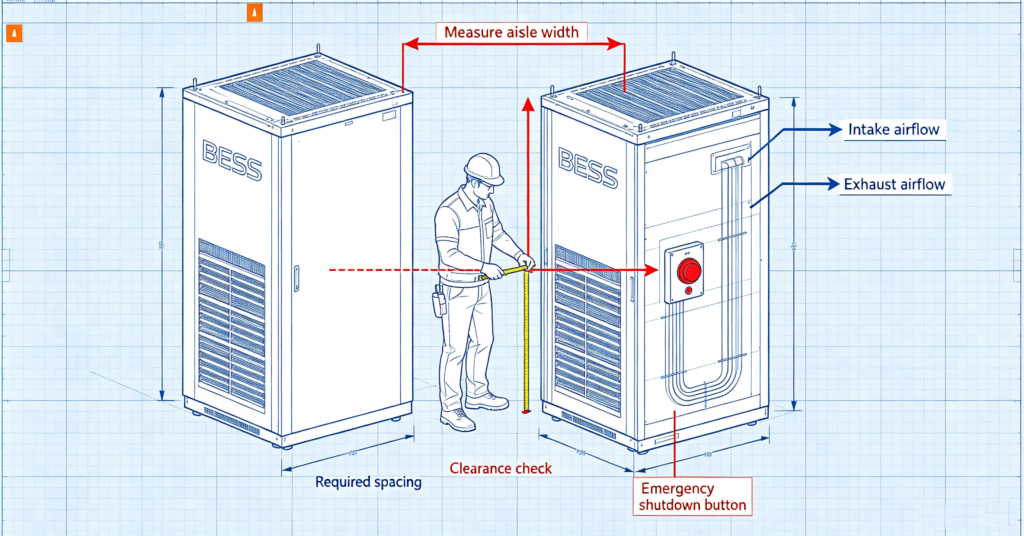
Design choices are where a generic battery becomes a safe installation. Ventilation removes heat under normal operation and vents gases in an abnormal event; the design must account for both intake and exhaust paths and the temperature of the air entering the cabinet. Thermal barriers between modules and racks increase the time it takes for heat to spread, giving the BMS and suppression system more time to act. Suppression systems range from aerosol and clean-agent systems to water mist; the right choice depends on enclosure volume, access and the authority’s preference, not on the battery brand alone. Detection uses temperature sensors, gas sensors and sometimes smoke detectors; early detection triggers contactor opening and suppression before flames appear. Spacing and access are installation-code requirements that keep a cabinet fire from spreading to the next cabinet and that give firefighters a safe path to the unit.
The cooling method also changes the fire risk picture. Liquid cooling can keep cell temperatures more uniform and lower during normal operation, but it adds plumbing and potential leak paths. Air cooling is simpler but depends on ambient airflow and may struggle in hot climates or congested rooms. The trade-offs are covered in #36 liquid cooling vs air cooling.
Procurement checklist for a safe BESS
Run these six questions against any quote and the safety story becomes clear:
- Which cell chemistry is used, and is the datasheet supported by a third-party test report? LiFePO4 test reports to IEC 62619/UL 1973 are a baseline; NMC systems need corresponding evidence.
- What is the BMS protection strategy? Look for cell-level voltage/temperature monitoring, contactor control, fuse coordination and communication with the inverter.
- Has the system been tested to UL 9540A or an equivalent propagation test? Ask for the report, not just the certificate.
- What is the enclosure rating and fire-resistance level? A fire-rated cabinet or separate fireproof storage room changes the installation code path; see #40 battery cabinet and fireproof storage.
- What does the installation manual require for spacing, ventilation and access? Compare those requirements to the actual site layout before ordering.
- What is the emergency response plan? First responders need a single-page guide with shut-off locations, gas warnings and contact details.
One more check that is often skipped: transport certification. Batteries that are not UN38.3 certified at the cell or pack level can be stopped at customs or refused by the shipping line, which turns a safety issue into a schedule issue.
How the standards fit together
| Buying stage | What to ask for | Typical standard or report |
|---|---|---|
| Cell / module selection | Cell abuse and propagation test data | IEC 62619; UL 1973 cell-level results |
| System certification | ESS system safety certificate | UL 9540; IEC 62933-5-2 |
| Fire propagation data | Large-scale test report | UL 9540A; NFPA 855 test data |
| Shipping | Transport test summary | UN38.3 |
| Site approval | Permit set and code compliance letter | NFPA 855; local building/fire code |
| Insurance / finance | Risk assessment and suppression design | Authority-approved submittal; insurer checklist |
Q.How common are BESS fires?
They are rare in certified, professionally installed stationary systems, especially those using LiFePO4 cells and a well-designed BMS. Most reported incidents involve older chemistries, uncertified or modified systems, installation errors, or situations where multiple safety layers were bypassed. The exact incident rate depends on the population and reporting requirements, which is why this article avoids quoting a single percentage.
Q.What is the safest battery chemistry for BESS?
For stationary energy storage, LiFePO4 is generally regarded as the safer choice because it has higher thermal stability and releases less energy during thermal runaway than NMC or NCA chemistries. NMC offers higher energy density, which is useful where space and weight matter, but it requires stronger thermal management and propagation controls.
Q.What does UL 9540A test for?
UL 9540A is a test method that evaluates whether a thermal runaway event in one battery module propagates to neighbouring modules, racks or cabinets. It measures heat release, gas composition and flame spread, and the resulting report is often required by authorities and insurers before a project is approved.
Q.Does NFPA 855 apply to my BESS project?
NFPA 855 is widely adopted in the United States for commercial and utility-scale stationary energy storage. Outside the US, local codes may reference IEC equivalents or may have their own requirements. Always confirm the applicable code with the local authority having jurisdiction before finalising the design.
Q.Can a BESS fire be put out with water?
Water can cool surrounding cells and suppress flames, but it does not stop the chemical reaction inside a cell that is already in thermal runaway. Emergency response for BESS fires relies on ventilation, containment, isolation and cooling together, not on a single suppression agent. Installers should provide first responders with a clear emergency response plan.
Next step: build the rest of the safety stack
Fire safety is one layer of a safe BESS. After checking the fire standards, review the chemistry, the BMS, the cooling method and the cabinet or enclosure that surrounds the battery.
- Compare cell chemistries in #33 LiFePO4 vs NMC
- Understand the BMS layer in #28 BMS 101
- Review cooling trade-offs in #36 liquid cooling vs air cooling
- Check cabinet and fireproof storage options in #40 battery cabinet guide
- Request leekooenergy BESS fire-safety submittals and IEC 62619 / UL test summaries for your project