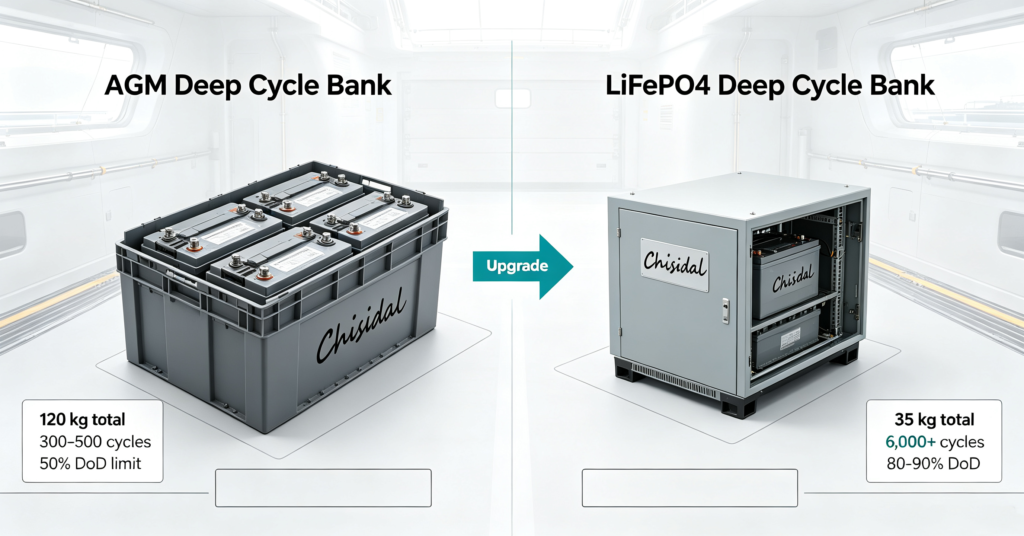
An AGM deep cycle battery is a sealed lead-acid battery that uses absorbed glass mat separators — it is the most common deep-cycle lead-acid type in marine, RV and off-grid systems today. A LiFePO4 deep cycle battery uses lithium iron phosphate chemistry and typically lasts 10–20 times longer, charges 2–4 times faster, weighs 60–70% less, and supports deeper discharge. The upgrade from AGM to LiFePO4 pays off when the battery is cycled frequently (daily or near-daily), when weight or space is constrained, or when the AGM bank is approaching end of life and would need replacement anyway. For a lightly used standby bank that cycles a few times a year, the premium does not pay back during the ownership period.
If you operate a boat, an RV, a remote telecom site or a small commercial backup system, you probably already have AGM batteries in service. They work. They are familiar. They are cheap per kilowatt-hour at purchase. The question is not whether AGM is “bad” — it is whether, at the next replacement cycle, switching to LiFePO4 delivers a lower total cost of ownership and better performance for your specific duty cycle. This guide answers that question with an eight-dimension comparison, a payback calculation you can adapt to your own numbers, and scenario-specific advice for marine, RV and C&I operators.
The broad lithium-vs-lead-acid chemistry comparison is in #24 lithium vs lead-acid deep cycle; the 12V LiFePO4 SKU and specification guide is in #70 12V LiFePO4 battery hub. This article stays on the AGM-to-LiFePO4 upgrade decision for operators who already have working AGM banks.
What an AGM deep cycle battery is — and where it fits
AGM stands for absorbed glass mat. It is a type of valve-regulated lead-acid (VRLA) battery — see the VRLA battery overview for background — in which the electrolyte is suspended in a fibreglass mat between the plates rather than sloshing as free liquid. This design makes AGM batteries spill-proof, maintenance-free (no water top-ups), and tolerant of mounting at angles — which is why they dominate marine and RV applications where flooded lead-acid would be impractical or unsafe.
AGM deep cycle batteries are built with thicker plates than starter batteries, allowing them to be discharged and recharged repeatedly. A quality AGM deep cycle battery typically delivers 300–500 cycles at 50% depth of discharge (DoD). They are sensitive to chronic under-charging (which causes sulfation) and to over-charging (which dries out the mat). They charge best at a regulated absorption voltage of roughly 14.4–14.8V for 12V systems, followed by a float stage. The single most common cause of premature AGM failure in off-grid and marine systems is chronic under-charging from an undersized charging source.
AGM vs LiFePO4: eight dimensions that decide the upgrade
The table below compares the two chemistries on the dimensions that matter for deep-cycle operation. The figures are typical ranges for commercially available 12V deep-cycle batteries; exact values vary by manufacturer and model.
| Dimension | AGM (lead-acid) | LiFePO4 (lithium) | What it means for the upgrade |
|---|---|---|---|
| Cycle life (80% DoD) | 300–500 cycles | 6,000–10,000+ cycles | LiFePO4 lasts 12–20 times longer; this is the single largest TCO driver |
| Usable capacity | 50% of rated (do not discharge below 50%) | 80–90% of rated | A 100Ah AGM gives ~50Ah usable; a 100Ah LiFePO4 gives ~85Ah. You need roughly 1.7× the AGM capacity to match a LiFePO4 bank |
| Charge speed | 0.1–0.2C typical (5–10h to full) | 0.5–1C possible (1–2h to full) | LiFePO4 recharges from a generator or shore power in a fraction of the time; critical for boats and RVs with limited charging windows |
| Weight (12V 100Ah) | ~28–32 kg | ~10–13 kg | 60–65% weight reduction; major benefit for boats (fuel efficiency, stability) and RVs (payload) |
| Volume (12V 100Ah) | ~25–30 L | ~8–12 L | LiFePO4 is roughly one-third the size for the same rated capacity — and delivers more usable energy |
| Purchase cost (12V 100Ah) | ~$200–$350 | ~$400–$700 | LiFePO4 costs 1.5–2× upfront; the premium is recovered through cycle life and usable capacity |
| Safety / thermal stability | Contains sulfuric acid; risk of thermal runaway under abuse; hydrogen gas if overcharged | Thermally stable cathode; no thermal runaway at cell level; no off-gassing in normal operation | LiFePO4 is inherently safer; important for enclosed boat lockers and RV battery compartments |
| Low-temperature charging | Can charge below 0°C (reduced current) | Should NOT charge below 0°C without heating (risk of lithium plating) | AGM has an advantage in unheated winter environments; LiFePO4 systems in cold climates need a heated battery or charging-temperature interlock |
Two rows deserve emphasis. The usable-capacity row means that a direct 1:1 capacity swap from AGM to LiFePO4 actually increases available energy by roughly 60–70%. Operators who size the LiFePO4 bank to match the AGM bank’s usable capacity can often downsize the rated capacity and save money. The low-temperature charging row is the one scenario where AGM retains a genuine advantage: in unheated spaces that regularly drop below freezing, a LiFePO4 battery needs either a built-in heating element or a charge controller that blocks charging below the cutoff temperature. Skipping this is the most common installer mistake in cold-climate lithium conversions.
Upgrade ROI: how to calculate your own payback period
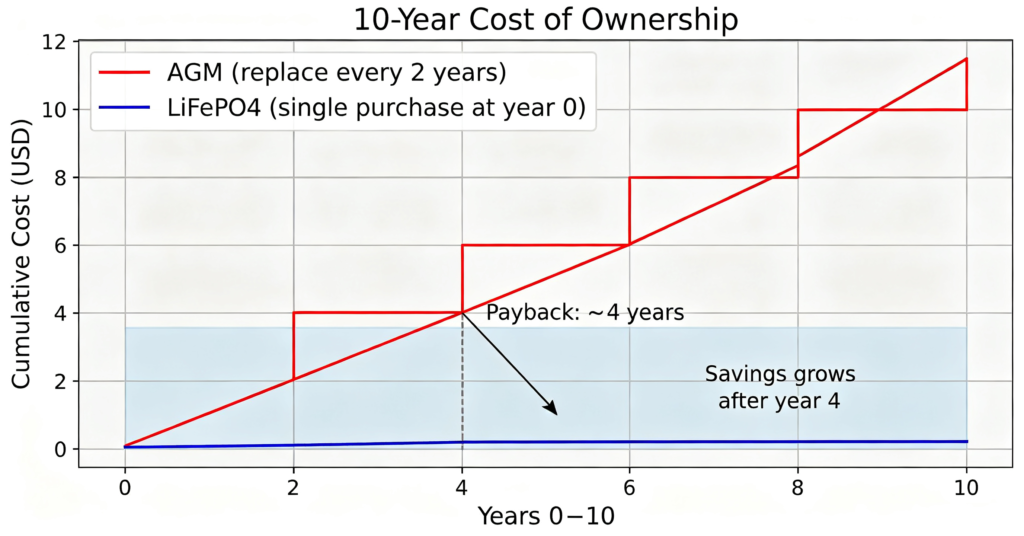
The payback period depends on four variables: the AGM battery’s cycle life in your application, how often you cycle, the price difference per usable kWh, and whether you need to modify the charging system. The formula below lets you estimate your own numbers.
Step 1 — Calculate annual AGM replacement cost. Divide the AGM bank’s purchase cost by its expected service life in years. For a daily-cycled marine or RV bank, an AGM battery typically lasts 1.5–2.5 years. For a standby bank that cycles monthly, it may last 5–7 years. Example: a $1,200 AGM bank lasting 2 years = $600/year replacement cost.
Step 2 — Calculate the LiFePO4 bank cost. Size the LiFePO4 bank to match the AGM bank’s usable capacity, not its rated capacity. If the AGM bank is 400Ah rated (200Ah usable), a 200Ah LiFePO4 bank (170Ah usable) is sufficient. Example: a 200Ah 12V LiFePO4 bank at $1,000.
Step 3 — Add conversion costs if needed. If the existing charger is not LiFePO4-compatible (wrong absorption voltage, no temperature compensation), budget for a charger or DC-DC converter upgrade. This typically adds $150–$400 for a 12V system. Many modern chargers have a LiFePO4 mode or can be set to the correct voltage, in which case no hardware change is needed.
Step 4 — Calculate payback. Divide the total LiFePO4 cost (bank + conversion) by the annual AGM replacement cost. Example: ($1,000 + $200) / $600/year = 2.0 years. After year 2, every additional year of LiFePO4 service is pure savings relative to continuing to replace AGM batteries.
The break-even point for a daily-cycled system is typically 2–4 years. For a weekly-cycled system, it stretches to 5–8 years. For a standby system that cycles a few times a year, the LiFePO4 premium may never pay back within a 10-year ownership window — and AGM remains the rational choice.
Scenario-specific upgrade advice
Marine (boats, yachts, workboats)
Marine deep-cycle banks are often cycled daily when at anchor, weight directly affects fuel consumption and stability, and battery compartments are enclosed — all three factors favour LiFePO4. The weight reduction alone (a 400Ah AGM bank weighs ~120 kg; an equivalent LiFePO4 bank weighs ~40 kg) improves trim and fuel efficiency. The fast recharge means a generator run-time can be cut from 4–6 hours to 1–2 hours. The main caveat is ensuring the battery compartment has adequate temperature control and that the charger/alternator regulator is LiFePO4-compatible. Marine operators with daily anchor cycles typically see payback in 2–3 years. The marine-specific 12V deep-cycle guide is in #75 12V deep cycle marine battery.
RV and campervans
RV batteries cycle daily when off-grid, payload is limited, and storage space is at a premium — again favouring LiFePO4. The ability to charge fully in 1–2 hours from a generator or shore power means shorter generator runs and more time at quiet campsites. The weight savings free up payload for water, food and gear. RV owners should confirm that their converter/charger has a LiFePO4 mode or can be set to 14.4–14.6V absorption, and that the battery is located where it will not be exposed to freezing temperatures during charging. For full-time RVers, payback is typically 2–3 years; for weekend users, 5–7 years.
Commercial and industrial (C&I) backup and off-grid
C&I operators run larger banks (typically 48V systems, 10–100+ kWh) where the cycle frequency varies by application. For telecom sites, remote monitoring stations and off-grid commercial facilities with daily cycling, LiFePO4 reduces site visits (fewer replacements), lowers maintenance labour, and improves system uptime. For standby generators at facilities that experience only occasional outages, AGM or even flooded lead-acid may remain the lower-cost option over a 10-year horizon. C&I buyers should also consider that a 48V LiFePO4 system requires a battery management system (BMS) and compatible inverter — the integration cost is real but typically included in a pre-assembled rack system. The 48V system architecture is covered in #35 48V lithium batteries explained.
When NOT to upgrade from AGM to LiFePO4
An upgrade is not always the right call. Stay with AGM when:
- The battery is a standby bank that cycles fewer than 5–10 times per year. The cycle-life advantage of LiFePO4 is irrelevant if the battery is rarely cycled; AGM’s lower upfront cost wins.
- The AGM bank is new and in good condition. Replacing a healthy one-year-old AGM bank to “upgrade” to lithium wastes the remaining service life. Wait until the AGM bank approaches end of life, then replace with LiFePO4.
- The operating environment regularly drops below 0°C and cannot be heated. LiFePO4 must not be charged below freezing without a heating system or temperature-interlocked charger. AGM has no such restriction (though its capacity also drops in cold weather).
- The budget cannot absorb the upfront premium. If cash flow is constrained and the AGM bank still works, defer the upgrade. A premature lithium purchase that strains the budget is worse than a planned replacement at the AGM end of life.
Q. Can I replace AGM batteries with LiFePO4 in my boat or RV?
Yes, in most cases. LiFePO4 batteries are available in the same 12V, 24V and 48V form factors as AGM batteries and fit standard battery trays. The two requirements are: (1) the charger or converter must be set to the LiFePO4 charge profile (typically 14.4–14.6V absorption for 12V, no equalisation, no float or a low float voltage), and (2) the battery must not be charged in temperatures below 0°C unless it has a built-in heater or the charger has a low-temperature cutoff. Many modern chargers have a LiFePO4 mode; older chargers may need replacement or a DC-DC converter between the charger and the battery.
Q. How long does an AGM deep cycle battery last compared to LiFePO4?
A quality AGM deep cycle battery typically lasts 300–500 cycles at 50% depth of discharge, which translates to 1.5–3 years for a daily-cycled marine or RV bank and 5–8 years for a standby bank. A LiFePO4 deep cycle battery typically lasts 6,000–10,000+ cycles at 80% depth of discharge, which translates to 10–20+ years for daily cycling. The cycle-life difference is the primary driver of the total-cost-of-ownership advantage: a LiFePO4 battery may cost 1.5–2× as much upfront, but it replaces 10–15 AGM batteries over its service life.
Q. Do I need to change my charger when switching from AGM to LiFePO4?
It depends on the charger. A modern smart charger with a selectable LiFePO4 or “lithium” profile does not need replacement — simply select the correct profile. A charger without a lithium profile may still work if its absorption voltage can be manually set to 14.4–14.6V (for 12V) and its equalisation function can be disabled. Older chargers that cannot adjust voltage or that automatically run equalisation cycles should be replaced, because the equalisation voltage (15.5V+) can damage LiFePO4 cells. A DC-DC converter with a LiFePO4 output profile is an alternative that sits between the existing charger and the battery, avoiding a full charger replacement.
Q. Is LiFePO4 safer than AGM for enclosed battery compartments?
Yes. LiFePO4 chemistry is thermally stable — the cathode does not release oxygen at elevated temperatures, so the cell does not enter thermal runaway under normal abuse conditions. AGM batteries contain sulfuric acid and, if overcharged, can vent hydrogen gas (which is explosive in enclosed spaces) and can experience thermal runaway in severe fault conditions. LiFePO4 batteries also include a battery management system (BMS) that disconnects the pack during over-voltage, under-voltage, over-current and over-temperature events. For enclosed boat lockers, RV battery compartments and indoor C&I battery rooms, LiFePO4’s inherent safety and BMS protection reduce fire and gas-accumulation risk.
Q. What is the typical payback period for an AGM-to-LiFePO4 upgrade?
For a daily-cycled system (marine at anchor, full-time RV, off-grid telecom), the payback period is typically 2–4 years. For a weekly-cycled system (weekend RV, seasonal boat), it stretches to 5–8 years. For a standby system that cycles fewer than 10 times per year, the premium may never pay back within a 10-year ownership window. The payback calculation is: (LiFePO4 bank cost + any charger/conversion cost) divided by (annual AGM replacement cost). The annual AGM replacement cost is the AGM bank purchase price divided by its expected service life in years — which depends entirely on how often it is cycled and how well it is maintained.
Next step: size the LiFePO4 bank for your actual duty cycle
The right AGM-to-LiFePO4 upgrade is the one that matches your cycle frequency, your space and weight constraints, and your budget — not the one with the largest advertised capacity. Before you replace a working AGM bank, calculate your daily energy consumption, confirm your charger’s lithium compatibility, and check the operating temperature range.
- Read the broad chemistry comparison in #24 lithium vs lead-acid deep cycle
- Check 12V LiFePO4 specifications and form factors in #70 12V LiFePO4 battery hub
- Understand 48V system architecture for C&I upgrades in #35 48V lithium batteries explained
- See marine-specific 12V deep-cycle guidance in #75 12V deep cycle marine battery
- Review off-grid system sizing in #23 off-grid solar system batteries
- Ask leekooenergy for an AGM-to-LiFePO4 upgrade specification that includes: your current AGM bank capacity and age, your daily energy consumption in Wh, your charger make and model (for lithium-compatibility check), your operating temperature range, and your preferred battery form factor (rack / stackable / wall-mounted) — so the replacement LiFePO4 bank is sized to your actual usable-capacity requirement rather than a nominal 1:1 swap