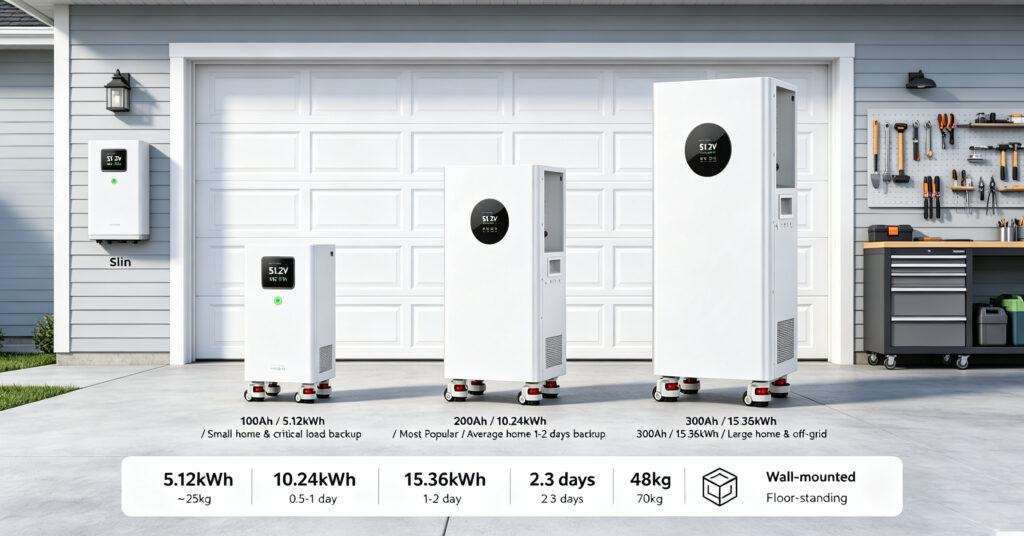
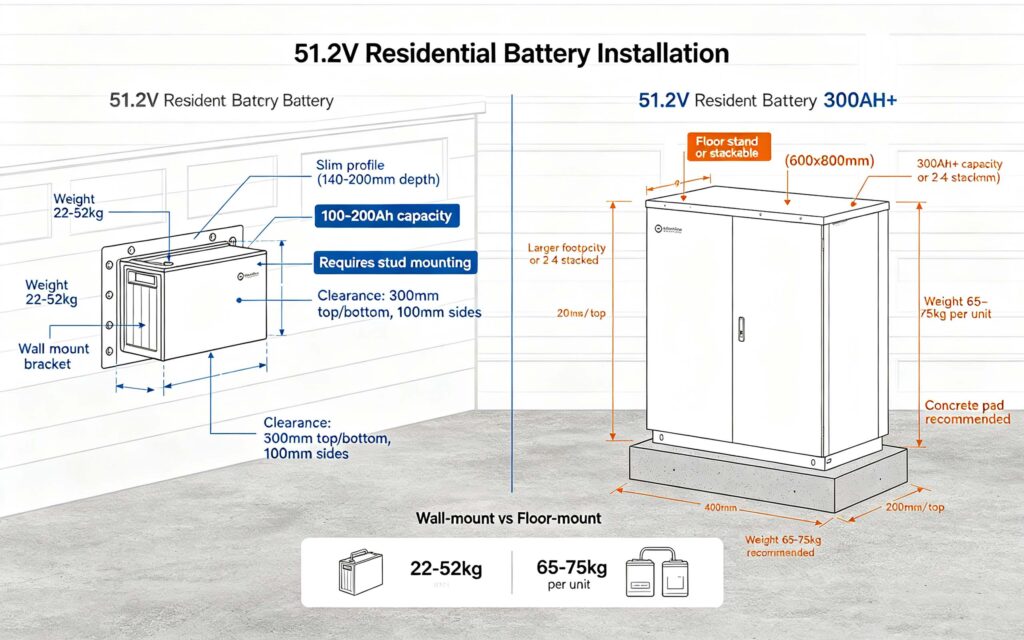
51.2V 200Ah LiFePO4 battery is a residential energy storage battery that uses 16 lithium iron phosphate cells in series (16 × 3.2V = 51.2V nominal), delivering 10.24kWh of nominal energy and 8.2–9.2kWh of usable energy at 80–90% depth of discharge. The “51.2V” designation is the nominal voltage of a 16-cell LiFePO4 battery — it is often called “48V” in the industry (48V is the nominal system voltage category, while 51.2V is the actual LiFePO4 nominal voltage). The three most common residential capacities are 100Ah (5.12kWh), 200Ah (10.24kWh), and 300Ah (15.36kWh). A 100Ah battery is suitable for small homes, apartments, or backup of critical loads (fridge, lights, internet); a 200Ah battery is the most popular choice for average homes with 3–6kW solar arrays and provides 1–2 days of backup for essential loads; a 300Ah battery is for large homes, high-demand loads (air conditioning, electric cooking), or off-grid applications. All 51.2V LiFePO4 batteries include a built-in BMS and are designed to be compatible with 48V hybrid inverters (e.g., Victron, Growatt, Deye, Sol-Ark) — always verify the inverter supports the battery’s BMS communication protocol (CAN, RS485, or proprietary). Residential 51.2V batteries are available in wall-mounted (slim, space-saving) and floor-standing (higher capacity, stackable) form factors.
Residential energy storage is rapidly shifting from 12V/24V systems to 48V/51.2V systems, and the 51.2v 200ah lifepo4 battery has emerged as the standard building block for home solar storage. A 51.2V system offers higher efficiency (lower current for the same power, reducing wiring losses), thinner and cheaper wiring, and compatibility with the latest hybrid inverters. This hub compares the three most popular 51.2V residential battery capacities (100Ah, 200Ah, 300Ah), explains the 51.2V vs 48V naming convention, provides capacity sizing guidance, and covers inverter compatibility and mounting options. For the broader 48V battery system architecture, see #35 48V lithium battery complete guide.
51.2V vs 48V: why the same battery has two names
One of the most common sources of confusion in residential battery storage is the “51.2V” vs “48V” naming convention. These terms refer to the same battery system category, but describe different voltage measurements.
48V is the nominal system voltage category — it is the standard voltage class for telecommunications, data centers, and increasingly residential solar storage. When a product is called a “48V battery,” it means it belongs to the 48V voltage class.
51.2V is the actual nominal voltage of a 16-cell LiFePO4 battery. Each LiFePO4 cell has a nominal voltage of 3.2V, so 16 cells in series = 16 × 3.2V = 51.2V. This is the voltage you will see on the battery label and display.
For comparison, a 16-cell lead-acid battery (16 × 2.0V = 32V nominal, but typically called “48V” because lead-acid cells are 2V each and 24 cells = 48V) has a different actual voltage. The industry uses “48V” as the category name regardless of chemistry, but LiFePO4 batteries in this category have a 51.2V nominal voltage. When shopping for a battery or inverter, look for “48V” or “51.2V” compatibility — they mean the same thing for LiFePO4 systems. The full charge voltage of a 51.2V LiFePO4 battery is 58.4V (16 × 3.65V), and the cut-off voltage is 40.0V (16 × 2.5V).
51.2V 100Ah vs 200Ah vs 300Ah: specification comparison
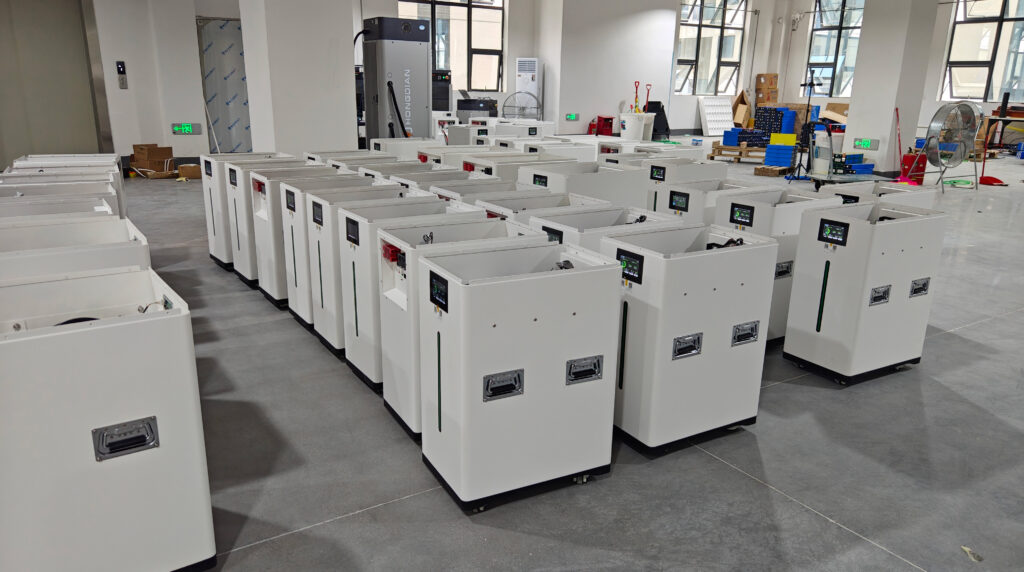
All three capacities use the same 16-cell series configuration (51.2V nominal) and differ only in the number of parallel cell groups, which determines amp-hour capacity, energy, weight, and size. The table below compares key specifications.
| Specification | 100Ah | 200Ah | 300Ah |
|---|---|---|---|
| Nominal voltage | 51.2V | 51.2V | 51.2V |
| Nominal energy | 5.12 kWh | 10.24 kWh | 15.36 kWh |
| Usable energy (85% DoD) | 4.35 kWh | 8.70 kWh | 13.06 kWh |
| Cycle life (80% DoD) | 6,000–10,000 | 6,000–10,000 | 6,000–10,000 |
| Max continuous discharge | 50–100A (2.5–5kW) | 100–200A (5–10kW) | 150–300A (7.5–15kW) |
| Max charge current | 50A | 100A | 150A |
| Weight | 22–28 kg | 45–52 kg | 65–75 kg |
| Typical dimensions (W×H×D) | 440×600×140mm (wall) | 520×700×200mm (wall/floor) | 600×800×250mm (floor) |
| Mounting | Wall-mounted | Wall or floor | Floor-standing (stackable) |
| Typical price (USD) | $1,800–$2,800 | $3,200–$5,000 | $4,500–$7,000 |
| Best for | Apartment, small home, critical load backup | Average home, 3–6kW solar, 1–2 days backup | Large home, high-demand loads, off-grid |
How to size a 51.2V residential battery for your home
Sizing a 51.2V residential battery depends on your goals: backup power during outages, peak shaving (avoiding high time-of-use rates), or full off-grid operation. The sizing process differs for each goal.
For backup power: Calculate your critical load consumption (fridge, lights, water pump, internet router, medical equipment, garage door opener). A typical US home critical load is 1–3kWh per day. A 100Ah battery (4.35kWh usable) provides 1.5–4 days of critical load backup; a 200Ah battery (8.70kWh usable) provides 3–8 days. Most homeowners choose 200Ah for a comfortable margin.
For peak shaving / self-consumption: Size the battery to store excess solar production for evening use. A typical home with a 5kW solar array produces 20–25kWh per day, of which 8–12kWh is exported to the grid during midday. A 200Ah battery (8.70kWh usable) can store most of the excess midday production for evening use, reducing grid consumption and maximizing self-consumption. A 100Ah battery is sufficient for smaller arrays (3kW) or partial peak shaving.
For off-grid operation: Size the battery for 3–5 days of autonomy (no solar charging). A typical off-grid home uses 10–20kWh per day. A 300Ah battery (13.06kWh usable) provides less than 1 day of autonomy for a 15kWh/day home — most off-grid systems use 2–4 × 300Ah batteries (600–1200Ah total, 30–60kWh) for 3–5 days of autonomy. Off-grid systems also require a backup generator for extended cloudy periods.
A common rule of thumb for grid-tied residential solar + storage: size the battery at 50–100% of your daily energy consumption. For a home using 20kWh/day, a 10–20kWh battery (1–2 × 200Ah) is appropriate. Always leave 20–30% headroom for future load growth and efficiency losses.
Inverter compatibility and communication protocols
A 51.2V LiFePO4 battery must be compatible with your hybrid inverter for safe and efficient operation. The most important compatibility factors are: voltage range (the inverter must support 48V/51.2V battery input), charge profile (the inverter must use LiFePO4 charge voltages: 56.0–58.4V bulk, no float or 51.2–53.0V float), and BMS communication (the inverter must support the battery’s communication protocol for state of charge reporting and protection coordination).
The most common BMS communication protocols for 51.2V residential batteries are: CAN bus (most common, used by Victron, Sol-Ark, Deye, and many others), RS485 (used by some older inverters and battery brands), and proprietary protocols (e.g., Tesla Powerwall uses a proprietary protocol and is only compatible with Tesla inverters). When choosing a battery, always verify that the inverter manufacturer lists the battery brand as “compatible” or “tested” — using an unlisted combination may result in incorrect state of charge reporting, improper charge voltage, or loss of warranty.
For more details on 48V/51.2V system design and inverter selection, see #35 48V lithium battery complete guide.
Q. How many kWh is a 51.2V 200Ah battery?
A 51.2V 200Ah LiFePO4 battery stores 10.24 kWh nominal, calculated as 51.2V x 200Ah. Usable energy is less because you should not discharge below the recommended depth: at 85% depth of discharge it delivers about 8.7 kWh. A typical US home uses 25-35 kWh a day, so one 200Ah unit covers essential loads, like fridge, lights, water pump, and internet, for 1-2 days, or evening peak shaving when paired with solar.
Q. What is the difference between 51.2V and 48V batteries?
They are the same voltage category described two ways. “48V” is the system voltage class used across telecom, data centers, and residential storage. “51.2V” is the actual nominal voltage of a 16-cell LiFePO4 battery, 16 x 3.2V. A 48V inverter works with a 51.2V LiFePO4 battery; the terms are used interchangeably. Lead-acid 48V is 24 cells x 2.0V = 48.0V, which is why the category kept the name. LiFePO4 charge voltage is 56.0-58.4V.
Q. Can I parallel two 51.2V 200Ah batteries to get 400Ah?
Yes, if both are identical, meaning the same brand, model, capacity, age, and firmware, and their BMS supports parallel operation. Two 200Ah units give 51.2V 400Ah, or 20.48 kWh. Requirements: match voltages within 100mV, use equal-length correctly sized cables of 25-50mm2, fuse each positive terminal, and follow the manufacturer connection sequence, negatives first and master last. Most systems support 2-8 batteries in parallel. Consult the manual for the maximum count.
Q. How long does a 51.2V 200Ah battery last?
It lasts 6,000-10,000 cycles at 80% discharge depth, which is 16-27 years if cycled once daily. In practice, most residential units last 10-15 years because daily discharge is usually shallower, at 20-50%, and calendar aging runs about 2-3% per year. At ten years, capacity typically remains 70-80%. BMS electronics may fail before cells. Most warranties guarantee 70% capacity after ten years or 6,000 cycles. Keep it at 15-25C and avoid deep discharge.
Q. What inverters are compatible with 51.2V LiFePO4 batteries?
Most modern 48V hybrid inverters work with 51.2V LiFePO4 batteries, including Victron, Growatt, Deye, Sol-Ark, Schneider, OutBack, and SMA lines. Always check the inverter manufacturer official compatibility list. Key factors: the inverter must accept 48V/51.2V battery input, have a LiFePO4 charge setting of 56.0-58.4V, support the battery BMS protocol, CAN being most common, and its charge current must not exceed the battery limit. When unsure, choose a manufacturer-tested combination to protect warranties and safety.
Next step: size your 51.2V battery and verify inverter compatibility
The 51.2v 200ah lifepo4 battery is the most popular residential storage building block for good reason — it provides 10.24kWh of capacity in a compact, wall-mountable form factor, compatible with all major 48V hybrid inverters. But choosing the right capacity (100Ah, 200Ah, or 300Ah) and verifying inverter compatibility are critical for a successful installation. Calculate your daily energy usage, determine your primary goal (backup, peak shaving, or off-grid), and verify that your inverter supports the battery’s BMS communication protocol before purchasing.
- Read the 48V lithium battery complete guide in #35
- Learn LiFePO4 chemistry fundamentals in #1
- Compare hybrid vs off-grid vs grid-tied systems in #99
- Understand battery thermal management in #88
- Ask leekooenergy for a 51.2V residential battery specification that includes: recommended capacity (100Ah/200Ah/300Ah or parallel configuration) based on your daily energy calculation and storage goals (backup/peak shaving/off-grid), exact battery dimensions and weight for your installation space, wall-mount vs floor-mount recommendation, compatible inverter list with BMS communication protocol verification (CAN/RS485), charge profile settings (bulk/float voltages), parallel expansion options and maximum battery count, required cable gauge and fuse sizing, operating temperature range and ventilation requirements, certification status (UL 1973, IEC 62619, UN 38.3), and total cost of ownership comparison (10-year) — so your 51.2V residential battery is correctly sized, safely installed, and fully compatible with your inverter and solar system