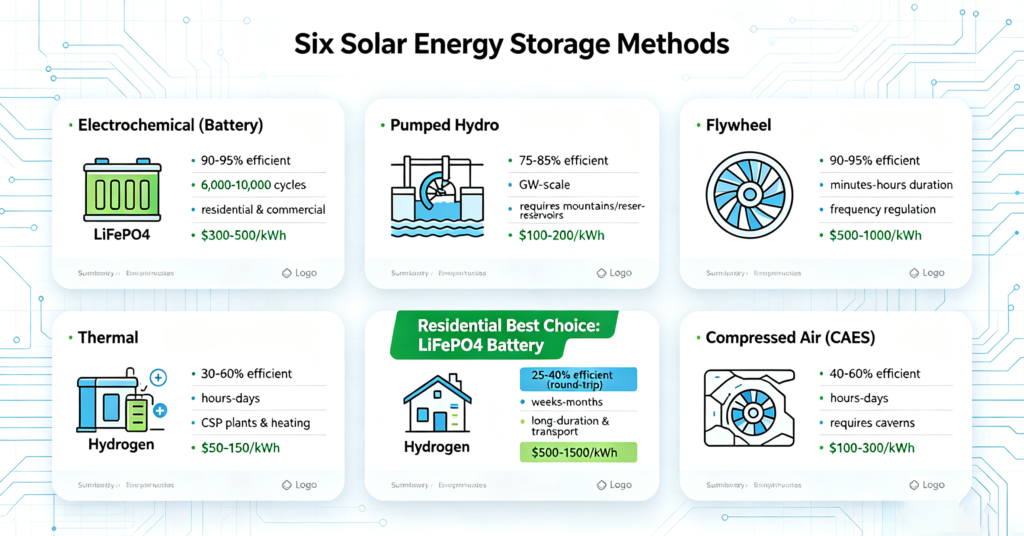
How to store solar energy is one of the most important questions in the transition to renewable energy, because solar panels only produce power when the sun is shining — to use solar energy at night or during cloudy periods, you need to store it. There are six main methods of storing solar energy: (1) electrochemical storage (batteries — lithium-ion, lead-acid, flow batteries), which stores energy in chemical bonds and is the most common method for residential and commercial solar; (2) pumped hydroelectric storage, which pumps water uphill during excess solar production and releases it through turbines when needed — this is the largest-capacity storage method globally but requires specific geography; (3) flywheel storage, which stores energy in a spinning mass and is used for short-duration, high-power applications like frequency regulation; (4) thermal storage, which stores solar energy as heat (molten salt, hot water, or phase change materials) and is used in concentrated solar power plants and some residential heating systems; (5) hydrogen storage, which uses excess solar to electrolyze water into hydrogen, which can be stored and used later in fuel cells or combustion — currently expensive but promising for long-duration storage; (6) compressed air energy storage (CAES), which compresses air into underground caverns during excess production and releases it through turbines. For residential and small commercial solar systems, lithium-ion batteries (specifically LiFePO4 — lithium iron phosphate) are the clear best choice due to their high efficiency (90–95%), long cycle life (6,000–10,000 cycles), high depth of discharge (80–90%), compact size, and rapidly declining cost. A typical residential solar storage system uses 5–20kWh of LiFePO4 battery capacity, paired with a hybrid inverter, and can power essential home loads for 1–3 days during an outage or store excess daytime solar for evening use.
The question of how to store solar energy is fundamental to making solar power a reliable, 24/7 energy source. Solar panels produce electricity only during daylight hours, and their output varies with weather, season, and time of day. Without storage, excess midday solar production is exported to the grid (for net metering credits) and evening energy needs must be met by grid power — or, in off-grid systems, by a generator. This guide explains the six main methods of storing solar energy, compares their technical characteristics and best-use scenarios, and explains why lithium-ion (specifically LiFePO4) batteries have become the dominant storage technology for residential and small commercial solar systems. For detailed battery bank sizing and chemistry selection, see #2 how to choose a solar battery bank.
Six methods of storing solar energy: technical comparison
Solar energy can be stored in many forms, each with different efficiency, capacity, duration, cost, and best-use scenario. The table below compares the six main methods.
| Method | Round-trip efficiency | Typical duration | Scale | Cost ($/kWh) | Best for |
|---|---|---|---|---|---|
| Lithium-ion battery | 90–95% | Hours–days | kW–MW | $300–$500 | Residential, commercial, grid peak shaving |
| Lead-acid battery | 75–85% | Hours–days | kW–MW | $150–$300 | Budget systems, backup (being replaced by LiFePO4) |
| Pumped hydro | 75–85% | Hours–days | GW | $100–$200 | Grid-scale, requires mountains & reservoirs |
| Flywheel | 90–95% | Seconds–minutes | kW–MW | $500–$1,000 | Frequency regulation, UPS, short-duration |
| Thermal (molten salt) | 30–60% | Hours–days | MW–GW | $50–$150 | Concentrated solar power (CSP), heating |
| Hydrogen (electrolysis) | 25–40% | Days–months | MW–GW | $500–$1,500 | Long-duration storage, transport, industry |
| Compressed air (CAES) | 40–60% | Hours–days | MW–GW | $100–$300 | Grid-scale, requires underground caverns |
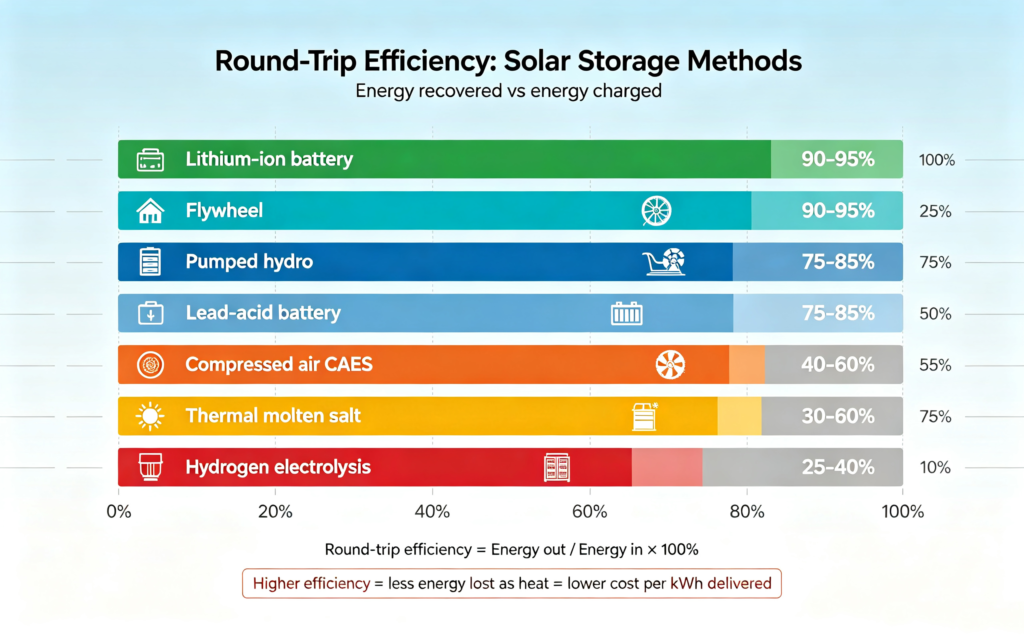
Why lithium-ion (LiFePO4) batteries dominate residential solar storage
Among all six storage methods, lithium-ion batteries — and specifically LiFePO4 (lithium iron phosphate) — have become the dominant choice for residential and small commercial solar storage. The reasons are a combination of technical superiority, practicality, and rapidly declining cost.
High round-trip efficiency (90–95%). LiFePO4 batteries convert 90–95% of the energy stored in them back to usable AC power (after inverter losses). This means for every 10kWh of solar energy stored, you get 9–9.5kWh back. Lead-acid batteries are 75–85% efficient, and hydrogen is only 25–40% efficient (due to losses in electrolysis, storage, and fuel cell conversion).
Long cycle life (6,000–10,000 cycles). A LiFePO4 battery can be charged and discharged 6,000–10,000 times before reaching 80% of original capacity. At one cycle per day, that is 16–27 years of life. Lead-acid batteries last 1,000–2,000 cycles (3–6 years at daily cycling). This long life makes LiFePO4 the lowest-cost option on a total cost of ownership basis despite higher upfront cost.
High depth of discharge (80–90%). LiFePO4 batteries can be safely discharged to 80–90% of their capacity without significant damage. Lead-acid batteries should only be discharged to 50% to maintain cycle life. This means a 10kWh LiFePO4 battery provides 8–9kWh of usable energy, while a 10kWh lead-acid battery provides only 5kWh — you need nearly twice the lead-acid capacity to get the same usable energy.
Compact and lightweight. LiFePO4 batteries are 50–60% lighter and 30–40% smaller than equivalent lead-acid batteries. A 10kWh LiFePO4 battery weighs 45–55kg and can be wall-mounted; an equivalent lead-acid bank weighs 120–150kg and requires a floor stand.
Zero maintenance. LiFePO4 batteries are sealed and require no watering, equalization charging, or regular maintenance. Flooded lead-acid batteries require monthly watering and equalization charging; AGM batteries are maintenance-free but have shorter life.
Rapidly declining cost. Lithium-ion battery costs have declined by more than 90% since 2010, and LiFePO4 specifically has become the cheapest lithium-ion chemistry due to the absence of expensive cobalt and nickel. At $300–$500/kWh (installed), LiFePO4 is now cost-competitive with lead-acid on a total cost of ownership basis, and the gap continues to narrow.
How a residential solar battery storage system works
A residential solar battery storage system consists of four main components: solar panels, a hybrid inverter (or charge controller + inverter), a battery bank (LiFePO4), and the home electrical panel. The system operates in different modes depending on grid availability and energy supply/demand.
Daytime (grid up, solar producing): Solar power first serves home loads. Any excess solar power charges the battery (if below a set state of charge, typically 90–95%). Once the battery is full, excess solar is exported to the grid for net metering credits (if available).
Evening (grid up, solar not producing): The battery discharges to serve home loads, reducing grid consumption. This is called “peak shaving” or “self-consumption” — using stored solar energy during expensive evening peak rate periods. When the battery reaches a minimum state of charge (typically 10–20%), the system switches back to grid power.
Grid outage: The hybrid inverter automatically disconnects from the grid (islanding mode) and powers critical loads from the battery and solar. The system continues to charge the battery from solar during the day, providing indefinite backup as long as solar production meets or exceeds consumption. Non-critical loads may be shed to extend battery life.
Off-grid (no grid connection): The system operates entirely on solar + battery, with a backup generator for extended cloudy periods. The battery is sized for 3–5 days of autonomy, and the charge controller manages solar charging to prevent overcharge or overdischarge.
For more details on system architecture and component selection, see #99 hybrid vs off-grid vs grid-tied solar system.
Q. What are the methods of storing solar energy?
Six main methods: batteries, electrochemical storage using lithium-ion or lead-acid, most common for residential and commercial; pumped hydro, pumping water uphill and releasing through turbines, largest scale but needs specific geography; flywheel, a spinning mass for seconds-to-minutes duration; thermal storage, molten salt or hot water used in CSP and heating; hydrogen, electrolysis into H2 for weeks-months duration, currently low efficiency; and compressed air, CAES, using underground caverns. For homes, lithium-ion, specifically LiFePO4, is the clear best choice.
Q. How does solar battery storage work?
Solar battery storage converts excess DC power from solar panels into chemical energy, then back to AC when needed. During the day, when production exceeds consumption, the hybrid inverter or charge controller charges the battery; the BMS monitors voltage, temperature, and current. When solar is insufficient, such as evening, clouds, or outage, the battery discharges through the inverter to power home loads. The BMS and inverter manage charge and discharge for self-consumption, peak shaving, or backup. Round-trip efficiency is typically 85-90%.
Q. What is the best battery for storing solar energy at home?
LiFePO4, lithium iron phosphate. It beats other chemistries for home storage: 6,000-10,000 cycles at 80% depth of discharge, meaning 16-27 years at daily cycling; 80-90% usable capacity versus 50% for lead-acid; 90-95% round-trip efficiency; the best thermal stability of any lithium chemistry with 270C runaway onset; zero maintenance; and 50-60% lighter than lead-acid. A 51.2V 100-200Ah unit, 5-10kWh, with a 48V hybrid inverter is the typical home setup. NMC suits EVs; lead-acid costs more long-term.
Q. How long can solar energy be stored in a battery?
Weeks to months with minimal loss. LiFePO4 self-discharges only 2-5% per month at 20-25C, so a full battery retains 95-98% after a month and 70-80% after six. In practice, home batteries cycle daily, charged by solar and discharged in the evening, so storage is typically 12-24 hours. During an outage, a full battery runs essential loads for 1-3 days, recharged by daytime solar. For long-term storage, keep the battery at 50-70% state of charge in a cool place and recharge every 3-6 months.
Q. How much does solar energy storage cost?
For residential LiFePO4, installed cost is $300-$500 per kWh, or $3,000-$10,000 for a typical 5-20kWh system. A 10kWh system runs $5,000-$8,000 installed; after the 30% federal credit and local incentives, net is roughly $3,500-$5,600. Lead-acid costs $150-$300 per kWh upfront but has a third of the cycle life and half the usable capacity, so total cost of ownership is higher. Grid-scale storage, such as pumped hydro or CAES, costs $100-$300 per kWh but needs specific geography. Lithium costs have fallen over 90% since 2010.
Next step: choose your storage method and size your battery
The question of how to store solar energy has a clear answer for residential and small commercial systems: LiFePO4 batteries. Among all six storage methods, LiFePO4 offers the best combination of efficiency, cycle life, safety, compactness, and cost for stationary solar storage. Once you have chosen LiFePO4, the next steps are to size your battery bank based on your daily energy usage and storage goals, select a compatible hybrid inverter, and decide between grid-tied with backup, hybrid, or off-grid system architecture.
- Learn how to size a solar battery bank in #2
- Compare system architectures in #99
- Read the LiFePO4 chemistry guide in #1
- Review residential 51.2V battery options in #101
- Ask leekooenergy for a solar energy storage specification that includes: recommended storage method (LiFePO4 for residential/commercial) with justification, battery capacity (kWh) based on your daily energy usage and storage goals (backup/peak shaving/off-grid), recommended system architecture (grid-tied with battery, hybrid, or off-grid), LiFePO4 battery configuration (voltage, capacity, quantity, parallel options), compatible hybrid inverter with BMS communication verification, cost estimate (battery, inverter, installation, incentives), payback period calculation, expected battery lifespan and warranty, and a comparison of LiFePO4 vs lead-acid total cost of ownership — so your solar energy storage system is correctly sized, properly architected, and delivers the best return on investment