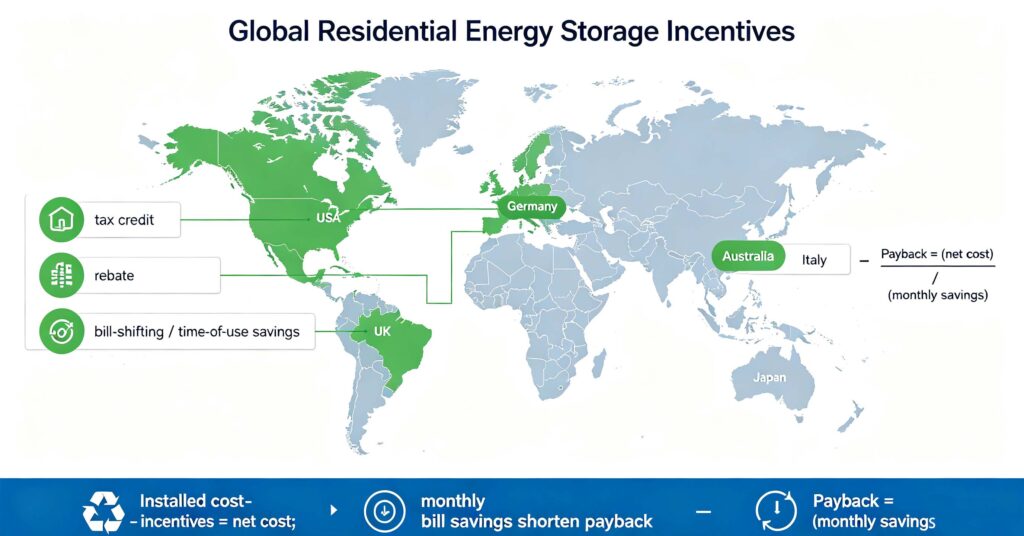
Residential energy storage incentives are financial programs — tax credits, upfront rebates, and tariff structures like time-of-use rates or net metering — that reduce the net cost of a home battery or improve its savings. The three main types are: a tax credit (a percentage of the installed cost deducted from tax liability, such as the US federal credit), an upfront rebate (a fixed amount per kWh or per system paid by a state, utility or national program), and bill-shifting economics (time-of-use rates that make stored energy worth more when you discharge it at peak prices). Which incentive applies depends on where the system is installed, so the same battery can have a very different payback in different countries or even different states. The practical way to evaluate any residential energy storage incentive is to calculate net cost after incentives, estimate monthly bill savings from your actual usage pattern, and divide the two to get a payback period; typical payback for a home battery with incentives runs 5–10 years, without them 10–15 years or more depending on local rates.
For most homeowners the question is not whether battery storage works — it is whether residential energy storage incentives in their location make the economics work — it is whether the economics work in their location. This guide explains the incentive types that change that answer, compares major markets, and gives a method for judging any offer. For how to size the system first, see #09 how to size a home battery.
Three ways residential energy storage incentives change the economics
Every residential energy storage incentive falls into one of three buckets, and most markets combine them.
Tax credits reduce what you owe at filing time. A common structure is a fixed percentage of installed cost — the US federal investment tax credit has historically been 30% for standalone storage. The credit applies to the system cost, so the effective price drops immediately on paper, though the cash benefit arrives at tax filing.
Upfront rebates are paid directly, either before or after installation, by a state, utility or national scheme. They are usually quoted per kWh of capacity or per system, sometimes income-tiered or paired with demand-response enrolment. Rebates are the strongest lever on payback because they act on the capital cost immediately.
Bill-shifting and tariff structures are not paid as cash but change the value of every cycle. Time-of-use rates with a large day-night spread, net metering that lets surplus solar be credited, and export tariffs for battery discharge all increase the savings a battery can earn. In markets with low rate spreads, a battery mostly earns resilience value rather than arbitrage. For the commercial-side version of this logic, see #57 demand charges and peak shaving.
How incentives differ by country
The mix of incentives varies widely. The table below summarises the common structures in the main residential storage markets; amounts change frequently, so treat it as a map of incentive types, not a price list.
| Market | Main incentive type | Typical structure | Payback effect |
|---|---|---|---|
| United States | Tax credit + state rebates | Federal credit on storage; state/utility per-kWh rebates | Strong — credit cuts 20-30% off cost |
| Germany | Upfront rebate + low-interest loan | Per-kWh subsidy on storage paired with solar; KfW-style loans | Strong — subsidised systems are common |
| United Kingdom | VAT reduction + export tariff | Reduced VAT on storage; export payments for discharged energy | Moderate — tariff value matters |
| Australia | State rebates + high solar export | Per-kWh rebates (e.g. NSW-style), time-of-use tariffs | Strong — high solar penetration drives self-consumption |
| Italy | Tax credit on storage with solar | Percentage credit on combined solar+storage installation | Strong when solar is included |
| Japan | Prefecture subsidies + net metering | Local subsidies for storage, high retail rates | Moderate-strong — rates make arbitrage meaningful |
Two practical rules apply everywhere. First, incentives are often tied to conditions — the battery must be paired with solar, installed by a certified installer, or enrolled in a virtual power plant program. Second, the rules change; a program that exists this year may be restructured next year, so verify the current program before quoting a payback to a customer.
How to apply: the sequence that works
Applying for residential energy storage incentives is paperwork-heavy but mechanical, and the sequence below avoids lost money. The sequence that avoids lost money:
- Check eligibility before purchase: system size caps, solar-pairing requirements, installer certification, and address eligibility.
- Get the paperwork right: the installer typically provides the spec sheet and certificate of installation; keep all invoices with line items.
- Claim tax credits at filing: keep the IRS- or tax-authority-required form and documentation with your return.
- File rebate claims promptly: many rebates have deadlines and limited annual budgets; apply early in the program year.
- Re-check after installation: some programs pay after inspection or utility interconnection approval.
For installers, packaging residential energy storage incentives into the proposal — showing net cost and payback with the incentive applied — is one of the strongest close tools, and it is also where a wrong assumption can destroy trust. Present incentive numbers as “current programs, subject to change”, not as guarantees.
How to judge whether an incentive makes the battery worth it
An incentive only matters if it changes your decision. The disciplined way to judge:
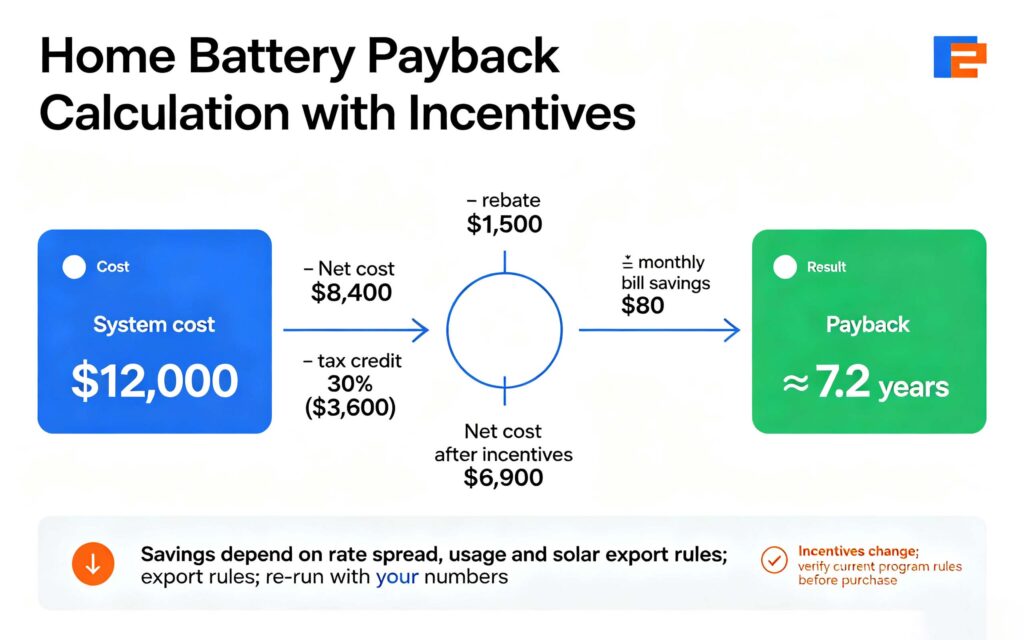
Calculate the net cost: installed system cost minus every incentive you are confident of receiving, not the ones you hope to get. Then estimate monthly savings from your own usage: how much energy you can shift to cheaper periods, what your solar export rules pay, and what the rate spread is. Payback = net cost ÷ monthly savings. A common mistake is to compare headline rebate percentages without checking whether the savings assumption (rate spread, usage) is realistic for the actual household.
Also count the non-economic value: outage resilience is worth real money in areas with frequent grid events, and some buyers value the independence more than the payback. The battery that makes sense is the one whose combined value — savings, resilience, incentives — exceeds its cost over its life. For the technical side of what to buy once the economics pass, see #14 residential energy storage systems and #27 home battery + solar self-consumption.
Q. What is a residential energy storage incentive?
It is a financial program that reduces the net cost of a home battery or improves its savings: a tax credit (percentage of installed cost deducted at filing), an upfront rebate (fixed payment per kWh or per system), or a tariff structure such as time-of-use rates that make discharged energy worth more. Which one applies depends on your country, state and utility, and the rules change over time.
Q. Do home battery rebates require solar panels?
Sometimes. Many programs pair storage with solar, either requiring an existing solar system or installing both together, while others allow standalone storage — the US federal credit, for example, has covered standalone storage. The requirement is written in each program’s rules, so check eligibility before purchase. A battery sized for backup only may qualify under different programs than a solar-plus-storage system.
Q. How is the payback period calculated with incentives?
Payback equals net cost divided by monthly savings. Net cost is the installed price minus every incentive you are confident of receiving. Monthly savings come from shifting usage to cheaper periods, solar self-consumption, and export payments. With incentives, typical payback is 5-10 years; without them it is longer, and the number depends on your actual rate spread and usage, not a generic figure.
Q. Which country has the best residential battery incentives?
There is no single answer because programs change and the best fit depends on your situation. Germany and the US have historically had strong combinations of credits and rebates, Australia pairs state rebates with high solar penetration, and Italy’s credit applies to solar-plus-storage. Compare the structure available where you live, and verify current program rules before purchase.
Q. How often do battery incentive programs change?
Frequently — most programs are reviewed annually, and budgets are limited, so rebates can be cut mid-year or refilled at the start of a program year. Tax credits are more stable but are still legislated and can be restructured. The practical rule is to verify the current program before quoting a payback to a customer or committing to a purchase.
Next step: run the numbers with your local incentives
Residential energy storage incentives change the economics of a home battery, but only when they actually apply to your system, your installer and your address. Start with the net-cost calculation in this guide, verify current programs in your market, and size the battery to your real usage.
- Size the system first with #09
- Maximise self-consumption with #27
- Understand rate structures in #57
- Ask leekooenergy for a home storage quote that separates hardware cost, installation, and the paperwork you need for common incentive programs in your market — so the net cost you plan around is the real number, not the sticker price