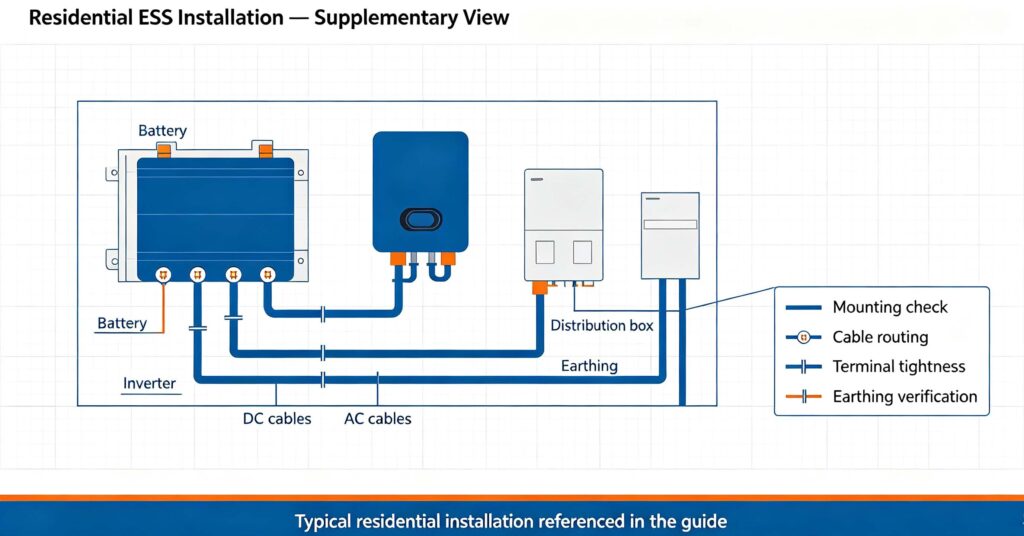
A residential energy storage system (RESS) is a home battery — usually LiFePO4 — plus an inverter that stores solar or grid power for evening use and backup. Most homes pair 5–20 kWh with rooftop PV. The specs that decide fit are usable capacity (kWh), continuous power (kW), and whether the unit backs up the whole house or just key circuits.
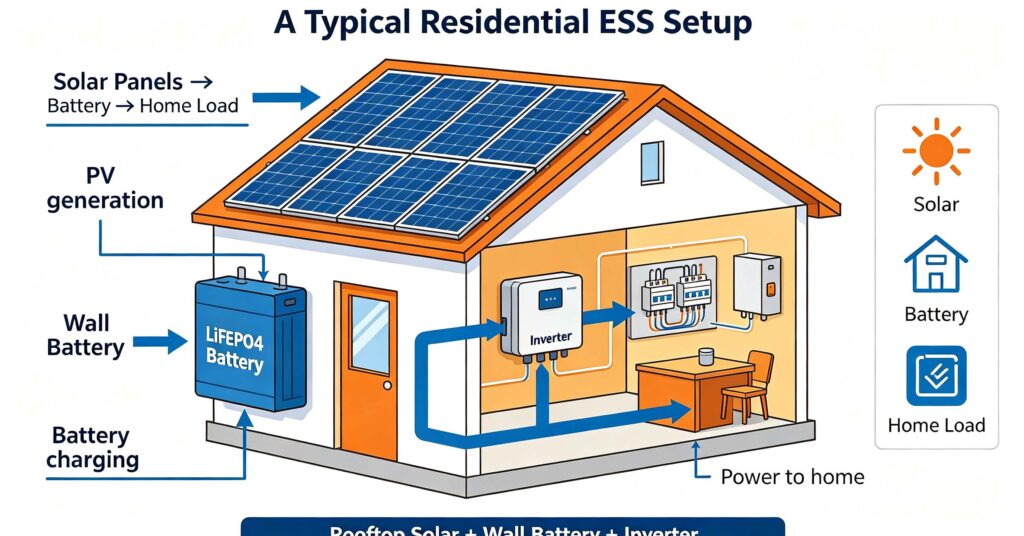
What a residential ESS does
It charges from solar when the sun shines, discharges in the evening, and can island from the grid during an outage. “Home battery storage system” and “residential ESS” mean the same thing; ESS is the formal term, “home battery” is the consumer label.
Key specifications
| Spec | What it means | Typical home range |
|---|---|---|
| Usable capacity | Energy you can draw (kWh) | 5–20 kWh |
| Continuous power | Max simultaneous load (kW) | 3–10 kW |
| Chemistry | Cell type | LiFePO4 (standard) |
| Backup type | Whole-house vs critical loads | Critical-load panel common |
| Cycles | Rated life | 3,000–6,000+ |
Typical configurations
- Solar + battery (AC or DC coupled). Most common; stores excess PV for night use.
- Battery only (no solar). Charges from grid on cheap rates or for backup — see the no-solar analysis.
- Critical-loads panel. Backs up fridge, lights and router, not the whole house — cheaper than full backup.
RESS vs a generator
A battery is silent, instant, and recharges from solar. A generator runs on fuel, needs maintenance, and is louder — but can run for days. Many homes use a small battery for daily outages and keep a generator only for extended multi-day events.
How much capacity do you need?
That depends on your daily evening load and backup goal. Rather than guess, work it from your loads — the home battery sizing guide walks the calculation step by step. A 10 kWh unit covers most evening shifts; 5 kWh covers critical loads only.

Key parameters, explained
Five numbers decide whether a residential system fits a home:
- Usable capacity (kWh) — energy you can actually draw, after depth-of-discharge reserve. This is what powers your evening, not the nameplate.
- Continuous power (kW) — how many appliances run at once. A 5 kW unit runs fridge + lights + a few circuits; whole-home needs more.
- Round-trip efficiency — share of stored energy you get back. LiFePO4 systems typically return most of what you put in.
- Cycle life — how many charges before notable fade. LiFePO4 leads here, which is why it dominates residential.
- Backup duration — hours of autonomy at your load. Set by capacity ÷ load, not by a single rated number.
Three deployment models
Retrofit (solar already installed)
Add a battery to an existing inverter (AC-coupled) or replace the inverter with a hybrid (DC-coupled). AC-coupled is simpler and keeps the original array running; DC-coupled is often slightly more efficient. Choice depends on the existing inverter’s age and warranty.
New build (solar + battery together)
A hybrid inverter handles both from day one, usually the cleanest design and lowest balance-of-system cost. Size the battery to evening load and backup goals, not the array.
Battery-only (no solar)
For homes that want backup or time-of-use arbitrage without panels, the battery charges from the grid. Capacity follows backup hours; see the without-solar guide.
Residential storage vs a portable generator
A generator runs on fuel and needs refueling; a battery is silent, instant, and needs no fuel, but stores limited energy. Many homes pair both: battery for short, clean outages; generator for extended grid-down events. The battery also adds daily solar self-consumption value a generator cannot.
How residential differs from C&I
Residential priorities are safe, quiet, wall-mount form and simple backup; C&I priorities are higher continuous power, stacking, and tariff-driven payback. The same LiFePO4 cells appear, but the enclosure, PCS, and software differ. A homeowner rarely needs the peak-shaving logic a factory does.
Rules of thumb for sizing
Start from daily evening load in kWh and desired backup hours, then add reserve. A 10 kWh unit covers a typical efficient home for a night of essentials; 15–20 kWh covers more circuits or a well pump. Confirm against your actual bill, not a generic number. Residential storage is a long-term asset, not a one-off purchase — the right size today should leave room to add a second unit or more solar later, since load tends to grow. Confirm the system supports expansion before committing.
What to confirm before you buy
- Usable (not nameplate) capacity at your planned depth of discharge.
- Continuous power vs your peak circuit list.
- Whether the unit islands the whole home or only critical loads.
- Which safety standard the enclosure meets in your market.
- Warranty basis: years or throughput, whichever first.
Common mistakes
Buyers over-size power and under-size energy, or chase the lowest price and miss the enclosure standard. Match capacity to backup hours and power to simultaneous load; the cheapest box is rarely the cheapest ownership.
Monitoring and light maintenance
Most systems report state of charge and cycles in an app. Check it monthly, keep the unit in a temperature-stable spot, and review the warranty’s throughput limit annually if you cycle daily. No regular servicing is needed beyond visual checks.
A simple sizing worksheet
Write down three numbers: average evening kWh use, the backup hours you want, and the peak kW of circuits you’ll run at once. Multiply evening kWh by backup hours for a rough capacity, then add 20% reserve. Compare that to the unit’s usable capacity, not nameplate. If peak kW exceeds the unit’s continuous power, either drop circuits or size up. This worksheet prevents the two classic errors: under-sized energy and over-/under-sized power. For example, a home using 8 kWh in the evening with one backup night and a 3 kW peak wants roughly 8 × 1 × 1.2 ≈ 10 kWh usable at 3 kW continuous — a standard wall-mounted unit. Double the backup nights and you double capacity, not power.
When to plan for a second unit
If your worksheet lands near the top of a unit’s range, plan expansion from day one. Confirm the system supports parallel units or an external breaker, and leave wall or floor space. Adding later is cheaper when designed in than when retrofitted around existing kit. Many homeowners start at 10 kWh and add a second after a year as they learn real usage.
One more check: the app and alerts
Before you rely on the system, set the alert thresholds in the app — low state of charge, communication loss, and temperature out of range. A system that warns you beats one that fails silently, and most residential issues show as an early alert you can act on the same day.
Q. What is a residential energy storage system?
A home battery with an inverter that stores solar or grid electricity for later use and backup. “Home battery” and “residential ESS” are the same concept.
Q. How big a residential battery do I need?
Most homes start at 5–10 kWh for evening shift and critical-load backup; size up with daily load and backup hours. See the sizing guide for the math.
Q. Is LiFePO4 the right chemistry for home?
For most homes, yes — safe, long-lived, and stable at high temperatures. NMC is lighter but less common in stationary home storage.
Q. Does a home battery work without solar?
Yes. It can charge from the grid (for backup or time-of-use arbitrage) even with no panels. Many buyers add solar later.
Q. Whole-house or critical-loads backup?
Critical-loads backup powers essentials (fridge, lights, internet) and costs less. Whole-house backup needs a larger inverter and is pricier.
Choosing a residential storage system?
See Residential Energy Storage,start with Value Analysis and Capacity Calculation,then decide the configuration. Channel partners can request distribution materials.