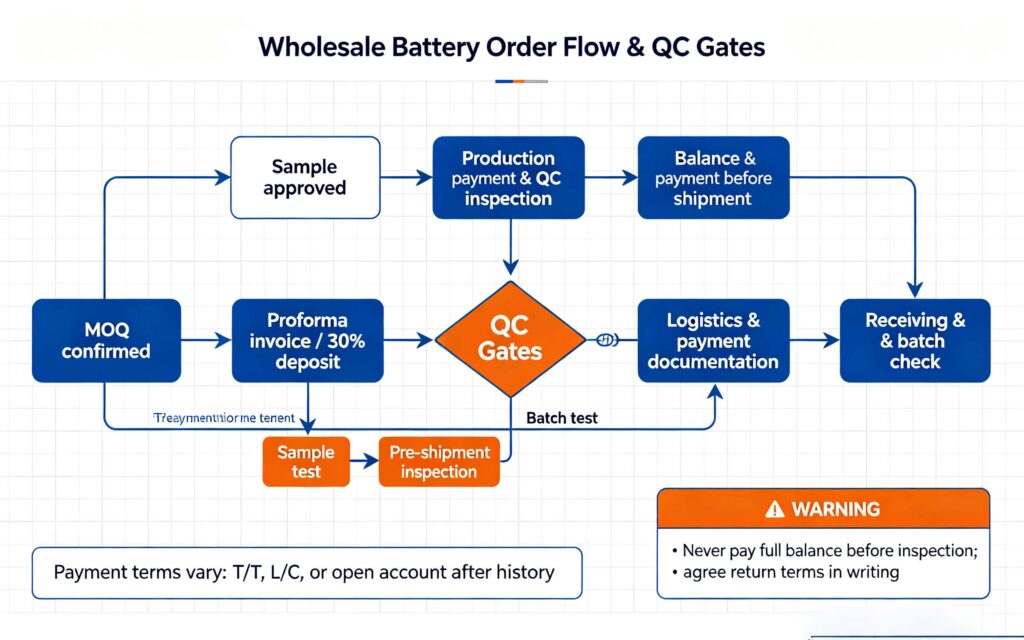
Lithium ion battery wholesale is the business of buying battery packs in volume from a manufacturer and reselling them through a channel — typically as a direct wholesale customer, a regional distributor, or a private-label/OEM buyer. The three models differ in commitment and margin: direct wholesale gives the best unit price but requires larger MOQs and self-managed stock; a distribution partnership adds local inventory and support responsibilities in exchange for territory and pricing protection; private label means the reseller owns the brand and spec while the factory handles production and certification. What every model shares is that success depends on the same core terms: MOQ, lead time, payment terms, warranty and after-sales responsibility, certification documentation, and defect return policy. The common mistake in lithium ion battery wholesale is choosing a model for its headline price without checking whether the partner’s stock policy, technical support and warranty execution match your market — the cheapest container can be the most expensive one once support failures and returns are counted.
Buyers entering lithium ion battery wholesale are usually deciding between buying deep from one factory, spreading across distributors, or building their own brand. This guide compares the models and lays out the selection criteria that prevent costly mistakes. For evaluating the factory side first, see #21 how to evaluate battery manufacturers.
Lithium ion battery wholesale models: the three channels and when each fits
Most lithium ion battery wholesale starts with one of three models. The table below compares them on the dimensions that actually decide fit.
| Model | Margin | Commitment | Best for | Key risk |
|---|---|---|---|---|
| Direct wholesale | Highest per unit | Large MOQ, self-managed stock | Distributors with storage and volume | Inventory and cash tied up |
| Regional distributor | Protected territory, moderate margin | Stock, local support, marketing | Companies with service capability | Territory and quota obligations |
| Private label / OEM | Brand premium potential | Spec + certification ownership | Brands wanting their own SKUs | Certification and QC ownership |
There is no universally best model. A reseller with warehouse space and cash flow may do best on direct wholesale; one with a strong local brand but no factory relationship is better served by private label; a company selling into a region where customers expect local stock and support should pursue a distributor agreement. The right model is the one that matches your inventory capacity, service depth and brand ambition.
How to evaluate a wholesale supplier beyond price
In lithium ion battery wholesale, the price sheet is only the starting point. The specification alone does not tell the whole story — the questions below separate serious suppliers from traders.
Factory vs trader: confirm whether the supplier manufactures or resells. A trader can be fine for spot buys but adds a layer for warranty, QC and lead time. Ask for the production site, the BMS source, and the cell source — the cell is the largest cost and the biggest reliability variable.
Certification and documentation: the supplier should provide current UN38.3, CE and (for target markets) UL or IEC documents, with the test reports, not just the certificates. Certificates with wrong model numbers or expired dates are a common finding in wholesale audits. For the certification detail, see #107 battery export certification explained.
QC and traceability: ask how batches are traced, what the outgoing inspection covers, and what the defect rate is tracked as. A supplier who cannot name their test items probably does not run them consistently.
Warranty execution: the warranty clause in the contract matters less than how claims are actually handled — replacement lead time, freight responsibility, and the process for field failures. Ask for a worked example of a recent warranty case.
Terms that protect both sides: MOQ, lead time, payment and warranty
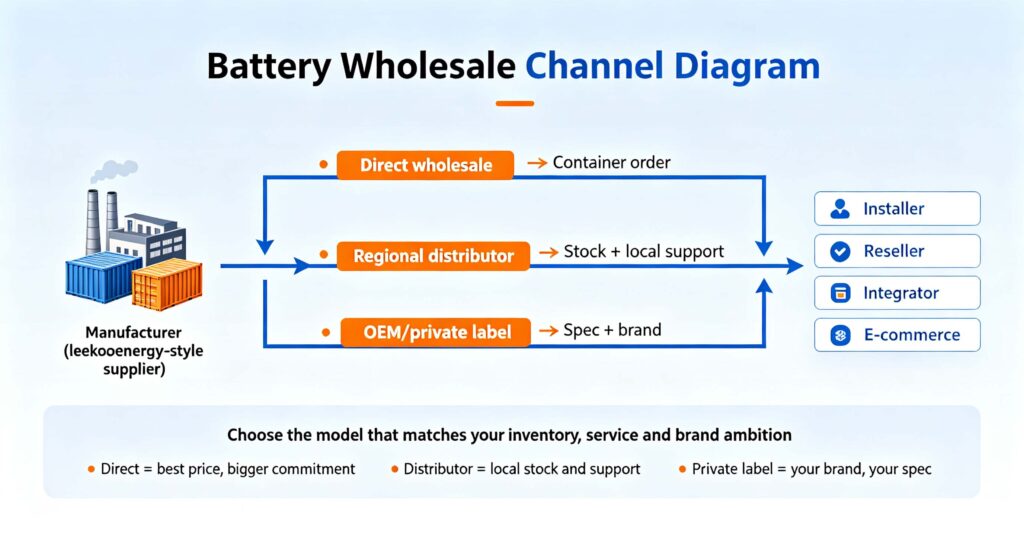
The four commercial terms in any lithium ion battery wholesale deal deserve written clarity, because each one has a common failure mode.
MOQ: confirm whether it is per SKU or per order, and whether mixed SKUs count. A MOQ that is per SKU can force a distributor into overstock of slow lines.
Lead time: separate standard lead time (common chemistries and packs) from custom lead time (new BMS settings, new labels, certification changes). Get the lead time in writing with the milestone dates, not just a promise.
Payment terms: the typical structure is a deposit (often 30%) with the balance before shipment, or letter of credit for larger orders. Be wary of any supplier demanding full payment before production with no inspection stage; conversely, suppliers are wary of customers who treat open account as free credit. For the negotiation detail, see #124 battery MOQ, lead time and payment terms.
Warranty and returns: write down the defect definition, the return window, freight responsibility, and the replacement time. “Warranty 5 years” without the process attached is not a warranty you can rely on.
Building the partnership: how a wholesale relationship develops
Serious lithium ion battery wholesale relationships do not start with a container; they start small and scale on proof.
Typically: sample evaluation, then a small first order, then a repeat order with QC feedback, then volume. Each stage builds evidence — the sample proves the product, the first order proves logistics and payment flow, repeat orders prove consistency, and volume proves the partnership. Suppliers who push for a large first commitment before any of that evidence are a red flag; so are buyers who demand distributor terms before placing a first order. For the factory-direct angle and why it can work for the right partner, see #41 battery cleanroom manufacturers and China lithium suppliers.
Red flags in wholesale battery deals
A few warning signs recur in battery wholesale negotiations, and they are worth treating as deal-breakers until proven otherwise.
- Price far below market — usually means mixed cells, used cells or a thin BMS.
- Certificates that cannot be verified — wrong model numbers, expired dates, or no test reports.
- Refusal of a pre-shipment inspection — legitimate suppliers accept third-party QC on batch orders.
- Vague warranty process — no written defect definition, return path or replacement time.
- Payment terms that skip the inspection stage — full prepayment with no QC gate is the classic loss pattern.
None of these automatically means fraud, but each one means the deal needs more evidence before money moves. In practice, this is where problems often start — and they start on paper, before any battery ships.
Q. What does lithium ion battery wholesale involve?
It is buying battery packs in volume from a manufacturer and reselling them through a channel, as a direct wholesale customer, regional distributor or private-label buyer. The core terms are MOQ, lead time, payment terms, warranty execution and certification documentation. The model that fits depends on your inventory capacity, service depth and brand ambition.
Q. What is the difference between direct wholesale and a distributor agreement?
Direct wholesale is transactional: you buy at volume pricing, manage your own stock, and carry the resale risk. A distributor agreement adds obligations — holding local inventory, providing support, meeting quotas — in exchange for territory protection and pricing stability. Direct wholesale suits buyers with storage and cash flow; distributor terms suit those selling into regions where local stock and support are expected.
Q. What MOQ should I expect for wholesale battery orders?
MOQs vary by supplier, chemistry and SKU: common packs may have a moderate MOQ per order, while custom BMS settings, labels or certification changes raise it. Confirm whether the MOQ is per SKU or per order, and whether mixed SKUs count, before planning your stock. A per-SKU MOQ can force overstock of slow-moving lines.
Q. How do I verify a wholesale battery supplier?
Confirm the supplier manufactures rather than resells, name the cell and BMS sources, and request current certificates with the underlying test reports. Ask how batches are traced, what outgoing inspection covers, and how warranty claims are actually handled. If you can, visit or audit the production site, or use a third-party pre-shipment inspection on batch orders.
Q. What payment terms are normal in battery wholesale?
The common structure is a deposit (often 30%) with the balance before shipment, or a letter of credit for large orders. Some suppliers offer open account after a payment history. The important protection is an inspection stage before the balance payment — paying the full amount before any QC gate is the classic loss pattern in wholesale deals.
Next step: pick the model that fits your channel, then verify the partner
Lithium ion battery wholesale works when the model matches your inventory, service and brand ambitions — and when the partner passes scrutiny on cells, certificates, QC and warranty execution. Choose the model first, then evaluate the supplier against the checklist in this guide.
- Audit the factory with #21
- Check certification requirements in #107
- Nail the commercial terms with #124
- Ask leekooenergy for a wholesale program that matches your channel model: volume pricing with stated MOQ and lead time, current certification documents, a written warranty and return process, and a pre-shipment inspection option — so your first container is a start, not a gamble