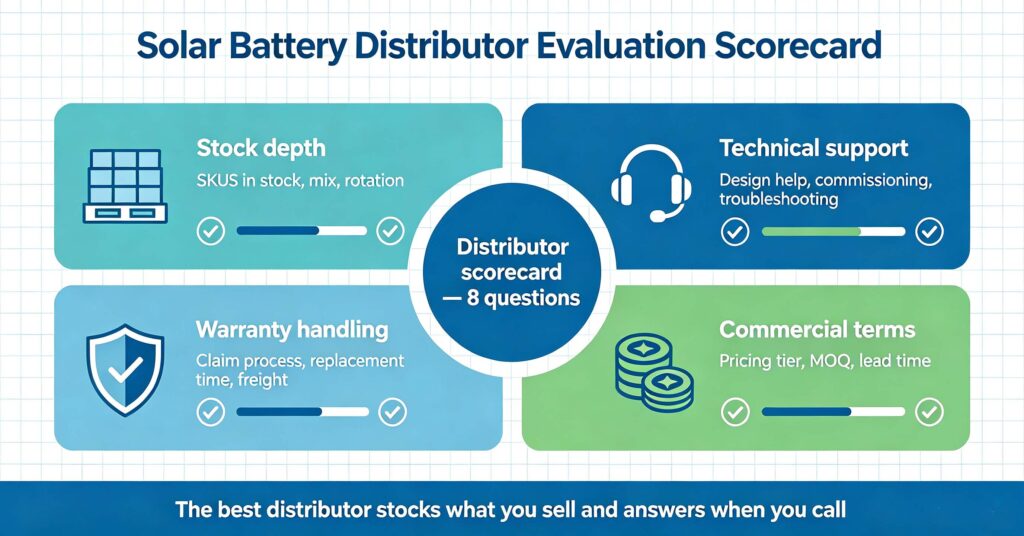
Solar battery distributors are the middle layer between manufacturers and installers: they hold stock, handle logistics, provide local technical support and execute warranty claims on the batteries they sell. A good distributor makes the difference between a smooth project and a stalled one, because they absorb the friction of ordering, the risk of inventory, and the burden of after-sales — but only if they actually carry the right stock, know the products, and honour the warranty process when something fails. The 8 questions that separate a partner from an order-taker are: what SKUs do you stock in depth; what is your fill rate and typical lead time; who provides technical support and at what hours; how are warranty claims handled and how fast are replacements; what pricing tier applies and what is the MOQ; do you hold certification documentation; what happens to defective stock — who pays freight; and how do you handle firmware or product updates. Asking these before committing avoids the situation where the distributor is great at taking orders and slow at everything else.
Installers and integrators usually buy batteries through distributors, and the choice of distributor shapes project margin and customer satisfaction. This guide explains what a good solar battery distributor actually does and gives the 8 questions to ask before partnering. For the factory-side audit that complements this, see #21 how to evaluate battery manufacturers.
What a distributor does beyond moving boxes
A solar battery distributor is not just a warehouse with a website. The value they add — or fail to add — shows up in four places.
Stock and availability: they hold inventory so you can order in project-sized quantities without waiting for a container. Fill rate (how often they ship what you order, in full, on time) is the single most useful number to ask for.
Technical support: batteries need sizing help, commissioning support and troubleshooting. A distributor with engineers who know the product saves installers hours on site and prevents misconfigurations.
Warranty execution: the manufacturer’s warranty is only as good as the channel that executes it. The distributor is usually the one who processes claims, ships replacements and handles returns — so their process, not the certificate, is what you should test.
Commercial terms: pricing tiers, MOQ, lead time, payment terms and restocking rules. These determine your margin and cash flow more than the per-unit price alone.
For the wholesale models that sit behind distributors, see #117 lithium ion battery wholesale models.
8 questions to ask solar battery distributors before partnering
When you evaluate solar battery distributors, these questions map directly to the value each one adds. Ask them in writing, then verify with a small test order.
- What SKUs do you stock in depth? — depth matters more than breadth; a distributor with many products but shallow stock of yours is a showroom.
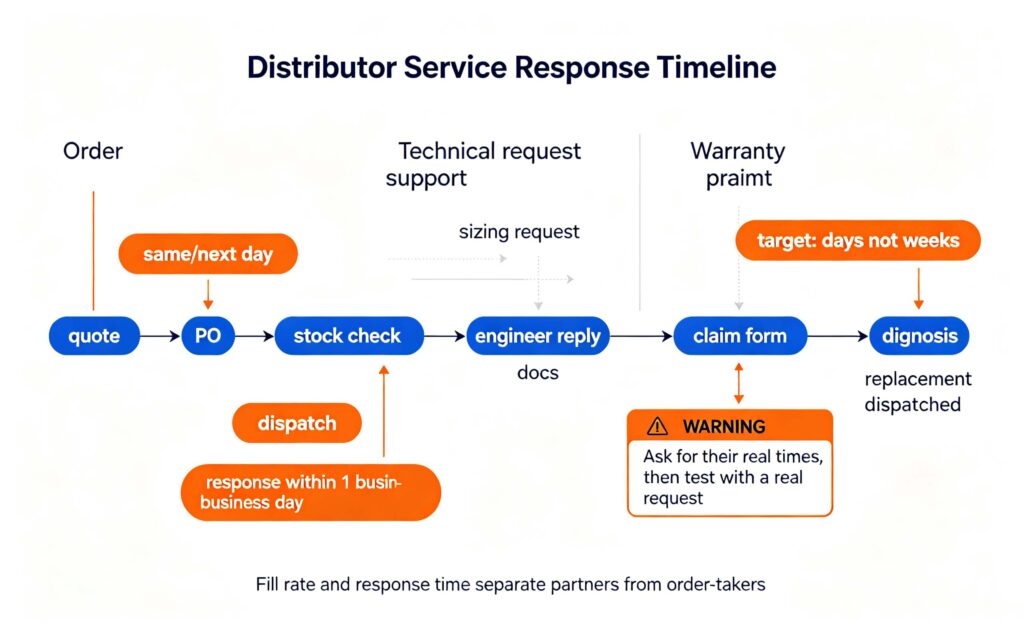
- What is your fill rate and lead time? — ask for real numbers on stocked items; “we ship fast” is not a number.
- Who provides technical support, and when? — do they have engineers, or do they forward questions to the factory?
- How are warranty claims handled? — the process, the replacement time, and who pays freight on both legs.
- What pricing tier and MOQ apply to me? — confirm volume thresholds and whether mixed SKUs count toward MOQ.
- Do you hold current certification documents? — they should be able to provide UN38.3, CE and market-specific certificates on request.
- What happens to defective stock? — restocking rules, testing process, and return freight responsibility.
- How do you handle firmware and product updates? — who notifies installers, and how is the update applied?
How to verify a distributor before committing volume
Answers on paper are cheap; behaviour is the evidence — and the verification sequence below is how serious buyers test solar battery distributors before committing. The verification sequence that works in practice: request a quote and time the response; place a small order and measure fill rate and dispatch speed; ask one technical question and judge the quality of the answer; and simulate a warranty claim on a low-value accessory to see the process work. The specification alone does not tell the whole story — the same applies to a distributor’s promises.
Also check the brands they carry and how they position them: a distributor who stocks competing battery lines may have incentives that do not match your project recommendations. And ask how they handle product recalls or safety notices — the distributor should have a process, not a silence. For the inverter side of the same channel decision, see #50 evaluating inverter suppliers.
Distributor vs manufacturer-direct: which to use
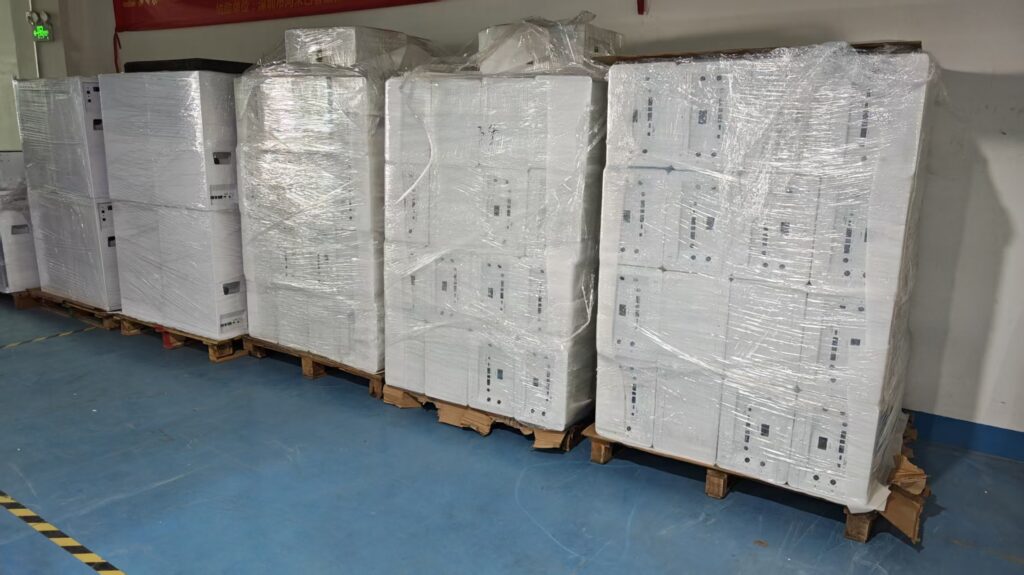
Manufacturer-direct buying can look cheaper than working through solar battery distributors, but the comparison is not just price. Direct wholesale means you carry the stock, handle logistics, and call the factory for support; a distributor carries those costs for you but adds a margin. The right answer depends on volume and service needs: high, predictable volume with in-house capability favours direct; project-sized orders with on-site support needs favour a distributor. Many installers use a mix — a primary distributor for routine orders and a direct relationship for large or custom projects. For the wholesale model comparison, see #117 lithium ion battery wholesale models again, and for OEM custom work, #98 custom battery packs for OEM/ODM.
Q. What do solar battery distributors do?
They are the middle layer between manufacturers and installers: they hold stock, manage logistics, provide local technical support and execute warranty claims. Their value shows in fill rate, support quality, warranty handling and commercial terms. A good distributor absorbs ordering friction and after-sales burden; an order-taker only processes invoices.
Q. How do I evaluate a solar battery distributor?
Ask the 8 questions in this guide: stocked SKUs and depth, fill rate and lead time, technical support availability, warranty claim process and replacement time, pricing tier and MOQ, certification documents, defective-stock handling, and firmware update process. Then verify with a small test order and a real technical question before committing volume.
Q. Is it cheaper to buy direct from the manufacturer?
Direct can be cheaper per unit, but you take on stock, logistics and support costs. A distributor adds a margin but carries inventory and after-sales burden. The right answer depends on volume and service needs: high predictable volume favours direct; project-sized orders with on-site support favour a distributor. Many installers use both.
Q. What is a good distributor fill rate?
A good fill rate on stocked items is around 95% or above — meaning nearly every order ships complete and on time. Ask the distributor for their actual number, and test it with a small order rather than accepting a promise. Fill rate is the single most useful indicator of whether a distributor is a partner or an order-taker.
Q. Who handles the warranty if I buy through a distributor?
In most cases the distributor processes the claim: they diagnose, arrange the replacement and handle returns with the manufacturer. This is why the distributor’s warranty process matters — the claim experience, replacement time and freight responsibility are what you actually feel. Ask for a worked example of a recent claim before partnering.
Next step: test the distributor with a real order before you commit
Solar battery distributors earn their margin on stock depth, support and warranty execution — not on the invoice. Ask the 8 questions, then verify with a small order, a technical question and a test claim before you commit your project pipeline.
- Audit the manufacturer side with #21
- Evaluate inverter suppliers with #50
- Understand wholesale models in #117
- Ask leekooenergy for the distributor program: a real stock list with fill-rate data, named technical support contacts, a written warranty claim process with replacement targets, and current certification documents — so your channel partner is a partner, not an order-taker