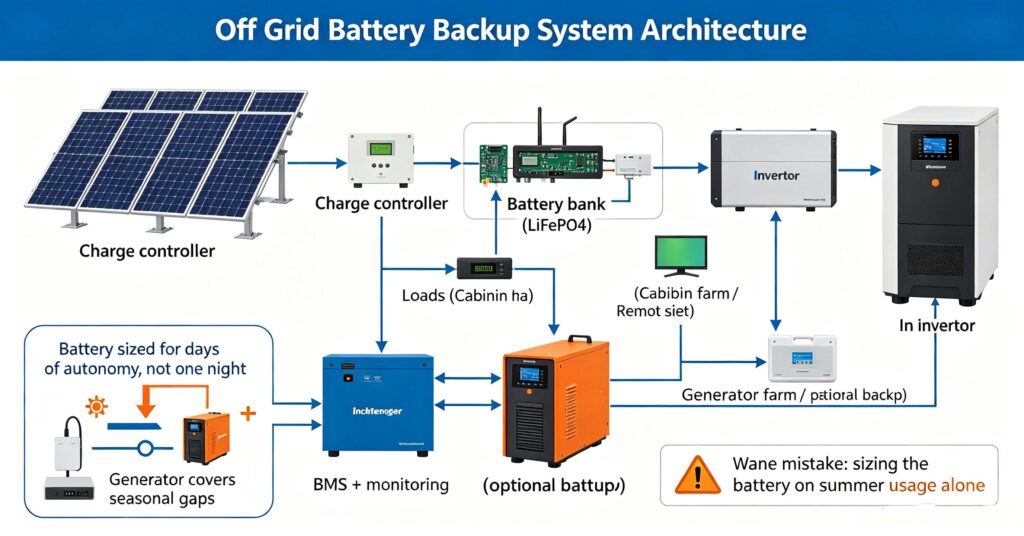
Off grid battery backup is the storage layer that keeps a remote site powered when solar generation is absent — at night, in clouds, and across multi-day weather gaps — and it works only when the battery is sized for those gaps, not for a single evening. The design starts with an honest load list (what runs, for how long, in the worst week), then sizes the battery for days of autonomy, the solar array for the charging needed to refill it, and the inverter for the largest simultaneous load. LiFePO4 is the practical chemistry for most sites because it cycles deeply, holds voltage well under load and survives partial states of charge without damage. The most common failure is sizing the system on summer usage and ideal weather, leaving the site short in winter or extended cloud. The generator is not a failure of the design; it is the seasonal insurance that lets the battery be sized economically.
Cabins, farms and remote sites share one problem: the grid is far, the weather is not cooperative, and the load list grows every year. This guide walks through what off grid battery backup must handle, how to size it honestly, and the configuration choices that fit different sites. For the battery selection parameters themselves, see #23 how to choose batteries for an off-grid solar system first.
Off grid battery backup design: how each site type changes it
The same components appear in every off grid battery backup system, but the numbers change dramatically by site type.
| Site type | Load pattern | Design driver |
|---|---|---|
| Cabin / seasonal | High on weekends, low midweek, seasonal | Cover the occupied days; avoid oversizing for empty weeks |
| Farm | Daily pumps, refrigeration, possible machinery | Continuous critical loads; power for starts (pumps and motors) |
| Remote site / outbuilding | Monitoring, communication, small loads | Reliability and low maintenance over peak power |
Seasonal cabins are the classic oversizing trap: designing for the busiest holiday week doubles the battery cost for a system used a fraction of the year. For how the whole off-grid versus on-grid choice fits together, see #72 off-grid and on-grid solar systems.
Sizing the battery for days of autonomy, not one night
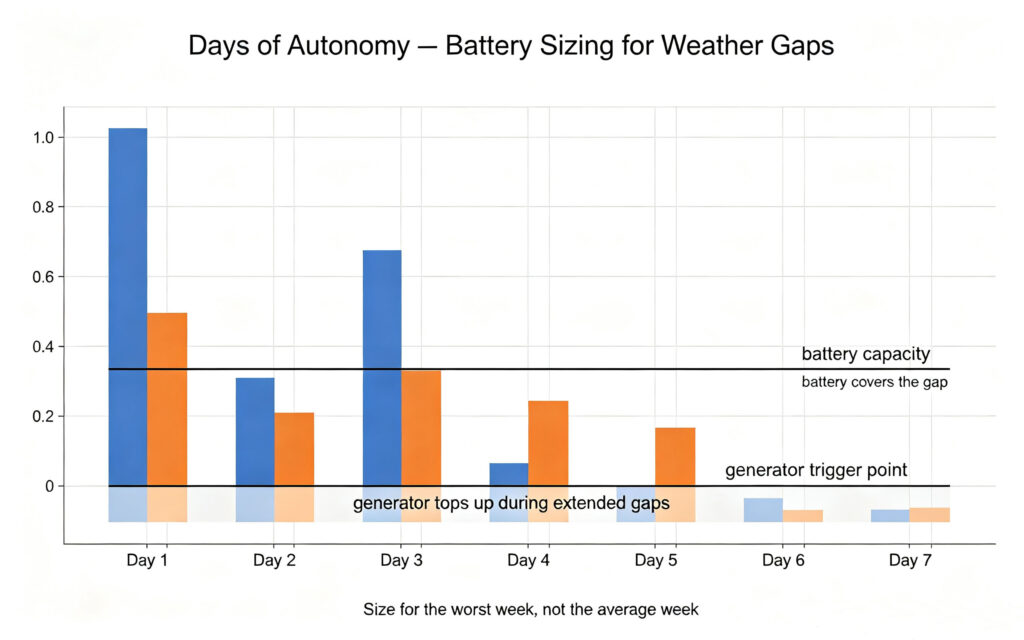
The battery is the insurance against generation gaps, so the sizing question is: how many days must the site run without meaningful solar input?
- Build the load list in Wh per day: list every load, its watts, hours per day, and whether it runs in the worst season. Sum to daily energy.
- Pick days of autonomy: typically a few days of winter weather for most sites, more where cloud or snow is prolonged. The generator shifts this number — a generator shortens the autonomy the battery must carry.
- Account for inverter losses and depth of discharge: size the battery so the usable energy equals daily load times autonomy days, with headroom for efficiency and the DoD limit of the chemistry.
- Check the power side: the inverter must start the largest load (pumps and motors draw several times their running watts at start).
For the capacity math at the battery level, see #9 how to size a battery: the kWh sizing guide — the same math applies off-grid, with more autonomy days.
Configuration choices that fit the site
Beyond the battery, the configuration decisions determine how well off grid battery backup performs in practice.
Charge controller type: MPPT charge controllers extract more energy from the solar array than older PWM types, which matters most in cold and low-light conditions. The difference is real money over years.
Battery voltage: 48V systems are the practical standard for anything beyond small cabins — lower current, smaller wire, better inverter compatibility. For the voltage question in detail, see #35 48V lithium batteries explained.
Generator integration: a charger or hybrid inverter that accepts generator input lets the generator charge the battery efficiently rather than running loads directly. This combination is usually cheaper than buying extra battery for the worst two weeks of the year.
Monitoring: for a site visited weekly, remote monitoring of battery state, generator starts and faults is not optional — it is the difference between catching a problem and finding it dead. See #120 remote battery monitoring guide.
Common mistakes in off-grid battery design
Most off-grid failures are designed in, not caused by equipment.
Sizing on the best week: the system must survive the worst week, and the battery is the buffer that absorbs it.
Ignoring start currents: a pump or motor that starts every morning can stall a system whose inverter power was sized on running watts.
No generator plan: refusing a generator to “stay pure solar” leads to either a massively oversized battery or a dead site in February. The generator is insurance, and insurance is normal.
Lead-acid habits carried to lithium: LiFePO4 has different charging and DoD rules; see #24 lithium vs lead-acid: the switching decision before reusing old assumptions.
Q. How much battery do I need for an off-grid cabin?
It depends on the daily load and the days of autonomy you design for. Start with a load list in watt-hours per day, multiply by the days the site must run without solar (typically a few days of winter weather), and add headroom for inverter losses and the depth of discharge limit. A seasonal cabin that is occupied part-time should size for occupied days, not the whole year.
Q. What is the best battery chemistry for off-grid backup?
LiFePO4 is the practical choice for most off-grid sites because it cycles deeply, holds voltage well under load, and tolerates partial states of charge without damage. It is heavier per watt-hour than some chemistries, but for stationary off-grid storage that weight rarely matters. Its charging and depth-of-discharge rules differ from lead-acid, so the system must be set up for lithium, not converted in place.
Q. Do I need a generator with an off-grid battery system?
Not always, but for most sites a generator is the economical insurance. Without one, the battery must be sized for the worst weather stretch of the year, which doubles its cost for a few weeks of use. With a generator that charges the battery through a charger or hybrid inverter, the battery can be sized for normal conditions and the generator covers the rare gap.
Q. How many days of autonomy should an off-grid system have?
Typically a few days, depending on the site’s weather, the criticality of the loads and whether a generator exists. More autonomy means a bigger battery and more cost; less autonomy means more generator runs or risk of outage. The professional approach is to size the battery for normal worst-case weather, add a generator for the extreme gap, and verify the math with the actual load list.
Q. Can I expand an off-grid battery system later?
Often yes, but only within the limits of the inverter and BMS. Confirm the maximum battery capacity the inverter supports, the expansion voltage (whether modules add in parallel within the same bank), and the BMS’s ability to manage the larger pack. Expansion after installation is usually cheaper if it was planned in the original design, so decide the ceiling early.
Next step: size the system on the worst week
Off grid battery backup works when it is sized for the worst week, not the best one: honest loads, days of autonomy, the right voltage, and a generator as insurance. Design the ceiling, plan the expansion, and monitor the site remotely so problems surface before the battery is dead.
- Choose the right batteries in #23
- Run the sizing math in #9
- Set up remote monitoring in #120
- Ask leekooenergy for an off-grid sizing proposal: send your load list, site type, worst-season usage and generator preference, and receive a battery + inverter configuration with autonomy math you can verify