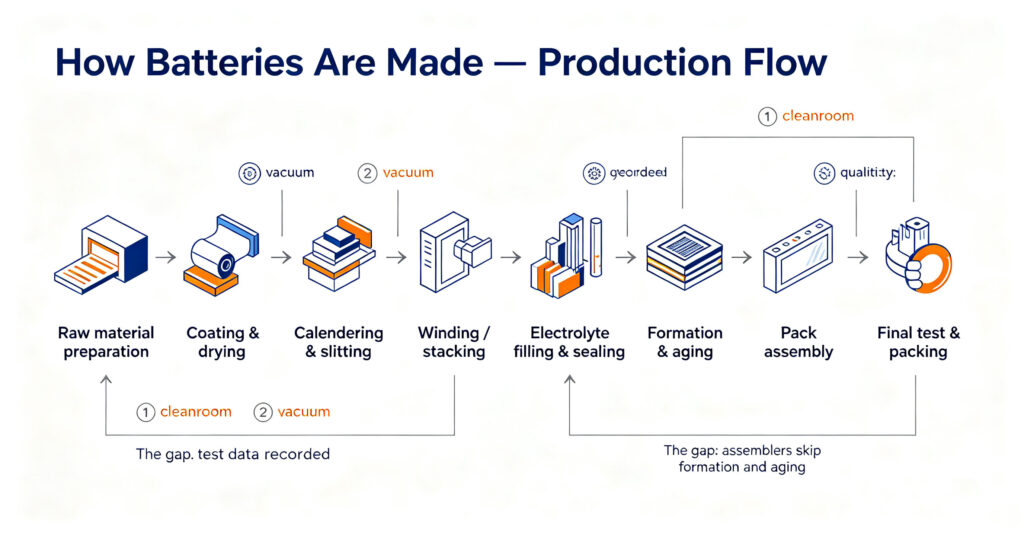
How are batteries made? In short: active materials are coated onto metal foil, dried and compressed, then wound or stacked with a separator into a jelly roll or stack; electrolyte is added in a dry room, the cell is sealed, and formation charging activates it for the first time. After aging, cells are grouped by matching data, assembled with a BMS and enclosure into a pack, and tested again before shipping. The steps that separate a real factory from an assembler are the formation and aging stages — without them, early failures reach the customer. A buyer who understands this flow can ask the right questions of any supplier.
For a B2B buyer, knowing how batteries are made is not curiosity; it is the basis for judging whether a supplier actually manufactures cells or merely assembles them from purchased parts. This guide walks the production flow and points out the gates that determine quality. For the QC side of this process, see #133 OEM battery quality control and traceability.
How are batteries made: the cell production steps
To answer how are batteries made, cell manufacturing is where the chemistry becomes a usable energy storage unit. Each step has environmental and equipment requirements that define the factory.
- Raw material preparation: cathode (lithium iron phosphate powder for LiFePO4), anode (graphite), conductive additive and binder are mixed into a slurry with solvent.
- Coating and drying: the slurry is coated precisely onto aluminum (cathode) and copper (anode) foil, then dried in controlled ovens. Coating weight and uniformity set the capacity baseline.
- Calendering and slitting: the coated foil is compressed to a uniform thickness, then slit into strips of the required width.
- Winding or stacking: cathode, separator and anode are wound (cylindrical/pouch) or stacked (prismatic) into a jelly roll or stack, then placed into a can or pouch.
- Electrolyte filling and sealing: in a dry room (very low humidity), electrolyte is injected under vacuum and the cell is hermetically sealed.
- Formation: the first charge-discharge cycle activates the chemistry. This is not optional; it creates the solid electrolyte interphase that governs cycle life.
- Aging: cells rest and are monitored for self-discharge. Early failures surface here, in the factory, not at the customer.
Understanding how are batteries made requires the cleanroom and dry room conditions are detailed in #41 battery cleanroom manufacturers — a factory without these conditions cannot answer how batteries are made with credibility.
From cells to pack: the assembly stage
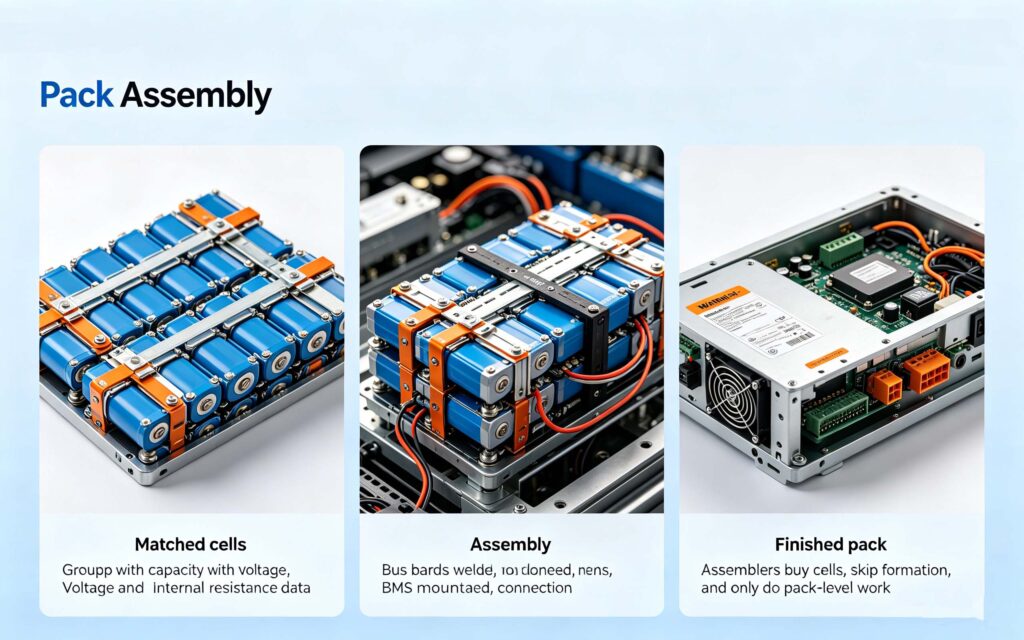
After cells are formed and aged, the pack stage turns individual cells into a system that a customer can install. This is where many suppliers stop being cell makers and become assemblers.
| Stage | What happens | Quality record expected |
|---|---|---|
| Cell matching | Cells grouped by capacity, voltage and internal resistance | Matching group data per pack |
| Stacking & welding | Cells arranged, busbars welded or bolted | Welding quality inspection |
| BMS integration | BMS mounted, wired and configured to pack parameters | Firmware version, configuration log |
| Enclosure & cooling | Pack placed in enclosure, cooling path designed | Thermal test record |
| Final test | Full functional, capacity and protection test | Test log per pack |
The BMS configuration that happens at this stage is explained in #28 battery management system 101.
What a real factory demonstrates vs an assembler
The answer to how are batteries made also separates manufacturing from assembly, visible in what a supplier shows during an audit. A cautious buyer asks for the live demonstration.
Formation and aging: a real factory has formation lines and aging rooms; an assembler has none. Ask to see the aging room and the data it produces.
Cell matching data: matched cells produce longer pack life. Ask to see the matching records, not just the finished pack.
Test records per pack: every pack should carry its own test log. For the traceability logic behind this, see #133 OEM battery quality control and traceability again.
Q. How are lithium batteries made in a factory?
Lithium batteries are made by coating cathode and anode slurries onto foil, drying, compressing and slitting them, then winding or stacking them with a separator. Electrolyte is added in a dry room, the cell is sealed, and formation charging activates it for the first time. After aging, cells are matched and assembled with a BMS into a pack, then tested again before shipment.
Q. How are LiFePO4 batteries made differently?
LiFePO4 batteries use lithium iron phosphate as the cathode material instead of NMC or NCA. The production steps — coating, winding, electrolyte filling, formation and aging — are the same, but the cathode powder and the electrolyte formulation differ, which affects safety characteristics and cycle life. The manufacturing environment requirements are similar across chemistries.
Q. What is battery formation and why does it matter?
Battery formation is the first charge-discharge cycle after assembly, which creates the stable layer between electrolyte and electrode that governs cycle life. It is a controlled, time-consuming process that consumes factory capacity. Skipping formation saves days but ships cells without the stabilized chemistry, leading to early capacity fade. A real factory runs formation on every cell; an assembler buys pre-formed cells and cannot verify it.
Q. How can I tell if a supplier makes cells or just assembles packs?
Ask to see the production flow: a cell factory has coating lines, dry rooms, formation equipment and aging rooms; an assembler buys finished cells and only does stacking, BMS wiring and enclosure. Request a live audit where they show the aging room and pull a cell’s formation data. A supplier that cannot show formation and aging is an assembler, not a manufacturer.
Q. What quality checks happen after a battery pack is assembled?
After assembly, a pack goes through a full functional test (protection triggers, communication, charge-discharge behavior), a capacity check, voltage and internal resistance verification, and often a thermal or insulation test. The records should be attached to the pack serial number. The buyer should ask which tests run on every pack versus on samples, because that difference defines the batch risk.
Next step: verify the factory before you buy
Knowing how batteries are made lets you audit a supplier with the right questions: formation, aging, cell matching and per-pack test records. Ask for the live demonstration, compare what you see to this flow, and treat any gap as a risk factor.
- Audit the QC gates in #133
- Evaluate the manufacturer in #21
- Check cleanroom standards in #41
- Ask leekooenergy for a factory tour package: the production walkthrough from coating to pack, formation and aging data samples, and a live traceability pull from a pack serial number