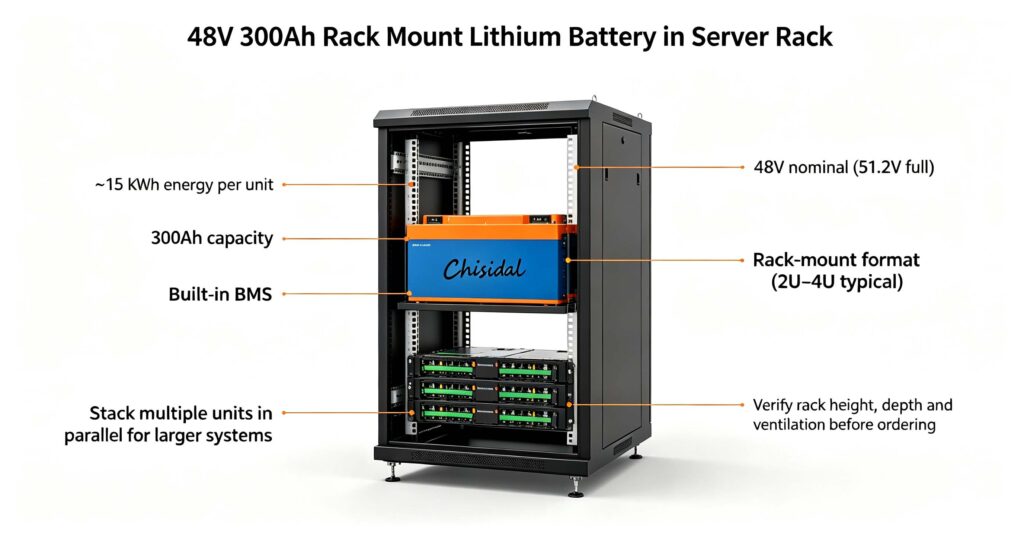
A 48v 300ah rack mount lithium battery is a server-rack-format LiFePO4 storage unit delivering about 15.4 kWh per unit (51.2 V × 300 Ah), with a built-in BMS, designed to stack in standard server racks for residential, commercial and off-grid energy storage. It sits between single 48V batteries (50–100 Ah) and larger floor-standing cabinets: compact enough for a home server rack, powerful enough for a small office or shop. Buyers compare it on energy per rack unit, dimensions, BMS features and how many units parallel before choosing.
For an integrator or installer, the 48v 300ah rack mount lithium battery is a popular building block because it combines the 48V architecture that most hybrid inverters use with a rack format that fits standard enclosures. This guide covers the specs, sizing and installation considerations. For the rack product family, see #81 server rack battery.
48v 300ah rack mount lithium battery: key specifications
The core specs that determine whether a 48v 300ah rack mount lithium battery fits a project are energy, voltage, dimensions and BMS features.
| Parameter | Typical value | Why it matters |
|---|---|---|
| Nominal voltage | 48V (51.2V full, 40V cutoff) | Matches 48V hybrid inverters |
| Capacity | 300Ah | ~15.4 kWh per unit |
| Rack size | 2U–4U typical | Fits standard 19-inch racks |
| BMS | Built-in, cell balancing, protection | Safety and lifespan |
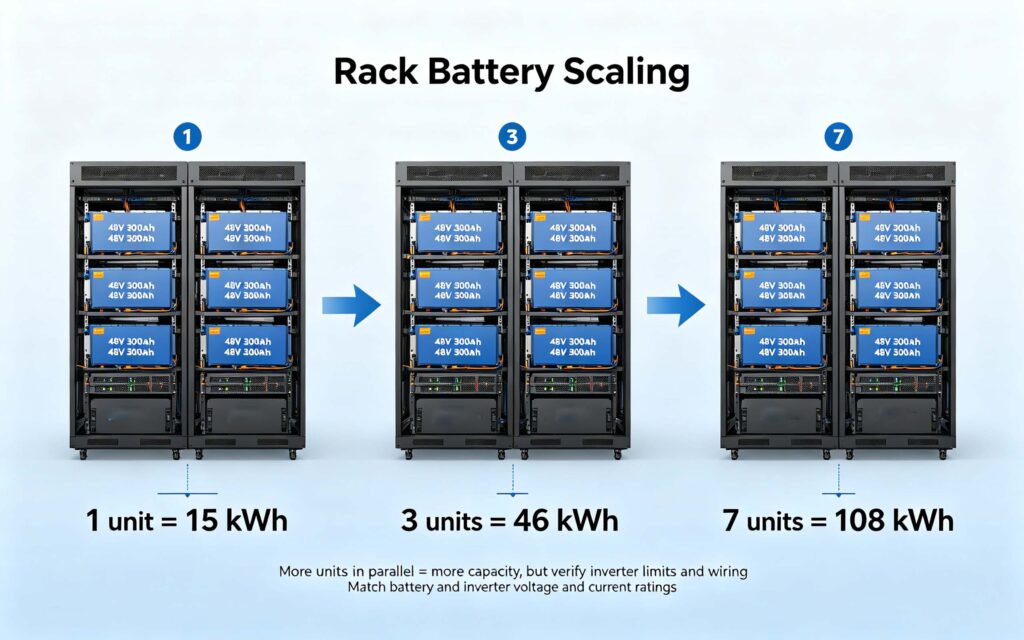
| Parallel units | Typically up to 15 | Scale from 15 kWh to 200+ kWh |
| Chemistry | LiFePO4 | Safe, long cycle life |
For the 2U format at smaller capacity, see #45 rack formats.
The reason the 48V 300Ah rack format has become the default for residential and small commercial storage is simple: it balances voltage, current and physical size. At 48V, a 5kW inverter pulls about 100A, which means 25mm² cables are enough — at 12V the same 5kW would pull over 400A and require bus bars and welding-cable-sized conductors. The 300Ah capacity per rack unit also means a typical home needs only two to four units to cover daily use, rather than a wall of 12V batteries. This is why installers who started with 12V systems in 2018–2020 have largely moved to 48V rack units for new projects.
Typical applications and sizing
The 48v 300ah rack mount lithium battery is versatile enough for several use cases, but sizing still depends on load and autonomy.
Residential solar storage: one unit (15 kWh) covers a typical home’s daily use; two units give backup through multi-day outages.
Small commercial and office: 3–5 units provide 46–77 kWh for shops, clinics or small offices with critical loads.
Off-grid and telecom: rack units pair with hybrid inverters in remote sites where floor space is limited and a tidy rack is preferred.
When you size multiple rack units in parallel, two details decide whether the system runs cleanly for years. First, use batteries from the same production batch: cells from different batches have slightly different internal resistance, which causes one unit to carry more current than the others and age faster. Second, respect the inverter maximum parallel count and total current. A 10kW inverter can charge and discharge at roughly 200A at 48V; stacking seven 300Ah units gives 2,100Ah total, but the inverter will never draw more than its rating allows, so extra units only add autonomy, not power. Do not buy more capacity than the inverter can actually use.
For the larger floor-standing cabinet at the same energy class, see #53 C&I cabinet.
Installation considerations
Installing a 48v 300ah rack mount lithium battery looks simple but has a few non-obvious constraints.
- Rack space: verify rack height (U), depth and weight capacity — a fully loaded rack is heavy.
- Ventilation: LiFePO4 is safe but still needs airflow; follow the manufacturer’s spacing guidance.
- Cabling: high-current 48V runs need properly sized cables and lugs.
- Inverter compatibility: confirm the inverter supports the battery’s BMS communication and parallel count.
For the BMS communication details, see #18 CAN/RS485 compatibility guide.
Installers also report three recurring field issues. Rack units heat up in summer, so the cabinet needs real ventilation, not just a vent slot — a 15kWh bank can pump out several hundred watts of heat during heavy charge or discharge. The battery breakers should be sized per unit, not one main breaker for the whole stack, so a fault on one unit does not take the whole system offline. And the monitoring cable must be daisy-chained in the order the manufacturer specifies; getting the sequence wrong leaves half the units invisible to the BMS. These are not exotic failures — they are the same install mistakes repeated on every project type.
Q. How much energy does a 48V 300Ah rack battery store?
A 48V 300Ah battery stores about 15.4 kWh (51.2V × 300Ah). At 90% usable depth of discharge, that is roughly 13.9 kWh available. For a typical home using 10–15 kWh per day, one unit covers a day; two units give multi-day backup. Stacking up to 15 units in parallel scales the system from 15 kWh to over 200 kWh.
Q. What size rack do I need for a 48V 300Ah battery?
Most 48V 300Ah rack batteries fit a standard 19-inch server rack and take 2U to 4U of vertical space, depending on the model. Confirm the unit’s height, depth and weight before ordering, and leave space for cabling and ventilation. A fully loaded rack of several units is heavy — verify the rack’s weight rating and anchor it properly. Depth matters as much as height.
Q. Can I parallel multiple 48V 300Ah rack batteries?
Yes, most models support parallel stacking, typically up to 10–15 units, which scales the system from 15 kWh to 150+ kWh. Parallel connection keeps the voltage at 48V while adding capacity. Verify the inverter’s maximum battery count and current rating, and use matched batteries from the same batch. More units mean more capacity, not higher voltage.
Q. Is a 48V 300Ah rack battery safe?
Yes, when installed and operated within specifications. LiFePO4 chemistry is thermally stable, and the built-in BMS protects against overcharge, over-discharge, overcurrent and short circuit. Rack installation with proper ventilation and correctly sized cables follows safe practice. As with any large battery, installation should be done by qualified personnel following local codes.
Q. What inverter works with a 48V 300Ah rack battery?
Use a 48V hybrid or off-grid inverter rated for the battery’s capacity and charge/discharge current. The inverter must support the battery’s BMS communication (often CAN or RS485) for optimal charging, and its current rating must match the battery’s continuous and peak discharge current. Most 48V hybrid inverters (3kW–10kW) work well with one to four units; larger commercial inverters handle more.
Next step: get the rack specs for your project
The 48v 300ah rack mount lithium battery is a building block, not a whole system. Confirm rack space, inverter compatibility and parallel count before you quote. Ask for the dimensions, weight, BMS protocol and parallel limit up front.
- Compare floor cabinet in #53
- Check BMS protocol in #18
- Ask leekooenergy for a 48V 300Ah rack battery quote with dimensions, BMS protocol and parallel limit listed before you commit