A server rack battery is a lithium battery module built to the 19-inch rack form factor — typically 1U to 5U tall — and wired to a 48V bus so it can drop into a standard IT rack alongside UPS modules, PDUs, switches and servers. The same word covers two quite different builds: a residential rack battery that backs up a few home circuits, and a data-center-grade module that backs IT loads for tens of minutes to hours and carries the certifications, BMS handshake and OEM paperwork enterprise buyers require.
This guide is for buyers specifying the rack battery as part of a project — a data-center build, a telecom site refresh, an OEM cabinet programme, or an integrator replacing an ageing UPS battery. It covers the four decisions that decide whether a server rack battery delivers: 48V architecture, IT-room vs residential certification, capacity matching to runtime, and the OEM checks that matter at scale. The home-rack angle is in #45 rack vs stackable vs wall-mounted.
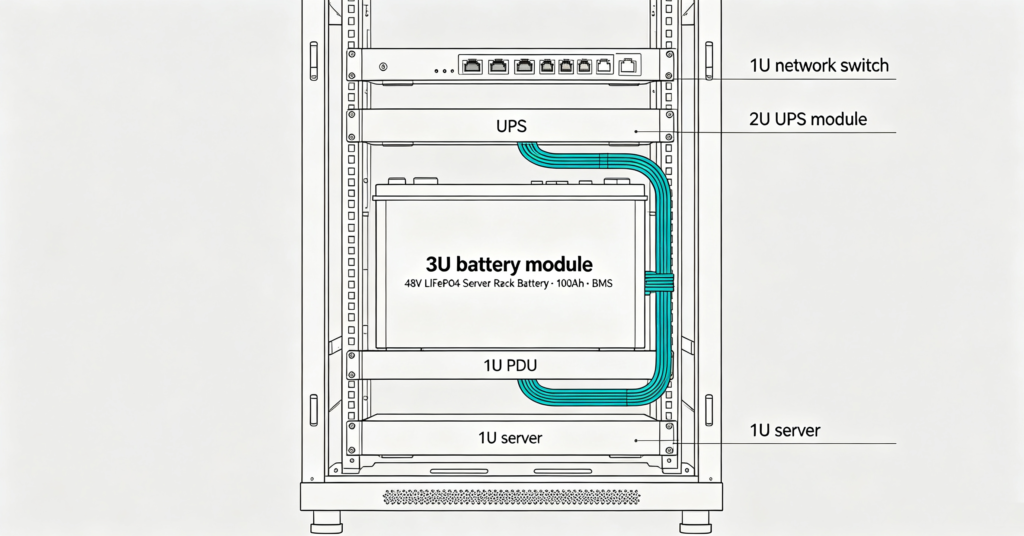
What “server rack battery” actually means
Three pieces of information sit inside the phrase. Server rack is a 19-inch-wide equipment rack with standardised rail spacing, originally defined for IT servers but now used for UPS, PDU, network gear and monitoring. Rack battery is a battery module built to mount in that same rack, with the same rail-mount ears and chassis width, height expressed in rack units (1U = 44.45 mm, 2U = 89 mm, 3U = 133 mm). Server qualifies the deployment as IT-grade: the rack battery’s job is to feed IT loads through a UPS during mains failure, with the runtime the SLA requires.
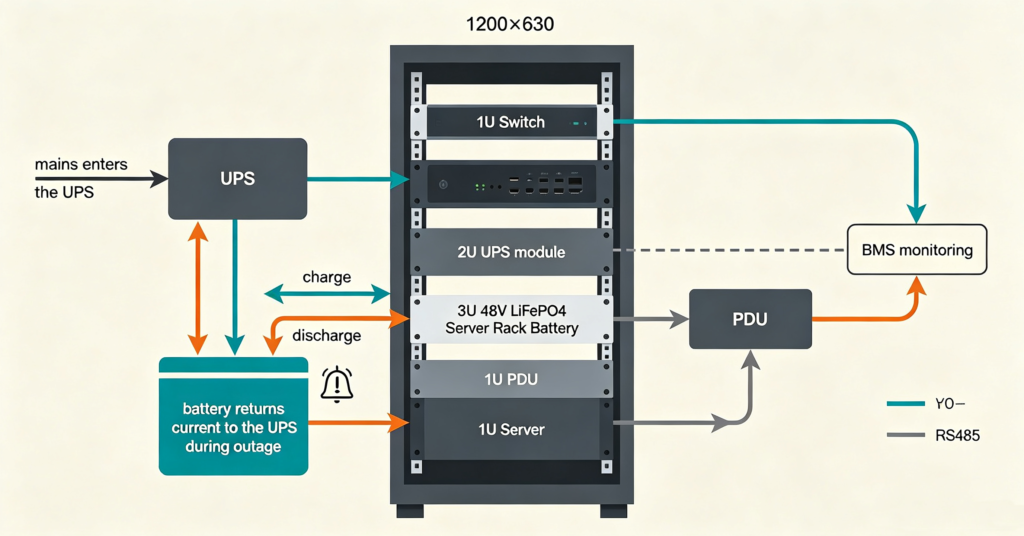
Two practical consequences follow. The rack battery does not feed IT loads directly — it feeds the UPS, and the UPS feeds the servers; both must speak the same voltage and ideally the same protocol. And the rack battery must carry the certifications a server room demands: UL 1973 (stationary energy storage safety, North America), IEC 62619 (industrial lithium cells, international), CE-EMC, UN38.3 for transport, and often a seismic / vibration rating. A residential rack battery — the kind sold for home solar — typically carries a different set of marks and lacks the BMS handshake an enterprise UPS expects.
Server rack battery vs residential rack battery
The form factor looks the same from across the room; the engineering inside is quite different. The table below summarises the differences that decide whether a rack battery can actually go into a server room.
| Property | Residential rack battery | Server rack battery (IT-grade) |
|---|---|---|
| Nominal voltage | typically 48V, sometimes 51.2V | 48V (telecom standard) or 51.2V (LiFePO4 nominal) |
| Typical capacity per module | 50–200 Ah | 50–200 Ah (modular, paralleled) |
| Certifications expected | CE, UN38.3, sometimes UL 9540 | UL 1973, IEC 62619, CE-EMC, UN38.3, often UL 9540 / IEEE 1547 |
| BMS handshake with UPS | basic (voltage sense only) | RS485 / Modbus / CAN bus; SOC, SOH, alarms, individual cell voltages |
| Cycle life target | 3,000–6,000 cycles (residential cycling) | 3,000–6,000 cycles (deep discharge OK) |
| Warranty support | 5–10 years, residential SLA | 5–10 years, with field-serviceable BMS and documented RMA |
| Thermal management | passive or fan-cooled | active fan or liquid-ready, with sensor reporting |
| Front-panel display | basic SOC LED | full LCD/LED with alarms, communication status, per-cell data via portal |
Three rows deserve attention. The BMS handshake is the one most often missed at procurement: a residential rack battery lets the UPS pull current, but does not tell it state of charge, temperature, or whether a cell is drifting out of balance — the UPS treats it as a “dumb” 48V source without the visibility an enterprise SLA needs. Certifications matter because insurance carriers read datasheets, not brochures. Thermal management matters because a server room runs warm and a battery that cannot cool itself derates or trips early.
Why 48V dominates the server rack
Three reasons keep 48V at the top of the rack. Telecom history: the world’s telephone network runs on 48V DC, so every central office already has a 48V bus, and a rack battery can share the same bus bars. Copper economy: doubling the bus voltage quarters the current for the same power, so thinner cables, smaller breakers, less voltage drop. Lithium cell math: a 48V nominal LiFePO4 pack is 16 cells in series (16 × 3.2V = 51.2V nominal, 3.6V × 16 = 57.6V absorption) — a healthy series count that balances cell engineering with pack-level performance and maps cleanly to the 48V telecom standard.
The 12V and 24V rack batteries that exist are low-power residential or industrial niche products; the IT-room mainstream is 48V. The broader 48V platform comparison is in #35 48V lithium batteries explained.
Sizing the rack battery to the IT load and runtime
The sizing problem is straightforward: the UPS has a nameplate load (in kVA or kW) and a required runtime (in minutes), and the battery must hold enough usable energy at 48V to deliver that runtime. A simple rule of thumb:
- Energy required = UPS load (kW) × required runtime (hours) / inverter efficiency (typically 0.92–0.96).
- Battery capacity required = energy required / (DoD × nominal battery voltage). For LiFePO4 the practical DoD is 80–90%; for lead-acid (still common in legacy UPS rooms) it is 50%.
- Modules required = battery capacity required / per-module capacity. Most 48V rack modules are 50 Ah, 100 Ah or 200 Ah; paralleling several modules is the standard way to scale.
A 5 kW UPS load at 15 minutes runtime needs about 34 Ah at 48V / 80% DoD — well within a single 50 Ah module with margin. At 1 hour runtime the same load needs about 130 Ah, which means two 100 Ah modules in parallel, or one 200 Ah module. The matching logic that ties inverter sizing to battery kWh is laid out in #79 hybrid inverter sizing vs battery capacity.
Compatibility: UPS, PDU and the rack itself
Three compatibility questions decide whether the rack battery actually drops in.
- UPS handshake: the rack battery’s BMS must speak the UPS’s expected protocol. Most modern 48V UPS systems accept a generic 48V LiFePO4 source with a voltage-sense lead, but enterprise UPS systems look for CAN or RS485 telemetry from the BMS to report SOC, SOH and individual cell voltages. The BMS protocol family is laid out in #34 Victron BMS integration; the protocol landscape for monitoring is in #83 battery monitoring system manufacturers.
- Mechanical fit: the chassis width must be 19 inches (or 23 inches for some telecom racks), and the height in rack units (1U to 5U) must leave room for the UPS and PDU. A 3U module and a 2U UPS fit a 6U slot; a 5U module needs more planning. Thermal: server rooms run 22–27 °C, comfortable for LiFePO4; in an unconditioned telecom shelter, derating starts above 35–40 °C.
Compliance: the marks that matter
For a server-room deployment, the datasheet should show at minimum:
- UN38.3: transport safety for lithium cells.
- UL 1973: stationary energy storage safety (North America — the mark an insurance carrier reads first).
- IEC 62619: industrial lithium cell safety (international equivalent).
- CE-EMC / FCC Part 15: electromagnetic compatibility for the BMS and any communication modules; UL 9540 / IEEE 1547 if the rack battery is part of a grid-interactive energy storage system rather than a backup-only system.
The full compliance landscape for grid-tied and off-grid BESS is in #44 BESS fires: energy storage safety codes; the architectural decisions that decide which marks apply are in #56 BESS cost ROI.
Buying for OEM, system integrator or fleet
When the order is dozens or hundreds of rack modules, the questions move from “does it work” to “does it work the same way every time”.
- Batch consistency: cells from one batch, BMS firmware at one version. Mixing generations inside a paralleled bank is how balancing problems start.
- White-label / OEM programme and protocol validation: can the modules ship with the buyer’s brand and pre-loaded firmware defaults? List the UPS brands and BMS protocols the module has been validated with, and request test reports.
- Cycle data at realistic DoD: ask for cycles tested at 80% DoD with the method stated. The cycle-life arithmetic behind a credible number is in #46 cycle life vs price. Service and spares: confirmed RMA process, field-replaceable BMS, spare modules available for next-day shipment.
- Cost per usable kWh: compare offers on delivered kWh at 80% DoD with the stated cycle count, not on headline price per module.
The OEM pathway for cells, BMS modules and assembled packs that go into a server rack is in #48 lithium cell wholesale; the matching industrial-scale storage that the same modules can also feed is in #15 industrial battery storage.
Q. Can a home solar battery be used as a server rack battery?
Physically yes — many residential rack batteries are 48V LiFePO4 in a 19-inch chassis — but in practice no. A residential rack battery typically lacks the BMS handshake (RS485 / CAN bus / Modbus) that enterprise UPS systems expect, and it usually does not carry UL 1973 / IEC 62619. The UPS will run, but without the visibility and the certifications that a server room requires.
Q. How many rack batteries can I parallel in one system?
Most 48V rack battery systems support 8 to 16 modules in parallel, sometimes more. The exact limit depends on the BMS and the CAN bus addressing — every paralleled module needs a unique address and a peer-to-peer handshake so the master can balance current across the bank. Going beyond the datasheet’s stated maximum usually requires a vendor consultation.
Q. What is the difference between a server rack battery and a UPS battery?
A UPS battery ships inside the UPS chassis — historically a sealed lead-acid string, increasingly a lithium module. A server rack battery is a separate lithium module that mounts in the rack next to the UPS and feeds its DC bus. Modern IT rooms replace the internal UPS battery with a separate, larger rack-mounted lithium module the UPS treats as external.
Q. Does a server rack battery need a separate BMS?
Yes, every lithium server rack battery has its own BMS inside the chassis. It handles cell balancing, over-voltage and under-voltage cutoff, over-current protection, temperature monitoring and the communication handshake with the UPS. A rack battery without a BMS is a sealed lead-acid replacement, not a lithium module.
Q. How long does a 48V server rack battery last in IT-room duty?
A quality LiFePO4 rack battery rated for 6,000 cycles at 80% DoD typically delivers 10+ years in a server-room backup role where it floats at full charge and only cycles deeply during monthly or quarterly discharge tests. In a daily-cycling role (solar self-consumption shifting) the cycle count is consumed much faster — perhaps 5–7 years.
Next step: match the rack battery to the rack, the UPS and the SLA
The right server rack battery is the one that fits the 19-inch rail, speaks 48V, carries the marks the room’s insurance policy reads, and lasts the SLA’s full term without a surprise BMS swap.
- Confirm the platform basics in #35 48V lithium batteries explained
- See the residential rack angle in #45 rack vs stackable vs wall-mounted
- Match BMS protocol in #34 Victron BMS integration
- Plan capacity against runtime in #79 hybrid inverter sizing vs battery capacity
- Check the BESS compliance landscape in #44 BESS fires: energy storage safety codes
- Ask leekooenergy for a 48V server rack battery specification that states chassis size (1U/2U/3U/4U), UL 1973 / IEC 62619 / UN38.3 marks, RS485 / CAN / Modbus protocol support, BMS firmware version, cycle data at 80% DoD and OEM white-label terms — a module that drops into a server rack, a UPS, a PDU and a service contract from a single component line