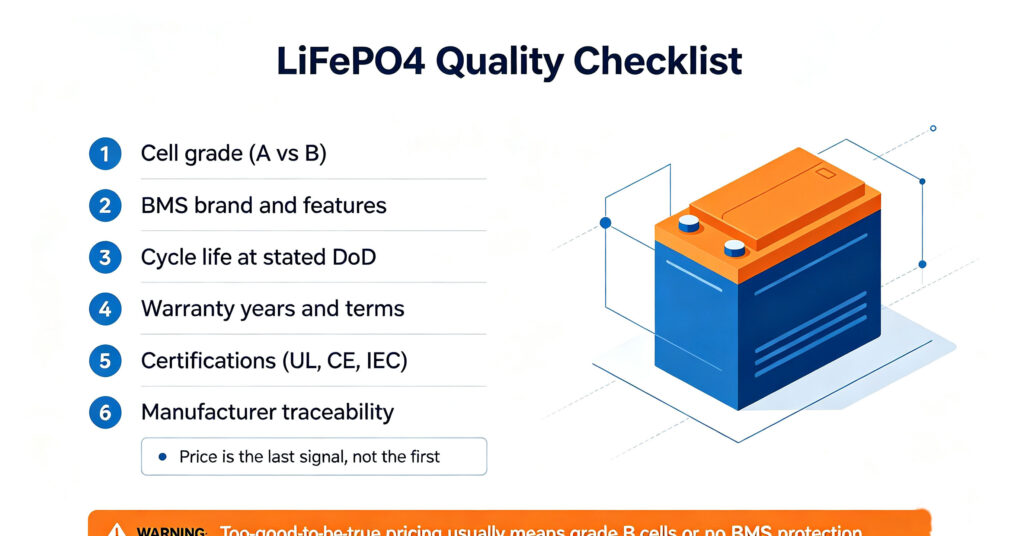
When buyers search for the latest high-quality lifepo4 batteries in 2026, the meaningful answer is not a brand list but a quality checklist: look for Grade A cells from traceable manufacturers, a reputable BMS with active balancing, a stated cycle life at a defined depth of discharge, a clear multi-year warranty, and relevant certifications (UL, CE, IEC). The market is flooded with cheap LiFePO4 products that look identical on paper — quality is decided by cell grade, BMS design and warranty terms, not by the advertising claims. This guide tells you what to check before you pay.
As an application engineer who has seen good and bad LiFePO4 products in the field, the question latest high-quality lifepo4 batteries is usually a buyer trying to avoid the cheapest options. This guide is the practical version. For the chemistry basics, see #01 lithium iron phosphate batteries guide.
What makes the latest high-quality lifepo4 batteries different
The latest high-quality lifepo4 batteries differ from cheap clones in five concrete areas. These are the signals to check on a datasheet.
| Signal | Quality sign | Risk sign |
|---|---|---|
| Cell grade | Grade A, named manufacturer | “LFP cells” with no source |
| BMS | Known brand, active balancing, logs | Unknown chip, no protection detail |
| Cycle life | Stated at 80% DoD, 25°C | “6000 cycles” with no conditions |
| Warranty | 5–10 years, clear terms | 1–2 years, vague exclusions |
| Certifications | UL, CE, IEC listed | No test reports offered |
For the Grade A vs Grade B cell detail, see #136 LFP battery cells selection guide.
The practical test of a “high-quality” battery is not the brochure but the gap between the datasheet and the field result. Ask three questions: what cells are inside, what BMS algorithm is running, and what happens when a cell drifts out of balance. A supplier who can answer all three in writing is showing you a product, not a marketing page. The cheapest option on a 10-year cycle is rarely the one with the thinnest documentation.
Field data also favors established designs. A new BMS algorithm may offer faster balancing or better thermal control, but until it has two or three years of field reports, it carries the risk of early firmware bugs that the supplier will solve on your system rather than someone else’s. For a commercial buyer who cannot afford downtime, the safer choice is often the previous generation: same cells, proven BMS, known failure modes, and a price that has come down as production matures. Innovation is valuable in consumer products; in an industrial battery that sits in a cabinet for ten years, maturity is a feature. Ask for reference installations, not just product brochures.
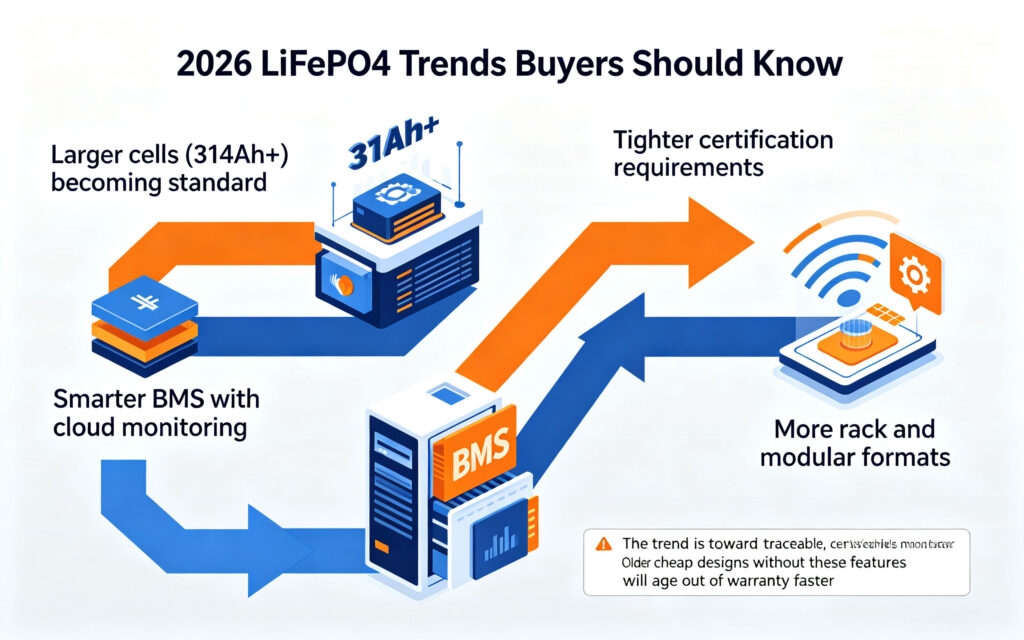
2026 trends in high-quality LiFePO4
The market for the latest high-quality lifepo4 batteries is moving in four directions that matter for buyers.
Larger cells: 280Ah and 314Ah cells are becoming standard, improving energy density per pack.
Smarter BMS: built-in monitoring, cloud logs and cell-level diagnostics are expected, not optional.
Tighter certification: buyers increasingly require UL and IEC reports, which cheap products struggle to provide.
Modular formats: rack and floor cabinets that scale in 5–15kWh steps are replacing one-size designs.
For the capacity side of the trend, see #143 high capacity batteries guide.
The same logic applies to price comparison. A battery that costs 20% more but carries a 10-year warranty with defined capacity retention (typically 70% after the warranty period) is cheaper over a decade than a 20% cheaper unit that fades to 60% in year four. Ask suppliers for the warranty capacity threshold and the test condition, then calculate the cost per usable kWh over the warranty period. This number, not the sticker price, is what determines the real cost of ownership.
Buyers in 2026 also need to watch two quality signals that did not matter five years ago. The first is cell provenance: as the LiFePO4 cell market has consolidated, “Grade A” has become a marketing term rather than a guarantee. Ask the supplier to name the actual cell manufacturer and, where possible, the cell model — a supplier who can only say “LFP cells” is asking you to trust a black box. The second signal is warranty structure: a 10-year warranty that excludes everything except a dead BMS is not the same as a warranty that covers capacity fade below 70%. Read the exclusions, not just the headline years. The cheapest unit rarely has the cheapest cost of ownership.
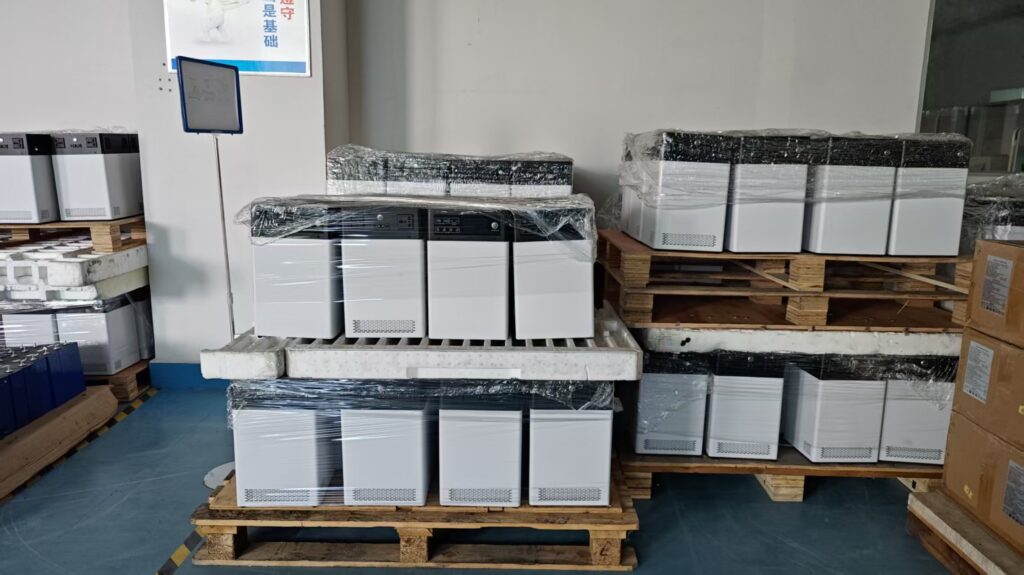
What to ask a supplier before you buy
When a supplier claims to offer the latest high-quality lifepo4 batteries, ask these four questions before comparing price.
- Who made the cells? Ask for the cell manufacturer and grade, not just “LFP”.
- What BMS? Ask for the BMS brand, balancing type and communication protocol.
- What are the warranty terms? Get the years and the exclusions in writing.
- Can you provide test reports? Certifications should be available, not just claimed.
Q. What should I look for in the latest high-quality LiFePO4 batteries?
Look for four things: Grade A cells from a named manufacturer, a BMS with active balancing, cycle life stated at a defined depth of discharge and temperature, and a clear 5–10 year warranty with UL, CE or IEC reports. Avoid products that only claim “LFP” without naming the cell source. Price is the last check, not the first.
Q. Are cheap LiFePO4 batteries good value?
Rarely. Cheap units often use Grade B cells, simplified BMS or vague warranty terms, which show up later as capacity fade or warranty disputes. If the price seems too low, ask for cell grade, BMS brand and test reports. If the supplier cannot provide them, it is not a bargain.
Q. How long should a high-quality LiFePO4 battery last?
Typically 4,000–8,000 cycles, or 10–20 years of daily cycling. The real number depends on depth of discharge, temperature, charge rate and BMS quality. Ask for cycle life at a defined depth of discharge (usually 80%) and temperature (25°C), and compare warranties rather than headline numbers.
Q. What certifications should high-quality LiFePO4 batteries have?
At minimum, look for CE for market access, UL listings for safety (especially in North America) and IEC 62619 for industrial Li-ion safety. Certifications should come as test reports, not just logos. If a supplier cannot provide reports, treat the claim as unverified.
Q. Should I buy the newest LiFePO4 product or a proven design?
For most B2B buyers, a proven design with a multi-year track record is safer than the newest product. Early-production units carry field-risk. Choose the newest generation only when the supplier can show field data, warranty history and certification reports. Otherwise, pick a design with established references.
Next step: ask for the quality documents, not just the price
For the latest high-quality lifepo4 batteries, the real difference is in the paperwork: cell grade, BMS brand, cycle life conditions, warranty terms and certification reports. Get those first, then compare price.
- Read LiFePO4 basics in #01
- Compare cells in #136
- Size capacity in #143
- Ask leekooenergy for high-quality LiFePO4 batteries with cell grade, BMS, warranty and certification reports listed before you compare quotes