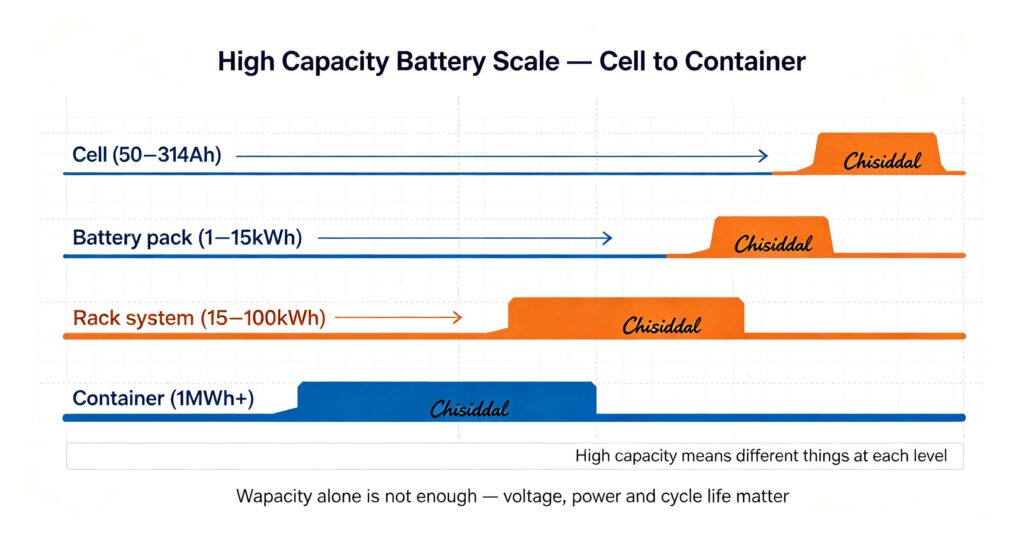
High capacity batteries are storage units whose energy rating is large for their application — the label shifts with context: at cell level it means 100Ah or larger LiFePO4 cells, at pack level it means 10kWh–15kWh rack or floor units, and at system level it means 100kWh to multi-MWh container installations. For a buyer, “high capacity” is not a spec on its own; it must be paired with voltage, power rating (kW), cycle life and round-trip efficiency. The mistake to avoid is choosing capacity by marketing language rather than by daily load, autonomy target and the inverter that must accept the battery.
The phrase high capacity batteries appears in product pages, RFQs and search queries without a single definition. This guide gives buyers a practical way to think about it. For the 12V capacity comparison, see #141 12V lithium battery sizes.
High capacity batteries: what counts as “high”?
The definition of high capacity batteries depends on the level of the system. The table below shows the common thresholds buyers encounter.
| Level | “High capacity” range | Typical use |
|---|---|---|
| Cell | 100Ah–314Ah LiFePO4 | DIY packs, EV, storage |
| Pack | 5kWh–15kWh | Home storage, small business |
| Rack/cabinet system | 15kWh–100kWh | Commercial, multi-family |
| Container system | 500kWh–MWh+ | Utility, C&I microgrid |
For the rack format at 15kWh, see #142 48V 300Ah rack mount battery.
What makes a battery “high capacity” is not the Ah number on a datasheet but the gap between the nameplate and what the system can actually deliver. Two systems both labeled 100kWh can behave very differently: one may deliver 90kWh because it has a conservative BMS and good temperature management, while another may only deliver 70kWh because it cuts off early or throttles in heat. When buyers compare quotes, the kWh number is the start of the conversation, not the end. Ask for usable kWh, continuous kW discharge, and the round-trip efficiency at the expected operating temperature — those three numbers tell you what the system actually does, rather than what its label says.
How to specify high capacity batteries correctly
When you write high capacity batteries into an RFQ, the response is only as good as the specs behind it. Five fields matter.
- Energy (kWh): total stored energy, not just Ah.
- Voltage: 48V residential, higher voltage for large systems.
- Power (kW): continuous and peak charge/discharge.
- Cycle life: at what depth of discharge and temperature.
- Efficiency and round-trip loss: how much of stored energy you actually get back.
For the cell-level choices behind large systems, see #136 LFP battery cells selection.
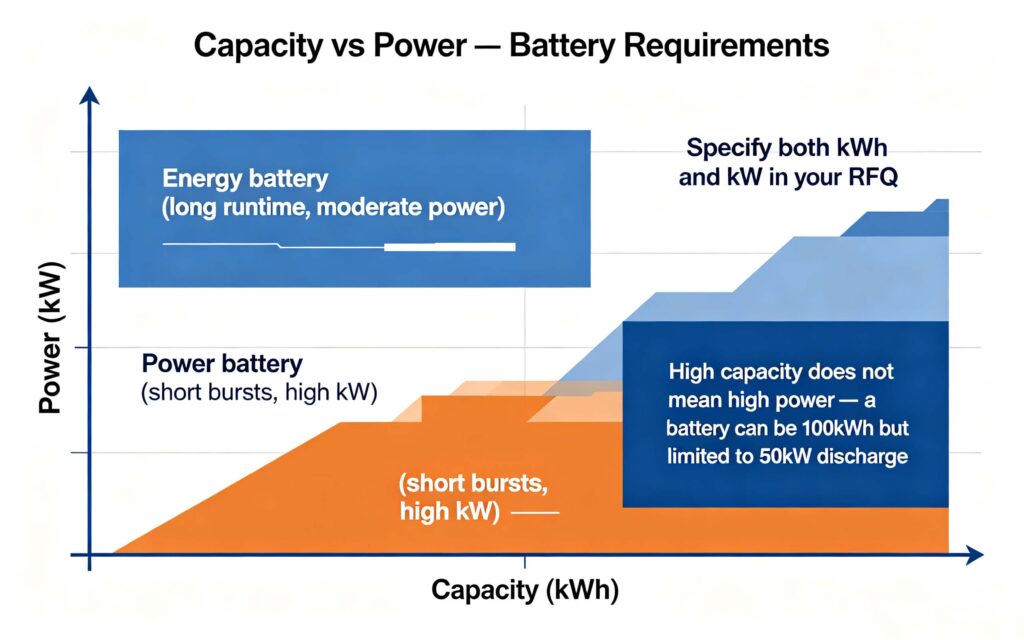
The other mistake is treating high capacity as a substitute for design. A 200kWh system with a 50kW inverter cannot start a 100kW motor, no matter how much energy it holds; the inverter is the bottleneck, not the battery. Conversely, a 100kW inverter paired with only 50kWh of battery will drain the system in 30 minutes. Buyers who size by capacity alone end up with a system that either cannot handle the load or cannot sustain it. The correct process is to define the load profile first — what runs, for how long, and at what peak — then choose the battery and inverter together. A capacity-only spec leads to expensive compromises.
Common mistakes when buying high capacity batteries
Buyers who search high capacity batteries often repeat the same three mistakes.
Mistake 1: Capacity without power. A 100kWh battery that can only discharge 20 kW cannot start a large load, even though it holds a lot of energy.
Mistake 2: Oversizing to “be safe.” Extra capacity costs money and space; undersizing cycles the battery harder. Size to real load.
Mistake 3: Ignoring round-trip efficiency.
Mistake 3: Ignoring round-trip efficiency. “100kWh” at 85% efficiency delivers 85kWh. Specify efficiency, not just nameplate.
Q. What is considered a high capacity battery?
It depends on the level. At cell level, 100Ah or larger LiFePO4 cells are considered high capacity. At pack level, 5kWh–15kWh units are large for home use. At system level, anything from 100kWh to multi-MWh containers is industrial-scale. The label is relative to your application — a 100Ah cell is high capacity for a phone-sized device but small for a grid project.
Q. Is higher capacity always better?
No. Higher capacity costs more upfront, takes more space, and if it exceeds your load the battery spends most of its life lightly cycled, which is not harmful but wastes the investment. Higher capacity also does not mean higher power — a large battery may still have a limited kW discharge rating. Size to your daily load and autonomy target, and specify power separately.
Q. How do I choose between a high capacity battery and multiple smaller ones?
One large unit has a single BMS and enclosure; multiple smaller units in parallel give flexibility, easier handling and modular upgrades, but require matched batteries and a parallel connection. Fixed installations often prefer one large unit; upgradable or service-constrained projects often prefer modular smaller units. Total kWh is the same; the difference is logistics, service and future expansion.
Q. What voltage should high capacity batteries use?
Residential and small commercial systems commonly use 48V. Larger commercial and utility systems use higher DC voltages to reduce current and cable size, and they require system-level integration. The voltage must match the inverter or converter you plan to use. Do not choose a battery voltage in isolation — it must be defined together with the inverter and the expected load.
Q. How long do high capacity batteries last?
LiFePO4 high capacity batteries typically last 4,000–8,000 cycles, which translates to 10–20 years in normal cycling use. Actual life depends on depth of discharge, temperature, charge rate and maintenance. A battery that stays near 100% charge or runs very hot ages faster. Specify cycle life at a defined depth of discharge and temperature rather than accepting a headline number.
Next step: write a spec sheet, not a keyword
When you ask for high capacity batteries, the answer should come back with kWh, voltage, kW power, cycle life and efficiency — not just a capacity number. Ask for all five fields before comparing quotes.
- See 12V sizes in #141
- See 48V 300Ah rack in #142
- Compare cells in #136
- Ask leekooenergy for a high capacity battery quote with kWh, voltage, kW, cycle life and efficiency all listed before you compare suppliers