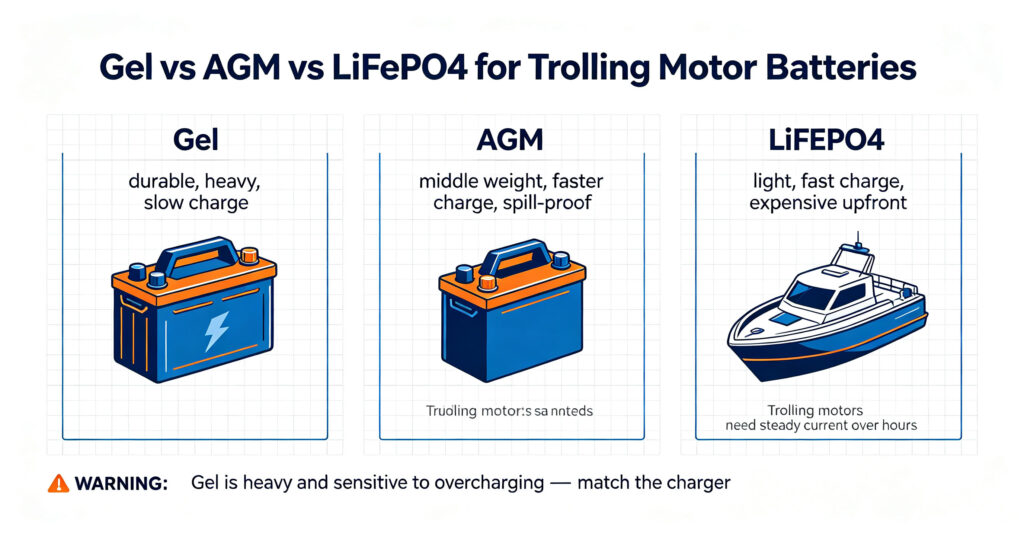
Gel cell trolling motor batteries are valve-regulated lead-acid batteries with gelled electrolyte, known for durability, spill resistance and deep-cycle tolerance. They work well for trolling motors but have two drawbacks: they are heavy (often 30 kg or more for a 100Ah unit) and they charge slowly, requiring a charger matched to gel chemistry. For most boat owners today, AGM is the middle option and LiFePO4 is the lighter, faster-charging alternative with higher upfront cost. Gel remains a reasonable choice for budget-conscious users who do not mind the weight and charge time, but it is no longer the default best choice for new trolling motor setups.
The question of whether gel cell trolling motor batteries are still worth buying is common among anglers and boat owners. This guide compares gel with AGM and LiFePO4, and explains when each makes sense. For the three-chemistry comparison, see #86 AGM vs LiFePO4.
Gel cell trolling motor batteries vs AGM vs LiFePO4
For a trolling motor, the choice between gel cell trolling motor batteries, AGM and LiFePO4 comes down to weight, charge speed and budget.
| Factor | Gel | AGM | LiFePO4 |
|---|---|---|---|
| Weight (100Ah) | Heavy (~30 kg) | Medium (~27 kg) | Light (~12 kg) |
| Charge speed | Slow | Medium | Fast |
| Cycle life | Moderate (500–1,000) | Moderate (500–1,000) | Long (4,000+) |
| Upfront cost | Low | Medium | High |
| Spill-proof | Yes | Yes | Yes |
For the 12V LiFePO4 option in marine use, see #70 12V LiFePO4 battery.
For anglers who fish in cold water, temperature matters more than chemistry. Gel batteries tolerate cold better than LiFePO4 on paper, but a LiFePO4 battery kept inside a warm boat compartment outperforms a gel battery sitting on the deck. Insulate the battery box and monitor temperature; this single step extends either chemistry by years. The choice between gel and lithium is less about the battery and more about how the boat is used and stored between trips.
The switch from gel to LiFePO4 on a fishing boat is more than a weight saving. Trolling motors draw current in bursts — holding position against wind and current can pull 30–50A for minutes at a time. Gel batteries deliver this, but their voltage sag under load is noticeable: at 50% state of charge, a gel battery under a 40A load may sag to 12.0V, which is enough to slow the motor. A LiFePO4 battery holds 13.0–13.2V down to 20% state of charge, so the motor keeps full power all day. This is the difference that anglers feel after one trip, and it is why the weight comparison understates the real benefit.
How to size a battery for your trolling motor
Whether you choose gel cell trolling motor batteries or another chemistry, the size depends on motor thrust and how long you fish.
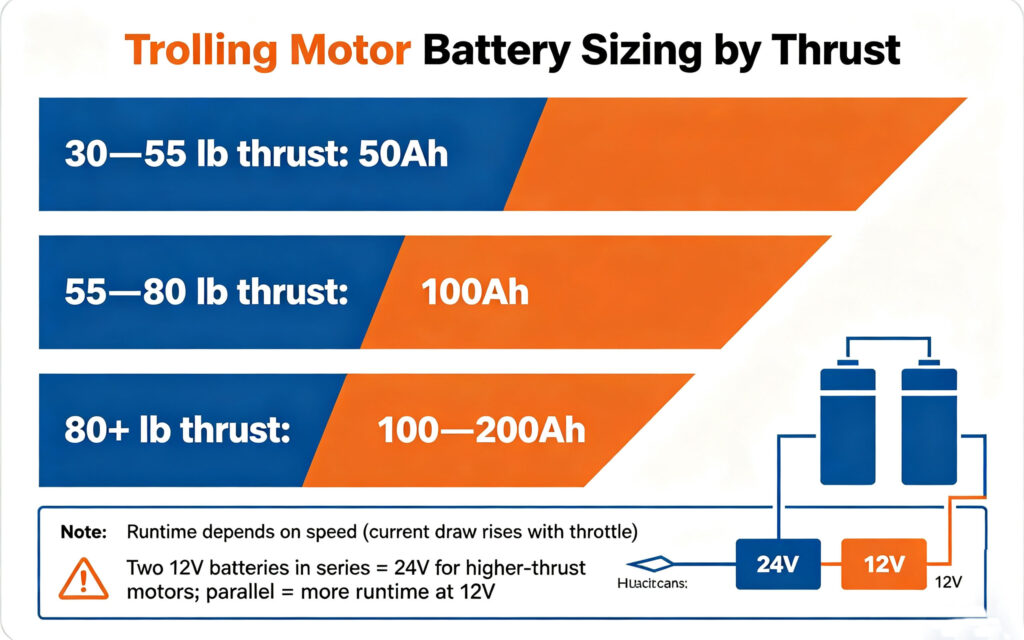
- Match voltage: most small trolling motors are 12V; higher-thrust motors use 24V (two 12V batteries in series).
- Size by thrust: 30–55 lb motors suit 50Ah; 55–80 lb need 100Ah; 80+ lb need 100–200Ah.
- Plan runtime: current draw rises with throttle, so estimate real fishing hours, not ideal.
- Match the charger: gel batteries need a gel-compatible charger; using the wrong charger shortens life.
For the capacity sizing method, see #141 12V battery capacity comparison.
If you do stay with gel, three charging rules matter. First, use a gel-compatible charger: a flooded-lead-acid charger that bulk-charges at 14.4V will overcharge gel cells and shorten life. Second, do not deep-cycle below 50% — gel tolerates it less well than AGM, and repeated deep discharge cuts cycle life faster. Third, store the battery fully charged over winter; gel cells that sit at 50% for months develop permanent capacity loss. These rules are not optional, and they are the reason many boat owners who bought gel in 2019 have already replaced them, while LiFePO4 batteries bought the same year are still running.
When gel still makes sense
Despite the LiFePO4 trend, gel cell trolling motor batteries remain a reasonable choice in two situations.
Budget-limited builds: gel costs less upfront than LiFePO4, and for occasional use the shorter cycle life is acceptable.
Existing gel charger and wiring: if your boat already has a gel-compatible charger, staying with gel avoids an upgrade.
For most new builds where weight on the boat matters, LiFePO4 saves significant weight and charges faster — the trade-off is upfront cost.
Q. Are gel batteries good for trolling motors?
Yes, gel batteries work for trolling motors. They are spill-proof, tolerate deep cycling and handle the steady current a trolling motor draws. They are heavier and more expensive than LiFePO4 but cheaper upfront and widely available. They remain a valid choice for anglers who do not want to switch chemistry.
Q. How long do gel trolling motor batteries last?
A gel trolling motor battery typically lasts 500–1,000 cycles, which is several years of regular use if charged correctly. Marine use shortens life: hot engine compartments and deep discharge below 50% cut cycles significantly. LiFePO4 lasts 4,000–8,000 cycles in the same application, though the upfront cost is higher.
Q. Should I switch from gel to lithium for my trolling motor?
Switching to LiFePO4 saves significant weight (roughly half the weight of a gel 100Ah battery) and charges much faster. It also holds 13.0–13.2V down to 20% state of charge, so the motor keeps full power all day. You need a LiFePO4-compatible charger. The cycle life and weight advantage pay off within a few seasons.
Q. What amp hour battery do I need for a trolling motor?
Size by motor thrust: 30–55 lb thrust motors suit a 50Ah battery; 55–80 lb need 100Ah; 80+ lb need 100–200Ah. Higher-thrust motors draw more current and drain a smaller battery fast. Add 20% margin for wind and current. Two 12V batteries in parallel give 24V for higher-thrust setups if the motor supports it.
Q. Can I use a regular car battery for a trolling motor?
No, not as a long-term solution. A starting battery is designed for short high-current bursts, not the steady deep discharge a trolling motor needs. Deep cycling a starting battery destroys it in weeks. Use a deep-cycle gel, AGM or LiFePO4 battery. A starting battery works for one emergency trip, but not for regular fishing.
Next step: choose the chemistry that fits your boat
Gel cell trolling motor batteries are durable but heavy and slow to charge. If weight and charge time matter, compare LiFePO4; if budget is the priority, gel or AGM still work. Match the battery voltage and size to your motor thrust, and use a charger that fits the chemistry.
- Compare chemistries in #86
- See 12V LiFePO4 in #70
- Size capacity in #141
- Ask leekooenergy about a 12V LiFePO4 marine battery sized for your trolling motor, with weight and runtime documented so you can compare against gel