Technical guide · Seplos engineering & sourcing team · Last reviewed: 2026-08
Most storage buyers have stopped asking whether to use lithium. They ask which lithium. Lithium iron phosphate batteries — written as LFP or LiFePO4 — now carry most of the stationary storage market because they survive daily cycling, tolerate heat better than nickel-based cells, and use cathode materials that are cheap and widely available.
That does not make every LFP product equivalent. Two 51.2 V racks with identical nameplate kWh can behave very differently after eighteen months of daily cycling, and the difference usually sits in the cell grade, the BMS logic and the current limits — not in the marketing sheet. This guide covers what the chemistry actually is, how it compares with NMC and lead-acid, and which numbers decide whether a pack fits your system.
What Is a Lithium Iron Phosphate Battery?
A lithium iron phosphate battery is a rechargeable lithium-ion battery that uses lithium iron phosphate (LiFePO4) as the cathode material and graphite as the anode. Its nominal cell voltage is 3.2 V, and the olivine crystal structure of the cathode is thermally more stable than the layered oxides used in NMC or LCO cells.
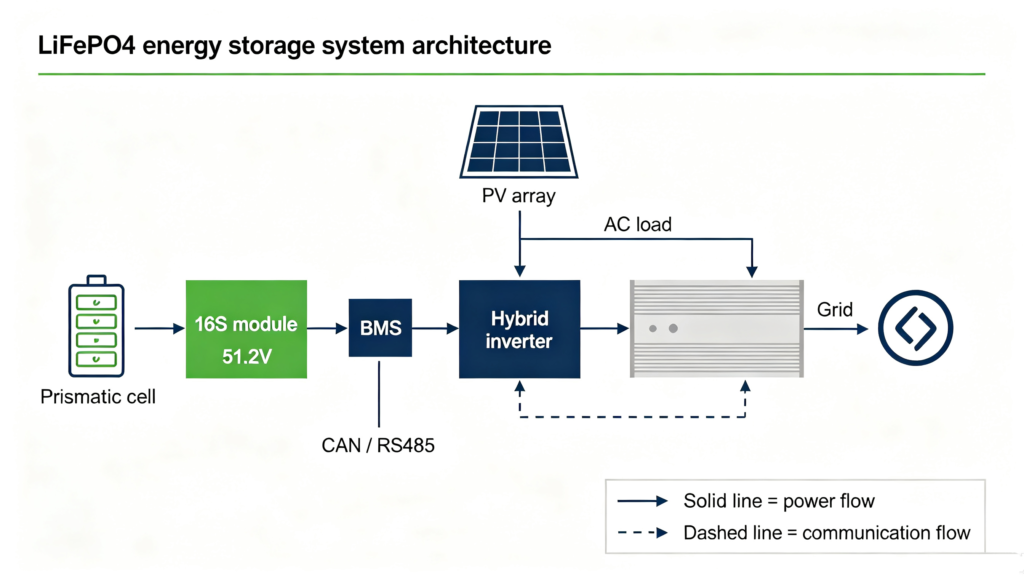
Everything else in the pack follows from that 3.2 V figure. Sixteen cells in series give 51.2 V nominal, which is why the “48 V” class of storage products is physically a 16S LiFePO4 string. Fifteen cells give 48 V nominal, and eight give 25.6 V. When a datasheet says 48 V but lists 16 cells, it is quoting the legacy lead-acid label rather than the real nominal voltage.
The flat discharge curve matters just as much as the voltage. A LiFePO4 cell holds roughly 3.2–3.3 V across most of its usable capacity, then drops sharply near the end. Inverters therefore cannot estimate state of charge from voltage alone, and the battery must report SOC over a communication bus instead.
Why LiFePO4 Became the Default Chemistry for Stationary Storage
LiFePO4 became the default chemistry for stationary storage because it combines long cycle life, a stable thermal profile and low material cost — the three properties that matter when a battery is charged and discharged every day for a decade in an unattended location.
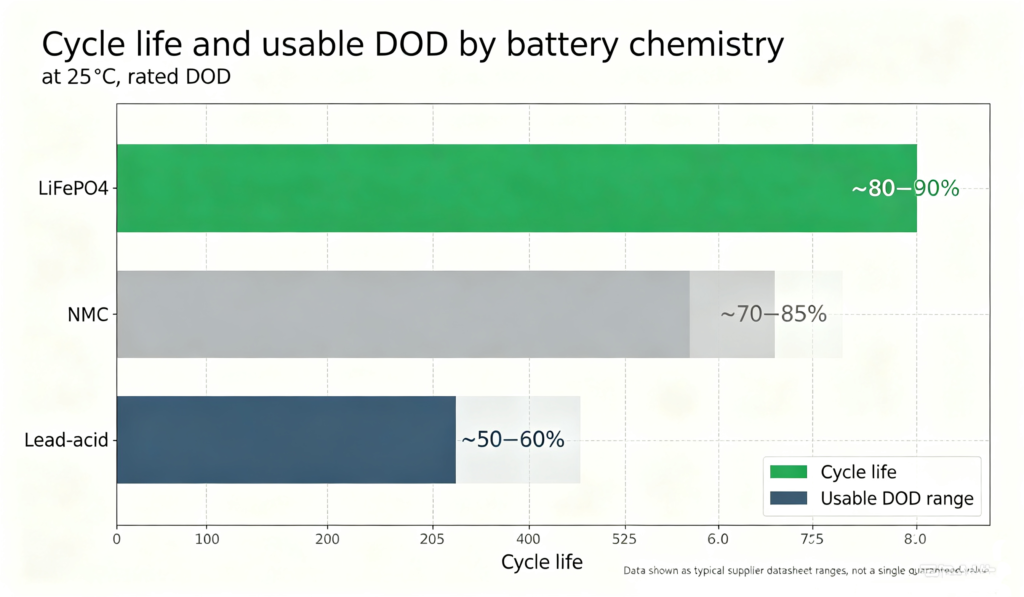
Cycle life is the commercial argument. Quality LFP cells are typically rated for several thousand full cycles at 80 % depth of discharge and 25 °C, an order of magnitude beyond flooded lead-acid. For a solar self-consumption system that cycles once per day, that rating is the difference between replacing the bank twice and never replacing it inside the system’s design life.
Thermal behaviour is the safety argument. The phosphate-olivine cathode releases oxygen at a much higher temperature than nickel-rich cathodes, so LFP cells are less prone to sustained thermal runaway once a fault starts. This does not make an LFP pack intrinsically safe — enclosure design, cell spacing, fusing and BMS protection still decide the outcome — but it gives integrators more margin.
Cost and supply are the procurement argument. Iron and phosphate are not constrained by the same geopolitical and pricing pressure as cobalt and nickel, which is why LiFePO4 batteries for solar energy storage displaced NMC in residential and C&I products even while NMC kept its place in vehicles.
LiFePO4 vs NMC vs Lead-Acid: How the Chemistries Compare
Choose LiFePO4 when the application cycles daily and space is not the binding constraint. Choose NMC when volumetric and gravimetric energy density decide the design. Choose lead-acid only when the load is a rarely used backup and the lowest possible purchase price outweighs total cost of ownership.
| Property | LiFePO4 (LFP) | NMC | Flooded / AGM lead-acid |
|---|---|---|---|
| Nominal cell voltage | 3.2 V | 3.6–3.7 V | 2.0 V |
| Usable depth of discharge | 80–95 % | 80–90 % | 30–50 % |
| Cycle life at rated DOD | Thousands of cycles | Fewer than LFP at the same DOD | Several hundred cycles |
| Gravimetric energy density | Lower | Highest of the three | Lowest |
| Thermal stability | Highest of the three | Requires tighter thermal control | Stable, but vents hydrogen |
| Charge below 0 °C | Not permitted without heating | Not permitted without heating | Permitted at reduced current |
| Maintenance | None; BMS managed | None; BMS managed | Watering, equalisation, ventilation |
| Best fit | Daily-cycling solar, C&I, off-grid | Weight- or volume-limited systems | Standby / seldom-cycled backup |
The lead-acid comparison is often misread. A 200 Ah AGM bank and a 200 Ah LiFePO4 bank are not the same purchase: after usable depth of discharge is applied, the LFP bank delivers roughly two to three times the energy per cycle. Sizing a replacement on nameplate amp-hours alone leads to an oversized, overpriced quote.
How LiFePO4 Cells Are Built Into Storage Products
Buyers rarely purchase chemistry. They purchase one of four physical formats, and the format determines who carries integration responsibility.
Bare cells
Prismatic LFP cells — 105 Ah, 280 Ah, 314 Ah are common sizes — are sold to assemblers who build their own packs. The buyer takes full responsibility for grading, busbar torque, compression fixtures, BMS selection and enclosure safety. Cell-to-cell capacity and internal-resistance matching decides how the finished bank ages, which is why grade A, matched batches are worth specifying explicitly.
Modules and battery packs
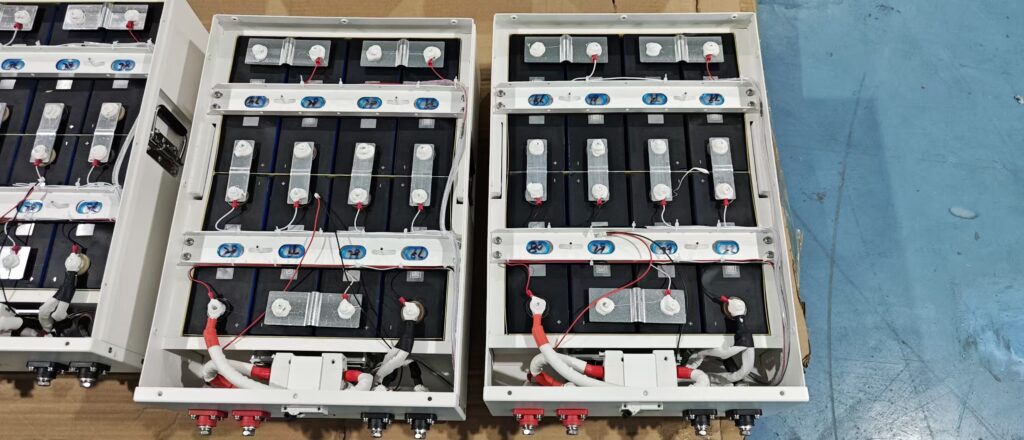
A LiFePO4 lithium iron phosphate battery pack arrives as a sealed unit with its own BMS, fusing and terminals. This is the normal choice for installers who need a predictable product with a warranty. The specifications to compare here are usable kWh, continuous charge and discharge current, communication protocol and enclosure rating.
Rack-mounted and stackable systems
Rack and stack formats put several 51.2 V modules in parallel behind a master controller. They exist because commissioning time and serviceability matter: a faulty module can be swapped without dismantling the bank. Parallel limits are real design constraints — confirm the maximum module count per string and whether the master unit is mandatory.
Integrated cabinets and all-in-one units
Cabinets combine batteries, a hybrid inverter and protection in one enclosure. They shorten installation but lock you into the inverter inside. For C&I projects where the electrical design is already fixed, a separate battery rack usually gives more freedom.
Key Specifications Buyers Should Read Carefully
Five numbers cause most of the disputes we see after delivery. None of them are hidden — they are simply reported inconsistently across suppliers.
1. Usable capacity, not nominal capacity
Nominal kWh is cells × voltage × amp-hours. Usable kWh is what the BMS will actually let out. Ask for both figures and for the depth of discharge used to derive the usable number, because a 5.12 kWh module at 90 % DOD and a 5.12 kWh module at 80 % DOD are different products in the same box.
2. Cycle life and the conditions attached to it
A cycle-life rating without test conditions is not a specification. Request the DOD, ambient temperature, charge and discharge rate, and the end-of-life threshold — typically 70 % or 80 % of initial capacity. A 6,000-cycle claim at 0.2 C and 25 °C says nothing about a rooftop plant room that sits at 40 °C in summer.
3. Continuous current versus peak current
Peak current figures are usually quoted for a few seconds. Motor starting, welding loads and large inverter surges depend on how long the pack can hold that current, so ask for the peak duration and the derating curve rather than the headline amps.
4. Low-temperature charging
Charging a LiFePO4 cell below 0 °C plates lithium on the anode and permanently reduces capacity. Packs intended for unheated garages, containers or northern climates need either an integrated heater or a BMS that blocks charge current below a set threshold. Confirm which of the two the product uses, and whether the heater draws from the battery or from the charge source.
5. BMS behaviour and communication protocol
The BMS decides how the pack reports SOC, how it balances cells, and whether it can talk to your inverter at all. CAN bus and RS485 are the two common physical layers, but the protocol on top of them is often brand-specific. Ask for the supported inverter list and the protocol version before ordering, not after.
Where LiFePO4 Batteries Are Used
LiFePO4 batteries are used wherever energy is stored and released on a daily schedule: solar self-consumption, off-grid systems, commercial peak-shaving, telecom backup, and light industrial equipment. The chemistry is chosen for cycle life rather than for weight.
In residential solar, the pack absorbs midday PV surplus and covers the evening load. Sizing follows the evening consumption profile and the backup ambition, not the array size — a point covered in our home battery sizing guide.
In off-grid systems the battery becomes the grid. Autonomy days, worst-month solar yield and the surge behaviour of the largest single load drive the design, and the bank is usually the most expensive line item. Our solar battery bank selection guide works through that calculation.
In commercial and industrial sites the driver is tariff structure rather than autonomy. Demand-charge reduction and time-of-use arbitrage need high continuous current and a duty cycle the cells can sustain for years, which is where cycle-life test conditions stop being a paperwork detail.
Telecom and light-industrial applications sit somewhere between: shallow cycling, long standby periods, and a strong preference for a chemistry that will not need a maintenance visit.
Common Mistakes When Sourcing LiFePO4 Battery Packs
- Comparing nameplate kWh only. Usable energy, round-trip efficiency and current limits change the real capacity of the offer.
- Assuming 48 V products are interchangeable. A 15S 48 V pack and a 16S 51.2 V pack have different charge voltage windows; the inverter may accept one and fault on the other.
- Ignoring the inverter compatibility list. Most commissioning failures we are asked to troubleshoot are protocol mismatches, not battery faults.
- Buying mixed cell batches for one bank. Cells from different production lots age at different rates, and the weakest module ends up limiting the whole string.
- Treating certification as a single label. A cell certificate does not cover the finished pack, and a pack certificate does not cover your installation.
- Skipping the sample stage on custom packs. Mechanical fit, cable entry direction and display orientation are cheap to change before tooling and expensive afterwards.
Standards and Certification: What to Ask For
Certification for lithium storage products is layered, and the layers are frequently blurred in sales documents. Ask which document covers which object.
| Document | Applies to | What it does not cover |
|---|---|---|
| UN 38.3 test summary | Transport of the cell / battery | Stationary operating safety |
| IEC 62619 | Industrial secondary lithium cells and batteries | Your enclosure, wiring and site design |
| Cell-level test report | The cell only | The assembled pack and its BMS |
| Pack / system report | The specific pack configuration tested | Modified configurations or other firmware |
| Local electrical code compliance | The completed installation | Anything decided before installation |
The accurate formulation is that a product is designed to meet or tested according to a standard, for a stated configuration. Buyers should verify which requirements apply in their own market, and should ask for the test report rather than the logo.
Glossary: LiFePO4 Terms You Will See in Datasheets
- 16S / 15S — number of cells in series; 16S LiFePO4 = 51.2 V nominal, 15S = 48 V nominal.
- C-rate — current expressed as a multiple of capacity. 0.5 C on a 100 Ah pack is 50 A.
- DOD (depth of discharge) — how much of the nominal capacity is used per cycle.
- SOC / SOH — state of charge (present energy) and state of health (remaining capacity versus new).
- Balancing — equalising cell voltages; passive balancing bleeds energy, active balancing moves it.
- Round-trip efficiency — energy out divided by energy in, including BMS consumption.
- Calendar ageing — capacity loss over time regardless of cycling, driven mainly by temperature and storage SOC.
How to Decide Whether LiFePO4 Fits Your Project
Work through four questions in order. They are ranked by how expensive the mistake is to correct later.
- Duty cycle. One or more cycles per day points to LFP. A few discharges per year rarely justifies the capital cost over lead-acid.
- Electrical envelope. Confirm the inverter’s battery voltage window and its supported protocol list before selecting a pack format.
- Environment. Ambient temperature range, ventilation and the possibility of sub-zero charging determine whether heating or derating is required.
- Service model. If a single failed module must not take the bank offline, choose a rack or stack format with per-module isolation.
Only after those four are settled does chemistry grade, brand and price become the deciding factor. Reversing the order — picking a price point first — is how systems end up commissioned but derated.
Product-level detail for each format sits on the LiFePO4 battery category page, with the two most common configurations documented on the 51.2 V rack-mounted battery and 280 Ah / 314 Ah prismatic cell pages.
FAQs About Lithium Iron Phosphate Batteries
Q. How long do LiFePO4 batteries last?
Service life depends primarily on depth of discharge, operating temperature and charge rate. Well-managed LFP packs used for daily solar cycling are generally specified for thousands of cycles before capacity falls to 70–80 % of the original figure. Calendar ageing also applies, so a lightly cycled pack still loses capacity over the years. Always compare cycle ratings at the same DOD and temperature.
Q. Is a LiFePO4 battery the same as a lithium-ion battery?
Yes — LiFePO4 is one chemistry within the lithium-ion family. The difference is the cathode material: lithium iron phosphate instead of nickel manganese cobalt or lithium cobalt oxide. That single change lowers cell voltage to 3.2 V, improves thermal stability and extends cycle life, at the cost of energy density.
Q. Can LiFePO4 batteries be charged below freezing?
No, not without heating. Charging below 0 °C causes lithium plating on the anode and permanent capacity loss. Packs for cold locations should either include an integrated heater or use a BMS that blocks charge current below a defined temperature. Discharging at sub-zero temperatures is generally permitted, though available capacity is reduced.
Q. What voltage is a 48 V LiFePO4 battery?
Most products labelled 48 V are 16 cells in series, giving 51.2 V nominal and a charge voltage in the region of 56–58 V. A true 15S pack is 48 V nominal. The distinction matters because inverters have a fixed battery voltage window, so check the nominal, charge and cut-off voltages against the inverter specification rather than relying on the label.
Q. Are LiFePO4 battery packs worth the price over lead-acid?
For daily-cycling applications, usually yes, once usable energy is taken into account. A lead-acid bank is typically limited to 30–50 % depth of discharge, so it needs roughly two to three times the nameplate capacity to deliver the same energy per cycle, and it is replaced far more often. For standby loads discharged a few times a year, lead-acid can still be the lower total cost.
What to Confirm Before You Order
LiFePO4 is a mature chemistry, and the remaining risk in a purchase is rarely the chemistry itself. It is the gap between the datasheet and the installed system: usable versus nominal capacity, cycle life without test conditions, current limits without duration, and a communication protocol that turns out to be brand-specific.
Settle those four points in writing and most LFP products from a competent manufacturer will do what the quotation implies.
Discuss your configuration with our engineering team
If you are specifying a LiFePO4 system, send the following and we will come back with a configuration proposal rather than a generic catalogue:
- application and expected cycles per day;
- target usable capacity (kWh) and system voltage;
- inverter brand and model;
- installation environment and temperature range;
- quantity, target market and any certification requirement.
Cell-level enquiries (280 Ah / 314 Ah, grade and batch matching) can go to the same address — please state whether you assemble packs in house.