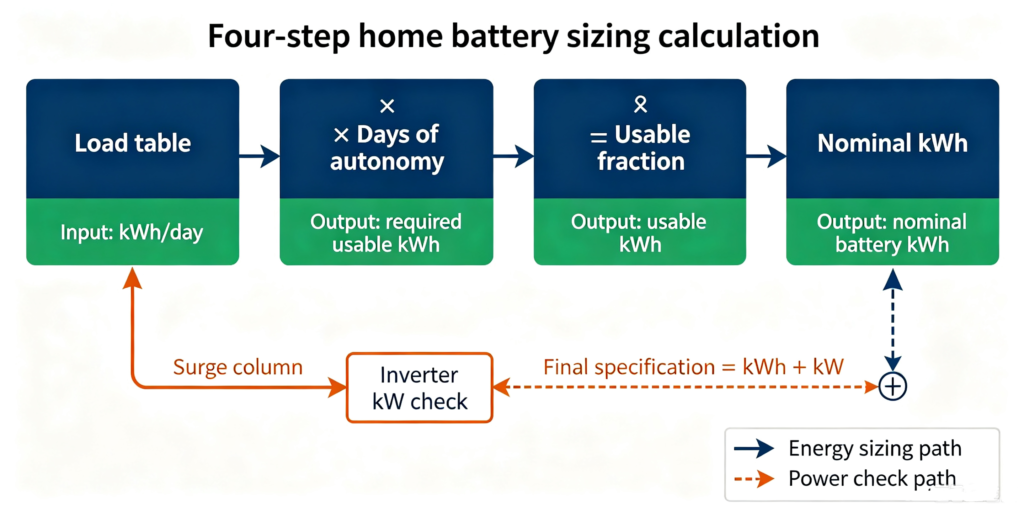
Size a home battery from the loads you intend to back up and the hours you need them to run — not from the household’s annual electricity consumption. The calculation is: total backed-up energy per day, multiplied by the days of autonomy required, divided by the battery’s usable fraction. Then check separately that the inverter’s power rating can start the largest motor in that load list.
Annual consumption is the wrong input because most of it belongs to loads nobody intends to back up. A house using 12,000 kWh a year does not need a 33 kWh battery to survive an evening outage.
Sizing Means Two Numbers, Not One
Definition. Sizing a home battery storage system means specifying two independent quantities: the energy capacity in kilowatt-hours, which determines how long the system can supply the backed-up loads, and the power rating in kilowatts, which determines whether it can supply them at all. A system with adequate energy but insufficient power will shut down the moment a large motor starts, regardless of its state of charge.
Confirm with the supplier which capacity figure a quotation uses. Nominal capacity is the cell chemistry’s rated energy; usable capacity is what the battery management system will actually let you take out. The ratio between them — the usable fraction, sometimes expressed as depth of discharge — varies between products and is the single most common reason two batteries labelled the same size behave differently.
Step 1 — Build the Load Table
List every circuit that must stay live, its running power in watts, and the hours it will actually run during an outage. Multiply to get watt-hours, then total.
| Load | Running power (W) | Hours in 24 h | Energy (kWh) | Starting surge? |
|---|---|---|---|---|
| Refrigerator / freezer | 150 | 8 (cycling) | 1.2 | Yes, brief |
| LED lighting, essential rooms | 100 | 5 | 0.5 | No |
| Router, modem, security | 20 | 24 | 0.5 | No |
| Gas furnace blower / heat pump fan | 400 | 6 | 2.4 | Yes |
| Sump pump | 800 | 1 | 0.8 | Yes, large |
| Well pump | 1,000 | 1 | 1.0 | Yes, large |
| Home office equipment | 100 | 8 | 0.8 | No |
| Total backed-up energy per 24 h | 7.2 kWh | — | ||
Two practical points about this table. Cycling loads — refrigeration, heating fans — run intermittently, so use equivalent run hours rather than the full outage duration, or the result will be roughly double what is needed. And note which loads have a starting surge; that column is used in Step 4, not in the energy total.
Confirm with the supplier: ask whether their sizing tool uses running power or nameplate power. Nameplate figures on pumps and compressors are often well above actual running draw, and sizing from nameplate inflates the battery.
Step 2 — Set the Backup Duration
Decide how many hours, or how many days, the system must carry those loads without recharging. This is a business decision, not an engineering one, and it should be based on the site’s actual outage history rather than a worst case imagined at the kitchen table.
- Short outages (up to about 8 hours). Covers the majority of grid events in most developed networks. Modest capacity, and the priority is transfer behaviour rather than energy.
- Full day (24 hours). The common specification where outages are occasional but disruptive.
- Multi-day autonomy. Only defensible with a recharge source — solar, or a generator. Without one, each additional day multiplies the battery cost linearly, which is rarely the best use of the budget.
Where the house has solar, the battery only needs to bridge the hours between sunset and useful generation the next morning, not the full outage. That single distinction often halves the required capacity.
Step 3 — Convert to Usable, Then to Nominal Capacity
Required usable kWh = daily backed-up energy × days of autonomy
Required nominal kWh = required usable kWh ÷ usable fraction
Using the example table at one day of autonomy: 7.2 kWh usable required. At a usable fraction of 90 %, that is 8.0 kWh nominal. At 80 %, it is 9.0 kWh nominal. Same requirement, two different products.
| Nominal capacity | Usable at 90% | Runtime on the 7.2 kWh/day example | Typically specified for |
|---|---|---|---|
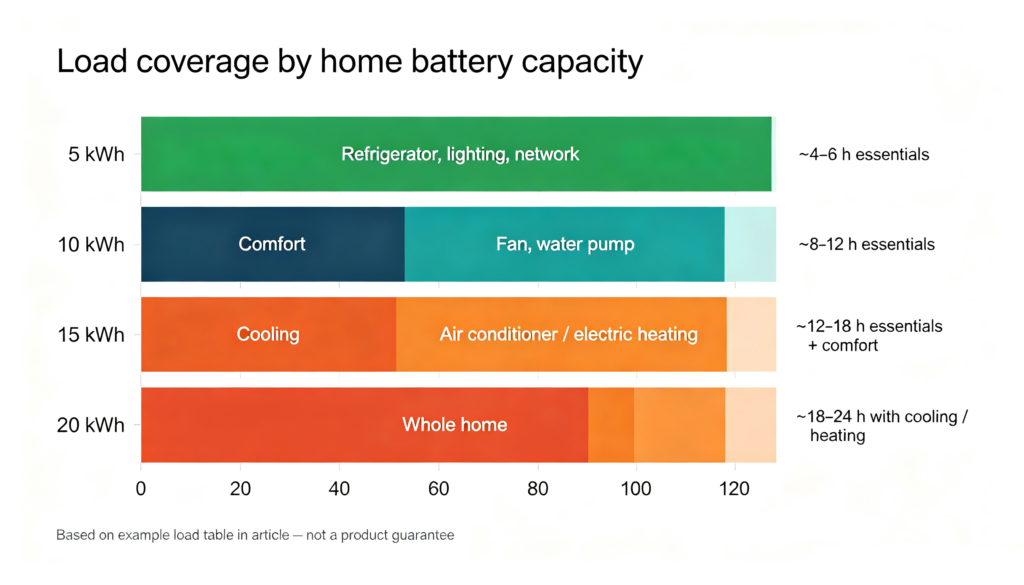
| 5 kWh | 4.5 kWh | ~15 hours | Essential circuits, short outages, or a starter system for phased expansion |
| 10 kWh | 9.0 kWh | ~30 hours | The common specification: essential circuits plus comfort loads, full-day autonomy |
| 15 kWh | 13.5 kWh | ~45 hours | Larger load lists, or one day of autonomy with air conditioning included |
| 20 kWh+ | 18 kWh+ | ~60 hours | Whole-home backup, or multi-day autonomy where solar recharges daily |
Confirm with the supplier: request the usable fraction in writing, and ask whether it changes at low temperature. A usable figure quoted at 25 °C may not hold in an unheated garage in winter, and that is exactly when backup matters most.
Step 4 — Check the Power Rating, Not Just the Energy
Return to the surge column. Motor loads — well pumps, sump pumps, compressors, air conditioning — draw several times their running power for a fraction of a second at start. The inverter has to supply that surge, and if it cannot, the system trips.
Three figures settle it: the inverter’s continuous kW, its surge kW, and how many seconds it holds the surge. Then identify the largest motor in the load list and the worst realistic case of two motors starting together.
This is where sizing most often goes wrong. A 10 kWh battery paired with a 3 kW inverter has plenty of energy and cannot start a well pump. Buyers searching for a 10 kwh home battery are usually thinking about duration, while the binding constraint on their load list is instantaneous power.
Confirm with the supplier: ask for the largest motor rating the inverter is specified to start, not just the surge number. It is a more useful answer and a harder one to give vaguely.
Is 10 kWh Enough?
For a typical essential-loads list — refrigeration, lighting, communications, a heating fan and a pump — 10 kWh nominal covers roughly a full day and often more. It is the most commonly specified size for that reason.
It stops being enough in three situations. When air conditioning or electric heating is included in the backed-up loads, energy consumption per day roughly doubles or worse. When the house has a well pump and the outage lasts more than a day, pump cycling adds up. And when the specification is whole-home rather than critical-loads backup, the load list is no longer under anyone’s control.
The reverse case is equally common: a household backing up only refrigeration, lighting and communications may be well served by 5 kWh, and the money saved is better spent on a properly rated inverter.
Sizing With Solar and Without
With solar, the battery bridges from sunset to the next morning’s useful generation, so daily autonomy is usually sufficient and the array does the recharging. Without solar, the battery must carry the entire outage on stored energy, and each extra day of autonomy costs a full battery increment. Our guide to backup without solar covers whether that trade-off is worth making at all.
The Sizing Errors That Cause Callbacks
- Sizing from annual consumption. Produces a battery two to four times larger than the backup requirement.
- Using nameplate instead of running power. Inflates the load table, particularly on pumps and compressors.
- Counting cycling loads at full duration. Roughly doubles the refrigeration and heating-fan lines.
- Comparing nominal against usable across quotes. Makes a smaller battery look larger.
- Sizing energy and ignoring surge. The single most common cause of a system that trips at commissioning.
- Ignoring temperature. A garage installation in a cold climate delivers less than its datasheet figure at exactly the wrong moment.
What to Confirm Before Ordering
- Usable kWh and nominal kWh, stated separately, with the usable fraction
- Whether the usable fraction changes with temperature, and the operating range for discharge
- Inverter continuous kW, surge kW, surge duration, and largest motor it can start
- Maximum number of modules that can be paralleled, for phased expansion
- Whether modules added later must match the original batch or firmware version
- Round-trip efficiency with its test conditions
- Cycle life with DOD, temperature and C-rate of the test, plus end-of-warranty capacity retention
- Whether the backup gateway and DC protection are included in the quoted scope
The fifth item is the one that catches phased projects. A household buying 10 kWh now and intending to add 10 kWh in two years needs to know whether that will be possible with the product as supplied — and the answer should be in writing before the first order, not discovered later.
FAQ
Q. How many kWh do I need for whole-house backup?
Whole-house backup is sized from the full connected load rather than a selected circuit list, which usually means both a substantially larger battery and a considerably larger inverter. In most cases the inverter power rating, not the battery capacity, sets the cost — which is why critical-loads backup is the more common specification.
Q. Is a 10 kWh home battery enough for a house?
For an essential-loads list — refrigeration, lighting, communications, a heating fan and a pump — 10 kWh nominal typically covers a full day or more. It becomes insufficient when air conditioning or electric heating is included in the backed-up loads, or when the specification is whole-home rather than critical-loads.
Q. Should I size a battery from my electricity bill?
No. A bill shows total annual consumption, most of which belongs to loads that will not be backed up. Sizing from a bill typically produces a battery two to four times larger than required. Build a load table from the circuits that must stay live instead.
Q. What size inverter do I need with a home battery?
The inverter must exceed the simultaneous running power of the backed-up loads and supply the starting surge of the largest motor among them. Check three figures — continuous kW, surge kW and surge duration — and ask which motor rating the inverter is specified to start.
Q. Can I add capacity to a home battery later?
Often yes, within a stated maximum number of parallel modules, but confirm before the first order whether later additions must match the original batch or firmware version. Some products allow free expansion; others restrict it, and the restriction is easier to plan around than to discover.
Want the load table checked?
Send us your circuit list with running power and expected hours, the backup duration you need, whether solar is present, and the largest motor on the list. We will return a configuration with usable kWh, nominal kWh, the required continuous and surge kW, and the expansion limit — with the assumptions written out so your electrician can check them.