Buyer’s guide · Seplos sourcing & application team · Last reviewed: 2026-08
A solar battery bank quote can vary by a factor of three for what looks like the same job. The spread almost never comes from supplier margin. It comes from four decisions being made in the wrong order — usually chemistry and brand first, capacity last.
Installers who size the bank from the load, fix the system voltage before shortlisting products, and only then compare chemistries end up with quotes they can actually compare. This guide follows that sequence and lists what to confirm with the supplier at each step.
What Is a Solar Battery Bank?
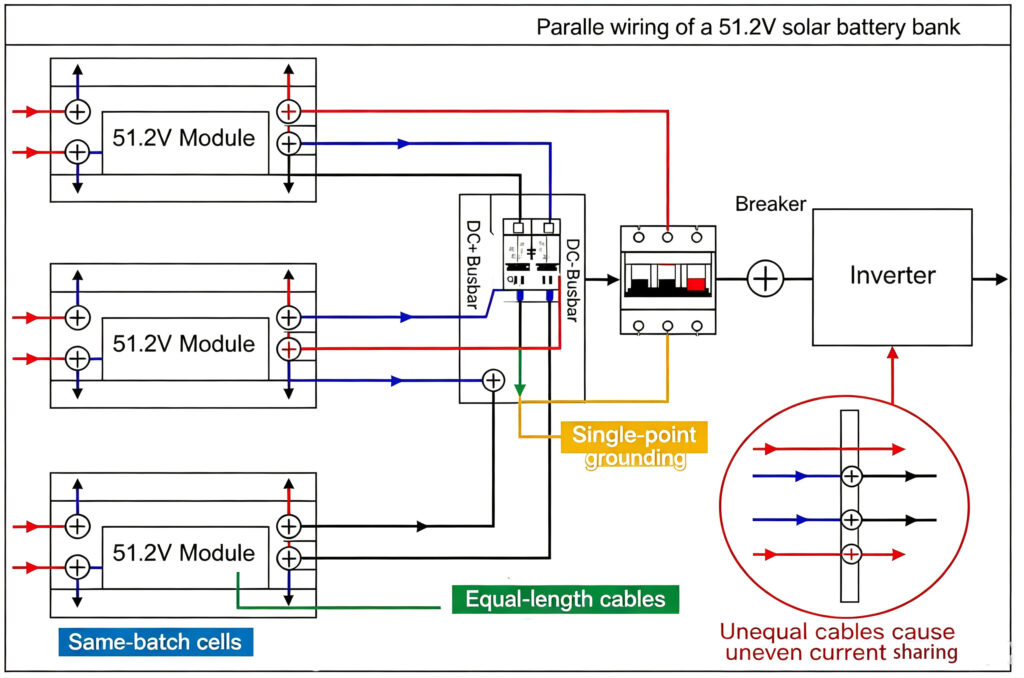
A solar battery bank is a group of batteries wired in series and parallel to store energy from a photovoltaic array at a defined system voltage and capacity. The bank is one electrical unit: its voltage comes from the series count, its capacity from the parallel count, and its behaviour from the weakest cell or module in the group.
That last point drives most procurement rules for battery banks. Mixed capacities, mixed ages or mixed brands inside one bank cause circulating currents and uneven ageing, so batches matter more here than in single-battery applications.
Four Decisions, in Order
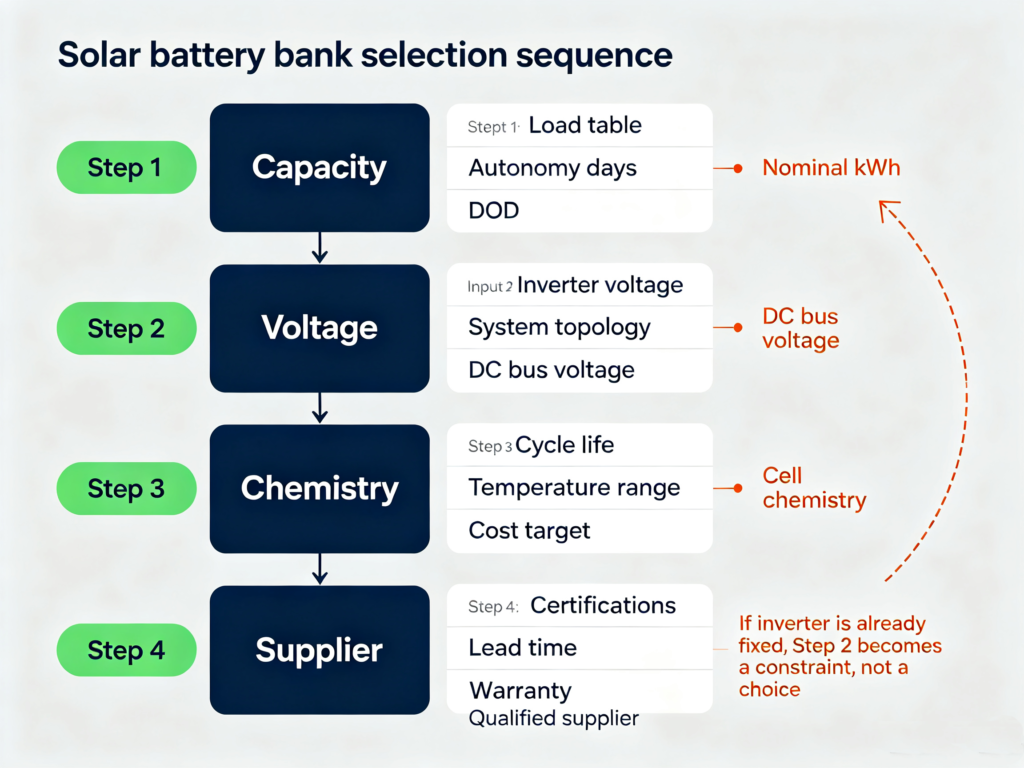
Size the capacity from the daily load and required autonomy, then fix the system voltage, then select the chemistry, and only then compare suppliers. Reversing this order is what produces quotes that cannot be compared against each other.
- Capacity — how much usable energy per day, and how many days without sun.
- Voltage — 12 V, 24 V, 48 V or 51.2 V, determined by inverter and current limits.
- Chemistry — lithium (LFP) or deep-cycle lead-acid, determined by cycle frequency.
- Supplier and configuration — format, BMS, protocol, lead time, MOQ.
Step 1: Size the Capacity from the Load, Not the Array
Battery bank capacity is set by daily energy consumption and the number of autonomy days required, then corrected for usable depth of discharge and round-trip losses. Array size does not determine bank size; it determines how quickly the bank can be recharged.
Start with a load table. List each load, its power draw and its daily run hours, and total the watt-hours. For grid-tied self-consumption, only the evening and night portion of that total needs to be stored. For off-grid, the full daily figure applies.
Then apply two corrections that are easy to forget:
- Usable depth of discharge. Lithium banks are commonly specified to 80–95 % DOD, deep-cycle lead-acid to 30–50 %. Divide the required energy by the DOD fraction.
- Round-trip efficiency. Inverter and battery losses mean stored energy is always higher than delivered energy. Add margin rather than assuming a datasheet best case.
| Item | Lithium (LFP) | Deep-cycle lead-acid |
|---|---|---|
| Daily energy to store | 10 kWh | 10 kWh |
| Usable DOD assumed | 90 % | 50 % |
| Capacity after DOD correction | 11.1 kWh | 20 kWh |
| Efficiency & ageing margin | +15 % | +20 % |
| Nominal bank size to specify | ≈ 12.8 kWh | ≈ 24 kWh |
| Typical 51.2 V configuration | 2–3 × 5.12 kWh modules | Large 2 V or 6 V cell string |
The comparison is the point: the same job needs roughly twice the nameplate capacity in lead-acid. Any quote comparison that ignores this is comparing different products.
Confirm with the supplier: the usable kWh figure and the DOD it assumes, whether the stated capacity is at beginning of life, and what capacity is guaranteed at end of warranty.
Step 2: Fix the System Voltage Before Shortlisting Products
Choose the system voltage from the inverter’s battery voltage window and the resulting DC current. Higher voltage means lower current for the same power, which reduces cable size and losses — this is why most solar storage above roughly 3 kW uses a 48 V class bank.
| System voltage | Typical use | Practical limit |
|---|---|---|
| 12 V | RV, small cabins, single-load backup | Cable and current become impractical above ~1 kW |
| 24 V | Small off-grid, telecom, marine | Comfortable to roughly 2–3 kW |
| 48 V / 51.2 V | Residential storage, off-grid homes, light C&I | Standard class for most hybrid inverters |
| High voltage (>100 V) | Larger residential and C&I stacks | Requires matched high-voltage inverter and controller |
One label needs care. A 48 V solar battery built from 16 LiFePO4 cells in series is 51.2 V nominal; a 15-cell string is a true 48 V. Both are marketed as 48 V. The charge voltage window differs, and some inverters accept one but fault on the other. We treat this in detail in the 48 V vs 51.2 V comparison.
Confirm with the supplier: nominal, maximum charge and low-voltage cut-off values, and the maximum number of modules that can be paralleled in one bank.
Step 3: Choose the Chemistry from the Cycle Frequency
Choose a lithium solar battery when the bank cycles daily. Choose deep-cycle lead-acid only when the bank is a standby reserve discharged a few times per year and the lowest purchase price outweighs replacement cost.
| Criterion | Lithium iron phosphate (LFP) | Deep-cycle lead-acid (AGM / GEL / flooded) |
|---|---|---|
| Usable DOD | 80–95 % | 30–50 % |
| Cycle life at rated DOD | Thousands of cycles | Several hundred cycles |
| Space and weight for equal usable kWh | Lower | Substantially higher |
| Maintenance | None; BMS managed | Watering and equalisation on flooded types |
| Charge below 0 °C | Requires heating or BMS block | Permitted at reduced current |
| Purchase price per nameplate kWh | Higher | Lower |
| Cost per delivered kWh over life | Lower in daily-cycling use | Higher in daily-cycling use |
The phrase deep cell solar battery — more correctly deep-cycle — describes construction, not chemistry. It means the plates or cells are built to be discharged substantially and recharged repeatedly, unlike a starter battery. Both lead-acid and LFP products are sold as deep-cycle, so the label alone does not tell you cycle life.
Confirm with the supplier: cycle life together with its test DOD, temperature and end-of-life threshold. A cycle number without those three conditions is not a specification you can hold anyone to.
Step 4: Match the Bank to the Inverter and the Supplier
With capacity, voltage and chemistry settled, the remaining variables are commercial and integration-related. This is where most delays originate.
- Inverter compatibility. Ask for the tested inverter list and the communication protocol — CAN or RS485, and which protocol version. Closed-loop communication is what lets the inverter read real SOC instead of estimating from voltage.
- Format and serviceability. Rack-mounted modules allow one unit to be replaced without dismantling the bank; a single large box does not.
- Parallel limits. Every product has a maximum module count per bank. Exceeding it voids the configuration even if it physically works.
- Traceability. Request cell batch information for the modules in one bank, and ask whether the supplier can guarantee same-batch delivery for a project.
- Lead time and MOQ. Both change with configuration. Custom voltages, non-standard enclosures and branded displays extend lead time more than quantity does.
- After-sales. Warranty terms should state whether they cover capacity retention, and who pays freight on a module replacement.
Product formats and parallel limits for each range are documented on the solar battery bank category page, with the standard residential configuration on the 51.2 V rack battery page.
Specification Checklist Before You Request a Quote
Suppliers can only quote precisely against a defined envelope. Sending these eleven lines shortens the quotation cycle and makes offers comparable.
- Application: grid-tied self-consumption, backup, or full off-grid.
- Daily energy to be stored (kWh) and required autonomy (days or hours).
- Peak and continuous load, including the largest single motor start.
- System voltage, or the inverter brand and model if already fixed.
- Required usable capacity, stated as usable rather than nominal.
- Installation environment: indoor or outdoor, temperature range, IP requirement.
- Format preference: rack, stackable, wall-mounted or cabinet.
- Communication requirement: CAN, RS485, closed-loop with a specific inverter.
- Certification requirements for the destination market.
- Quantity for this project and expected annual volume.
- Any branding, display language or enclosure customisation.
Common Sizing Mistakes
- Sizing the bank from the array instead of the load. A 10 kW array does not imply a 10 kWh bank.
- Comparing nameplate kWh across chemistries. Without the DOD correction the comparison is meaningless.
- Leaving no headroom for capacity fade. A bank sized exactly to today’s load is undersized in year five.
- Mixing old and new modules. Adding capacity later usually means a second bank, not an extension of the first.
- Choosing the product before the inverter. If the inverter is fixed, voltage and protocol are constraints, not preferences.
- Ignoring the ambient temperature. An unheated garage in a cold climate changes the charging specification entirely.
FAQs About Solar Battery Banks
Q. How many batteries do I need for a solar battery bank?
It depends primarily on daily energy consumption, required autonomy and the usable depth of discharge of the chemistry. Calculate the daily kWh to be stored, divide by the usable DOD fraction, add a margin for efficiency and ageing, then divide by the capacity of one module. Most residential systems land between two and four 5 kWh class modules.
Q. Can I mix lithium and lead-acid batteries in the same bank?
No. The two chemistries have different charge voltage profiles and internal resistance, so one will be chronically over- or under-charged. They also require different charge algorithms from the inverter. If both are present on a site, they must be separate banks on separate charge controllers.
Q. Is a 48 V battery bank better than 24 V?
For most solar storage above roughly 3 kW, yes. At the same power, 48 V halves the DC current compared with 24 V, which reduces cable cross-section, terminal heating and losses. Below about 2 kW the advantage is small, and 24 V products may be cheaper and easier to source.
Q. How long does a lithium solar battery bank last?
Service life is driven by depth of discharge, temperature and charge rate rather than by calendar years alone. LFP banks in daily solar cycling are generally specified for thousands of cycles before reaching 70–80 % of original capacity. Ask for the cycle rating together with its test conditions, and for the capacity retention figure guaranteed at the end of the warranty period.
Q. Can I expand a battery bank later?
Sometimes, but not indefinitely. Adding modules is only advisable within the manufacturer’s stated parallel limit and while the existing modules are still close to their original capacity. Mixing a new module with a three-year-old bank will drag the new unit down to the ageing profile of the old ones. Plan expansion capacity at the design stage instead.
Getting a Comparable Quote
A battery bank specification is finished when four numbers are locked: usable kWh, system voltage, chemistry, and the inverter it must talk to. Everything else — format, enclosure, display, branding — is configuration, and configuration is negotiable.
Deeper background on the chemistry itself is in the LiFePO4 battery guide, and off-grid autonomy calculations are covered in the off-grid battery sizing guide.
Send your load profile for a configuration proposal
We quote against a defined envelope rather than a product list. To receive a comparable proposal, send:
- the eleven checklist items above, or as many as are settled;
- inverter brand and model, if already selected;
- destination market and any certification requirement;
- project quantity and expected annual volume.
If the load profile is not yet available, send the appliance list and run hours and we will build the load table with you.